
For the past week or so, one image has stuck with me. It’s of a woman riding alone in a tiny space capsule, hurtling ever closer to the outer reaches of the earth’s orbit. It’s unclear where she’s going and what she will do there upon arrival. I imagine she has a purpose; I just don’t know what it is. No matter how many times she returns to me as a vision, during the day and at night, I can’t see what’s ahead of her or what she’s left behind. I want to know her story. I think it might be potentially interesting.
Despite being unable to develop the lone astronaut’s narrative, I can easily trace the different threads of information that likely led to her appearance in my mind’s eye. First and foremost, the first American woman in space, Dr. Sally Ride, died on July 23 at the age of 61, after quietly suffering from pancreatic cancer for more than a year. After her groundbreaking trips on the shuttle Challenger in 1983 and 1984 and their attendant media circuses, she lived out of the limelight, retiring from NASA in 1987 and then pouring all her energy into teaching and running the company she founded in 2001, Sally Ride Science. Ride’s high school classmate and sometime book collaborator Dr. Susan Okie recounts in The Washington Post her driven friend’s company mission to promote science and technology as “cool” for middle school students and their teachers, to inspire young girls especially to pursue careers in these fields. I don’t have a scientific or mathematical mind (I really wish I did!), but I so deeply respect Sally Ride and all of her accomplishments.

Then I read, before the August 1 premiere at Georgetown University, about a show titled History Matters/Back to the Future, Scenes by Historic Women Playwrights: Read by Luminaries of the Stage. I’m no authority on the theater, but I know enough to understand where the event’s organizers are coming from: there is an alarming disparity between the number of produced plays written by men and those by women. Washington Post reporter DeNeen L. Brown opens her account of the theatrical production, which coincides with the university’s Women and Theatre Program’s yearly conference, stating the cold, hard truth:
It is a peculiar distinction in the world of playwrights: Works written by men are often called plays. But works written by women are often categorized as “women’s plays.”
“There is a notion in the canon, when men write plays, they speak to the entire human condition, and plays written by women speak to women,” said actress Kathleen Chalfant, a 1993 Tony Award nominee for best actress in a play for her role in Angels in America: Millennium Approaches.
Even plays written by men that are “particularly masculine and talk about issues particular to men, are never called ‘men’s plays,’ ” she added.
Now, I don’t envision the lone astronaut’s narrative trajectory taking place on the stage (I don’t think in terms of the theater). But Brown’s and Chalfant’s observations made an impression on my psyche. Specifically, Chalfant’s choice of words really struck a chord with me, when she argues that there is a perception that plays written by men “speak to the entire human condition” whereas ones by and/or about women can only hope to speak to women, as if the woman’s experience is less than or at least incapable of elucidating the human experience for everyone. Certainly, this isn’t a new controversy or even one confined to the theater. There is a persistent gender bias across all art forms, manifest in libraries and bookstores, museums and galleries, and—most precious to me—cinemas. I think the image of the female space cruiser appeared to me unconsciously as a direct response to the bone-headed notion that women playwrights can’t, in Chalfant’s words, “speak to the entire human condition.” The drive to explore the worlds beyond our own and the desire to comprehend our purpose and beginnings are characteristically human. I know the lone astronaut’s journey of self-discovery is something of a hyperbole, but what if her story could capture for men and women alike a uniquely feminine take on the human experience?
Admittedly, I can’t wave any sci-fi geek flag, having never read Isaac Asimov, Philip K. Dick, George Orwell, or even Ray Bradbury. (But tell me, does Aldous Huxley’s Brave New World grant me at least a few colors? ‘cuz I loved that as a teen.) I’ve only ever seen two episodes of Star Trek, and that number indexes all iterations of the series. I’ve never cracked open a comic book, let alone picked one up. However, I can and do appreciate smart, sophisticated, hard-core sci-fi movies, particularly the kinds that tackle what it means to be human. This is why I love Blade Runner (Ridley Scott, 1982) and will never tire of it. I also like Duncan Jones’s directorial debut Moon (2009), starring the criminally underrated Sam Rockwell as the lone astronaut on a three-year-mission stationed on the massive titular rock. While I don’t suspect the female space explorer of my imagination is ultimately on a quest to discover her true identity in the same way that Rockwell’s Sam Bell does (see, I’m trying not to spoiling anything!), I see her journey as equally alienating, mundane, but also extraordinary.
Most importantly, I envision her story as one that doesn’t hinge on her relationships with men or children. She isn’t escaping a tumultuous love affair, or searching for her true love on another planet, for that matter. She isn’t trying to put her life back together because she lost a child or because she can’t have one. Don’t get me wrong: she’s not without her problems, but her problems don’t define her. And I’ll be damned if I ever base her entire identity on whether or not she has a significant other and/or whether or not she is a mother. After all, wife and mother are historically the only culturally acceptable roles prescribed to women. And in the cyclical culture wars about women’s place in society, debates about the constitutionality of accessible birth control measures and the (im)possibility of a woman “having it all” (meaning: balancing a rewarding career with a family) abound today. Just look at the uproar new Yahoo! CEO Marissa Mayer caused when she announced that she plans to return to work soon after the birth of her first child. The first hot-button issue affects me directly, whereas the conversation about rich white women’s struggles to negotiate their seemingly opposed desires for a career and family addresses me in no way at all. I have no career to speak of and, as of right now, I would be happy never to have children.
——————————
The roles afforded women in movies are no better. We’ve heard this a million times before. Writing an op-ed piece for The Washington Post, Melissa Silverstein, the founder and editor of the Indiewire blog Women and Hollywood and the co-founder and artistic director of the woman-centric Athena Film Festival, argues that the upper echelons of the American film industrial complex, aka “Hollywood,” should be more accommodating to stories about women because they represent half the ticket-buying public in the U.S. (she cites data from the Motion Picture Association of America). Silverstein writes,
Imagine the successes if there were more female characters onscreen than the 33 percent that appeared in the 100 top-grossing films in 2011. And imagine if more than 11 percent of those movies had female protagonists.
I find it alarming that the films she uses as evidence that female-driven movies can be resounding box-office successes include Sex and the City (Michael Patrick King, 2008), Mamma Mia! (Phyllida Lloyd, 2008), and Twilight (Catherine Hardwicke, 2008) as well as its first sequel. Especially since this is coming a little more than two months after she published a short editorial about how purging “chick flicks” from our culture is absolutely necessary. I know, I know, she’s merely pointing out that there is a “hungry, underserved female audience” for movies about women, but all of these examples represent just what she wants to see banished:
You know the kind of movies I mean. They inevitably star Kate Hudson or Katherine Heigl. Most involve a wedding, a boyfriend or, usually, both. And they’re often just bad movies.
Arguing that even Oscar-winning films like Terms of Endearment (James L. Brooks, 1983) and Thelma & Louise (Ridley Scott, 1991) are tainted with the label “chick flick,” Silverstein opines, “I want Hollywood to stop making these formulaic films and branding all movies starring women, good and bad, as chick flicks.” I definitely agree with this sentiment, and if we return to Silverstein’s first op-ed piece I mentioned, I also concur that having more women directing, producing, writing, photographing, and editing films would help alleviate the problem. Though, when you look at her three examples for women-focused blockbusters, Mamma Mia! and Twilight are both written and directed by women. Yikes.
I will say this: Silverstein sure does like to invoke Bridesmaids (Paul Feig, 2011) and its approximately $170 million domestic overhaul. But she fails to draw attention to the fact that its star, Kristen Wiig, wrote the screenplay with her old friend from their days with the improv group The Groundlings, Annie Mumolo. You’ve read me attest to Bridesmaids‘s assets before, so I won’t indulge in too much praise here now. Suffice it to say that, despite a subplot involving Wiig’s romantic dalliances with two diametrically opposed males, the film is actually about female friendship, as Wiig the maid of honor and Maya Rudolph the bride must adjust their long-term intimacy in expectation of the latter’s nuptials. Moreover, I think remembering that Wiig, the darling of Saturday Night Live from 2005 to 2012 and the scene-stealer from the likes of Knocked Up (Judd Apatow, 2007) and Adventureland (Greg Mottola, 2009), co-wrote her own breakout role isn’t just necessary, it is also a starting point when examining the trend making the rounds this year in film and on television.
——————————
Of course, I’m talking about actresses making their debuts as produced screenwriters in order to address the dearth of quality film roles for women. Within the last two weeks alone, indie starlet Zoe Kazan has released Ruby Sparks (Jonathan Dayton & Valerie Faris, 2012), her critical dissection of the Manic Pixie Dream Girl archetype that men often write for their male protagonists, and just two days ago Rashida Jones went against type in Lee Toland Krieger’s Celeste and Jesse Forever (2012). A regular from my favorite TV comedy, Parks and Recreation (2009-present), Jones acknowledges in an interview with Melena Ryzik of The New York Times that she usually plays “the dependable, affable, loving, friend-wife-girlfriend,” and that as co-scribe with former boyfriend-turned-best-friend Will McCormack, she was finally able to star as “a character that’s maybe less than likable.”
French-American actress Julie Delpy’s fourth feature, the sequel to 2 Days in Paris (2007), hits theaters next Friday. 2 Days in New York (2012) may not be her first film as writer-director-star, but like Kazan and Jones, she aims to write a “real” woman, not a fantasy that men have of (French) women, she tells Karina Longworth of LA Weekly. In the new film, she co-stars with Chris Rock as a successful, artistic/intellectual couple forging a blended family, and the arrival of her father, sister, and former lover from France threatens to upturn what they’ve built, albeit comically so. Casting Chris Rock as her romantic lead may provide a pointed commentary on race in contemporary America, especially since neither Marion nor Mingus make a big deal of their interracial coupling (it’s presented matter-of-fact, according to Longworth), but you might even say that as much as the role is a welcome leap for Rock, it may also bring fans of his raunchy stand-up into the art-house.
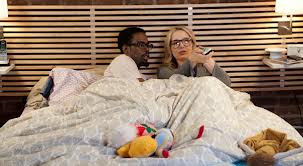
I wish to avoid analyzing a film I have yet to see (for the record, though, I really like 2 Days in Paris), and I want to acknowledge Delpy’s frustration with being categorized as a woman filmmaker: “By making it obvious that it’s rare, you also minimize my work.” In this way, she echoes Nora Ephron, who, of When Harry Met Sally… (Rob Reiner, 1989) and You’ve Got Mail (Ephron, 1998) fame, died June 26 of pneumonia at age 71 (she had suffered from acute myeloid leukemia). As recounted in Charles McGrath’s obituary in The New York Times, Ephron wrote in I Remember Nothing, one of her book of essays, that she won’t miss panels on Women in Film when she dies (sorry, Melissa Silverstein). Although Ephron’s films are dominated by female protagonists and might even have been branded “chick flicks,” her screenplay for When Harry Met Sally… is such a cultural touchstone that men and women often agree that the film is, in the words of Vulture’s editors, “arguably the greatest rom-com of all time.” In conversation with All Things Considered‘s Audie Cornish on NPR, Rashida Jones interpreted the interviewer’s observation that Celeste and Jesse Forever resembles Ephron’s beloved story about friends turning into lovers, although in reverse, as “the biggest compliment.” I haven’t seen Jones’s film yet, so I cannot weigh in on that score.

But are these women of summer, written and actualized in each case by the same woman, really a step in the right direction? According to The Washington Post‘s chief film critic, Ann Hornaday, that answer is “no.” She recently published a critical inventory of the season’s female characters, girls and women alike. While she finds much to celebrate when it comes to young women defying stereotypical roles, she finds the women leave much to be desired. And I quote:
At the box office, the summer of 2012 may be about breaking records with movies about boys and their toys (“Hulk smash,” indeed). But culturally, the season’s been all about the girls. Beginning with Snow White and the Huntsman, continuing through Brave and with a dash of talk-worthy premium cable thrown in, girls seem to have taken over screens both large and small, their inner struggles magnified into mythic battles, their most mundane problems examined with probing, disarmingly frank intimacy.
Hornaday also reminds us that Tim Burton’s version of Alice in Wonderland (2010) and this spring’s mega-hit The Hunger Games (Gary Ross, 2012) also feature strong-willed female teens who don’t need a Prince Charming to rescue them, as they fight epic duels on their respective quests to right evil social injustices. By comparison, the female leads of Ruby Sparks and Celeste and Jesse Forever, for example, are pathetic. In particular, Hornaday writes,
But as clever as Ruby Sparks is in puncturing the male wish-fulfillment fantasy of unconditional acceptance and worship, Kazan’s Ruby never gets to be her own fully realized character, instead playing a role similar to that of the Magical Negro, who exists chiefly in order to help the white male hero find transcendence, meaning and the happy ending that was somehow never in doubt.
As you might recall, I had similar misgivings about the conclusion of Ruby Sparks; it upholds the convention of other love stories featuring Manic Pixie Dream Girls when the narcissistic novelist finally releases his titular creation from his magical spell and later goes on to meet the girl of his dreams who resembles his ideal far too much. When it comes to Celeste and Jesse Forever, Hornaday laments that Jones’s eponymous character, a
put-together and on-track young woman who, as she navigates a complicated relationship with the far less directed man in her life (played by Andy Samberg), is made to look either uptight, witchily judgmental or miserably alone — before she sees the light and realizes that she’s the problem, what with her intelligence and high expectations and all [emphasis in original].

Certainly, I cannot just take this one critic’s word as the gospel truth. I will see these movies, eventually, to make up my own mind, but I can understand what Hornaday is saying. After all, both Ruby and Celeste are characters defined by the relationships that they have with the men in their lives. Marion of 2 Days in New York, which Hornaday doesn’t discuss, also fits the bill, and she’s also a mom.
But there’s one last facet to this trend of actresses writing their own parts: overwhelmingly, their chosen genre is the romantic comedy, which is historically perceived as a woman’s form (even though, of course, it has more male writers than it does female ones). As if men don’t enjoy movies about the pursuit of love and that very special happy ending! (There are enough movies focalized through the heterosexual male point-of-view, such as Annie Hall [Woody Allen, 1977] and Knocked Up, which are both written by men, to warrant a future article about the so-called masculinization of the romantic comedy.) To cut a long story short, I would like to see more female filmmakers work in other idioms and elevate female film characters to be more than just the wife and mother, the Madonna or the Whore. How about a chilling thriller or detective story? or a smart and sophisticated actioner? I would love a provocative sci-fi movie, too. I know what you’re thinking, doesn’t Another Earth (Mike Cahill, 2011) qualify? Well, star Brit Marling may have co-written the script about the possibility of finding redemption as if in a parallel universe, but—spoiler alert!—her character winds up having a sexual affair with the man whose family she killed in the car accident, an irreparable act for which she seeks forgiveness as a means of escape. This plot point is hardly original, as it falls into that same class of tropes I can’t stand.
There is some hope, though, that more complex female characters will continue to spring up. I would venture that at the moment only Girls, the controversial HBO comedy-drama series created by its star Lena Dunham (who also writes and/or directs some episodes), presents a convincing and nuanced vision of (young) women’s relationships—to men, parents, work, culture, and friends. The program follows the runaway success of Dunham’s first full-length motion picture, Tiny Furniture (2010), which she also wrote, directed, and starred in; it’s an acerbic and poignant study of the post-college malaise and the attendant struggles to understand the world and be understood within it. Girls may ostensibly be an urban exploration of recent college grads’ experiences with love and sex, tracking their conflicting desires for independence and dependable partnership, but in actuality it is a brilliant love story about two best friends, Hannah (Dunham) and Marnie (Allison Williams), who live together and grow apart while trying to make it big in the city.
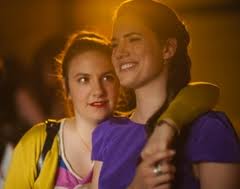
In the fall, Mindy Kaling, a staff writer, producer, and regular cast member of The Office (2005-present), will premiere her own show, entitled The Mindy Project (check out the trailer here). Yeah, I sincerely hope that as the program’s creator, producer, and writer, she changes the name before it first airs; as it stands, the title makes it sound like the comedy series, in which she plays a gynecologist, is a celebrity-hosted reality show or stand-up special. The trailer demonstrates that the self-professed lover of romantic comedies has deployed many generic conventions in creating this universe of characters and situations, including, but not limited to a drunken toast at an ex-boyfriend’s wedding, women’s anxiety over aging, and a female sidekick who tells her, “Your life is not a romantic comedy!” I know, I probably shouldn’t be looking forward to this, but I like Mindy Kaling, and I hope that her show—in the very least—offers an interesting critique of socially acceptable behavior for women. If not that, then maybe I’ll watch it just to dissect it.
——————————
Let’s return once more to the image I have of a woman astronaut gliding through space alone. I’m still nowhere closer to developing her back-story or devising her narrative purpose. Right now, she just represents the potential of female characters in fiction, but films in particular, who have interesting, fully realized inner lives that eschew all the narrative tropes that heretofore define women. She’s out there, doing it her own way, and if she comes back, maybe then I can make sense of her. Perhaps she will fulfill my fantasy and teach us something about what it means to be human—and not just a woman.



 CINE FEEL YEAH