If, like me, you enjoyed the fact that only two songs were nominated in the Best Original Song category at this year’s Oscars (because you thought that it meant the organizers finally realized that this particular race is irrelevant), well then, I have some sad news for you. Per Vulture, the Academy of Motion Picture Arts and Sciences has changed its bylaws again and dictated that the category is going to be even more competitive starting next year, with at least five nominees. I can’t even name one original song featured in a film this year, let alone five!
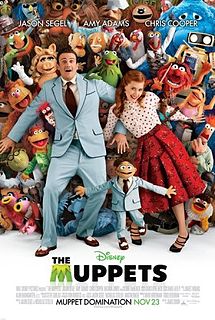
Vulture’s Kyle Buchanan points out that we don’t yet know if live performances of the five nominated songs will be incorporated into the telecast. Let’s hope not. They bloat the running time as it is (which is just one reason why the competition should be put out to pasture). They’re usually ballads, too, and I am predisposed to dislike ballads. The one time that the Oscars perhaps should have had live performances, they didn’t. Since there were only two this year, you have to ask, “Whose idea was it to not allow Jason Segel and Peter Linz (as Walter) perform the Bret McKenzie-composed ‘Man or Muppet’ from The Muppets (James Bobin, 2011)?” You might also ask, “And why wasn’t the infinitely superior ‘Life is a Happy Song’ also nominated?” But I digress. I may not have seen Rio (Carlos Saldanha, 2011), but I admit I was kind of looking forward to seeing and hearing the catchy, bombastic samba dance number “Real in Rio.” It certainly would have livened things up a bit.
In any case, this is some really disheartening news. Stop torturing us, AMPAS, and just let Best Original Song die. I doubt many would even miss it.
But what do you think? Should the Academy continue to hand out this award? And how do you feel about the inclusion of live performances of the nominated songs during the TV broadcast?
Wow. According to Sandra Gonzalez over at Entertainment Weekly, the ABC Family cable network has ordered a drama series about a “multi-ethnic family made up of both foster and biological kids, all of whom are being raised by two moms.” Well, color me impressed. Apparently, Jennifer Lopez has signed on to executive produce The Fosters (as it is currently known), whose creators are Bradley Bredeweg and Peter Paige (the latter of whom wrote and directed 2006’s Say Uncle, which explores why a busybody mom cries “pedophile!” when a middle-aged man regularly visits the neighborhood playground because he misses hanging out with his godson). No word yet on when the heavy-lifting pilot will premiere on ABC Family. (Seriously? Gay moms, biological and foster kids, and ethnic diversity? Better not be hammy!)
Anyway, this news couldn’t come at a more coincidental time. Just the other day, I lamented to my sister over the phone that, despite the critical and commercial success of The Kids Are Alright (Lisa Cholodenko, 2010), we still don’t have any TV shows about gay women running a household together, raising kids. “And that’s gotta change,” I told her. Sure, we have Cameron and Mitchell on ABC’s comedy phenomenon Modern Family (2009-present), and in just a few weeks we’ll be able to watch the premiere of The New Normal on NBC, in which two gay men invite their baby’s surrogate mother into their lives during her pregnancy (and presumably, beyond). I’m genuinely intrigued by that one, too. As a general rule, anything that challenges the traditional definition of family piques my interest.
For the past week or so, one image has stuck with me. It’s of a woman riding alone in a tiny space capsule, hurtling ever closer to the outer reaches of the earth’s orbit. It’s unclear where she’s going and what she will do there upon arrival. I imagine she has a purpose; I just don’t know what it is. No matter how many times she returns to me as a vision, during the day and at night, I can’t see what’s ahead of her or what she’s left behind. I want to know her story. I think it might be potentially interesting.
Despite being unable to develop the lone astronaut’s narrative, I can easily trace the different threads of information that likely led to her appearance in my mind’s eye. First and foremost, the first American woman in space, Dr. Sally Ride, died on July 23 at the age of 61, after quietly suffering from pancreatic cancer for more than a year. After her groundbreaking trips on the shuttle Challenger in 1983 and 1984 and their attendant media circuses, she lived out of the limelight, retiring from NASA in 1987 and then pouring all her energy into teaching and running the company she founded in 2001, Sally Ride Science. Ride’s high school classmate and sometime book collaborator Dr. Susan Okie recounts in The Washington Post her driven friend’s company mission to promote science and technology as “cool” for middle school students and their teachers, to inspire young girls especially to pursue careers in these fields. I don’t have a scientific or mathematical mind (I really wish I did!), but I so deeply respect Sally Ride and all of her accomplishments.
The pioneering American astronaut Sally Ride. Photo courtesy of NASA, via Agence France-Presse — Getty Images. Accessed at The New York Times.
It is a peculiar distinction in the world of playwrights: Works written by men are often called plays. But works written by women are often categorized as “women’s plays.”
“There is a notion in the canon, when men write plays, they speak to the entire human condition, and plays written by women speak to women,” said actress Kathleen Chalfant, a 1993 Tony Award nominee for best actress in a play for her role in Angels in America: Millennium Approaches.
Even plays written by men that are “particularly masculine and talk about issues particular to men, are never called ‘men’s plays,’ ” she added.
Now, I don’t envision the lone astronaut’s narrative trajectory taking place on the stage (I don’t think in terms of the theater). But Brown’s and Chalfant’s observations made an impression on my psyche. Specifically, Chalfant’s choice of words really struck a chord with me, when she argues that there is a perception that plays written by men “speak to the entire human condition” whereas ones by and/or about women can only hope to speak to women, as if the woman’s experience is less than or at least incapable of elucidating the human experience for everyone. Certainly, this isn’t a new controversy or even one confined to the theater. There is a persistent gender bias across all art forms, manifest in libraries and bookstores, museums and galleries, and—most precious to me—cinemas. I think the image of the female space cruiser appeared to me unconsciously as a direct response to the bone-headed notion that women playwrights can’t, in Chalfant’s words, “speak to the entire human condition.” The drive to explore the worlds beyond our own and the desire to comprehend our purpose and beginnings are characteristically human. I know the lone astronaut’s journey of self-discovery is something of a hyperbole, but what if her story could capture for men and women alike a uniquely feminine take on the human experience?
Admittedly, I can’t wave any sci-fi geek flag, having never read Isaac Asimov, Philip K. Dick, George Orwell, or even Ray Bradbury. (But tell me, does Aldous Huxley’s Brave New World grant me at least a few colors? ‘cuz I loved that as a teen.) I’ve only ever seen two episodes of Star Trek, and that number indexes all iterations of the series. I’ve never cracked open a comic book, let alone picked one up. However, I can and do appreciate smart, sophisticated, hard-core sci-fi movies, particularly the kinds that tackle what it means to be human. This is why I love Blade Runner (Ridley Scott, 1982) and will never tire of it. I also like Duncan Jones’s directorial debut Moon (2009), starring the criminally underrated Sam Rockwell as the lone astronaut on a three-year-mission stationed on the massive titular rock. While I don’t suspect the female space explorer of my imagination is ultimately on a quest to discover her true identity in the same way that Rockwell’s Sam Bell does (see, I’m trying not to spoiling anything!), I see her journey as equally alienating, mundane, but also extraordinary.
Most importantly, I envision her story as one that doesn’t hinge on her relationships with men or children. She isn’t escaping a tumultuous love affair, or searching for her true love on another planet, for that matter. She isn’t trying to put her life back together because she lost a child or because she can’t have one. Don’t get me wrong: she’s not without her problems, but her problems don’t define her. And I’ll be damned if I ever base her entire identity on whether or not she has a significant other and/or whether or not she is a mother. After all, wife and mother are historically the only culturally acceptable roles prescribed to women. And in the cyclical culture wars about women’s place in society, debates about the constitutionality of accessible birth control measures and the (im)possibility of a woman “having it all” (meaning: balancing a rewarding career with a family) abound today. Just look at the uproar new Yahoo! CEO Marissa Mayer caused when she announced that she plans to return to work soon after the birth of her first child. The first hot-button issue affects me directly, whereas the conversation about rich white women’s struggles to negotiate their seemingly opposed desires for a career and family addresses me in no way at all. I have no career to speak of and, as of right now, I would be happy never to have children.
Imagine the successes if there were more female characters onscreen than the 33 percent that appeared in the 100 top-grossing films in 2011. And imagine if more than 11 percent of those movies had female protagonists.
I find it alarming that the films she uses as evidence that female-driven movies can be resounding box-office successes include Sex and the City (Michael Patrick King, 2008), Mamma Mia! (Phyllida Lloyd, 2008), and Twilight (Catherine Hardwicke, 2008) as well as its first sequel. Especially since this is coming a little more than two months after she published a short editorial about how purging “chick flicks” from our culture is absolutely necessary. I know, I know, she’s merely pointing out that there is a “hungry, underserved female audience” for movies about women, but all of these examples represent just what she wants to see banished:
You know the kind of movies I mean. They inevitably star Kate Hudson or Katherine Heigl. Most involve a wedding, a boyfriend or, usually, both. And they’re often just bad movies.
Arguing that even Oscar-winning films like Terms of Endearment (James L. Brooks, 1983) and Thelma & Louise (Ridley Scott, 1991) are tainted with the label “chick flick,” Silverstein opines, “I want Hollywood to stop making these formulaic films and branding all movies starring women, good and bad, as chick flicks.” I definitely agree with this sentiment, and if we return to Silverstein’s first op-ed piece I mentioned, I also concur that having more women directing, producing, writing, photographing, and editing films would help alleviate the problem. Though, when you look at her three examples for women-focused blockbusters, Mamma Mia! and Twilight are both written and directed by women. Yikes.
I will say this: Silverstein sure does like to invoke Bridesmaids (Paul Feig, 2011) and its approximately $170 million domestic overhaul. But she fails to draw attention to the fact that its star, Kristen Wiig, wrote the screenplay with her old friend from their days with the improv group The Groundlings, Annie Mumolo. You’ve read me attest to Bridesmaids‘s assets before, so I won’t indulge in too much praise here now. Suffice it to say that, despite a subplot involving Wiig’s romantic dalliances with two diametrically opposed males, the film is actually about female friendship, as Wiig the maid of honor and Maya Rudolph the bride must adjust their long-term intimacy in expectation of the latter’s nuptials. Moreover, I think remembering that Wiig, the darling of Saturday Night Live from 2005 to 2012 and the scene-stealer from the likes of Knocked Up (Judd Apatow, 2007) and Adventureland (Greg Mottola, 2009), co-wrote her own breakout role isn’t just necessary, it is also a starting point when examining the trend making the rounds this year in film and on television.
——————————
Of course, I’m talking about actresses making their debuts as produced screenwriters in order to address the dearth of quality film roles for women. Within the last two weeks alone, indie starlet Zoe Kazan has released Ruby Sparks (Jonathan Dayton & Valerie Faris, 2012), her critical dissection of the Manic Pixie Dream Girl archetype that men often write for their male protagonists, and just two days ago Rashida Jones went against type in Lee Toland Krieger’s Celeste and Jesse Forever (2012). A regular from my favorite TV comedy, Parks and Recreation (2009-present), Jones acknowledges in an interview with Melena Ryzik of The New York Times that she usually plays “the dependable, affable, loving, friend-wife-girlfriend,” and that as co-scribe with former boyfriend-turned-best-friend Will McCormack, she was finally able to star as “a character that’s maybe less than likable.”
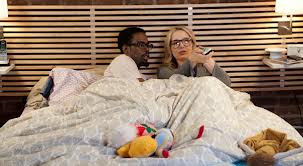
French-American actress Julie Delpy’s fourth feature, the sequel to 2 Days in Paris (2007), hits theaters next Friday. 2 Days in New York (2012) may not be her first film as writer-director-star, but like Kazan and Jones, she aims to write a “real” woman, not a fantasy that men have of (French) women, she tells Karina Longworth of LA Weekly. In the new film, she co-stars with Chris Rock as a successful, artistic/intellectual couple forging a blended family, and the arrival of her father, sister, and former lover from France threatens to upturn what they’ve built, albeit comically so. Casting Chris Rock as her romantic lead may provide a pointed commentary on race in contemporary America, especially since neither Marion nor Mingus make a big deal of their interracial coupling (it’s presented matter-of-fact, according to Longworth), but you might even say that as much as the role is a welcome leap for Rock, it may also bring fans of his raunchy stand-up into the art-house.
Mingus and Marion in bed, trying to overcome the vagaries of adult life in 2 Days in New York. Image courtesy of http://www.girls-can-play.blogspot.com.
I wish to avoid analyzing a film I have yet to see (for the record, though, I really like 2 Days in Paris), and I want to acknowledge Delpy’s frustration with being categorized as a woman filmmaker: “By making it obvious that it’s rare, you also minimize my work.” In this way, she echoes Nora Ephron, who, of When Harry Met Sally… (Rob Reiner, 1989) and You’ve Got Mail (Ephron, 1998) fame, died June 26 of pneumonia at age 71 (she had suffered from acute myeloid leukemia). As recounted in Charles McGrath’s obituary in The New York Times, Ephron wrote in I Remember Nothing, one of her book of essays, that she won’t miss panels on Women in Film when she dies (sorry, Melissa Silverstein). Although Ephron’s films are dominated by female protagonists and might even have been branded “chick flicks,” her screenplay for When Harry Met Sally… is such a cultural touchstone that men and women often agree that the film is, in the words of Vulture’s editors, “arguably the greatest rom-com of all time.” In conversation with All Things Considered‘s Audie Cornish on NPR, Rashida Jones interpreted the interviewer’s observation that Celeste and Jesse Forever resembles Ephron’s beloved story about friends turning into lovers, although in reverse, as “the biggest compliment.” I haven’t seen Jones’s film yet, so I cannot weigh in on that score.
Upon their arrival in New York, Sally and Harry enjoy a bite at Katz’s—much to Sally’s memorable delight. Image courtesy of http://www.impassionedcinema.com.
But are these women of summer, written and actualized in each case by the same woman, really a step in the right direction? According to The Washington Post‘s chief film critic, Ann Hornaday, that answer is “no.” She recently published a critical inventory of the season’s female characters, girls and women alike. While she finds much to celebrate when it comes to young women defying stereotypical roles, she finds the women leave much to be desired. And I quote:
At the box office, the summer of 2012 may be about breaking records with movies about boys and their toys (“Hulk smash,” indeed). But culturally, the season’s been all about the girls. Beginning with Snow White and the Huntsman, continuing through Brave and with a dash of talk-worthy premium cable thrown in, girls seem to have taken over screens both large and small, their inner struggles magnified into mythic battles, their most mundane problems examined with probing, disarmingly frank intimacy.
Hornaday also reminds us that Tim Burton’s version of Alice in Wonderland (2010) and this spring’s mega-hit The Hunger Games (Gary Ross, 2012) also feature strong-willed female teens who don’t need a Prince Charming to rescue them, as they fight epic duels on their respective quests to right evil social injustices. By comparison, the female leads of Ruby Sparks and Celeste and Jesse Forever, for example, are pathetic. In particular, Hornaday writes,
But as clever as Ruby Sparks is in puncturing the male wish-fulfillment fantasy of unconditional acceptance and worship, Kazan’s Ruby never gets to be her own fully realized character, instead playing a role similar to that of the Magical Negro, who exists chiefly in order to help the white male hero find transcendence, meaning and the happy ending that was somehow never in doubt.
As you might recall, I had similar misgivings about the conclusion of Ruby Sparks; it upholds the convention of other love stories featuring Manic Pixie Dream Girls when the narcissistic novelist finally releases his titular creation from his magical spell and later goes on to meet the girl of his dreams who resembles his ideal far too much. When it comes to Celeste and Jesse Forever, Hornaday laments that Jones’s eponymous character, a
put-together and on-track young woman who, as she navigates a complicated relationship with the far less directed man in her life (played by Andy Samberg), is made to look either uptight, witchily judgmental or miserably alone — before she sees the light and realizes that she’s the problem, what with her intelligence and high expectations and all [emphasis in original].
Celeste and Jesse Forever: a couple tries to stay best friends through a painful divorce. Image courtesy of http://www.cnn.com.
Certainly, I cannot just take this one critic’s word as the gospel truth. I will see these movies, eventually, to make up my own mind, but I can understand what Hornaday is saying. After all, both Ruby and Celeste are characters defined by the relationships that they have with the men in their lives. Marion of 2 Days in New York, which Hornaday doesn’t discuss, also fits the bill, and she’s also a mom.
But there’s one last facet to this trend of actresses writing their own parts: overwhelmingly, their chosen genre is the romantic comedy, which is historically perceived as a woman’s form (even though, of course, it has more male writers than it does female ones). As if men don’t enjoy movies about the pursuit of love and that very special happy ending! (There are enough movies focalized through the heterosexual male point-of-view, such as Annie Hall [Woody Allen, 1977] and Knocked Up, which are both written by men, to warrant a future article about the so-called masculinization of the romantic comedy.) To cut a long story short, I would like to see more female filmmakers work in other idioms and elevate female film characters to be more than just the wife and mother, the Madonna or the Whore. How about a chilling thriller or detective story? or a smart and sophisticated actioner? I would love a provocative sci-fi movie, too. I know what you’re thinking, doesn’t Another Earth (Mike Cahill, 2011) qualify? Well, star Brit Marling may have co-written the script about the possibility of finding redemption as if in a parallel universe, but—spoiler alert!—her character winds up having a sexual affair with the man whose family she killed in the car accident, an irreparable act for which she seeks forgiveness as a means of escape. This plot point is hardly original, as it falls into that same class of tropes I can’t stand.
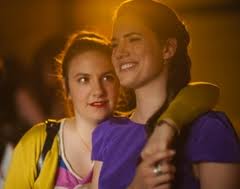
There is some hope, though, that more complex female characters will continue to spring up. I would venture that at the moment only Girls, the controversial HBO comedy-drama series created by its star Lena Dunham (who also writes and/or directs some episodes), presents a convincing and nuanced vision of (young) women’s relationships—to men, parents, work, culture, and friends. The program follows the runaway success of Dunham’s first full-length motion picture, Tiny Furniture (2010), which she also wrote, directed, and starred in; it’s an acerbic and poignant study of the post-college malaise and the attendant struggles to understand the world and be understood within it. Girls may ostensibly be an urban exploration of recent college grads’ experiences with love and sex, tracking their conflicting desires for independence and dependable partnership, but in actuality it is a brilliant love story about two best friends, Hannah (Dunham) and Marnie (Allison Williams), who live together and grow apart while trying to make it big in the city.
Hannah and Marnie are Girls and best friends who try hard not to let their dealings with men dictate who they are as individuals. Image courtesy of http://www.trippedmedia.com.
In the fall, Mindy Kaling, a staff writer, producer, and regular cast member of The Office (2005-present), will premiere her own show, entitled The Mindy Project (check out the trailer here). Yeah, I sincerely hope that as the program’s creator, producer, and writer, she changes the name before it first airs; as it stands, the title makes it sound like the comedy series, in which she plays a gynecologist, is a celebrity-hosted reality show or stand-up special. The trailer demonstrates that the self-professed lover of romantic comedies has deployed many generic conventions in creating this universe of characters and situations, including, but not limited to a drunken toast at an ex-boyfriend’s wedding, women’s anxiety over aging, and a female sidekick who tells her, “Your life is not a romantic comedy!” I know, I probably shouldn’t be looking forward to this, but I like Mindy Kaling, and I hope that her show—in the very least—offers an interesting critique of socially acceptable behavior for women. If not that, then maybe I’ll watch it just to dissect it.
——————————
Let’s return once more to the image I have of a woman astronaut gliding through space alone. I’m still nowhere closer to developing her back-story or devising her narrative purpose. Right now, she just represents the potential of female characters in fiction, but films in particular, who have interesting, fully realized inner lives that eschew all the narrative tropes that heretofore define women. She’s out there, doing it her own way, and if she comes back, maybe then I can make sense of her. Perhaps she will fulfill my fantasy and teach us something about what it means to be human—and not just a woman.
This being a movie blog, I thought it necessary to address the mass shooting that took place Thursday night at a midnight screening of The Dark Knight Rises (Christopher Nolan, 2012) in suburban Denver, Colorado. A lone twenty-four-year-old gunman named James Holmes shot and killed twelve people, wounding at least 58 others, including people as young as only a few months old. In the rush of news updates, these estimates are subject to change, and soon I suspect we’ll learn more about the movie-going victims.*
My nightly ritual consists of watching ABC World News with Diane Sawyer and NBC Nightly News with Brian Williams, and each news program dedicated last night’s episode to coverage of the horrific event and its aftermath. They were both hard to watch for a number of reasons, chief among them the featured amateur cellphone video of blood-soaked people exiting the multiplex and the repetition of terrifying eyewitness accounts. Tears welled up in my eyes, and sometimes I angrily shouted at the TV. Why did you bring your little children to a midnight movie screening? Why this movie in particular? I feel ashamed for so harshly judging people I don’t know personally, and I am thankful that Holmes’s attack didn’t produce even more casualties. I also couldn’t help but wonder, how could his mother, apparently a psychiatric nurse, reportedly say, upon first hearing that her son has been arrested, that the authorities indeed have the right man? She possibly knew he was capable of such an atrocity and never thought to alert anyone that her son is a potential threat to society?
It has been widely reported that Holmes either dyed his hair red or wore a red wig to mimic Heath Ledger’s portrayal of The Joker in The Dark Knight (Nolan, 2008), that he even announced—to the unassuming crowd watching the movie in Theater 9 before he started gunning people down and/or to the arresting police officers—that he was The Joker. Again, we won’t know the truth behind these details as everyone is still corroborating testimonials and processing exactly what happened. So it remains unclear what the relationship is between this hotly anticipated movie and Holmes’s intentions to massacre people. I agree with Roger Ebert, who wrote yesterday in The New York Times that Holmes more likely perpetrated his deadly actions in order to garner fame, infamy, or some twisted recognition rather than act out a movie-inspired fantasy. Seeing how the TV news media responded, devoting whole programs to “Tragedy in Colorado: Movie Theater Massacre,” makes me cringe, too. They’re just giving him what he wants, and they’re sensationalizing, I thought.
But I know one thing for sure, and it took me a while to make this realization: I won’t be going to see The Dark Knight Rises this weekend, and in fact, I’m not sure when I will feel comfortable going to the theater to do so.
I’m not a big fan of Christopher Nolan’s Batman trilogy; his movies are long, pretentious, and moralizing. However, I had thought I was going to see it because, as I have previously stated, I am interested in what people go to see. I do want to be part of a larger conversation. How could I justify standing on the sidelines, lambasting so-called mainstream audiences’ tastes in movies, if I don’t watch them, too, to form my own informed opinions? (The Dark Knight Rise‘s first controversy this week involved movie aggregator site Rotten Tomatoes having to shut down their comments section because fans who hadn’t even seen the film yet were bullying or threatening film critics who published negative reviews.) A dear friend of mine tried unsuccessfully to convince me to go to a midnight screening; I had no desire to see a 164-minute-long movie at that hour in a packed, claustrophobic theater. Besides, I told him, so many special screenings are sold-out or nearly sold-out, making it more difficult to secure tickets. Despite the Colorado tragedy, the movie has grossed over $30 million from midnight screenings alone, and it remains to be seen how its grosses will eventually be made public since its distributor, Warner Bros., and other movie studios have pledged not to report the numbers out of respect for the victims and their families.
The main reason I’m not going to see the movie is because I think it will be too traumatic an experience. I cannot imagine what the people in Theater 9 have gone through, but I am certain that I won’t be able to concentrate on the film unspooling on-screen because I will be thinking about how all those innocent people eagerly attended a movie they’d been waiting months—maybe years—to see, at first perplexed that one cinemagoer seemed to perform a movie stunt tie-in at the front until it became clear what his true intentions were. I echo the film director’s sentiment, released as a public statement: “The movie theatre is my home, and the idea that someone would violate that innocent and hopeful place in such an unbearably savage way is devastating to me.” I have even written a short essay about my love of going to the movies, getting lost in the dark amid celluloid shadows and strangers. The piece is for a humor writing contest, and I have yet to submit it. I’m a little apprehensive to turn it in without mentioning what happened in Colorado, even if my memories of movie-going are overwhelmingly positive—funny even—and have nothing to do with the violence of the theater.
Truth is, I don’t know when I will be ready to go to the theater to see any movie. It’s all still so raw.
Some have expressed concern that this will negatively impact The Movies (Rebecca Macatee of E! Online is already labeling the newest Batman sequel a “would-be blockbuster,” given what’s transpired). I don’t think most people who have really wanted to see The Dark Knight Rises will stay away. All the power to them, I say. We cannot let one crazed man’s fatal attacks deter us from doing the things we love. We cannot live our lives in fear, to paraphrase Barry Otto in Strictly Ballroom (Baz Luhrmann, 1992). We should pressure President Obama and his Republican challenger Mitt Romney to address the issue of gun control while on the campaign trail, as their tepid expressions of sorrow and compassion are not enough. (Their track records on the issue are not comforting if we’re looking for change, either.)
When it comes to Hollywood and cinema more generally, I do hope that studios, producers, and filmmakers reflect on their storytelling practices and recognize that they could make some changes, too, beyond re-editing the trailer for The Dark Knight Rises and yanking TV spots and trailers for it and the upcoming Gangster Squad (Ruben Fleischer, 2012), which features a scene involving men powering machine guns through a movie screen, firing on the audience. I am not blaming anyone for what happened in Theater 9 other than James Holmes, but the fact that violence is so permissible in movies, often glamorized or sensationalized, is a cultural problem. Many of us have become anesthetized to graphic representations of violence, accustomed to watching people, buildings, cities, and even the world blow up on-screen. Ninety-nine-point-nine percent of us know that this is not real, but there are those who might fetishize these images and seek to replicate them in the real world because the consequences of violence are barely ever the subject of sustained cinematic inquiry. One recent example of this more desirable filmic exploration comes to mind, though: Lynne Ramsay’s stark, impressionistic portrait of a mother coming to terms with the attack her teenage son perpetrated at school in We Need to Talk About Kevin (2011). It is a challenging, beautiful movie, and I guarantee it will stick with you. If more films addressed the viscerality and destructiveness of violence, perhaps they would remind us all that it is never cool, never something we should wish to emulate.
Yesterday, the U.S. Supreme Court ruled 5 to 4 that President Obama’s Patient Protection and Affordable Care Act of 2010 is in fact constitutional, thereby cementing his legacy. I was so excited to hear this news, as it will ensure that millions of presently uninsured Americans will get the affordable healthcare that they rightly deserve. Yep, the country is starting to look a little different, the future a little brighter, after June 28th.
But this probably has more to do with the fact that today marks the premiere in theaters of Steven Soderbergh’s Magic Mike (2012), which is being hyped as possibly the greatest male stripper movie ever made. (Have we forgotten all about Peter Cattaneo’s sleeper hit The Full Monty, from 1997?) The movie review aggregator site Rotten Tomatoes lists Magic Mike‘s rating as 82% fresh. Despite the cheesy marketing ploys–one of which saw star Channing Tatum, whose own experience as a stripper inspired the story, lead a flash mob during his Today Show appearance–it looks as if Magic Mike might be more than just the sum of its “beefcake” parts. This is important, for how else am I going to convince my dad to take me to see it? (I don’t drive, and I live nowhere near a theater, if you can believe it.) Apparently, the fact that serious auteur Steven Soderbergh directed it isn’t enough of a reason. But it should be.
Here’s why: this week, in anticipation of the film’s release, I kept thinking about what would influence Soderbergh to pursue this kind of project. He’s hardly ever made anything as campy; the Ocean’s Eleven trilogy (2001, 2004, 2007) is fun because the biggest movie stars in the world gamely make fun of themselves, all while strutting around in impeccably tailored clothes, in beautiful locales, to David Holmes’s smooth and funky score. Come to think of it, that doesn’t sound too dissimilar from his newest effort.
On a more serious note, what I recognized while going through Soderbergh’s filmography is that most of his films are concerned with the characters’ professional work. This is not to say that he is Ken Loach, who has made many films about working class British men’s work lives. I’m thinking of The Gamekeeper (1980), Riff-Raff (1991), and The Navigators (2001) in particular, not to mention his films about nationalist revolutions (Land and Freedom, 1995; The Wind That Shakes the Barley, 2006) and even U.S. labor unions (Bread and Roses, 2000).
But work in Soderbergh’s movies is more nuanced than in your average film, if the average film is now either a romantic comedy (in which the female lead inevitably works at a women’s fashion and lifestyle magazine) or an actioner along the lines of Die Hard (John McTiernan, 1988), in which a police officer successfully foils a terrorist’s plot, but not without a few explosions going off to highlight just how extraordinary his dayjob is. The point is that, sure, what the characters do for a living is important to the story in virtually all films, including ones in which the protagonist does not work. There’s usually a reason for that.
The director Steven Soderbergh. Photo courtesy of IMDb.
But consider this: Soderbergh’s first feature after the Cannes success sex, lies, and videotape. (1989) was Kafka (1991). I haven’t seen the film, but I can imagine that, given the author’s biography (his writing provided an escape from his hum-drum workaday life as a clerk for an insurance company), work is not just an important facet of Kafka’s identity, but also a setting much explored in the film.
Arguably his first studio film, Out of Sight (1998) centers in part on the romantic entanglement of a US Marshall (Jennifer Lopez as Karen Sisco) and bank robber-turned-prison escapee Jack Foley (George Clooney in a star-making turn), thereby subverting the narrative conceit of the pursuit that is essential to her line of work. The year 2000’s Erin Brockovich famously transformed Julia Roberts into a Best Actress Oscar winner for her portrayal of a real-life legal clerk and environmental activist. The film chronicles Brockovich’s investigation of Pacific Gas & Electric Company’s cover-up of groundwater contamination in a local community whose residents have become gravely ill. Her efforts take a toll on her relationships with her family and boyfriend, and she also confronts death threats because of what she has uncovered.
Based on a British TV series from 1989, Traffic, also from 2000, takes a more dynamic approach to its inside story of the illegal drug trade: through the interweaving perspectives of a Mexican police officer battling widespread corruption in his force, a conservative American judge/politician whose own daughter is an addict, and the wife of a drug lord going to extremes to protect her family from the law and the cartel. Again, this film, for which Soderbergh won the Oscar for Best Director, would not work without an emphasis on the conflict between each character’s personal and professional lives.
Last year’s underrated Contagion (2011) takes a similar multi-perspective approach to the recounting of a mysterious virus’s spread across the globe. Matt Damon’s part as a new widower, immune to infection, trying to keep his teenage daughter safe may have a pathetic advantage when you consider that the other story lines revolve around the work lives of scientists and public health officials. However, Contagion is compelling, both as a horror film and thriller, precisely because we see these people at work: epidemiologists trying to contain the virus (Kate Winslet) or investigating its point of origin (Marion Cotillard), the head of the Centers for Disease Control and Prevention (Laurence Fishburne) juggling the supervision of others’ tasks as well as being the face of an organization mired in controversy, and a CDC scientist (Jennifer Ehle) toiling away in the lab in order to develop a vaccine. In the end, we understand that business travel is the reason it immediately spread from Macau, near Hong Kong, to places as far-flung as the Minneapolis suburbs and Paris (if I’m not mistaken). Global business and culture are conduits through which more than just money, goods, and services are transferred.
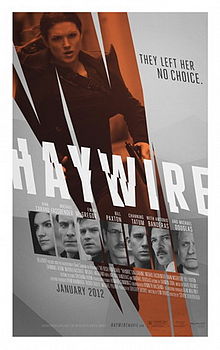
Even Soderbergh’s more experimental, low-budget features explore the world of work. The improvised Bubble (2005) stars non-professional actors in a murder mystery set in a depressed town’s doll factory. The porn actress Sasha Grey takes top-billing in The Girlfriend Experience (2009) as a NYC high-end call girl who specializes in providing clients with the titular fetish. I would even argue, alongside LA Weekly film critic Karina Longworth, that this past January’s release, Haywire (2011), fits into this category of Soderbergh’s ouevre. He built a film around the mixed martial artist Gina Carano, casting her as a double-crossed secret agent/assassin hell-bent on exacting revenge against her employer and one-time lover (Ewan McGregor). Carano’s body and the way she uses it, effectively propelling the action around the world, is a piece of performance art. She does all her own stunts, and much of the story is communicated through her victorious hand-to-hand fights with men like Channing Tatum, Michael Fassbender, and McGregor. In other words, we see Carano’s Mallory Kane excel at work despite the unfair treatment she endures in the workplace.
The director, who, I might add also serves as the cinematographer on his pictures, under the pseudonym Peter Andrews (is that gesture meant to hide his work or call attention to it?), has also made films about the actor and writer Spalding Gray: 1996’s Gray’s Anatomy and And Everything Is Going Fine (2010). The first is more accurately a filmed monologue, essentially capturing Gray at work as the performer of staged autobiographical storytelling, whereas the second is a more conventional documentary about the life and work of the artist, who allegedly drowned himself in New York’s East River in 2004.
The theme of work pops up in Soderbergh’s other films, including The Informant! (2009), Che (2008), and Solaris (2002). Even his foray into television, alongside oft-collaborator and co-producer George Clooney, K Street (2003), concerns the work of lobbyists and politicians. This is nothing to say of the projects that he has worked on as just a producer. Unscripted (2005), for instance, follows three real actors around Los Angeles as they scramble to book gigs and catch their big break.
Thus, it is not so strange to see that Steven Soderbergh, who has just renewed fears that he’s quitting movie-making forever, again, has directed a film about male strippers and how the world they inhabit at work dictates how they perceive and are perceived by those outside of it. From the first trailer, it appears as if Magic Mike (Channing Tatum) has aspirations of a career in furniture design. Interesting, eh? Anyway, his co-worker and friend (Alex Pettyfer) has a sister (Cody Horn) who’s made it her mission to get the guys out of the heavily exploitative business. The actress recently acknowledged that her character might be unpopular with female audiences, but that she reveled in watching the guys, including Matthew McConaughey in “the role he was born to play,” act and dance in g-strings while on the set. Since I am interested in cinematic representations of the male body’s desirability–in an academic sense, I swear!–and how audiences, men and women alike, read these images, I have been following coverage of Magic Mike pretty closely, and from the get-go I found it intriguing that Soderbergh would tackle this subject, but now I understand that it’s all about the work.

 Vulture’s Kyle Buchanan points out that we don’t yet know if live performances of the five nominated songs will be incorporated into the telecast. Let’s hope not. They bloat the running time as it is (which is just one reason why the competition should be put out to pasture). They’re usually ballads, too, and I am predisposed to dislike ballads. The one time that the Oscars perhaps should have had live performances, they didn’t. Since there were only two this year, you have to ask, “Whose idea was it to not allow Jason Segel and Peter Linz (as Walter) perform the Bret McKenzie-composed ‘Man or Muppet’ from The Muppets (James Bobin, 2011)?” You might also ask, “And why wasn’t the infinitely superior ‘Life is a Happy Song’ also nominated?” But I digress. I may not have seen Rio (Carlos Saldanha, 2011), but I admit I was kind of looking forward to seeing and hearing the catchy, bombastic samba dance number “Real in Rio.” It certainly would have livened things up a bit.








 CINE FEEL YEAH