Movie Travel Diary: Edinburgh

Approaching Edinburgh Castle along High Street (aka the Royal Mile), near sundown, as captured by the author.

Edinburgh. Edinburgh. Edinburgh. Say that three times fast, pronouncing the Scottish capital’s name just as the natives do (nowhere near “burg” and slightly clipped away from the longer “burra”). If only the incantation were like the one in Beetlejuice (Tim Burton, 1988), except it would transport me. When my sister and I came to Edinburgh, after a few days in Glasgow and before making our way to London in December 2006, my expectations were as high as the Castle, which sits above the city as if it were a crown or the cherry atop a hot fudge sundae. In the city center, it’s virtually impossible to look up without seeing Edinburgh Castle. This undoubtedly leaves a rather picturesque impression on the mind, long after you have gone.

Running tangential to my rampant Anglophilia (and the equivalent for Ireland, whatever its name may be), is my even more ravenous hunger for all things Scottish. I cannot pinpoint exactly where and when it began. I’m sure members of my family would tell you that it started consuming me when I first rented on VHS the new, much buzzed-about indie hit Trainspotting (Danny Boyle, 1996) at the tender age of ten. (What can I say? I have two of the most permissible parents on the planet when it comes to thematic content in film.) However, I don’t think that is entirely true, for I must have already had an intense interest in Scotland to have even heard of such a film about a cadre of heroin addicts and to seek it out for screening. But truth be told, it lay the groundwork for my passionate exploration of Scotland, through movies, music, history, literature, politics, comedy, etc., which continues unabated to this day. Trainspotting represents for me one of my most formative experiences of cinephilia, and thus warrants its own future post. But suffice it to say that when I arrived in Edinburgh, I wanted to see how it matched up with the hundreds of Trainspotting viewings I had enjoyed already.

I wasn’t expecting much overlap in scenery, actually. Trainspotting had been shot mostly in Glasgow. I remember a Glaswegian telling me in an anonymous online chatroom (remember those? how quaint!) that the Taxi Driver-themed nightclub where Mark Renton (Ewan McGregor) meets Diane (Kelly Macdonald) is—or at least, was—located in his city. I’m not sure that the filmmakers even used Irvine Welsh’s inspired setting, Leith, when they shot the picture. And in retrospect, I regret not riding the bus out there, especially after having read much of the Trainspotting author’s oeuvre set in the (once-)depressed municipal port north of the city.

Not being big shoppers, my sister and I knew that we still had to see Princes Street, the main thoroughfare in Edinburgh, which divides New Town from the Old (and vice versa). In the opening scene of Trainspotting, Renton and his best bud Spud (Ewen Bremner) run down this avenue, cops in hot pursuit. Iggy Pop’s “Lust for Life” provides the propulsive score to the action. Eventually, Renton’s voice-over intones why people “choose life” and why he explicitly hasn’t. These audio and visual ingredients are iconic on their own, but when mixed together, they ensure the film’s cult status right out of the gate. Which is exactly why I had to make a pilgrimage to Princes Street (it’s not hard to do, the train station’s right there). This scene is practically the only one shot in Edinburgh; they couldn’t easily double Glasgow when introducing the city with this kind of iconic shorthand.
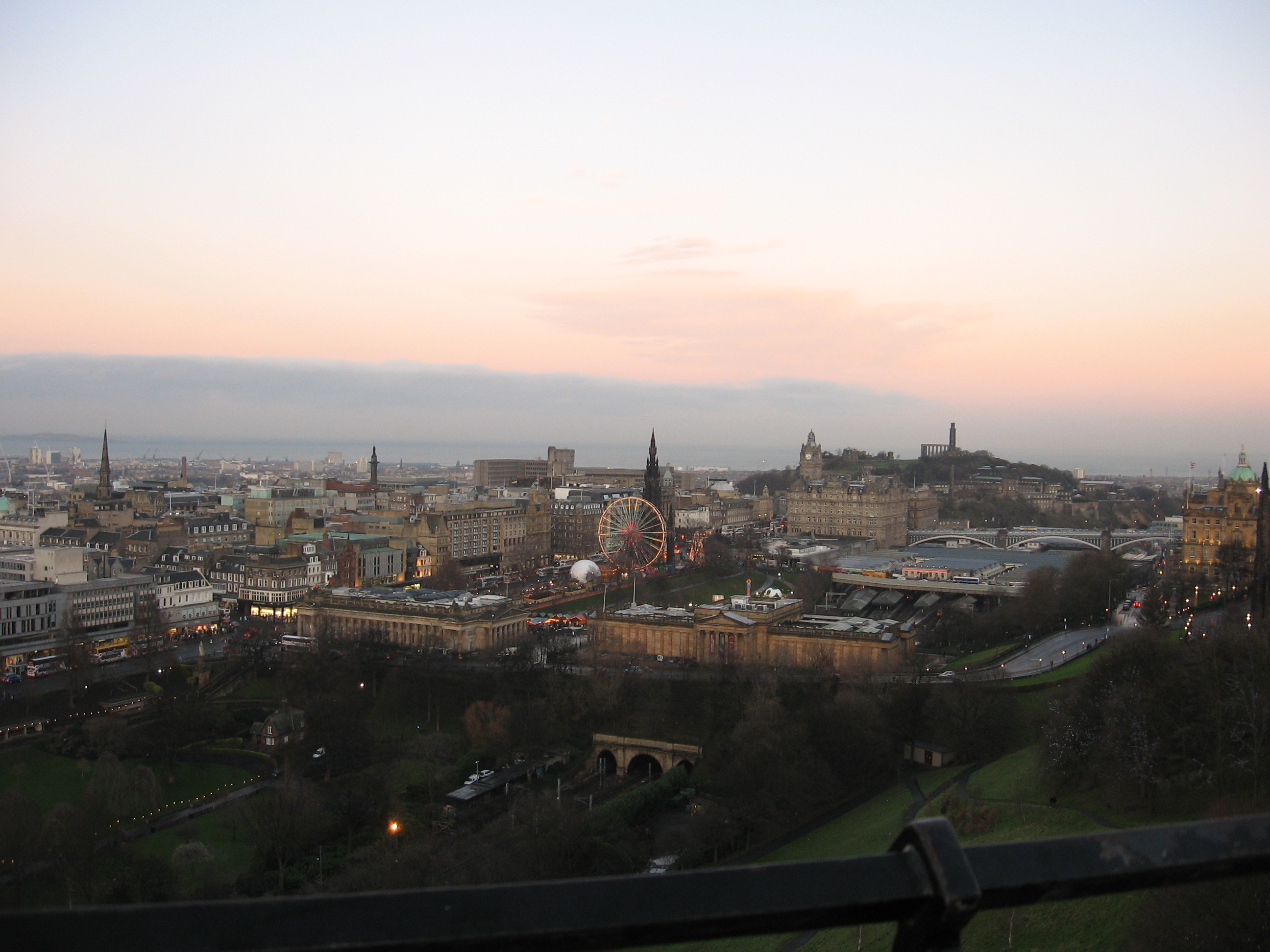
The view from Cockburn Street (if memory serves) of Princes Street. The Royal Scottish Academy and National Gallery of Scotland are in the foreground, with Waverley Train Station in the middle, and off in the distance is Calton Hill. Photo by the author.

There aren’t many films set—let alone shot—in Edinburgh, as film industries favor the more populous Glasgow for its urban Scottish stories (don’t get me started on Highland film settings). Shallow Grave (Danny Boyle, 1994) and One Day (Lone Scherfig, 2011) are notable exceptions, and they both capture Edinburgh as the beautiful, historic, lived-in city that I dreamily wandered around for days. But 16 Years of Alcohol (Richard Jobson, 2003) and Driving Lessons (Jeremy Brock, 2006) provide more specialized glimpses of the capital city that I recognize from personal experience.

The first, billed on a poster as “Trainspotting Meets A Clockwork Orange” (it’s like neither of those two), has a memorable scene set on Calton Hill, where the reformed skinhead protagonist (played by Kevin McKidd, of Trainspotting fame) seeks redemption. Standing on a hillside walkway, where I snapped the above picture, I remember feeling overjoyed at the sight of Calton Hill in the faraway distance, its unfinished early 19th century Parthenon and Nelson Monument (the tower that looks like an upside down telescope) presiding over the city. I recalled both landmark structures from my viewing of the little-seen 16 Years of Alcohol, which underscores their deeply symbolic position to quiet but melodramatic effect. The film also has many scenes set in closes, or steep streets that connect the Royal Mile to streets down below. Although I remember giddily exploring one or two of these dark passageways, I regret not taking a haunted tour of Edinburgh that used them as occasions to tell macabre stories about the city’s past.

Driving Lessons takes place mostly in England, but the wacky actress Julie Walters dupes her assistant Rupert Grint into chauffeuring her all the way to Edinburgh for a speaking engagement. Much of the Edinburgh action hews closely to the area around Princes Street, but the characters stop in at a pawn shop on the Royal Mile, not far from the chintzy souvenir shop where I purchased a Royal Standard of Scotland (you know, the golden flag with a red lion). I later found out it wasn’t the real thing (the lion on my flag didn’t have a blue tongue, probably because the unauthorized production and display of the royal family’s rampart is punishable by law). Whenever I see Driving Lessons, I’m reminded of this… fact. And until fairly recently, the flag’s inauthenticity always made me feel dejected whenever I looked up at it, hanging on the wall above my bed. So I finally replaced it with the Scottish national flag, the Saltire (or St. Andrew’s Cross), which my sister gifted me for my birthday a few weeks ago. Her message? “Let your Scottish freak flag fly!”

No film could prepare me for Edinburgh. When we first arrived, the air smelled delicious, of smoked hot dogs. Later, when my sister and I sampled different varieties of Scotch whisky at Edinburgh Castle, we realized the city’s aroma was the byproduct of numerous nearby distilleries. To this day, when I think of Edinburgh and inevitably yearn to return there (specifically to live), I can’t help but smell it. Even if the whisky burned my throat.
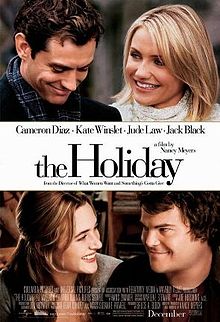
I woke up one morning in Edinburgh with a sore throat, but it wasn’t because of the whisky. I had stupidly gone to sleep with damp hair the night before. At the time, it spoiled my memory of the previous night, which came to me as an utter surprise. Not knowing how to spend the evening after dinner (my sister and I aren’t big on bars or nightclubs), I allowed her to drag me to see The Holiday (Nancy Meyers, 2006). As you might recall, she’s really into romantic comedies, and I am not. In any case, I rather enjoyed the film and its romantic sense of adventure. It made me wish I could meet a sensitive and sexy Scot while on my travels, just as Cameron Diaz’s unemotional-to-a-fault workaholic falls into bed with the mysterious cad-turned-superdad played by Jude Law. Oh well. Such romantic fantasies are just made for the screen (pun intended). After all, my real love affair was with Edinburgh, who made such a euphoric impact on all of my senses, including, most of all, my sense of self. This is going to sound really cheesy, but it’s true. Since I had romanticized the city for years, I hoped against hope that I would fall in love with the place and never want to leave. This dream did indeed come true, but I also had to make the painful realization that the days I spent in Edinburgh were not nearly sufficient enough for me to really get to know the city. Instead, Edinburgh is like a soul mate you meet all-too-briefly before you go your separate ways. No matter where I am or what I do, I can’t shake the memory of Edinburgh’s cheeky smile, traumatic and triumphant life experiences, and a self-confidence that set me at ease. I can’t wait for us to meet again.

Up next: another entry of Movie Travel Diary. But until then, tell me about your movie-related experiences in Edinburgh. Which film(s) best represents the Edinburgh you know from your own travels?

Movie Travel Diary: London

A view askew of Tower Bridge, from the southbank. Photo by the author.

It wasn’t until about a month after my mini-break weekend in Dublin, once my sister had flown in from Los Angeles to ride the rails all over Britain with me (we were on our winter holidays away from school), that I finally saw London. I’ve been an Anglophile for as long as I can remember. As such, I have always found the movies to be the perfect instrument to satisfy my intense interest in all things British. There are simply too many films set in London to name, but suffice it to say that before arriving in town (after a three-hour-long train ride from Newcastle in the Northeast), I had seen the city of my dreams represented in such classics as Alfie (Lewis Gilbert, 1966) and A Clockwork Orange (Stanley Kubrick, 1971), through to more contemporary fare, like Wonderland (Michael Winterbottom, 1999) and About a Boy (Chris & Paul Weitz, 2002). But none of these films captures the London that I experienced around Christmas in 2006.

Instead, we searched for the blue door of Hugh Grant’s travel book shop in the eponymous neighborhood of Notting Hill (Roger Michell, 1999), knowing full well the owners had repainted it to prevent passersby from peeking in. We strolled along the titular street of Brick Lane (Sarah Gavron, 2007) and wound up in a McDonald’s rather than a curry palace. We shopped for souvenirs from the open-air market stalls in Camden, which are on display in Mike Leigh’s comedy-drama Happy-Go-Lucky (2008), but the stench of pot and incense drew us away. Opting for the bus only once and using the tube to get everywhere, we did an awful lot of walking around London during our week or so in the city. And on December 25, when all of London—especially these public transportation networks—shut down, we were unable to leave our hostel to perform our yearly ritual: Chinese food and a movie.

You’ve seen this one before: the view from the Tate Modern across the Millennium Bridge. Image courtesy of http://www.wikipedia.org.

My sister and I explicitly chose not to do “touristy” things. (Don’t ask why, we were stupid and cheap and wanted to avoid crowds as much as possible.) We didn’t tour the Tower of London or see Big Ben up-close. We double-backed on hitching a ride aboard the London Eye (that’s really something I regret). No Westminster Abbey, Leicester Square, or Houses of Parliament for us, I’m afraid. We mainly kept to museums, like the British Museum and National Gallery—yes, both of which entice visitors with offers of free admission. The Tate Modern was on the top of our must-see list, and from there we strolled across the Thames on the not-so-new Millennium Bridge, toward St. Paul’s Cathedral. This part of London—Southwark, it’s called—is frequently represented in film: everything from Bridget Jones’s Diary (Sharon Maguire, 2001) to Salmon Fishing in the Yemen (Lasse Hallström, 2011) features its protagonist on this at one time eye-catching bridge, either making a resolution or having an existential epiphany. Well, nothing as lofty as that happened while I was on it.

Not too far from the Tate, on the south bank, is the reconstruction of William Shakespeare’s Globe Theatre, and even farther down, just east of Tower Bridge is the Design Museum, whose exhibitions focus on 20th and 21st century design across various industries. I remember never having heard of it before my sister suggested we go there, and it turned out to be one of the highlights of our trip. I can’t remember exactly what we saw, but after days of walking around London and feeling as if we weren’t “seeing” anything, I felt warm and fuzzy, a real sense of accomplishment. Stupidly, I thought we’d visited a place so far off the beaten path that it wasn’t on most international tourists’ radar. After all, it’s not as busy as the Victoria & Albert Museum.

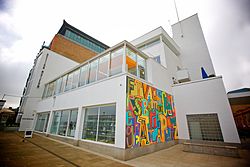
The Design Museum in 2010. Image courtesy of http://www.wikipedia.org.

I’ll never forget our approach to the Design Museum, trekking through a disorienting labyrinth of buildings that all looked the same and climbing a tiny incline right at the end, stepping lightly on the cobblestone street the whole time so as to avoid twisting our ankles. Aside from the Design Museum, which at the time was painted a bright white (I’d be willing to bet that it still is), all of the other buildings at Butler’s Wharf are brick warehouses with arched doorways and, according to Wikipedia, were once considered derelict. Gradually, over the past thirty years or so, the late 19th century shipping district has been home to luxury flats and a happening restaurants and arts corner. (Bridget Jones and her lascivious boss Daniel Cleaver dine here.) I should mention that we could hear the lapping of the river even if we couldn’t see it while walking along Shad Thames, the area’s main street.

Almost one and a half years later, I saw Run Fatboy Run (David Schwimmer, 2007) in the theater with my dad, and early on in the film I recognized one of its shooting locations straightaway: the Butler’s Wharf/Shad Thames warehouse district. “Pathetic excuse for a man” Dennis (the always charming Simon Pegg, who rewrote the script) has his ex-fiancee and mother of his child pick he and the boy up from the police station (he got caught buying scalped theater tickets), and she brings her new handsome, super-successful American boyfriend along with her. After putting Libby (Thandie Newton) and Jake (Matthew Fenton) in a cab, Dennis and his rival Whit (Hank Azaria) walk along Lafone Street, making awkward conversation and being generally passive-aggressive toward one another. Besides Bridget Jones’s Diary, I had never seen this part of London on-screen before (I didn’t even know what it was when I first saw that rom-com), and since “discovering” it on my way to the exemplary Design Museum, it has always felt like “my London.” Thus, despite being set in North London (but mainly shot in the East, according to The Worldwide Guide to Movie Locations), Run Fatboy Run memorably takes place in parts of the city that I most identify with.

As you may already know, Run Fatboy Run revolves around Dennis as he trains for the Nike River Run, a fictional stand-in for the London Marathon. He aims to prove to everyone—including Libby, Whit, Jake, his friend and coach (Dylan Moran), and the landlord to whom he owes a lot of back rent—but especially himself that he can commit to finishing something, after having ditched a pregnant Libby at the altar years ago (he has always loved her, though). Of course, there are many obstacles to achieving this goal; the greatest is having to hobble the long distance on a severely sprained ankle. It takes him all day and all night. Notably, the marathon route commences near the financial district in the City of London where Whit works, the Gherkin a stone’s throw away (that, we saw up-close), and finishes just outside St. Paul’s Cathedral. To get there—you guessed it—Dennis must cross the Millennium Bridge from the south side, his entourage of fans and a sports reporter cheering him on as they follow close behind. His journey reminds me of my own. Now, I cannot claim to have completed a marathon as Dennis has done in fourteen hours, but because my sister and I spent a long and tiring but wonderful day in Southwark walking from landmark to landmark, I can claim to have conquered them in my own way as a tourist. After all, the views were free.

Tomorrow: another entry of Movie Travel Diary. But while we’re waiting, tell me about your movie-related experiences in London. Which film(s) best encapsulates the London you know from your own travels?

Movie Travel Diary: Dublin

Look closely: it's the Ha'penny Bridge lit up at night. Photo by the author.
Look closely: it’s the Ha’penny Bridge lit up at night. Photo by the author.

I spent my third year of college studying abroad at Lancaster University in Northwest England. From there, one of my earliest trips was to Dublin with two of my friends. We rode the ferry from Holyhead in North Wales to Ireland’s capital city. I have very fond memories of that weekend, such as my first (half-)pint of Guinness stout, the friendliness of the people, and the sight of the Ha’penny Bridge lit up at night. And although I didn’t see it until after I came home, months after it was released in U.S. theaters, the intimate musical romance Once (John Carney, 2006) reminded me of the place I have come to think of as “my Dublin.”

I had seen countless films set in Dublin before, everything from The Commitments (Alan Parker, 1991) and The General (John Boorman, 1998) to InterMission (John Crowley, 2003) and Rory O’Shea Was Here (Damien O’Donnell, 2004). But by virtue of being about a musician who busks on Grafton Street for pocket change from tourists, Once invariably represents a Dublin that I, as a tourist, came into contact with. Many of the scenes in the film take place on that pedestrian thoroughfare, Dublin’s high street or main shopping district. This was where, after nearly two months in the British Isles, I spotted the first Starbucks, an occasion so momentous—even though I didn’t drink the stuff—that I snapped a photo of it from the cobblestone street (the major coffeehouse chain over there is Costa Coffee).

Once was produced on a shoestring budget, and it has a very improvisational quality to it. From what I understand, it wasn’t so much scripted as it was outlined, and nowhere is this on-the-fly, gritty documentary feel more pronounced than in the scenes on Grafton Street, where the unnamed guitarist (played by The Frames’ bandleader, Glen Hansard) meets the young Eastern European pianist (Markéta Irglová), before they embark on their pseudo-romance and journey toward self-discovery while they collaborate on a few original songs. From what I can remember, director John Carney and his tiny crew shot the unprofessional actors unobtrusively, allowing real passersby to walk in front of the camera. This explains why some of the protagonists’ exchanges aren’t clearly audible. When I was on Grafton Street, I remember feeling claustrophobic, trapped among seeming multitudes of people and their bulky shopping bags, as everyone walked in different directions. The busyness of the area represented on-screen in Once reminded me of my brisk walk down the street. I didn’t know where I was headed, my friend chasing after me in the crowd, but eventually I wound up at the northwest entrance to a city park, St. Stephen’s Green. Similarly, in one scene, Hansard’s character runs after Irglová’s, too, and they take the exact same route as my friend and I had done. Strange how someone else’s art imitates your life. (I should note that Lance Daly’s black-and-white 2008 film-story about a pair of runaways from abusive homes, Kisses, is also partially set in this corner of the city, rendering it even more menacing, full of real terror for children.)

When I watched Once for the first time in late 2007, I recognized straightaway a particular landscape beyond Grafton Street. Since my sojourn in the city, I have associated Dublin with rows and rows of brick townhouses that have brightly colored front doors, alternating among blue, yellow, green, and red. The movie Once merely reinforced this picture of the city for me. Although we see such dwellings throughout the film, I still can’t shake the image of the woman standing outside one of these houses—or poking her head out of her second-story window, I can’t be sure—and gazing up at the sky because she knows her songwriting partner should be in the air, on his way to London. This scene speaks volumes to me, as I would love to return to Ireland someday and spend more time in the city.

But don’t fret; I did much more than feel stifled on Grafton Street and admire the lushly painted doors on houses. Like any well-informed tourist, I frequented Temple Bar, the trendy arts district lined with restaurants and galleries, visited the National Gallery of Ireland for an exhibit on native son Francis Bacon, and stopped by Dublin Castle (which was, to my surprise, a mishmash of architectural styles) and Trinity College. I regret I was too cheap to pay the admittance fee to see the Book of Kells up-close while at the university, especially since an inventive animated movie inspired by the illuminated manuscript, The Secret of Kells (Tomm Moore and Nora Twomey, 2009), would come out of nowhere years later and earn an Oscar nomination. When I stop to think about it, I realize that much of my Dublin jaunt has movie-related anecdotes.

For one thing, the weekend I was in Dublin was the weekend that Tom Cruise and Katie Holmes (remember TomKat?) were wed in Italy. I remember seeing photos of the actress’s demented smile, as she nuzzled her cheek into Tom’s at the altar, splashed across the front pages of the tabloids while walking from the hostel to downtown Dublin.

Furthermore, I can’t think of the film Little Children (Todd Field, 2006) without being reminded of Dublin, because that is where I saw it—with one of my companions, Denise. I’ll never forget the morning—November 18th, it was—that we were walking along O’Connell Street (the Champs-Élysées of Dublin), near the “Stiffy by the River Liffey,” and came across a multiplex that advertised that it was screening the American indie picture about two suburban stay-at-home parents having a hot summer fling. Talk about making playdates.

Later that night, after dinner and during the film, I couldn’t stop thinking about how odd this movie-going experience was at the time. Here I am in Dublin, with my German friend, and we’re watching an American indie movie set in a resolutely American milieu and ennui at a giant multiplex on O’Connell Street. I bet I’m the only American sitting in this theater, I said to myself, as if mentally detached enough from the goings-on in the auditorium and up on the screen that I could see myself sitting in the back row. For all I know, the Cineworld in Dublin may have been the closest theater to where I lived (in Lancaster, England!) that was playing the film. Ever since having this “out-of-body, out-of-mind” experience while watching a movie in another country, I have sought to replicate it everywhere I go.

Stay tuned for a similar episode in a future edition of Movie Travel Diary. But in the meantime, tell me about your movie-related experiences in Dublin. Which film(s) best exemplifies the Dublin you have visited?

Jump Cut Series: Movie Travel Diary

Cinema is transportive. It takes you many places, real and imagined, and acquaints you with characters that are familiar and strange. Films, especially ones shot on-location rather than on a sound-stage, grant you glimpses of people’s everyday lives, their cultures and subcultures, their language, traditions, food, politics, religion, and aspirations—all through a complex storytelling apparatus beyond the camera and what’s in front of it (I’m referring to style choices as well as writing, framing, and editing scenes). In much the same way that reading throughout the centuries has ignited passions and spurred imaginations by providing escapes to faraway lands, movies, in little more than one hundred years, have brought worlds closer, too. As a film historian, I am interested in how place and identity are represented on-screen for audiences at home and abroad. How do these cinematic images inform what we know of others and, perhaps more crucially, of ourselves?

But as anyone will tell you, it is not enough to read books and watch movies to understand the world and your place in it. Travel, so the wisdom goes, is essential to producing a well-rounded individual, particularly someone who can emphasize with others. Although I have lived and traveled abroad and have even lived in this country’s two most populous cities, I don’t have as many stamps in my passport or frequent flyer miles to my name as I would like. And while I don’t have the money to bankroll more excursions in the near future, I can reflect on where I have been already.

So, without further ado, I’d like to present my Movie Travel Diary, a series of Jump Cuts to be published daily from August 26 through September 1, 2012 (if all goes according to plan). Each day, I will write about a film or group of films set in a city that I have spent some amount of time in (whether for a couple of days, a week or so, or even a year or two). Each film discussed presents the city in a way that I recognize from my own personal experience, since cities and films are mutable objects that are what they are because of what each of us brings to them (I’m not talking about toothbrushes and buckets of popcorn).

As always, I invite you to share your impressions of cities that you have visited, first through film and then in person. Once your feet were on the ground, how did the metropolises compare to the expectations you had going in, based your previous viewing of films set in those cities?

Movie Travel Diary entries:

Sunday, August 26th: Dublin

Monday, August 27th: London

Tuesday, August 28th: Edinburgh

Thursday, August 30th: Paris

Thursday, August 30th: Los Angeles

Friday, August 31st: New York City

Saturday, September 1st: Washington, DC

Quick Edit: How Do You Solve a Problem Like Bernie?

Viewed August 21, 2012

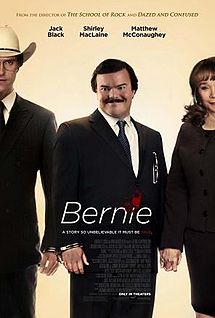
Director Richard Linklater originally made a name for himself with film-stories set in his native Texas, everything from Slacker (1991) and Dazed and Confused (1993) to SubUrbia(1996) and The Newton Boys (1998). Even his beloved European-set Before Sunrise “franchise” has a Texas connection: Ethan Hawke’s writer, who in some small part might be based on Linklater himself, also hails from the southwestern state. The comedic true crime story Bernie (2011) returns Linklater to Texas for the first time since 2006’s Fast Food Nation and reunites him with the star of 2003’s The School of Rock, Jack Black, as well as early muse Matthew McConaughey.

I passed on Bernie when the film hit select theaters in late April of this year, not because I wasn’t interested in the story of a much fawned-over gay assistant funeral director shooting dead his 81-year-old multi-millionaire companion, the small town’s wicked witch, but because I already knew all of its plot details. I had read a New York Times Magazine article by Joe Rhodes, the nephew of the victim Mrs. Marjorie Nugent, and learned that for nine months Bernie kept up the pretense that Marjorie, stuffed in a freezer, was alive while he spent millions of her dollars, “generously” gifting people all over town. Despite Bernie’s, uh, indiscretions, Rhodes, like practically everyone involved, seems to find him the more sympathetic character. It’s a fascinating story, but I wonder if Bernie‘s storytelling format was the best choice. In any case, I heartily recommend Rhodes’s examination of the events leading up to and following Bernie Tiede’s killing Mrs. Nugent that, as the movie’s tagline says, constitutes a story “so unbelievable it must be true.” You just might want to see the movie first, because it does spoil the plot. As does this review of the film Bernie.

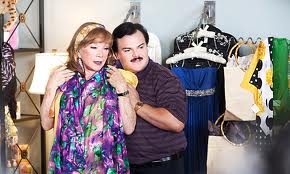
East Texas. The date? I’m not quite sure, as the true events took place in the 1990s. But while the production and costume design seem to indicate this period, Bernie (played by Jack Black) has an iPhone, which wasn’t released until summer 2007. So what can you do? Anyway, as the assistant funeral director in Carthage (approximately 7,000 inhabitants strong), Bernie is well-known for his attentive care of the recently bereaved (particularly elderly widows), and his boss especially values his employee’s superb up-selling skills. Bernie manages to thaw Marjorie’s (Shirley MacLaine) cold, miserly heart following his supervision of her bank-owning husband’s funeral (which actually took place in 1990). From that point on, they are virtually inseparable. They travel everywhere together, go on extensive shopping sprees, and eat at the finest restaurants as well as the local, rustic watering holes. (Hilariously, in one scene, Marjorie pesters Bernie to help her pick out a nice dress for dinner, forcing him to stop whatever he was doing at the time he received her call. Then, in an unfussy cut, it’s revealed that they’re only dining at a chintzy Mexican cantina in town). People speculate that Bernie has to be supplying sexual favors in order to receive that kind of lavish, undivided attention from Marjorie, who has alienated everyone who has ever come in her path, including her family members. Marjorie becomes so attached to Bernie that she demands to know where he is and what he is doing at every hour. In his defense, the word that Bernie constantly uses to describe Marjorie’s dependency on him is “possessive.” Then, in an impulsive move one day in 1996 (again, according to actual events), Bernie takes the shotgun for killing pesky armadillos and shoots Marjorie in the back four times, the symbolism not lost on the audience. Immediately remorseful, Bernie prays, but instead of alerting the police, he packs her into the freezer in the garage and goes about life as if she is merely the house-bound victim of a series of strokes. No one else likes to see or talk to her, anyway—except for her nosy stockbroker (Richard Robichaux), who’s onto Bernie’s misdeeds.

As they grow closer, Marjorie defers to Bernie on all matters of fashion. She even starts to wear her hair down. Image courtesy of http://www.nytimes.com.

No matter how overly prepared I was to watch Bernie, I never expected that Linklater, who co-wrote the script with Texas Monthly crime reporter Skip Hollandsworth, would choose to frame the narrative as a docudrama, complete with historical reenactments starring Black, McConaughey, and MacLaine; numerous talking head interviews with real townspeople; and title-cards that read “Who is Bernie?” and “Was Bernie gay?” One might even be tempted to label the film a mockumentary, for it gently pokes fun at the residents’ bigotry and simple-mindedness. For instance, knowing Bernie to be an outstanding Christian for all his involvement in church activities, including orgiastically singing hymns and paying for a new prayer wing (with Marjorie’s money, of course), the people of Carthage refuse to believe Bernie killed the town’s least popular resident—even after he confesses to the crime once Marjorie’s financial adviser and family members start investigating his trail of lies. In fact, Bernie is so well-liked for his caring and easygoing demeanor that District Attorney Danny Buck Davidson (McConaughey, made comically un-handsome and outfitted with shirts—baggy ones, at that—big, round eyeglasses, and short, matted hair) successfully motions for Bernie’s murder trial to be moved 50 miles away to ensure that selected jurors are unbiased. In the end, he’s sentenced to life in prison, and according to Rhodes, he will be eligible for parole in 2027, when he is sixty-nine-years-old.

One of the real, colorful townspeople of Carthage gives us a handy-dandy geography lesson, enumerating the cultural differences among almost all of the republics of Texas. Image courtesy of http://www.largepopcorn–nobutter.blogspot.com.

In exploring the surreal circumstances of Bernie and Marjorie’s relationship, the film regrettably relies too much on the testimonials of real Carthagians. It’s unclear if their lines are scripted, improvised, or unrehearsed. But the warm, burnt cinematography by Dick Pope seamlessly blends their one-sided conversations (with the documentary lens) with the scenes featuring the trio of the top-lining professional actors and their supporting cast. In other words, despite the fragmented structure of Bernie, Carthage comes across as a fully realized universe and lived-in place, even if Black, McConaughey, and MacLaine barely share any screen-time with the “real” people. However, though all three turn in captivating performances (particularly Black, who dials his trademark zaniness way down), I couldn’t help wishing that Linklater and co. had given the stars more to do. Earlier, I labeled their scenes “historical reenactments” because they mostly just serve the narrative as related by practically everyone in town. They seemingly act out scenes in order to support the Carthagians’ arguments about how gregarious a fellow Bernie was (cue Jack Black, in character, directing and performing in a high school production of The Music Man) and how downright nasty Marjorie was (see MacLaine throw a Hispanic family’s mortgage loan in the garbage as soon as they leave the bank).

Admittedly, one of the best scenes integrates the documentary and comedy-drama bits and, unsurprisingly, unfolds at the very end, allowing the story to come full-circle: one of Bernie’s real-life apologists visits him in jail, still in denial, and reiterates her request that he sing at her own funeral, whenever it is. Touched, Bernie tries to tell her that it’s impossible, as he doubts he’ll ever get permission. But she’s just not hearing him. When their time together is forced to close, the camera follows Bernie contentedly walk back toward his cell, eventually staying put to capture his receding presence—and slightly sashaying hips. As if to say again, “Can you believe this man is a convicted murderer?” This isn’t to say that the filmmakers think Bernie is innocent. He is most definitely not. Having formed my first impression of Bernie Tiede based on Joe Rhodes’s interpretation of his aunt’s life partner-turned-killer, I can see that the filmmakers find him just as sympathetic as Rhodes does. We’re meant to perceive Bernie as simply a good person who snapped and did a very bad thing. More tellingly, to some degree, I think the storytelling structure of Bernie precludes the spectator from strongly identifying with Marjorie. That is, representing the real townspeople’s overwhelmingly sentimental observations about Bernie does very little to redeem Marjorie; no one comes to bat for her. To add insult to injury, MacLaine’s limited screen presence means her character isn’t as fleshed out as Jack Black’s Bernie, leading my dad to comment that her bickering Marjorie recalls her performance as a grumpy and difficult First Lady to Nicolas Cage’s secret serviceman in Guarding Tess (Hugh Wilson, 1994).

It was only during my Google search for images to accompany this article that I made the connection that Bernie has a premise not-too-dissimilar from the one guiding Weekend at Bernie’s (Ted Kotcheff, 1989), wherein Andrew McCarthy and Jonathan Silverman live large at their horrible boss’s vacation home after the titular schmuck (Terry Kiser) dies unexpectedly during their stay; like Bernie, the pathetic stooges pretend their employer is still alive and try to outrun the cops (among others). But whereas Weekend at Bernie’s takes a slapstick approach to defiling the sanctity of the human corpse, Bernie explores the all-too-realness of this possibility. It’s an intriguing little story, and it’s shocking that Carthage still sings his praises. Just what exactly is in the well-water over there? I wonder how the town’s residents responded to the film, too.