There are shots and scenes in films that are designed to take your breath away. Sometimes it’s the gorgeous cinematography, dazzling special effects, or a character’s sweeping romantic gesture that does the trick. The filmmakers’ choices, when properly executed, generally advance the narrative and enhance the overall movie-going experience. Think: any scene from Darren Aronofsky’s The Fountain (2006), with Clint Mansell’s score pushing the spectator through the heavens, or the moment Drs. Alan Grant and Ellie Sattler first glimpse the Brachiosaurus on their way into Jurassic Park (Steven Spielberg, 1993). These scenes are memorable because they are beautiful, intense, imaginative, and poignant.
But what about those scenes that, seemingly out of the blue, disrupt a film’s serious tone? Whether driven by camp, satire, or irony, these scenes are usually shocking and hilarious. I bet each of us has our own collection of these filmic moments. I know that my dad, for one, enjoys it whenever a character is surprisingly killed in the middle of a scene, such as when a shark jumps out of the water and eats Samuel L. Jackson after he gives a rousing, survivalist speech to the members of his team in Deep Blue Sea (Renny Harlin, 1999). However, my collection of favorite “what the fuck?” movie moments revolves around, well, men dancing.
Before I share with you my top five, I need to clarify the criteria by which these dances make the cut. None is from a musical (that’s why his dancing is so jarring for the viewer), but a song–sung live or reproduced through the character’s sound system or radio–does play a part in each case. In all but two instances, the actor spontaneously dances by himself, and his body–clothed or unclothed–is on display. What I like most about these moments is how they individually and collectively represent a direct address to the female gaze. Some are more sexualized than others, and still a few are downright horrific and disgusting. Since these dance scenes are generally the bright spots in a dark (or even frivolous) film, there is no Tobey Maguire strutting down the street in Spider-Man 3 (Sam Raimi, 2007). And as much as I enjoyed the whitewashing effect of the cast singing and dancing to the O’Jays at the end of The Voices (Marjane Satrapi, 2014), their “Sing A Happy Song” routine is actually too big a choreographed set-piece to make the moment seem spontaneous overall.
Without much further ado, I give you my five favorite scenes of men using the power of dance to lighten a deeply disturbing mood:
Number one, with a bullet, comes from Alex Garland’s much celebrated directorial debut Ex Machina (2015), which opened in wide release last Friday. This scene may receive pride of place on this list because of my crush on the actor Oscar Isaac, whose sinister artificial intelligence mastermind Nathan dances with a female android. However, the real reason it lands here is because Nathan turns something as joyful as disco-dancing into a physical threat directed at houseguest Caleb (Domhnall Gleeson), who disapproves of Nathan’s methods. Trust me, the commitment of the actors in this scene elevates it to high comedy, even when the scene is taken out of context from the whole picture.
Another classic. Christian Bale’s Patrick Bateman, the Resident Doofus of Mergers & Acquisitions, takes rival Paul Allen (the beautiful Jared Leto) back to his place in Mary Harron’s brilliant 2000 adaptation of Bret Easton Ellis’s novel, American Psycho. Before chopping his colleague to pieces, Bateman waxes philosophical about the misunderstood meaning behind Huey Lewis and the News’s “Hip to be Square.” Apparently, it’s about the pleasures of conformity, something he knows a lot about. While Bateman doesn’t dance dance, per se, he does emphasize his point with a quick nerd-accented shake of the hips. You stop laughing as soon as he strikes an ax into Allen’s head.
This is not actually my choice! I couldn’t, for the life of me, find the clip from Charlie’s Angels (McG, 2000) wherein client-turned-villain Sam Rockwell dances to “Got to Give It Up” by Marvin Gaye. A relative unknown at this time, Rockwell burned his name into my memory with his sexy shimmying to the song, a way for him to announce to Drew Barrymore’s Dylan, whom he just bedded, that he is in fact the bad guy from whom she’s been assigned to protect him. Yep, long before “Blurred Lines,” the Marvin Gaye classic had been associated with shameful sexual acts.
But it turns out that Sam Rockwell is a regular old Christopher Walken: he dances every chance he gets. Among the video treasures that YouTube has of his moves, is the above scene from Charlie’s Angels. The film never truly adopts a serious tone, and Rockwell’s Eric Knox lampoons earlier James Bond-type villains. He has a secret, coastal hideaway, and technology that goes BOOM! “Revenge is fun,” he says, because he likes to dance it out. Shame the above clip doesn’t run long enough to include his doing the splits.
Reluctant but hungry vampire Louis (Brad Pitt) has just swept young Claudia (Kirsten Dunst) in his arms and fed on her blood. At this turning point in Interview with the Vampire (Neil Jordan, 1994), Louis is disgusted with himself, whereas Lestat (Tom Cruise, electrifying) is elated that his protege has finally taken the plunge. How does he celebrate what Louis would rather forget? Why, by dancing with the corpse of Claudia’s mother, of course! The jubilant dancing and operetta singing sharply contrasts with the dark, spartan interior of Claudia’s home. It’d been a while since there was much evidence of any life there. Which is why Lestat’s bemused exclamation, “There’s still life in the old lady yet!” is so hilarious. An immortal, death is a joke to him, and for once, he has made the audience laugh with him. But poor Louis and Claudia: forever doomed.
Finally, how about some levity? Love Actually (Richard Curtis, 2003) isn’t a serious movie, except for maybe some of its apologists. Hands down, the best scene from this syrupy concoction is when Prime Minister Hugh Grant dances around 10 Downing Street to the tune of “Jump (For My Love)” by the Pointer Sisters, celebrating a personal and professional victory. In Curtis’s rewrite of the concurrent War in Iraq, the PM refuses to toe the line set by the lecherous American President (Billy Bob Thornton, never better). All because the Prez hit on the Prime Minister’s assistant/crush (Martine McCutcheon). A moment the country world can be proud of: Hugh Grant shaking his hips.
That’s it. What are some of your most cherished “what the fuck?” moments? Sound it out in the comments section.
I had never heard of the indie horror film It Follows until I spotted its poster hanging in the hallway of a local art-house cinema here in Kansas City, announcing its imminent showcase. Using familiar iconography of American teenage rebellion, the minimalist printed advertisement poses two attractive young people in the midst of a backseat tryst in a classic car parked in the middle of the woods. A smoky footlight from within illuminates the interior of the car parked on this Lovers’ Lane. Without a tagline, the poster for It Follows relies on a quote from The Dissolve to entice spectators: “One of the Most Striking American Horror Films in Years,” which isn’t quite the same as saying it is the most striking American horror film in years. However, the beguiling film title is the viewer’s most helpful guide to interpreting the poster scene (and, by extension, the film it represents): what is “It?” Could “It” be me, as I look at this intimate moment between two people? The voyeuristic film poster perfectly encapsulates the dueling yet complementary senses of dread and yearning that the 2014 film, written and directed by David Robert Mitchell, instills in the audience.
Given the film’s strong word-of-mouth marketing campaign and sizable box office gross, distributors RADiUS-TWC scrapped plans to release the film via video-on-demand and instead rushed it to more theaters around the country. Even though I routinely eschew horror films (unless there are vampires; don’t ask why!), I determined that I had better see this thing, to judge for myself how “striking” it is. I couldn’t see It Follows at the Tivoli Cinemas in Westport now; when the film’s distribution widened ahead of the theater’s advertised opening day, Tivoli put on alternate programming instead. Wishing video-on-demand was still an option, I entered into an agreement at an AMC multiplex, voluntarily giving away control, allowing myself to be scared out of my mind. After all, if New York film critic and self-proclaimed “horror-movie freak” David Edelstein could barely handleIt Follows, how was I ever going to walk away un-traumatized? Apparently, the film had frightened him so much that he left with a “so-upset-I-feel-sick kind of amorphous dread.” Yikes.
And here is where I must insert my common refrain: there be spoilers ahead. But if you are like me and avoid torture porn, slasher movies, and possession flicks, then you should know—if you’re even considering seeing It Follows—that the film is not scary! That’s right: to my pleasant surprise, It Follows isn’t scary in the least. That doesn’t mean there aren’t any jump scares (there are a few) or that the plotting doesn’t create and alleviate some violent tension. The sole “hideously gory image” that Edelstein can’t wipe from his memory arrives early, but it is no more traumatizing to look at than any of the so-called elegant murderous tableaux featured on the network drama Hannibal. (I admit: I watch that, but never before or after eating and only during daylight hours.)
By now, you probably know the premise of It Follows. A pretty but nice girl, Jay (Maika Monroe), has sex with a quiet but nice boy, Hugh (Jake Weary). Afterwards, he chloroforms her face, and she wakes up in her underwear, bound in a wheelchair. In an abandoned parking garage somewhere in the suburbs of Detroit, Hugh explains to her that, through intercourse, he has just passed a “thing” onto her, a monster that only she can see and that will take different forms, usually people she knows and loves. It will never stop haunting her, Hugh warns Jay (and by extension, the audience). It will follow her everywhere on foot, but she mustn’t let it kill her. If she succumbs to its evil force, then it will come after him.
Hugh (Jake Weary) is on the lookout for what follows, just after sexually transmitting the haunting onto Jay (Maika Monroe). Image courtesy of RADiUS-TWC.
In the introduction to the interview she conducted with David Robert Mitchell, Flavorwire writer Alison Nastasi hints at the parallels that Jay’s newfound diagnosis shares with venereal disease (prognosis: not good!). She writes, “Jay’s sexually transmitted haunting evokes the film’s theme of the terror of interconnectivity and teenage anxiety” (emphasis mine). In other words, despite coming of age well after the initial HIV/AIDS epidemic of the 1980s and the subsequent “safe sex” movement of the 1990s, teenagers today approach sex with some trepidation regarding infection. But in the film, the teenagers don’t so much internalize the idea that intercourse is more than just physically and emotionally laying yourself bare. Instead, sex is a means of, to borrow Nastasi’s words, “surrendering a part of yourself to someone else” whose sexual history weighs heavily on your own. The “interconnectivity” inherent in the sexual act renders Jay vulnerable to the aftereffects of one of Hugh’s earlier assignations and winds up controlling her destiny. Despite the support that she receives from her sister and friends, the visions of stalkers are too much for Jay to bear, and the burden of having to pass on this “sexually transmitted haunting” constitutes not only cruel and unusual punishment for all involved but also her only means of escape from imminent death.
But what does it all add up to? While Mitchell is open to various interpretations of what It Follows means, in talking with Nastasi, he resolutely denies that viewers should walk out of the theater believing that Jay’s “sexually transmitted haunting,” to use that phrase again, is a result of her sexuality. He also disagrees with the notion that the film purports a “sex-negative” message, specifically about women losing something during the act and that they should therefore be afraid of sex. Jay is not being punished for sleeping with someone, and casual sex isn’t something to fear. Watching the movie, I purposefully looked beyond the STI connection and about midway through decided that It Follows is about the collision of the real and the imaginary and how convincing someone of your truth binds you both together. I thought that what Jay suffers from isn’t a real physical threat but rather the psychological torment that Hugh first puts into her head. Can she trust him? Is this “thing” real? Will anyone believe that she is not crazy?
Young adults commonly struggle to make sense of the world and their place within it. What do I want to be when I grow up? Will my best friend and I always be close? How can I be cool? I don’t want to be anything like my parents! One of the elements I like best about It Follows is the companionship that Jay enjoys with Kelly (Jay’s sister, played by Lili Sepe), Yara (Olivia Luccardi), and Paul (Keir Gilchrist). Eventually, a classmate and former high school paramour, played by a young Johnny Depp lookalike named Greg (Daniel Zovatto) joins the crew. They all trust that Jay is seeing some pretty disturbing visions and that she isn’t crazy. Their teenage clique demonstrates that even if they cannot see or identify with the viral bullying that Jay endures, they can relate to it and desire to put a stop to it. In this way, It Follows turns the average teenager’s general desire to fit in (and the complementary fear of rejection) on its head. Jay’s supernatural condition infects everyone around her, thereby producing a cohesive social unit that doesn’t label her an outcast or social pariah. This is the silver lining to “the terror of interconnectivity and teenage anxiety,” as Nastasi labels the film’s overarching theme. In the end, the group relies on Jay’s vision to extinguish the monster once and for all.
In trying to locate Hugh and learn more of his secrets, Jay and her friends snoop around an abandoned house that he’d given her as his address. Image courtesy of RADiUS-TWC.
But I’m getting ahead of myself. It Follows does showcase the interplay between Jay’s supernatural condition and the awkwardness of teenagehood in some poignant ways. Paul is in love with Jay, his best friend’s older sister. Years ago, they shared each other’s first kiss. When Paul finds out that Jay slept with Greg in order to pass on the haunting, he behaves somewhat like a petulant child. Why Greg? Paul wants to know. Because Jay thought that Greg could handle it. For days, Greg is unfazed, insisting that the monster has yet to visit him. Its absence leads him to believe that it is all in Jay’s mind. What happens next in the film rendered incorrect my observation about the slippage between what is real and what is imagined. One night, Jay watches a zombie-like stalker in the shape of Greg break into Greg’s house across the street. Jay realizes that her transmission, however successful, hasn’t freed her from the visions. So she runs across the street to warn him. Once in the house, it takes the form of Greg’s mother (Leisa Pulido), naked but for an untied silk robe, and pounds on Greg’s door. Jay yells for him to stay locked in his room. He doesn’t heed Jay’s warning, and for the first time the film audience catches a glimpse of what happens when the monster kills someone in the chain: it literally fucks the victim to death, their skin gelling together. That’s when it dawned on me that It Follows is simply about the fear of death—by incest.
In an interview with Vulture’s Kyle Buchanan, writer-director David Robert Mitchell discusses many of the film’s plot twists and turns. I think he’s being particularly cagey about why the monster takes the form of the victim’s loved ones, limiting his remarks to just the following: “So why did I make it the mom, other than just saying it was one of the more fucked-up things that I could think of? [Laughs.] It’s also that within the film, we’re sort of avoiding the influence of the adult world, and so I thought it was interesting to only enter into that space through the trope of the monster.” Without revealing much, this quote pinpoints exactly what the film is about: the anxiety over growing up and becoming an adult, and the film story uses incest as a metaphor for the teenagers to confront their own mortality, by becoming “one” with their parent.
Whereas my sister sees the teenagers’ mission to extinguish the monster on their own (that is, without adult supervision) as evidence of their self-sufficiency, I view it as an expression of the horror genre’s conventions. In these films, parents often don’t interact much with their teenagers—unless they are part of the problem. Just look at The Wicker Man (Robin Hardy 1973) or A Nightmare on Elm Street (Wes Craven, 1984), two seminal entries in the genre. In the former, orgiastic villagers use their children to lure a virginal fool to their Hebridean island in order to sacrifice him as part of their pagan May Day celebration. The titular nightmare(s) in the latter film also refer to a slippage between the real and the imaginary, and the adults are similarly of little use to solve the teens’ horrific ordeal. The adults’ attempt to murder Freddy Krueger, who now stalks the teens’ dreams, is the reason for their children’s torment today. It Follows even recalls the work of cult director David Lynch, specifically Blue Velvet (1986), Twin Peaks (1990-91), and Twin Peaks: Fire Walk With Me (1992). Writing for Slate, and without elaborating on the specifics, Mark Binelli claims that “Mitchell is clearly indebted to Blue Velvet,” probably because teenagers also investigate the psychosexual crimes of the adults in that voyeuristic picture. The highly influential Twin Peaks presents a more apt comparison; Leland Palmer killed his daughter but claims to have been possessed throughout his life by a demon, which led him to rape and murder her. The “influence of the adult world,” to use Mitchell’s phrase, is certainly something to avoid in these films and TV series, but since we only catch glimpses of the adults in It Follows, what makes them so sinister that copulation with your parent is deadly?
If the hallmark of teenage rebellion is not wanting to be anything like your parents, then, according to Freudian and Jungian psychoanalytical theory, the Oedipal and Electra complexes should be the death of you. It Follows realizes this destiny for those who contract the sexually transmitted haunting, but Mitchell goes one step further. Rather than merely promoting the fear of incest as the victim’s undoing, he combines these metaphors for psychosexual conflict with another Freudian theory: the interplay between the sexual and death instincts. While the former drives the individual to seek (sexual) pleasure and live life to the fullest, the latter binds the individual in a series of repetitious traumas that subconsciously influence the individual to seek solace in the space before his or her birth. In other words, life is about negotiating the libido and the death drive, which underpins the unconscious desire of the individual to cease to exist. In It Follows, the sexually transmitted haunting forces the infected to face his or her fear of death through violent confrontation with a monster that resembles the literal beginning of the victim’s being. For example, Greg’s pursuit of pleasure (his sexual instinct or libido) ends as his death drive brings him back to the place before he existed, in his mother’s loins. If the chain of victims haunted by the monster represents a series of repeated traumas, then the monster’s killing one victim and then going after another illustrates our inability to escape the death drive.
In the film’s prologue, Annie (Bailey Spry) is on the run from the monster in her house. Her unseen dad (Loren Bass) seems somehow involved in her psychosexual trauma. Image courtesy of RADiUS-TWC.
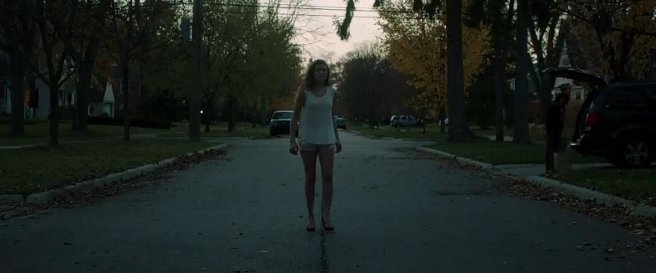
Evidence that It Follows is an exploration of (Neo-)Freudian psychoanalytical theory abounds throughout the picture. In fact, one of the most ominous aspects of the film’s prologue, shot in an extended long take, foreshadows what is to come. A young woman named Annie (Bailey Spry) runs out of her house dressed in a rather grown-up lingerie ensemble and high heels. Her father (Loren Bass) calls out to her as she circles around the stationary camera several times, afraid of whatever is in the house. The audience never sees what haunts her, so her father is the sole person (or even thing) that we can associate with the house. If you didn’t know the premise of the film, you might think that there is a history of sexual abuse between Annie and her father. She eventually gets into a car and drives far away to a secluded lakefront. She calls home and, fearing that the monster will soon reach her, insists that she loves her dad. Although we do not know who or what defiled and contorted Annie’s body (this is the gory image critic David Edelstein couldn’t erase from his memory), I think it is safe to assume that the monster probably took the form of her father in that unseen moment.
Jay’s first vision appears while she’s in the middle of a class at a community college. Find below the reverse shot of what Jay sees. Image courtesy of RADiUS-TWC.
Once Jay contracts the haunting, the fear of sexual misconduct with her loved ones becomes more obvious. In conversation with Kyle Buchanan, Mitchell comments on the first form that Jay’s iteration of the monster takes: “And I think what you’re saying is true, it’s about the contrast of this [old] woman in its location [the campus of Jay’s community college]. Instantly, you realize that something is not quite right. And people are not paying attention to her, although in any other situation, they would be.” I recognized the old woman in her nightgown as the old woman from a photograph on the wall that Jay studies earlier in the film. The implication is that this woman is Jay’s grandmother. When Mitchell refers in the same interview to his method of keeping a distance between what the protagonists see from their perspective on the ground and what may be haunting Jay from any other vantage point, I believe he is referring specifically to the moment when Jay sees an old naked man standing atop her roof. Even though Mitchell and co. didn’t put on a longer lens to capture the menace’s visage in more detail, I still recognized that he is probably Jay’s grandfather, from the same photo.
The reverse shot captures the first vision Jay has, while in class at a community college. The old woman, I argue, is her dead grandmother. Image courtesy of RADiUS-TWC.
Although the monster assumes more unfamiliar personages, including a young peeping tom from next door and an extraordinarily tall man (whom I couldn’t place), a majority of its reflections are familiar. When Jay and her friends track Hugh down and visit him at his real address, his mother answers the door, her wide smile in deep contrast to the emotionless face she had on while coming after Hugh (real name Jeff), completely naked, in the parking garage following his successful transmission of the haunting onto Jay. Furthermore, the violent climax at an indoor community pool not only resembles the end of Let the Right One In (Tomas Alfredson, 2008), it further illustrates my argument. The group (minus Greg, of course) plugs in various household appliances, hoping to use Jay to lure the monster into the pool so that they may electrocute it. Mitchell admits to Buchanan that the group’s plan is “the stupidest plan ever!” Paul has brought a gun and depends on Jay’s description of where it is in order to shoot it. Yara gets injured in the process, but it eventually falls into the pool, attempting to drown Jay. She gets away and watches as the pool fills up with blood. Crucially, however, throughout the whole scene the monster appears to Jay as her absent father, whom I also previously glimpsed in a family photograph. Besides wanting to keep these familiar connections as opaque as possible, I don’t understand why Jay, especially in this scene, never calls out whom it resembles. For that matter, after so many close calls, she never tells anyone whose appearance the monster adopts. Either I am completely off base as to why the monster threatens to kill the teenagers while in the form of their parents, or Mitchell is just one cagey guy.
Jay peers into the community pool to see if she and her friends successfully killed the monster. He’s no longer there. Image courtesy of RADiUS-TWC.
Despite the bloodbath, Jay and her friends are not out of the woods. Inexplicably, Jay sleeps with Paul. It Follows is not funny, but Paul’s asking Jay if she feels any different after they have sex cleverly corrupts the trope of (teenage) virginity. Next we see Paul troll for a prostitute. Meanwhile, Jay curls up on her bed in a familiar fetal position, her mother (Debbie Williams, whose face is never in focus—if it is even in the frame—throughout the film) stroking her naked back. This may be the most haunting image of It Follows. It demonstrates that the threat of death, expressed through her parent’s sexual menace, is ever near and ever present. The final shot of Jay and Paul, holding hands while walking down the street, may hint that the person following them in the distance is also haunting them. In this way, “the terror of interconnectivity and teenage anxiety” is defeated: these friends have become lovers and can now face the monster/death together. Although the film ends on an ambiguous but still upbeat note (in spite of everything that has happened, anyway), the image of Jay’s mother suggestively touching her daughter is creepier and more foreboding than the couple’s maybe-stalker.
Below is the lyric video for “From the Night,” the first song off the 2014 album No One is Lost by Stars. The Canadian band’s dreamy soundscapes complement the electronic synth score by Rich Vreeland (Disasterpeace), which borrows heavily from the horror-film themes of the 1970s and 80s, such as Halloween (John Carpenter, 1978). More than that, the newest record by the prolific band, which I only recently got into thanks to a live studio-session they performed on the CBC radio show Q, thematically and stylistically dovetails with one of It Follows’ themes: the average teenager’s desire to fit in and have fun. The cover of the album, which you can glimpse in the video, showcases a similar youthful yearning for connection and social acceptance that It Follows deconstructs. Most notably, listen to the lyrics after the bridge (at the 3.40 mark in the video). They could be telling Jay and Paul’s story.
I finished reading Patton Oswalt’s second memoir, Silver Screen Fiend, days ago but I’ve been struggling to find something to say about it ever since. That’s when it hit me: my not having much to say is indicative of how I feel about this book. It’s neither good nor bad. It’s mostly just underwhelming. As a film fanatic myself, I was very excited to read the newly released Fiend, whose subtitle is Learning About Life from an Addiction to Film. I thought it would offer me insights into how I might balance my career ambitions (whatever those are) with my chronic hunger to watch and analyze films and TV shows. Instead, Oswalt leaves it until the last chapter to bestow wisdom on this topic: “Movies—the truly great ones (and sometimes the truly bad)—should be a drop in the overall fuel formula for your life. A fuel that should include sex and love and food and movement and friendships and your own work. All of it, feeding the engine. But the engine of your life should be your life” (161, emphasis in original). I already knew all that. Thanks, Patton. What’s worse, he comes to the realization that the Movies have taken over his life only once The Phantom Menace profoundly disappoints him, and you know how I feel about Star Wars and George Lucas. At least I have never seen a film so terrible that it shook the very foundation upon which my cinephilia is built: I will never stop consuming films, because I want to better understand what effects they have on our lives, on our cultures.
Silver ScreenFiend briefly recounts the four years between 1995 and 1999 when he obsessively attended film screenings at the New Beverly Cinema and other repertory theaters playing classic films, in the hopes that feeding his addiction as much as possible would make him a (great) film director someday. At the same time, he also became a member of the alternative comedy scene in Los Angeles, and he wrote for MADtv for a short spell before the producers finally realized that his lackluster skits just weren’t cutting it. I’m not being harsh. Here is Oswalt himself on the subject of his being fired: “It also didn’t help that my writing at the time was so fashionably half-assed. I hadn’t even developed my distaste for typos, which made all the sketches I turned in look like I’d written them while being chased by Turkish assassins on a drifting steamboat” (133-4). There are amusing if not exactly laugh-out-loud funny scenes sprinkled throughout, such as his experience shooting Down Periscope (his debut film role, which also earned him a SAG card) and the legal trouble he and his friends faced when they tried to stage a table reading of Jerry Lewis’s controversial, never-publicly-shown Holocaust drama The Day the Clown Cried. What they wound up performing turned out to be a creative collaborative success: a series of sketches about their not being able to perform the screenplay itself due to a producer’s issuance of a cease-and-desist letter.
Although I could relate to his experience as a cinephile—and in particular, a desire to see films in the theater as part of an audience—I couldn’t connect with him in the way that I wanted to (that is, to learn about life through an addiction to film). The book itself starts in an off-putting way: he writes as if he is in conversation with the reader, who is either a friend or an acquaintance, outside the New Beverly, someone he “bulldoze[s] right over… and keep[s] gabbing” away about Billy Wilder’s Sunset Boulevard and Ace in the Hole. I get it; his mind runs sixty miles an hour when you get him started on a film about which he feels really passionate. The problem is that throughout most of the book, he mainly just mentions film titles, ones that appear in the handwritten and poorly duplicated calendar that begins most chapters. Occasionally, he reminds the reader that he uses five film encyclopedias to keep track of what classics he should see, and he marks each entry with a note in the margin describing how and when he saw a particular film. An appendix at the back of the book lists all of the films he saw between May 20, 1995 and May 20, 1999. It’s 33 pages long and quite impressive, but ultimately not very useful. What am I supposed to get out of it? In addition to a decades-old film stub collection, I’ve kept a film journal for almost ten years as well as an alphabetical index of its contents. I can’t imagine that anyone else would ever want to look at such a document or the information it contains. (I started journaling and indexing as a way to keep tabs on what I’ve not only seen but written about as well.) So scanning the wide assortment of titles listed in his appendix, all I could think was, for example, “Ooh! I wonder what he thought of Trainspotting.”
Actor, stand up comic, and author Patton Oswalt.
Oswalt’s film addiction and comedy scene shenanigans are probably given equal “screen time” in the slim volume, but his stories about the latter were more exuberant, filled with more personalities. I think I know why this is, and it’s not because he’s a lazy writer. (If anything, he may be too energetic, especially when it comes to philosophizing about Vincent van Gogh’s creative genius, from which Oswalt draws great and sometimes confusing inspiration.) It is because, as he implies throughout, it is sometimes difficult for a rabid film fanatic to translate her enthusiasm for a film in a way that someone not as interested in it will understand and appreciate. In the chapter “You Can, Unfortunately, Go Home Again,” he writes about meeting a high school friend for a movie while they were both home for Thanksgiving in 1996. Sitting down to the Bruce Willis western Last Man Standing, he geeks out about how the “movie is based on [Dashiell Hammett’s] Red Harvest, but it got there by way of [A] Fistful of Dollars and Yojimbo” (120). This fun fact lodges itself in his companion’s brain so deeply that Oswalt ruins the experience of watching Last Man Standing for the man, because he thinks he’s seen a version of a samurai film. Although I don’t condone binge drinking, this may be the best description Oswalt offers to illuminate the divide between people like us and people like his friend:
Movies, to him [meaning his old high school buddy] and the majority of the planet, are an enhancement to a life. The way a glass of wine complements a dinner. I’m the other way around. I’m the kind of person who eats a few bites of food so that my stomach can handle the full bottle of wine I’m about to drink. (122)
Owing to my gigantic sweet tooth, allow me to paraphrase this treatise using a dessert analogy instead. Some people I know don’t eat dessert or only do so on rare occasions, whereas I always eat dinner in order to have dessert. Since I’m in a confessional mood, I will also admit that sometimes I forgo dinner altogether and dash straight to dessert.
Early on in Silver Screen Fiend, Oswalt defines the film subculture he belongs to as one consisting of “sprocket fiends,” those who dwell in the “subterranean dimension” of repertory theaters, who travel through space and time at the will of a director and his/her vision (7-8). I learned on my first or second day in the Cinema Studies department at NYU that the rest of the Tisch School of the Arts referred to us as moles, because once we burrowed in the ground we were content to stay in the dark. Like Oswalt, I love the sound of celluloid passing through a projector. It makes me feel alive. That’s why the “First Epilogue,” written as a tribute to the owner and manager of the New Beverly Cinema, Sherman Torgan (to whom the book is also dedicated), is the best part. In it, Oswalt shows off his classic film knowledge in a highly imaginative and dexterous manner: he curates a 30-day festival of films that were never made but will hopefully entertain Sherman in the great beyond. If only Hal Ashby could have wrangled John Belushi and Richard Pryor for an adaptation of John Kennedy Toole’s A Confederacy of Dunces. I especially love the quick mention that a young Frances McDormand, one of my favorites, costars as Myrna Minkoff and is, in a word, “Sublime” (172).
Hector and the Search for Happiness (2014) came and went late last summer in limited release, but I don’t recall it ever coming to a theater near me. Which is just as well, because it is horrible. Ostensibly a comedy, the biggest laugh that the film story elicits occurs when a French woman struggles to pronounce the word “happiness.” The titular character, though embodied by Simon Pegg (one of my favorites), and all those who surround him are so criminally underdeveloped that it is difficult to care much about anyone in the film except in a more theoretical way that the filmmakers don’t support. What’s worse, the representation of the bored British psychiatrist’s journey around the world to find out what makes people happy paints multiple far-flung cultures in broad, caricatured brushstrokes. There is virtually no cultural specificity in any of the places that he visits, and when director and co-writer Peter Chelsom and crew attempt to add critical dissections of serious impediments to people’s general health and well-being in these places, these issues are wiped under the rug, never to be disturbed again. In case you are new to Hector and the Search for Happiness, be warned that I am going to spoil it now. And while you’re at it, take a peek at the film’s trailer to see how much potential the filmmakers wasted.
I have not read the original source novel by French psychiatrist François Lelord, but apparently its raison d’être is to educate a general readership about the psychology of happiness and to offer tips on finding it in everyday life. This explains why, after almost every interaction with someone throughout his international adventure, Hector jots down in his journal maxims such as “Happiness is knowing you’re alive” and “Happiness is not always knowing the full story.” These words are scrawled across the screen in order to keep a running tally of all the lessons learned, as if the film is a PowerPoint lecture. Hector also fills the pages of his notebook, which sexy and domineering girlfriend Clara (Rosamund Pike) gifted him upon his departure, with cutesy doodles of what his childish imagination encounters abroad. The main lesson he must learn is that losing Clara, even though she smothers him with a routine (always the same breakfast; she clips his toenails and packs his bag), would make him really unhappy. That’s right: he goes on this purportedly life-changing adventure only to realize that he likes his life just as it is. Although the couple’s Skype conversations widen the chasm between them more and more throughout, as the film drags on, there is never any doubt as to the fate of their relationship.
And this is why Hector’s first stop in “China” is so perplexing. He never gives any reason as to why he starts there (and isn’t it the tiny kingdom of Bhutan that is regularly cited as the happiest place on earth?) or what he is going to do once he arrives. But Hector doesn’t need a plan when he has filthy rich businessman Stellan Skarsgård to act as his guide in an unnamed Shanghai. It truly boggles the mind as to why Skarsgård’s Edward, so annoyed by Hector on the plane ride over from London, would take the ridiculous man under his wing and show him a good time. For, unbeknownst to Hector, Edward has secured the services of a prostitute named Ying Li (Ming Zhao) to keep Hector company in the nightclub and beyond. Although Clara gave Hector permission to fool around while on his trip, he winds up falling asleep before Ying Li can even get into the bed. At lunch the next day, believing he’s falling in love, Hector discovers the truth when her pimp whisks her away. Hector tries to do the honorable thing and stand up to him, but, despite calling her john “nice,” Ying Li hits Hector on the head and rides away. She doesn’t want his help. So in one fell swoop, Hector goes from ruminating that perhaps happiness is being in love with two women at the same time to realizing that he’s happier not knowing Ying Li’s full story. I never expected the film to engage the topics of prostitution and sexual tourism in Shanghai, but since the filmmakers did, I find it morally reprehensible that Hector, a psychiatrist, would find it so easy to disengage. It’s not as if Ying Li was happy to see her pimp, to return to her life as a sexually exploited woman. She seemed confused as to how she felt about Hector, as if wondering whether or not he could provide an escape. I wouldn’t have wanted to see a film about a white male tourist “saving” a Chinese prostitute. Nevertheless, I didn’t like how the experience of falling for a woman, no matter her profession, had exactly no consequences on Hector’s outlook other than admitting he rather just be ignorant of the circumstances of her life.
Hector (Simon Pegg) and Ying Li (Ming Zhao) get up close and personal. Image courtesy of Relativity Media.
But it only gets worse. From Shanghai, Hector treks through the Himalayas to a remote Buddhist monastery. No one mentions the place by name, but it is easy to assume that he has entered Tibet, to seek the advice of Togo Igawa’s Old Monk (the filmmakers couldn’t even give him a name), who mainly just speaks in rhetorical loop-de-loops to help Hector arrive at the lesson that always avoiding things that make you unhappy is no surefire way to attain long-lasting happiness. He spends all of five minutes there, without ever contemplating how the Chinese government’s suppression of Tibetan statehood might affect the happiness of the people living and working there.
Then he moves on to “Africa.” I found this section the most offensive, beginning with the filmmakers’ failure to name a more specific region or country. Perhaps they left the place intentionally unidentified so as to not incur the wrath of people and governments of a particular place or area. But this lack of cultural specificity effectually purports that Hector’s “Africa” stands in for a whole continent, dominated by warlords foreign-born and native alike, backward villagers who travel with their chickens on prop planes, and “Western” organizations that provide humanitarian aid. In fact, Hector spends two weeks helping his medical school friend Michael (Barry Atsma) at the clinic he runs with his African boyfriend. Embarrassingly, it takes him a full two weeks to recognize that Michael and Marcel (Anthony Oseyemi) are romantically involved, coming to the delightful conclusion that “Happiness is when you are loved for who you are.” Unfortunately, just as Michael’s work is merely the conduit through which Hector can explore “Africa,” the former’s sexual relationship with Marcel exists purely as a way for Hector to learn this widely shared belief. Hector doesn’t seem to care about the challenges that the mixed-race, homosexual couple—his friends—must face in this setting. And nor do the filmmakers.
You wouldn’t know it from this photo, but Michael (Barry Atsma), Hector (Pegg), and Marcel (Anthony Oseyemi) are cruising in a war-torn “Africa.” Image courtesy of Relativity Media.
Hector continuously acts the fool, and he even comes to the aid of a local warlord named Diego Baresco (Jean Reno). Despite warnings from Michael and Marcel about warlords in the area, Hector proves his goodness to Baresco, who suspects him of working for an international peace-keeping outfit that swoops in only to leave before seeing their work through. Hector reviews the prescriptions that Baresco’s beloved wife takes and makes revisions to her regime, thereby instilling some peace of mind in Baresco. They get drunk together, and on his ride back to the clinic, Hector fails to recognize that his taxi cab has been hijacked by two armed rebels, because all black men look the same to him. He’s soon taken hostage, destined to rot in a cell with one rat as his friend. It’s unclear as to how long he is held captive, and of course we have no idea what the rebels seek to accomplish with their violent acts. We’re just supposed to accept this, because isn’t that what happens in Africa? According to this film, white European and American tourists go missing all the time and are swept into guerrilla warfare. Hector uses Baresco’s pen to negotiate his release, for his captors fear retribution from Hector’s powerful “friend.” They abandon Hector on a country road, and “Happiness is knowing you’re alive” is emblazoned on the screen. Yes, absolutely, but did we need such an extreme scenario to demonstrate this? Especially since nothing becomes of it? Hector doesn’t suffer any post-traumatic stress, and we never witness Michael’s or Marcel’s worry over Hector’s abduction. Before moving on to Los Angeles to meet his former med school flame Agnes (Toni Collette), Hector experiences the gloriousness of sweet potato stew, which a baby-swaddling woman on the prop plane promised to prepare for him once they landed safely in “Africa.” It’s supposed to be physically and emotionally fulfilling, but we viewers never see it. The filmmakers can’t even commit to showing us a traditional “African” dish.
Having survived being held hostage by an indistinguishable “African” rebel group, Hector celebrates by cooking sweet potato stew with local women. Image courtesy of Relativity Media.
In Los Angeles, Hector takes part in Professor Coreman’s (Christopher Plummer) neuroscience study to map emotions such as happiness, sadness, and fear across different parts of the brain. After breaking up with Clara over the phone because his traveling to Los Angeles has finally signaled for the couple that Hector still longs for Agnes, Hector exhibits all three emotions in the scanner, lighting up Coreman’s screen with a rainbow of colors that the professor has assigned to each emotional state. Is this the payoff we’re supposed to receive from Hector and the Search for Happiness? What makes Hector special is his ability to feel happiness, sadness, and fear at the same time when recalling a wide range of events in his life? Having been rebuffed by Agnes, a happily married psychologist with a third child on the way, Hector determines that he must get back to London to be with Clara. As I said before, they live happily ever after. He’s more emotionally available and compassionate towards his patients, and Clara finally realizes that, yes, she wants to have a baby with Hector.
What and whom they always wanted. Clara (Rosamund Pike) and Hector finally tie the knot. Image courtesy of Relativity Media and MovieStillsDB.com.
The one bright spot in this mess is the chemistry between Simon Pegg and Rosamund Pike. Although their relationship isn’t exactly desirable (she takes great pride in clipping his toe nails!), they have an appealing, silly rapport in scenes where they interact in person. In fact, most of their exchanges occur over video conferencing calls. Notably, Hector and the Search for Happiness may be implying that staying connected through this kind of technology is no substitute for human contact (when Hector tries to tell her that he’d been kidnapped, she fails to register the gravity of the situation). Even phone conversations do not go well between them. There is simply a lack of communication between the lovers, and isn’t that a definite sign of their incompatibility? Clara cannot make up her mind regarding Hector’s up and leaving her for an indeterminate period of time. Hector needs to leave the person he loves in order to realize that happiness lies in a life made with her. This is not an earth-shattering revelation, especially since we watch him come to this conclusion under the most ridiculous of circumstances. As I said before, I am a huge fan of Pegg’s, and it was disappointing to see him attached to such bone-headed and culturally insensitive material. I wonder what attracted him to it in the first place: Hector’s childhood love of The Adventures of Tin Tin, maybe? Then again, shooting a film about happiness around the world does sound really exciting. If only the film wasn’t so concerned with checking off the lessons in the original source novel and instead let the characters interact with each other in more plausible, organic ways.
For weeks, I have been lamenting the end of The Great British Baking Show. And now here I am, on the other end of the finale. The very deserving Nancy has been crowned champion, even though my sister and I were rooting for Luis. (The teenaged Martha was my favorite all along—so much potential!) I have been so emotionally invested in this reality competition television program that I cried. To put this in perspective, I did not cry during the series finale of Parks and Recreation earlier in the week. Don’t get me wrong: Leslie and co. received the heartwarming send-off we all wanted. The difference is that I wanted Parks to end, whereas I have no idea what I am going to without The Great British Baking Show.
Nancy, the Best British Amateur Baker, from The Great British Baking Show. Photo courtesy of PBS.
I am not a baker; I don’t really know my way around the kitchen. My domain is restricted to the sink, where I do the washing up while the cook puts his/her feet up after dinner. But I do love bread, cakes, cookies, pastries, donuts, etc. Whenever a judge, whether Paul Hollywood or Mary Berry, gave an amateur baking contestant negative feedback, I liked to say, with a bit of a shrug, “I’d eat it.” When the design of a cake or the flavor of a tart didn’t come off quite as intended: “I’d still eat it.” Every week, I was in awe of the twelve contestants’ talent—well, if I’m being completely honest, it was more like the top six bakers. They were the ones who impressed the most with their skill and creativity.
Richard, Five-Time Star Baker, from The Great British Baking Show. Photo courtesy of PBS.
In fact, when you think about it, that’s what this baking competition has been about: balancing skill and creativity in equal proportions. Richard, a builder from London, won the coveted title Star Baker an unprecedented five times throughout the season, mainly because his precision and balance of flavors hit the mark. On the other hand, Luis’s background in graphic design gave our beloved Mancunian an advantage when it came to crafting stunning personal artworks made of food. Sometimes the bakes were bang on; sometimes they were overdone. A retired office manager for a general medical practice, Nancy-of-Lincolnshire won because, as she displayed on the final weekend in the tent, she produced more technically accurate bakes with the right amount of visual flair. As much as I wanted Luis to win, I would have accepted anyone. But it does tickle the belly that the sole woman in the top three triumphed over the men.
Luis, my favorite to win The Great British Baking Show. Photo courtesy of PBS.
What made The Great British Baking Show so watchable, so satisfying, was the representation of friendly competition. No one was a diva, a trouble-maker, or a back-stabber. Everyone, at least from how the makers edited it together, seemed to get along. They were supportive of each other in times of doubt or after receiving stinging critiques. There was a kerfuffle midway through, when it was debatable whether or not Diana purposefully forgot to put Iain’s baked Alaska back in the freezer. But it was Iain’s decision to throw away everything that he was working on that cost him a place in the tent the next week. Emotions, I learned, do run high in the kitchen, and if you don’t control them, they can burn you.
That’s another thing. As the hosts for the PBS pledge drive accompanying (or is it obstructing?) the finale made clear, over and over and over again, The Great British Baking Show is very educational. I have learned more about baking than I could ever have imagined. For instance, British English favors “sponge” for what we Americans call “cake,” cake as opposed to frosting. I now have a lot of respect for those brave enough to bake, and I recognize that I have no business messing with the oven nobs or toying with the stand mixer. My place is behind the gingham altar. Next time someone brings me something sweet and doughy to eat, I will try not to eat everything on display before me.
I started a new tradition a couple of years ago whereby I connect all of the year’s nominees for Best Picture via the actors starring in them. A twisted take on the popular (and now defunct?) Six Degrees of Kevin Bacon Game, I limit the kinds of connections that I can make. For instance, I cannot connect nominated films through anyone but actors (no directors, screenwriters, producers, foley artists, etc), nor can I use TV shows or film appearances wherein actors play (versions of) themselves. And no matter how tempting they may seem (in order to get the job done more quickly and succinctly), I restrict myself from borrowing actors’ romantic relationships with each other. Also, I try to do as much mapping as possible without turning to IMDb. I will admit that I had to research some actors’ filmographies, namely those of Patricia Arquette and J.K. Simmons, both of whom have been in everything.
Without further ado, here are the Academy Award nominees for the Best Picture of 2014:
The Imitation Game with Benedict Cumberbatch, who’s in The Other Boleyn Girl with Eddie Redmayne, who’s in
The Theory of Everything with Felicity Jones, who’s in The Invisible Woman with Ralph Fiennes, who’s in
The Grand Budapest Hotel with Edward Norton,* who’s in
Birdman with Zach Galifianakis, who’s in The Hangover with Bradley Cooper, who’s in
American Sniper with Sienna Miller, who’s in Foxcatcher with Channing Tatum, who’s in 10 Years with Oscar Isaac, who’s in A Most Violent Year with David Oyelowo, who’s in
Selma with Carmen Ejogo, who’s in Away We Go with Josh Hamilton, who’s in Freak Talks About Sex with Steve Zahn, who’s in Reality Bites with Ethan Hawke, who’s in
Boyhood with Patricia Arquette, who’s in Stigmata with Gabriel Byrne, who’s in Little Women with Kirsten Dunst, who’s in Spider-Man with J.K. Simmons, who’s in
Whiplash with Miles Teller, who, in order to bring us back to the first nominee, is in Rabbit Hole with Nicole Kidman, who’s in Stoker with Matthew Goode, who’s in
The Imitation Game!
Did I go about this all the wrong way? Do you have a less circuitous route between or among the eight nominated films? Leave your directions in the comments below.
* I previously drew my map connecting The Grand Budapest Hotel to Birdman via Bill Murray and Naomi Watts (stars of St. Vincent), completely forgetting that Birdman actor Edward Norton was amongst all those people in The Grand Budapest Hotel.







 CINE FEEL YEAH