Why I’m Not Seeing The Dark Knight Rises This Weekend

This being a movie blog, I thought it necessary to address the mass shooting that took place Thursday night at a midnight screening of The Dark Knight Rises (Christopher Nolan, 2012) in suburban Denver, Colorado. A lone twenty-four-year-old gunman named James Holmes shot and killed twelve people, wounding at least 58 others, including people as young as only a few months old. In the rush of news updates, these estimates are subject to change, and soon I suspect we’ll learn more about the movie-going victims.*

My nightly ritual consists of watching ABC World News with Diane Sawyer and NBC Nightly News with Brian Williams, and each news program dedicated last night’s episode to coverage of the horrific event and its aftermath. They were both hard to watch for a number of reasons, chief among them the featured amateur cellphone video of blood-soaked people exiting the multiplex and the repetition of terrifying eyewitness accounts. Tears welled up in my eyes, and sometimes I angrily shouted at the TV. Why did you bring your little children to a midnight movie screening? Why this movie in particular? I feel ashamed for so harshly judging people I don’t know personally, and I am thankful that Holmes’s attack didn’t produce even more casualties. I also couldn’t help but wonder, how could his mother, apparently a psychiatric nurse, reportedly say, upon first hearing that her son has been arrested, that the authorities indeed have the right man? She possibly knew he was capable of such an atrocity and never thought to alert anyone that her son is a potential threat to society?

It has been widely reported that Holmes either dyed his hair red or wore a red wig to mimic Heath Ledger’s portrayal of The Joker in The Dark Knight (Nolan, 2008), that he even announced—to the unassuming crowd watching the movie in Theater 9 before he started gunning people down and/or to the arresting police officers—that he was The Joker. Again, we won’t know the truth behind these details as everyone is still corroborating testimonials and processing exactly what happened. So it remains unclear what the relationship is between this hotly anticipated movie and Holmes’s intentions to massacre people. I agree with Roger Ebert, who wrote yesterday in The New York Times that Holmes more likely perpetrated his deadly actions in order to garner fame, infamy, or some twisted recognition rather than act out a movie-inspired fantasy. Seeing how the TV news media responded, devoting whole programs to “Tragedy in Colorado: Movie Theater Massacre,” makes me cringe, too. They’re just giving him what he wants, and they’re sensationalizing, I thought.

But I know one thing for sure, and it took me a while to make this realization: I won’t be going to see The Dark Knight Rises this weekend, and in fact, I’m not sure when I will feel comfortable going to the theater to do so.

I’m not a big fan of Christopher Nolan’s Batman trilogy; his movies are long, pretentious, and moralizing. However, I had thought I was going to see it because, as I have previously stated, I am interested in what people go to see. I do want to be part of a larger conversation. How could I justify standing on the sidelines, lambasting so-called mainstream audiences’ tastes in movies, if I don’t watch them, too, to form my own informed opinions? (The Dark Knight Rise‘s first controversy this week involved movie aggregator site Rotten Tomatoes having to shut down their comments section because fans who hadn’t even seen the film yet were bullying or threatening film critics who published negative reviews.) A dear friend of mine tried unsuccessfully to convince me to go to a midnight screening; I had no desire to see a 164-minute-long movie at that hour in a packed, claustrophobic theater. Besides, I told him, so many special screenings are sold-out or nearly sold-out, making it more difficult to secure tickets. Despite the Colorado tragedy, the movie has grossed over $30 million from midnight screenings alone, and it remains to be seen how its grosses will eventually be made public since its distributor, Warner Bros., and other movie studios have pledged not to report the numbers out of respect for the victims and their families.

The main reason I’m not going to see the movie is because I think it will be too traumatic an experience. I cannot imagine what the people in Theater 9 have gone through, but I am certain that I won’t be able to concentrate on the film unspooling on-screen because I will be thinking about how all those innocent people eagerly attended a movie they’d been waiting months—maybe years—to see, at first perplexed that one cinemagoer seemed to perform a movie stunt tie-in at the front until it became clear what his true intentions were. I echo the film director’s sentiment, released as a public statement: “The movie theatre is my home, and the idea that someone would violate that innocent and hopeful place in such an unbearably savage way is devastating to me.” I have even written a short essay about my love of going to the movies, getting lost in the dark amid celluloid shadows and strangers. The piece is for a humor writing contest, and I have yet to submit it. I’m a little apprehensive to turn it in without mentioning what happened in Colorado, even if my memories of movie-going are overwhelmingly positive—funny even—and have nothing to do with the violence of the theater.

Truth is, I don’t know when I will be ready to go to the theater to see any movie. It’s all still so raw.

Some have expressed concern that this will negatively impact The Movies (Rebecca Macatee of E! Online is already labeling the newest Batman sequel a “would-be blockbuster,” given what’s transpired). I don’t think most people who have really wanted to see The Dark Knight Rises will stay away. All the power to them, I say. We cannot let one crazed man’s fatal attacks deter us from doing the things we love. We cannot live our lives in fear, to paraphrase Barry Otto in Strictly Ballroom (Baz Luhrmann, 1992). We should pressure President Obama and his Republican challenger Mitt Romney to address the issue of gun control while on the campaign trail, as their tepid expressions of sorrow and compassion are not enough. (Their track records on the issue are not comforting if we’re looking for change, either.)

When it comes to Hollywood and cinema more generally, I do hope that studios, producers, and filmmakers reflect on their storytelling practices and recognize that they could make some changes, too, beyond re-editing the trailer for The Dark Knight Rises and yanking TV spots and trailers for it and the upcoming Gangster Squad (Ruben Fleischer, 2012), which features a scene involving men powering machine guns through a movie screen, firing on the audience. I am not blaming anyone for what happened in Theater 9 other than James Holmes, but the fact that violence is so permissible in movies, often glamorized or sensationalized, is a cultural problem. Many of us have become anesthetized to graphic representations of violence, accustomed to watching people, buildings, cities, and even the world blow up on-screen. Ninety-nine-point-nine percent of us know that this is not real, but there are those who might fetishize these images and seek to replicate them in the real world because the consequences of violence are barely ever the subject of sustained cinematic inquiry. One recent example of this more desirable filmic exploration comes to mind, though: Lynne Ramsay’s stark, impressionistic portrait of a mother coming to terms with the attack her teenage son perpetrated at school in We Need to Talk About Kevin (2011). It is a challenging, beautiful movie, and I guarantee it will stick with you. If more films addressed the viscerality and destructiveness of violence, perhaps they would remind us all that it is never cool, never something we should wish to emulate.

* The New York Times has just published (circa 10.30 pm on Saturday, July 21st ) the names of the twelve victims as well as the first in-depth attempt to get a handle on James Holmes’s character.

Long Take: Salmon Fishing in the Yemen Comes Up With an Easy Catch

Viewed July 18, 2012

On Tuesday, Alison Nastasi of Flavorwire posted ten movie titles she has deemed the quirkiest in the history of cinema. Her list runs the gamut from Stanley Kubrick’s classic Cold War black comedy Dr. Strangelove or: How I Learned to Stop Worrying and Love the Bomb (1964) to Sacha Baron Cohen’s performance art piece Borat: Cultural Learnings of America for Make Benefit Glorious Nation of Kazakhstan (Larry Charles, 2006). I would venture to add 2011’s Salmon Fishing in the Yemen, Lasse Hallström’s latest exercise in milquetoast filmmaking, to this group. Released in March 2012 in the U.S., the film went on to receive generally favorable reviews, or so says Rotten Tomatoes, but it failed to catch lots of fish in the audience pool. Could it have been the off-putting and somewhat confusing title? (When I mentioned to my father and brother that I had rented the movie on DVD, they both seemed puzzled by the title. Who calls Yemen “The Yemen”? With a shrug, I suggested that perhaps Yemen is like Gambia, whose short name is technically The Gambia.)

Based on Paul Torday’s novel of the same name, Salmon Fishing in the Yemen charts the relationship between a British financial consultant, Harriet Chetwode-Talbot (Emily Blunt), and a government fisheries expert, Dr. Alfred Jones (Ewan McGregor), whom she contacts to help with a project that one of her clients would like to see implemented. And that’s just what the movie title refers to: the Yemeni Sheikh Muhammad (Amr Waked) wishes to introduce the sport of fly fishing salmon in his arid, river-less homeland. As the film’s romantic leads, McGregor and Blunt have a fair amount of chemistry, but they hardly set the screen on fire. In fact, the film neither works as a romantic comedy nor as an emotional and spiritual uplift movie, the kind of cinema with which director Hallström has made his name. As per usual, I’m going to spoil the plot of the movie below.

The first twenty minutes or so of Salmon Fishing in the Yemen establish the respective personal and professional worlds of Harriet and Fred, cutting between them so that the tension mounts and the spectator knows that as soon as these super-attractive individuals meet, sparks are going to fly. Like many other romantic comedies, Salmon Fishing utilizes the Pride and Prejudice template, at first pitting Harriet and Fred against each other before they fall in love. Obsessed with his own research, Fred resents having to take a meeting with the persistent Harriet at her office, clear on the other side of London town. He rejects her client’s proposal as “fundamentally unfeasible” and laughs in her face; the geography and climate of the Arabian country just don’t allow for this species’s survival. So things between them get off to a rocky start. By the time he returns to his cubicle at the Department of Fisheries and Agriculture, the Prime Minister’s office has gotten involved, forcing Fred’s boss, Bernard (Conleth Hill), to issue an ultimatum: either accept termination of employment or work exclusively on this project—with a raise. If only all career decisions were as easy to make. I should mention that as the head of the PM’s press office, Patricia Maxwell (played by Kristin Scott Thomas) latches onto the sheikh’s aspirational story so as to counterbalance all of the other destructive events taking place across the Middle East and Central Asia, particularly when it comes to Britain’s continued fighting in Afghanistan.

The trouble with Harriet and Fred’s relationship is that the filmmakers have no creative ways to keep them apart, which is a plot contrivance they’re very committed to upholding until the last scene. A reserved and humorless Ph.D. from Scotland, Fred is married to a cold and distant career-minded woman named Mary (Rachael Stirling). Their sex is passionless and perfunctory, and when he desperately suggests that they have a baby together, pledging to raise it while she goes off to work everyday, she doesn’t hear him. He is so emasculated and unfulfilled that he doesn’t have the balls to repeat himself when she requests for him to do so. Much of the film story unfolds while Mary takes an extended business trip to Geneva, freeing Fred to hang out with Harriet outside of their office hours, in London, Yemen, and Scotland. Thus, when Mary returns to surprise Fred, she receives one of her own: during an interrogation, Fred tells his wife that he’s in love with his work colleague Harriet. Seriously? That’s the best you can come up with? It’s completely unoriginal to make the romantic hero unhappily married, to a distant woman, no less, in order to render his attraction to a caring and sensitive woman compelling, even refreshing. How many times have we seen this before? It would have been more interesting if the script merely presented Fred’s being socially awkward as an impediment to their getting together, with his interactions with Harriet and the sheikh eventually loosening him up. At one point, Harriet teases him about having Asperger’s syndrome, and his response is so cryptic that it’s unclear whether or not he truly has it.

But, if you can believe it, the reason why Harriet cannot attach herself to Fred is even more ridiculous. She spends most of the film crying over her boyfriend of three weeks, Army Captain Robert (Tom Mison), who goes missing in action in Afghanistan. Three weeks?! Don’t get me wrong: it’s a devastating loss, and I cannot imagine how unbearable that kind of uncertainty is. However, I can’t help but wonder if her constant grieving, which Fred does his best to soothe her through, isn’t at least a smidge overly dramatic (and how is he able to do that anyway if he has Asperger’s?). When she finally receives notice that Robert was in fact killed in an attack, she blubbers about how she didn’t even get to know him. Mourning what might have been is perfectly understandable, but through most of the film, she acts as if she has known Robert her whole life (even going so far as to quit coming in to work for days on end), perhaps clinging to his proposal that she wait for him until he gets back from the war. And when he miraculously survives, Patricia uses Robert to elevate the Yemeni project in the eyes of the British public, inviting him to the site to fish in the wadi. No surprise: Robert turns out to be a bore whose embraces stifle Harriet and make her long for Fred. Hmm, I wonder whom she will pick.

But Salmon Fishing carries more than just a clunky romantic comedy narrative; it also represents an emotional and spiritual uplift movie because it is about the personal growth that derives from leaving one’s comfort zone and dreaming the impossible. Sheikh Muhammad, funnily enough, ties these two strands together, but not without some clumsy narrative tropes. On the one hand, the sheikh, upon his quirky introduction at his Scottish loch-side estate, is established as Harriet and Fred’s matchmaker. Over drinks after dinner, he quizzes his project’s top team members about their personal lives, remarking that what Harriet and Fred have in common is that they are each away from their loved ones. What is the sheikh suggesting, anyway? “Ooh, you can get up to something while you’re here, in one of my dozens of guestrooms”? No, but it is a hint that the sexual tension between them is noticeable and that Sheikh Muhammad would approve of their eventual union. Later, at the end of the film, just when it appears that Harriet is leaving the wadi with Robert, the sheikh climbs atop a mound of rocks to see if the salmon have survived a flood that local dissidents have caused by opening the sheikh’s dam. When he spots one still unbelievably swimming upstream, Harriet and Fred rejoice, and he renews his vow to stand by the sheikh and continue to build the site. Harriet volunteers to assist (meaning: to stay with him). Thus, in this moment, Sheikh Muhammad’s gaze from on-high allows him to keep alive the twin dreams of introducing salmon fishing in the country and commencing in earnest their heretofore tentative romance, which I must add, is signaled not with a passionate kiss but with their holding each other’s hands.

Sheikh Muhammad, Fred, and Harriet go over their plans—for salmon fishing in the desert and, implicitly, for romance. Image courtesy of http://www.collider.com

More problematic, however, is the sheikh’s characterization. He is obviously meant to challenge stereotypes about Middle Eastern men, specifically those with oil-exploitative wealth and thus political power, but in doing so, he perpetuates them. He quickly bonds with Fred over a session of fly fishing, talking candidly and self-consciously about his crazy plans, inserting the odd curse word here and there. But he is also stoic and wise, speaking eloquently about his country, hobby, and dreams of development. That he trusts a young British woman with his £50 million investment, asking her to recruit a fisheries consultant and such, suggests that he not only holds zero grudges against the former occupiers of his country, but that he is also one for gender equality. Eh, not so fast: while hobnobbing with Harriet and Fred during their first stay at his Scottish glen estate, he mentions that he has many wives. Thus, he isn’t quite as progressive or “visionary” as Harriet believes; he still leads a rather traditional lifestyle, and the fact that the filmmakers use polygamy to signify his Otherness means that they are treading on popular Western-conceived notions of Middle Eastern cultures. In other words, are there no other ways to say the sheikh is a mixture of worldviews? There isn’t anything even distinctly Yemeni about him, his culture remaining a mystery to the Anglo-American viewer. (Morocco stands in for Yemen, I should I add, too.)

Worse still, it isn’t until the end of the film, I think during a press conference or photo opportunity, that Sheikh Muhammad explains his uncommon project for developing the wadi and surrounding land areas as beneficial to the local communities. Although it is unclear what his title entails (as in, what is his jurisdiction?), the sheikh obviously feels a sense of responsibility toward his people (whoever they are) and thus wants to use his wealth to enrich their lives. However, for most of the film, given Fred’s reluctance to accept the sheikh’s plans, salmon fishing in Yemen comes across as merely one rich, eccentric man’s expensive and incomprehensible (i.e. Western) hobby. The intricacies of his vision are never really elaborated; has he surmised that fly fishing promotes irrigation, provides clean water access, or even relieves stress for resident farmers? This is also why I couldn’t help but wonder, why wouldn’t he just invest £50 million in a much more practical development plan? Added to all of this is the sheikh’s unpopularity with some gun-toting, perhaps tribal, terrorists. His heated argument with one of the militants, who harasses him on the building site, goes un-subtitled, and when he later summarizes what transpired between them for Harriet and Fred, they don’t follow up with questions. At one point, while fishing in Scotland, Fred even saves the sheikh from an assassination attempt with his perfectly angled and cast fishing line. Right… Did no one ever ask Sheikh Muhammad if his money would be better spent on a more popular project? Then again, no one can argue with money and power.

Sheikh Muhammad and Harriet supervise the construction of a Yemeni river for salmon fishing. He comes prepared with a sheathed dagger at his waist. Image courtesy of http://www.pinkjulepabroad.com

In fact, the premise and beginning of Salmon Fishing in the Yemen seemed to suggest that the film is about a clash of cultures, which is something that director Hallström specializes in. Scanning his filmography, it is easy to spot how he gravitates toward stories that revolve around outsiders, such as Tobey Maguire’s Homer Wells in The Cider House Rules (1999) and Juliette Binoche’s Vianne in Chocolat (2000), characters who bring about sea-changes when they, respectively, step onto an apple orchard or into a small ultra-religious village. You might expect something similar to happen between Fred and Sheikh Muhammad, but because the sheikh is so “Western” he doesn’t present any real culturally ideological challenges. Instead, Fred, a skeptical scientist, merely must learn to believe that they can pull it off, despite all evidence to the contrary, because the sheikh’s unflappable faith is contagiously comforting. After all, when a rich man charms you with a highly appreciative salary, glowing compliments, and lavishly furnished wadi-side tents in addition to granting you free-reign at his Scottish estate, how can you resist agreeing with him?

This brings me to my next point: I cannot ignore Salmon Fishing‘s representation of Scotland and Scottish identity, topics that I have begun to ritually analyze. Sheikh Muhammad is obviously obsessed with Scotland, a somewhat perplexing but ultimately amusing characterization. His fascination with the culture presents something of a chicken-and-the-egg paradox: is his Scottish estate—located in the Highlands, no less—his favorite among all his land holdings because he loves fishing for salmon or is it the other way around? In other words, how did his love affairs with Scotland and salmon even start? Interestingly, Yemeni men dressed in traditional clothing guard his glen manor, but he keeps on a Scottish butler, Malcolm (Hamish Gray), to greet guests and manage the property’s day-to-day operations. Later, when the British Prime Minister’s publicist Patricia visits to discuss the impossibility of swiping 10,000 wild British salmon and transferring them to Yemen, the sheikh’s men are decked out in kilts!

Patricia, Malcolm, and Sheikh Muhammad pass a line of Yemeni guards in kilts. Image courtesy of http://www.allmoviephoto.com

My knee-jerk reaction to this scene was a rolling of the eyes. Kilts, of course. What could be more Scottish? But on second thought, this image is representative of how Salmon Fishing sheds light on how Scottish identity seems much more performative than others. That is, putting a kilt on a man renders a whole history, culture, and nation wearable, transferrable. Just notice how the sheikh’s robe clashes with the tartan of his men’s kilts, thereby divorcing the fashion statement from the cultural significance of the patterns, which historically correspond to Scottish families or clans. One of my favorite commentaries on the flexibility of Scottish identity, or how easy it is for non-Scots to adopt traditional Scottish clothing, dancing, or cooking as a way to express themselves or define who they are, comes from The Big Tease (Kevin Allen, 1999). In it, co-screenwriter and now-late night talk-show host Craig Ferguson stars as a Glasgow-based hairstylist who travels to Los Angeles to compete in a hairdressing competition. When he meets with the manager of his hotel to discuss a discrepancy on his bill, the manager (Larry Miller) professes his love for Scotland, saying that, though he’s never been to the Northern European country, he has seen enough pictures of the place to feel that he is, in fact, Scottish. Why do so many non-Scots identify with Scotland, perhaps even wishing to be Scottish? Do they feel an affinity toward a group of people who they perceive as eccentric (i.e. kilts, bagpipes, thick accents, haggis) or as heroic underdogs (Braveheart certainly made fighting against English colonizers fashionable)?

I think that it is all these things, to some degree, and in the case of Salmon Fishing, Sheikh Muhammad’s eccentric character (manifest in his hobby, dress, and home) aligns with his perception of Scottishness as a wearable identity. Unfortunately, Fred, as a Scotsman, never remarks on the sheikh’s overly enthusiastic appreciation for Scotland and Scottish culture. If he had, perhaps a more satisfying cultural exchange between the two men would have occurred. Instead, the filmmakers leave it up to Harriet’s boyfriend Robert to comment on the sheikh’s seemingly conflicted cultural identities. Once the war-torn lovers reunite in Yemen, Robert jokes that Sheikh Muhammad’s next venture will be to erect a golf course in the desert. This rubs Harriet the wrong way, as she is by now a full-on convert to the sheikh’s optimistic vision, and signals the lovers’ fundamental incompatibility.

As with its rom-com narrative thread, Salmon Fishing in the Yemen‘s inspirational theme flounders. But at least its dissection of Scottishness proved more rewarding, though not wholly satisfying.

Long Take: Dreaming of Joseph Lees Has Many Pleasures

Viewed July 9, 2012

Thank goodness for friends who have access to an HBO Go account. Without such a person I wouldn’t have been able to see the very hard-to-find Dreaming of Joseph Lees (Eric Styles, 1999). I had once seen a teeny bit of the film many years ago when it aired on a cable channel in the middle of the night. Since then, I have never forgotten about it. So when my sister announced its temporary availability (through July 15) on the subscriber-only online streaming service, I jumped at the chance. Boy, am I glad that I did! Given its scarcity on the DVD (and even VHS) market, I kind of regret that I must spoil the film’s story in my analysis, but I hope that my enthusiasm for its representation of female desire and pleasure will convince you to put it on the top of your must-see list, if it’s not already there. (Amazon.com allows you to rent or buy a digital copy.)

A British production shot on the Isle of Man and distributed in the U.S. by Fox Searchlight Pictures in 1999, Dreaming of Joseph Lees is actually all about desire: the act and emotional and mental states of wanting as well as the wish to be wanted right back. Samantha Morton, in one of her early film roles, plays Eva, a young woman living in rural Somerset, England, in 1958 with her aloof father (Frank Finlay) and much-younger siblings Janie (Lauren Richardson) and Robert (Felix Billson). As her voice-over narration states from the get-go, she has been in love with her second cousin, the geologist Joseph Lees (Rupert Graves), since she was fourteen years old. Presumably, WWII and the subsequent reconstruction of displaced or otherwise ravaged lives have a lot to do with separating them. However, thirteen years out, the war is never so much implied. Instead, Joseph loses one of his legs in a marble quarry accident while doing research in Italy, a tragic event that delays his return home and his re-entrance into distant family affairs. Having given up the hope of ever reuniting with her childhood crush, Eva allows local pig farmer Harry (Lee Ross) to aggressively pursue her. Defying the expectations of her family, she even moves in with her possessive paramour. And that’s when Joseph re-emerges, to shake up her life.

The story is divided into two sections, pre- and post-Joseph’s reappearance. The first chronicles Eva’s day-to-day existence, working as a clerk in a sawmill, looking after her family, attending a life-drawing class some evenings, and even helping Harry’s adult sister, Maria (Holly Aird), learn to read and write. Anytime someone at home mentions Joseph, his injury, or his whereabouts, Eva is overcome with emotion. Morton uses her characteristically expressive face to relate Eva’s all-consuming infatuation, her eyes looking as if they’re on the verge of tears at just the mention of his name. Father doesn’t quite understand her fascination with a distant cousin whose name he can barely remember, but Janie knows all about Eva’s private longing. In fact, demonstrating the pleasures of sharing a secret with someone close is part and parcel of the film’s overall representation of female desire. Not to mention its affecting portrait of the intimate friendship between sisters.

During the first (approximate) half, Eva explores her passionate yet pent-up sexuality in the absence of her beloved. Eva accompanies Maria, who encourages her lovesick brother to seduce her friend, to the boxing gym where Harry and Maria’s own crush train. In a reversal of the male gaze, so dominant in mainstream narrative cinema, the women peek through the window to ogle the male nude bodies in repose following arduous physical exercises. Although eventually caught, Eva feels no shame. If anything, glimpsing the affable and unpretentious Harry in this space may comfort her in her subsequent decision to date him. After all, he had previously tried wooing her outside the sawmill by suggesting he “take [her] to heaven and back,” a proposition she first rejected because she not only views his euphemism for sex as immature, but she also would rather take Joseph as her first lover.

However, Harry and Eva’s first official date to watch a boxing match foreshadows their incompatibility. At the sporting event, Eva, goaded on by Maria, attempts to get close to the action, to be nearer the “blood and gore.” I have interpreted this to mean that she is interested in the male form in masculine settings, but the violence of the sparring and the encroaching crowd prove too much for her. Harry may come to her rescue, but not much can be helped. The fact that Harry’s nose bleeds whenever he’s nervous around Eva, spontaneously echoing the brutality of the fight, suggests that their burgeoning romance is unstable and unsustainable.

Despite this, their relationship intensifies. Later, she reflects that, even though she moved to his nearby farm and entered into a fully sexual relationship with Harry, she knew that she would never marry him. For the film spectator, this probably constitutes the most confusing decision Eva makes; why move in with him, in 1958, if you never wanted to marry him? It’s equally surprising that her father, who initially protested, allows her “to follow [her] heart,” perhaps believing that their cohabitation would later lead to marriage. However, it is clear that, at the beginning of their new living arrangements, Eva feels a sense of freedom, unbound by social restrictions and familial commitments. This release is no better expressed than through Harry’s masturbating Eva on the bed, under the frill of her skirt. This is the first of a few sex scenes in which Eva’s pleasure is highlighted—almost to the exclusion of her individual partners’.

Soon, things are far from tranquil on the farm. Harry’s possessiveness and emotional instability are too much for Eva to handle, but whenever he threatens violence against her or himself, she feels she cannot abandon him. (Late in the film, he kills his three dogs when, out of frustration, she pleads for him to get rid of them, meaning to shoo them out of the house. His misinterpretation of her feelings convinces her to leave, but she stays because he threatens suicide.) Thankfully, Janie arrives with good news that changes Eva’s life: the whole family’s been invited to a cousin’s wedding where she is sure to bump into Joseph, finally. The sisters embrace, Eva kissing Janie’s forehead in a tacit acknowledgment of their shared secret.

Although the audience has glimpsed Joseph before in scenes establishing his rehabilitation in Italy as well as through Eva’s memories of him, the wedding presents the first instance he appears contemporaneously. Sitting in the church pews, Eva looks over her shoulder as he enters the building, and at the wedding reception, she and Janie watch him from across the room, the camera assuming their perspective. Inter-cut with shots of Joseph are shots of Eva fidgeting with her earring, looking longingly and deep in thought. Janie is so desperate to see her older sister end up with Joseph that she rejects a man’s dance invitation to Eva and nudges her to go over to Joseph. If not now, when? is the thinking. You might expect a clumsy exchange, with Eva making an ass of herself. But that’s not the case. She skips greetings, and at first Joseph turns down her request to dance, citing his physical disability, but when she persists, he agrees. A tinkling lullaby-like score replaces the up-tempo song that the live band plays as they slow-dance on the floor with other couples bouncing around them. It is as if they are of another time and place, but the audience is made privy to their instant (re)connection. The melodramatic change on the sound track emphasizes the granting of Eva’s—and by extension, our—wish fulfillment.

In the next scene, my fear that Joseph would not remember Eva proves unfounded; they strike up an easy rapport, reminiscing about the past, and they both resent Eva’s father for tearing her away, as the party wears down. Their attraction extends beyond the event, with Janie mailing a postcard inviting him to the family home and his sending Eva coffee-table books on Italian art that she later pours over, as if looking for Joseph within their pages. Of course, Harry becomes jealous, throwing her book in the mud. He makes amends the next morning by cleaning and returning the book to its proper owner, but not without attaching a guilt-inducing line about how he would die if she didn’t love him.

Thus, even after we have met Joseph, he remains at a distance. An unnamed film reviewer in The Hollywood Reporter is frustrated that Joseph “remains an enigma” throughout the film. The supposed underdevelopment of his character is beside the point because we know Joseph as Eva’s Obscure Object of Desire. The pleasure of seeing him on-screen is bound up in the realization that Eva’s fantasy is finally made real and he is made flesh. For example, in the sex scenes between Eva and Joseph (which take place after she temporarily leaves Harry and surprises Joseph on his doorstep), Eva never appears naked on-screen, but Joseph’s skin is regularly exposed. The camera objectifies his body as Eva caresses it with kisses, particularly when, in bed with her straddling his torso, Joseph tells Eva the harrowing story of how he lost his leg. His vulnerability turns her on. So, although the short scene following the wedding party demonstrates his own sentimental attachment to his distant cousin (he rummages through photo albums and scrapbooks), it may not even be required. For it is enough that Joseph exists to reciprocate her feelings and want her as much as she wants him. Then again, I may be biased: I have enjoyed watching the actor Rupert Graves perform on-screen ever since 1996’s Different for Girls (Richard Spence), and I find him very attractive.

The thorn in their side, though, is Harry, who becomes increasingly more manipulative. His dangerous behavior lures a concerned Eva back home, a measure that Joseph understands and supports. To cut a long story short, Harry, who, I might add, had cheated on Eva before she ever left, disappears and worries his sister. Using Eva’s guilt over having wanted someone else, Harry traps her into staying with him because he breaks into the sawmill where she works and cuts off his left leg below the knee. Superficially, his act of mutilation suggests that he believes Eva will only love him if he is (anatomically) more like Joseph, but it more accurately recalls the disorder of his bleeding nose.

One might argue that the film isn’t feminist (enough) because Eva suffers for having desires and for seeking out their attendant pleasures, consigned to the position of Harry’s caregiver. I would argue, however, that it is feminist because the whole film is an exercise in fantasy-building. In other words, following feminist film theorist Elizabeth Cowie’s influential reasoning in “Fantasia,” the ending is satisfying for the (female) spectator of this romantic melodrama because identifying with and watching Eva’s desire unfold may actually be more pleasurable than the desire itself. It does not matter whether or not Eva and Joseph live happily ever after. The fact that she even had a desire (which Joseph reciprocated) is enough is please or “makes it all worthwhile.” Better to have loved and suffered than never to have loved at all.

But who is to say that our hope-against-hope lovers won’t end up together after all? The film closes with Joseph paying a surprise visit at the farm, which obviously stirs up a whirlwind of emotions in Eva. She still wants Joseph; he knows this. He has come to take her away, but she refuses to budge for the sake of Harry’s well-being. Her sacrificing their happiness wounds both lovers. And when Joseph loiters outside the house after their exchange, Eva, sensing his presence but assuring Harry she’s not leaving, steps outside. The camera lingers on their hearty embrace, which suggests that they are trying to savor each other’s presence, fearing a long-term and potentially permanent separation. (He’s going to Italy again for work.) Janie steps out of the house, smiling as she looks on. It is in this moment that her role as a stand-in for the film viewer comes full-circle. Throughout the film, we the audience have lived somewhat vicariously through Eva’s dreaming of Joseph Lees, which Janie has played an instrumental part in shaping.

Despite Janie’s approving smile, I still think the filmmakers leave their future open-ended. Maybe that’s just me. After all, I prefer romantic dramas to romantic comedies because I like being reminded that loving someone is, for lack of a better word, hard. Emotionally draining. Conflicting. Perhaps even dangerous. My sister, a rom-com connoisseur, thinks the hug between Eva and Joseph at the end means they do wind up together. I just don’t think it’s that easy. Besides, believing that their longing for each other will persist in perpetuity may actually be more pleasurable than seeing or imagining them, say, cutting into a wedding cake.

Long Take: The Decoy Bride Charms a Rom-Com Skeptic

Viewed July 7, 2012

It is not yet apparent—but it soon will be—that I am not one for romantic comedies. While I can enjoy some of them, I much prefer romantic dramas, particularly those set in a bygone era. We tend to think of such narrative dramas as more plausible than their comedic counterparts. And with good reason. Comic writer, essayist, and actress Mindy Kaling put it best in The New Yorker, back in October of last year:

I like watching people fall in love onscreen so much that I can suspend my disbelief in the contrived situations that occur only in the heightened world of romantic comedies. I have come to enjoy the moment when the male lead, say, slips and falls right on top of the expensive wedding cake. I actually feel robbed when the female lead’s dress doesn’t get torn open at a baseball game while the JumboTron camera is on her. I regard romantic comedies as a subgenre of sci-fi, in which the world operates according to different rules than my regular human world. For me, there is no difference between Ripley from Alien and any Katherine Heigl character. They are equally implausible. They’re all participating in a similar level of fakey razzle-dazzle, and I enjoy every second of it.

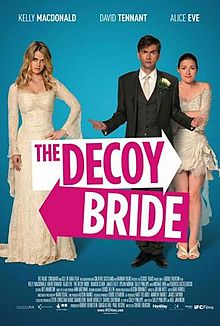
I felt a sense of enlightenment upon first reading her observation about the romantic comedy. It is with her outlook on her favorite movie genre that I am able to approach—and even appreciate—examples from it. For this reason, I was able to enjoy Sheree Folkson’s The Decoy Bride (2011), though I admit that the setting and actors were the main draws. Spoilers ahead!

Kelly Macdonald stars as Katie NicAoidh, a thirty-two-year-old who gives up her dreams of making it in the big city (Edinburgh!) and returns home to Hegg, a fictional island located way out there in the Outer Hebrides. She leaves her cheating musician of a fiance behind, along with a soul-sucking job writing for an online men’s trousers catalogue (laying it on thick, eh?), to wallow in self-pity at her mother’s bed & breakfast establishment. Her romantic future looks bleak (she’s turned “vegan” when it comes to men), as she is the youngest of 75 island residents and the only single woman among them. Cue the arrival of her soul-mate! James Arber (a flappable David Tennant) is an up-and-coming “serious author” who is engaged to the superstar American actress Lara Tyler (Alice Eve). When the pestering cameras of paparazzi make it impossible for the couple to get married in private, Lara and her handlers (agent Michael Urie and his assistant Sally Phillips, who co-wrote the screenplay) arrange their super-secret nuptials on Hegg. Having glimpsed her arch-enemy, the paparazzo Marco (Federico Castelluccio), trawling the chapel, Lara runs away the morning of her wedding, leaving her agent, Steve (Urie), to devise a dubious plan: he hires Katie to pose as Lara during the ceremony, hoping to pass off the event as the couple’s wedding to the press (he doesn’t even let James in on it). Steve believes that if the press and public already think they’re married, then they will be able to wed privately, for real. Don’t you see why it’s best to think of the romantic comedy as a sub-genre of sci-fi?

Complications arise when Katie accidentally signs the register with her own name, rendering her marriage to James official. (Seriously, she thought Steve’s offer of £5000 was worth the trouble of breaking the law?) It’s worth mentioning here that they had met each other the day before: James, under an assumed name (to keep his wedding secret from the islanders), bumped into her while Katie was researching the definitive guidebook to Hegg that she is writing. After she makes a disastrous pass at him, they both decide that they don’t like each other. Later, when James discovers what Steve has orchestrated, the verbal sparring matches between James and Katie really begin.

Steve locks the fighting newlyweds in the tower of the castle that he has had renovated for the secret, romantic destination wedding. James and Katie’s being locked up in the honeymoon suite and their subsequent determined escape from it subvert the setting’s fairytale ending connotations. But this is just the beginning of their love story. Like in the seminal romantic comedy Pride and Prejudice, the protagonists must offend each other before they fall deeply in love. This process begins shortly after James saves Katie from drowning in the castle’s moat, a heroic gesture that is clearly a reference to legends of chivalry. Astonishingly, his rescue surprises both of them—but not the spectator. Besides, how could anyone let someone else drown, no matter how irritating the person is?!

The Decoy Bride utilizes many tropes of the romantic comedy genre, especially the wedding theme, which is so prevalent that it warrants its own sub-genre. The “wedding film” has proliferated in the 2000s, counting among its ranks such films as The Wedding Planner (Adam Shankman, 2001), The Wedding Date (Clare Kilner, 2005), 27 Dresses (Anne Fletcher, 2008), Bride Wars (Gary Winick, 2009) and even the “manly” antidotes Wedding Crashers (David Dobkin, 2005) and American Wedding (Jesse Dylan, 2003). Last year’s hugely successful Bridesmaids (Paul Feig, 2011) injected a feminine-inspired cynicism into all the stages of planning a wedding. Feminist film scholar Diane Negra, in What a Girl Wants? Fantasizing the Reclamation of Self in Postfeminism, estimates that the American bridal industry is worth about $161 billion today (52). Along with magazines and news stories, these films contribute to pop culture’s fascination with the wedding event and stress the importance of the heteronormative rite-of-passage that getting married supposedly is for young women. As a wedding film, The Decoy Bride both makes fun of marriage and reaffirms its significance. On the one hand, the film upends the notion that marriage is a sacramental testament to everlasting love because James and Katie, who despise each other, accidentally wed. But on the other, since the mismatched couple fall in love while trying to get divorced, the spirit with which they were married turns out not to have been a fluke after all.

Although The Decoy Bride belongs with other wedding films, it has more in common with Pride and Prejudice than it does, say, Bride Wars. An English-language classic, Jane Austen’s 1813 novel is a telling portrait of the life options available to the women of her time: marry for money, for the betterment of your family, or face poor spinsterhood. The strength of Austen’s story lies in its form as a comedy of manners, the whole time poking fun at the institution of marriage and the people who endeavor to strike up the deals. While there is much more at stake pending Elizabeth Bennet and Mr. Darcy’s eventual union as opposed to whether or not Anne Hathaway and Kate Hudson will each secure the same overbooked wedding venue, Mr. and Mrs. Darcy’s early nineteenth century love story is thoroughly modern. Perhaps that is because our Anglo-American culture continues to recycle it. The (im)probable lovers have been immortalized in book and screen adaptations numerous times, often with funny sounding titles like Bridget Jones’s Diary (written by Helen Fielding in 1996 and directed by Sharon Maguire in 2001) or You’ve Got Mail (Nora Ephron, 1998). In fact, Katie resembles Bridget Jones’s version of Lizzie Bennet in that she is often publicly shamed for being over thirty and single. As struggling authors, James, who suffers from writer’s block, and Katie, who is just coming into her own as an author of a Hegg travel guide, lunge their daggers into each other’s literary egos in much the same way that Tom Hanks and Meg Ryan of You’ve Got Mail spar over carving out their respective book-selling niches on the Upper West Side. The Decoy Bride goes one step further in its homage to romantic comedies, pretty much all borne of Pride and Prejudice, with a scene in which James and Katie strip out of their wet clothes in her mother’s kitchen, a thin linen separating them—and tempting them to look at each other—as if they are in Frank Capra’s It Happened One Night (1934).

My sister, an unabashed aficionado of romantic comedies, insists that the films work so long as the leads have chemistry. Kelly Macdonald and David Tennant do set off some romantic fireworks, but I’m afraid that James is not as appealing or likeable a character as Katie is. Mindy Kaling would be happy to learn that Katie is not so broadly drawn as to fit any of the archetypes for romantic comedies’ leading ladies that Kaling identifies in the piece I quoted from earlier. Katie is not an adorable klutz, a Manic Pixie Dream Girl, a humorless and ambitious workaholic, or a gluttonous slob with a six-pack of abs. She is self-aware (she knows that James is her type, an emotionally stunted “arty” guy, which means trouble) and has a self-deprecating sense of humor. Casting Macdonald in this role is actually refreshing. An “indie” actress who made her debut in Danny Boyle’s Trainspotting (1996), one of my all-time favorite films, she is usually cast in dark pictures, namely the Coen Brothers’ No Country for Old Men (2007) and HBO’s Prohibition-set gangster epic Boardwalk Empire (2010-present). She brings to her character more nuance than we are used to seeing in other rom-com’s heroines. The look on her face when she decides to turn the ferry traveling away from Hegg back around, to reunite with James at the very end, is a prime example of this.

The problem with James as a male lead, an object of desire that we’re meant to want Katie to want and obtain, is that he never gets over himself or overcomes his charlatan ways. Lara chooses Hegg as the destination for their would-be super-secret wedding because it is the setting of his one and only book, The Ornithologist’s Wife, a heavy tome that the locals, including Katie, resent because it misrepresents the place. Using James’s book as a guide for planning their wedding, Steve soon discovers that James had never been to Hegg, because the lavish, bird-decorated castle doesn’t already exist there. Steve must invent it to appease his client. James’s dirty little secret remains buried vis-a-vis his fiancee, who, contrary to her lifestyle, is actually a down-to-earth, if a little naive, woman. Lara loves James because she believes he is a genius, regularly quoting his words back to him. On the occasion she says something stupidly romantic, he says he can’t believe he wrote that. In fact, it was her own original sentiment. Not only is he cruel, James has nothing in common with Lara, and it seems as if he wants to marry her because her desirability to others is a feather in his cap. He thinks that in addition to stroking his ego, she will also prove to be a fruitful muse and ensure his own fledgling fame lasts.

Despite the journey he takes with Katie all over the island, falling in love while trying to get divorced, it is revealed in the end, following the improbable lovers’ separation, that James and Lara never corrected the press and public’s shared impression that they wed. In other words, everyone thinks they’re still married. Thus, the dedication in his second book (“To my wife”), which is based on his experience with Katie, is directed not at Lara but at our heroine. While it may be a comfort that James and Katie share a private romance that is made public through his new novel, the fact that James would wish to deceive everyone, especially Katie, about being married to someone he does not love means he hasn’t learned his lesson. He may have started to write what he knows, at Katie’s insistence, but he hasn’t fully understood how to own up to it. Some romantic prize to be won.

Of course, embedded in all of this is a slight critique of our celebrity-obsessed culture. Lara is sympathetic in her desire for privacy, as is her hiding out in the village once the world’s press descends on Hegg. Since Steve has barred anyone from entering the castle, in trying to maintain the so-called integrity of the sham wedding, Lara applies her own makeup (quaint!) and takes up a disguise as an old village lady so that she may wander around the press camp undetected. In doing so, she chats with Marco, the paparazzo who has made her life a living hell and who redeems himself because he shows off candid photos of Lara that he never sold. In a pre-end credits scene, Lara attends Marco’s gallery opening, their suggestive smiles captured on film by a hovering paparazzo for the glossy tabloid Stars Today.

Back in Hegg, Lara also meets Katie’s mother, Iseabail (Maureen Beattie), who sold the wedding story to the press. Given the fact that Iseabail is terminally ill with an unnamed disease (this constitutes the weakest part of the film story), Lara’s threatening to push Iseabail, in her wheelchair, over a cliff if she doesn’t throw her huge wad of cash into the sea is unbelievably harsh. Lara then mistakes Iseabail as the inspiration for the titular character in James’s novel, a move that Iseabail encourages and in the end influences the actress to fund the dying woman’s trip around the world with Katie. (Having stayed put in Hegg all her life, Iseabail is itching to leave, her bucket list dreams recalling those of Tom Hanks in Joe Versus the Volcano [John Patrick Shanley, 1990].)

An opportunist and busybody, Iseabail is but one of the eccentric villagers. Others include elder citizens who hawk cookies and tea as well as expensive pet rocks to the deluge of visitors. Stranger still, there is Angus (Hamish Clark), a former boyfriend of Katie’s who weds someone he does not evidently love on the very day that Katie comes back to town. He later attempts to fight James for Katie’s hand. This is a ridiculous plot contrivance to prove to James and the audience that Katie is desirable. Then again, Katie is uneasy when it comes to the attention that Angus and William (James Fleet), Katie’s boss at the general store, regularly pay her. This probably has more to do with her unwillingness to stay in Hegg and her professional ambitions to travel and write. In the end, while she succeeds as the published author of a definitive if little-read history of Hegg, it is unclear if she and James will stay in Hegg. Or whether they will get married again—for real.

The Decoy Bride, a Scottish and Manx co-production, was shot on the Isle of Man in the Irish Sea, and while Hegg by no means represents a mythical Scotland a la the villages in Brigadoon (Vincente Minnelli, 1954) or Brave (Mark Andrews, Brenda Chapman & Steve Purcell, 2012), the film does tread on all-too-familiar territory. The script calls for Katie and James to seek out Reverend McDonough (Tony Roper) because, as Katie assures, “he’ll know what to do.” Apparently in tune with island superstitions, he officiates their ceremonial divorce, which he rushes to perform before the first sunset as if he is breaking a spell. In fact, you might say that James and Katie’s determination to reverse their vows is not too dissimilar from Princess Merida and Queen Elinor’s race to lift the bear curse on the latter woman in Brave, which coincidentally stars Kelly Macdonald as the fiercely independent princess.

According to the film’s trivia page on the Internet Movie Database, many scenes and characters were struck from the shooting script because the budget was much lower than the screenplay’s earliest appraisal. This handicap is most noticeable toward the end of the film, leading up to the lovers’ inevitable reunion. I have no idea what changes would have been made if the filmmakers had the full £7 million as intended, but The Decoy Bride is a cute little movie nonetheless. Especially if you suspend your disbelief.

Long Take: Reclaiming Brave

Viewed June 27, 2012

Pixar’s thirteenth feature, Brave (Mark Andrews, Brenda Chapman & Steve Purcell, 2012), may not be the best of the studio’s output. While it doesn’t reach the narrative heights of Ratatouille (Brad Bird, 2007), The Incredibles (Bird, 2004), Wall-E (Andrew Stanton, 2008), or Toy Story 3 (Lee Unkrich, 2010), the film certainly doesn’t belong with the drudgery that is Cars (John Lasseter, 2006) or Cars 2 (Lasseter, 2011). Set in medieval Scotland, Brave is a solid piece of Pixar animation and an affecting story that anyone would be proud to produce. Unlike most critics, who have contributed to the film’s middling score on Rotten Tomatoes (it’s middling for a movie by Pixar, whose works are almost always universally praised), I didn’t find Brave disappointing. In fact, it exceeded my expectations. Originally conceived by director Brenda Chapman, Brave is a welcome woman-centric entry into the Pixar canon. But it really should be celebrated for what it gets right: its overwhelmingly feminist story. You know the drill by now: I’m going to spoil the movie below.

During its opening weekend, Brave racked up $147 million in worldwide box office receipts ($66 million of which was gained in the US alone), thereby quelling fears that audiences wouldn’t turn out for the first Pixar movie to have a female protagonist. There is such a thing as brand loyalty, and when the film’s studio is synonymous with quality (in terms of story, characters, and art), who really could have thought that Brave wouldn’t bring audiences in, anyway? Still, it is refreshing to reflect that, provided the little ones weren’t bored with the emotional story, spectators of all ages were treated to a poignant film about mother-daughter relationships. In other words, Brave is not just another fairytale.

The mother-daughter relationships in fairytales historically pit good against evil, generally in the form of a young, beautiful, and sweet-natured “princess” overcoming the emotional and physical torture inflicted upon her by her stepmother. For example, Cinderella’s stepmother punishes her with menial labor around the house because her now deceased husband loved his daughter more than he loved her, and Cinderella is rewarded in the end for her moral goodness when the prince chooses her for his bride and not one of her stepsisters. More tellingly, one of the most enduring fairytales, which is coincidentally the first full-length animated feature (by Pixar’s parent company, Disney, no less), is about a witch’s murderous envy of her stepdaughter’s beauty. According to Maria Tatar, the Grimm brothers’ early version of “Snow White” reflects “children’s fears about the cruelty of stepmothers, at a time when mortality rates for child-bearing women were exceptionally high.” However, Monica Hesse is quick to point out that the original Grimm story was about a mother’s desire to kill her own daughter for the same reason. In this sense, Brave breaks with the fairytale tradition because the generational conflict is about compromise forged out of love.

Princess Merida (voiced by Kelly Macdonald) and Queen Elinor (Emma Thompson) don’t see eye-to-eye on how the princess should comport herself. The teenaged Merida has taken after her warrior father, the fun-loving and rough-housing King Fergus (Billy Connolly). She prefers to fill the hours horseback riding through the nearby forest, climbing steep rock-faces to enjoy the view from the top, and practicing her already accomplished archery skills. Elinor is trying to make a lady out of her daughter, insisting she perfect her enunciation, needlepoint, and hospitality. Even though Merida is nowhere near ready to assume queenly duties (and nor does she want to), the queen has gone behind her daughter’s back to invite the first-born sons of three neighboring clans to compete in the Highland Games for Merida’s hand in marriage. Merida tries what she can to deter her mother’s plans, even going so far as to compete in—and win—the archery contest for her own hand. Watch this scene and get the chills:

So, Brave is a universal story about wanting to choose your own path in life. Following Merida’s embarrassing commandeering of the Games, mother and daughter get into a heated fight. Unfortunately, I can’t remember who acted first, but I know that Merida takes a knife to Elinor’s tapestry-in-progress, a portrait of the family, separating Elinor from the rest, and Elinor throws Merida’s bow into the fireplace, immediately regretting such an impulsive move. Although Merida’s desires are decidedly different from Ariel’s, the generational conflict in Brave reminds me of the one central to The Little Mermaid (Ron Clements & John Musker, 1989). Merida even enlists the transformative powers of a witch (Julie Walters), only, unlike Ariel, she selfishly wishes to change her mother rather than herself. (Recall how, in striking a deal with Ursula in order to meet and woo a land-bound prince, Ariel gained legs in exchange for her beautiful singing voice.) In Brave, the witch, who so desperately wants to work in peace as a wood-carver (“too many dissatisfied customers”), forgets to give Merida special instructions for serving Elinor the magic cake, and that is when the action really takes off.

The working title of Brave was The Bear and the Bow, and it is a good thing that the filmmakers made the switch. For the title would have given away the narrative twist, which Brave‘s marketing materials have done so well to keep under wraps: consuming Merida’s peace offering, the witch’s cake, transforms Elinor into a bear! A wacky Freaky Friday of sorts ensues with mother and daughter teaming up to reverse the spell while dodging the riotous clansmen in the castle. King Fergus in particular has a bear on his hit list; in the pre-title sequence, set when Merida received her first bow as a little girl, the giant, legendary bear Mor’du attacks the family’s picnic and eats Fergus’s left leg below the knee (off-“camera,” of course).

I’m not sure that the bear carries any special significance in Scottish culture, especially since neither Scotland nor the whole island of Great Britain has been home to wild bears for thousands of years. However, the bear metaphor is apt because we tend to anthropomorphize the wild animal due to the mother bear’s fierce protection of her cubs. Just this week, Good Morning America reported that three bear cubs broke into a car near Denver searching for food, their mother initially scared off by police officers who snapped photos of the bandits red-handed. The only other mention of animals in Brave are of the mythical sort. I can’t recall the exact circumstances, but someone mentions to Fergus the impossible existence of dragons, which I have interpreted to be a slight against How to Train Your Dragon (Chris Sanders & Dean DeBlois, 2010), perhaps the first and only near-Pixar quality DreamWorks Animation film about a viking community that, oddly enough, has a character or two with a Scottish accent.

In any case, Brave has received a lot of attention because animating Merida’s untamed orange curls pixel-by-pixel is an impressive feat. However, just as the filmmakers successfully infused children’s toys with life and a rat with excellent culinary skills, the animators of Brave wonderfully imbue the bear with Elinor’s prim-and-proper personality. We still see Elinor in the bear as she proudly wears her crown and insists that Merida keep her bow off the table. Though they’re both despondent, things calm down between them once the duo have learned, via a potion-controlled automated message from the now-absent witch, that if they do not mend their bond by the second sunrise, Elinor’s metamorphosis will become permanent. Frustrated that she can no longer speak, mother and daughter gradually develop a language based on non-verbal sounds, hand (or paw) gestures, and facial expressions. The first steps toward reconciliation occur on the banks of a river, where Merida teaches her mother how to fish. The irony is not lost on me: a young woman teaches a bear to fish with just its bare claws. Later, when they happen upon Mor’du’s pit and must run away to save themselves from his wrath, Merida rides on her mother bear’s back. Merida’s horse Angus may prove valuable in the end, but this earlier scene is poignant because it shows how connected mother and daughter are, despite (or because of) Elinor’s change.

In fact, one of the aspects I like best about Brave is how active both Merida and Elinor are. Their daring escape from Mor’du’s lair is just the tip of the iceberg. In the end, after Fergus finally discovers the broken furniture in Elinor’s bedroom and attributes the mess to Elinor the bear, believing she is Mor’du and therefore responsible for taking his leg and killing his beloved wife, he locks a protesting Merida in her room and chases Elinor out of the castle. With the manpower of the three visiting clans behind him, Fergus follows Elinor to a mystical Druid circle. Eventually, Merida gets out of her temporary prison, stitching up her mother’s tapestry while bouncing along on Angus’s back. She arrives just in time for the real Mor’du to show up and attack the humans. Fergus withdraws his fight, and everyone watches as Elinor the bear defends Merida, ingeniously wearing down one of the stones so that when Mor’du slams into it, it crushes and kills him. This resolution is satisfying because it defies expectations laid out at the beginning. Not only has the queen come to respect her daughter’s rough-and-tumble talents, she has also exhibited them herself. It is Elinor, after all, a woman bear of action, who defeats her husband’s wild foe—and not Fergus himself who does the deed. It is also important to note that Mor’du isn’t a villain; he is the way he is because he was once a human prince who broke with tradition and sought the witch’s magic in order to rule the kingdom on his own. His curse became permanent because he was too stubborn to right his wrongs. So, when Elinor kills him, his soul gratefully finds peace.

The maternal melodrama reaches its tearful conclusion when Merida, having practiced the womanly needlepoint skills her mother desperately grilled into her, wraps the tapestry around Elinor the bear. With a humble apology and a profession of love, Merida manages to bring back her mother’s human form, just as the sun rises. As much as I like New York magazine’s pop culture blog, Vulture, I am not willing to ignore its faults. Contributor Kyle Buchanan misunderstands a lot about the witch’s spell, believing that she casts it “[j]ust for cruel kicks.” First of all, Merida asks for the witch to “change” her mom, not for one to more accurately change her mother’s mind about her future, so we can hardly blame the witch for Merida’s confusing choice of words. Buchanan also takes the witch’s explanation of the spell’s conditions too literally, incredulous as to how the witch could have known that Elinor’s tapestry needed mending. That’s not actually the case, Kyle. The witch’s “answering service antidote” refers to the mother-daughter bond in a metaphorical way. It is Merida who conjures the idea to stitch the tapestry back together. Just think of how pleasing it would be to her mom!

Originally, I rolled my eyes at the the plot contrivance that the spell’s effects are only temporary for the first two days, but in hindsight I realize that it is enough time for the mother and daughter to reconnect. After all, they used to be close because of their shared belief in magic, and they do know each other very well. Through their adventure, they arrive at a compromise, which technically lies heavily in Merida’s favor. For even before Merida breaks the spell in the Druid circle, the princess’s agility outdoors and heartwarming speech in front of the fighting clansmen who have convened for the Highland Games inspires Elinor, still a bear, to sign the rest of her daughter’s speech, announcing that Queen Elinor has decided to suspend the Games. In witnessing Merida’s full appreciation for tradition, Elinor insists that the three suitors who have competed for her hand, along with everyone else throughout the kingdom, should have the right to choose whomever they want to marry. Talk about a change of heart.

This resolution complements the film’s overarching feminist representation of power. Fergus may be the king of all four clans, which are each headed by men, but it is Elinor who effectively rules. She organizes the Highland Games and arranges Merida’s marriage. When fighting breaks out among the clans upon their arrival, she brings it to an end with a stern turn about the room, silencing even her brawling husband. Most importantly, Queen Elinor stops Merida, who speaks passionately about the importance of tradition, before her daughter chooses who among the sons of Lords Macintosh (Craig Ferguson), MacGuffin (Kevin McKidd), and Dingwall (Robbie Coltrane), will be her husband. In this way, through her influence over her mother, Merida becomes the most powerful DunBroch in the kingdom. In the future, she may remember to keep her bow off the dining room table to please her mother, but she will not have to hang it up completely.

Brave is violent in parts, such as whenever Mor’du appears on-screen. But perhaps more shocking than this is the prevalence of nudity. For example, Merida locks Fergus and his men outside on the tower in order to get Elinor, newly transformed into a bear, out of the castle. The men tie their kilts together and climb down, and as they walk out of the frame, the spectator glimpses their bare asses. Later in the film, after Merida breaks the spell, her mischievous little brothers, the triplets Hamish, Hubert, and Harris, run over to the naked Queen Elinor, their bare asses also visible (they had eaten from the magic cake at one point, too). It is an interesting choice to feature comic nudity in an animated family film. Pixar had never gone this route before. But I am glad that the filmmakers included a sexualized instance of the female gaze. When Lord Dingwall introduces his son before the royal family, a gigantic Schwarzenegger-like figure with bulging muscles and an unreal tan stands in front of them. Elinor leans forward in her throne to watch the expression on Merida’s face as she registers the man’s appearance. It’s not clear whether or not the denouement that he is not Lord Dingwall’s son disappoints either woman, but their looking at his body suggests that the filmmakers have a keen sense of irony when it comes to fairytale desires.

As a lover of all things Scottish, I admit that I was originally trepidatious going in to see Brave because the film circulates many stereotypes, including a mystical highland setting, jokes about kilts (Lord Dingwall moons Lord MacGuffin), and anachronistic blue face paint. In fact, I didn’t even like the title because it resembles too closely Mel Gibson’s rape of Scottish and English history also known as Braveheart (1995). Thankfully, the film is neither Brigadoon (Vincente Minnelli, 1954) nor Braveheart, and these small quibbles do not detract from the emotional pull of the story. In sum, I appreciate that the film reclaims the adjective “brave,” which typically connotes masculine courage, by attaching it to a young woman’s adventure of self-discovery.

Long Take: Reaffirming Awkward in 21 Jump Street

Viewed June 26, 2012

Having been too young to watch the Fox TV series 21 Jump Street when it originally aired from 1987 to 1991, I mainly just knew it as the show about young-looking undercover cops that launched Johnny Depp, among other also-rans. That’s probably how most people of my generation (the news media has anointed us “millennials,” a moniker that annoys me to no end) “remember” it. So why not re-package it as a comedy with the up-and-comers Jonah Hill and Channing Tatum? Despite the surprisingly positive reviews 21 Jump Street (Phil Lord & Christopher Miller, 2012) received upon its release as well as my dad’s oft-repeated requests to see it, I refused to see it in the theater. Honestly, I can’t remember my specific reasons for holding so firm on this point; it was not as if I had wanted to see something else and Dad refused to go. March 2012, unless you are a dedicated follower of all things The Hunger Games, was a bad month for movies.

Why did my father want to see 21 Jump Street so badly? Well, ever since catching Superbad (Greg Mottola, 2007) on basic cable years ago, he has been obsessed with Jonah Hill’s foul-mouthed performances. That’s right: even with the channel’s edits for language and content, my dad still found the film–and Jonah Hill’s horny teenager–uproariously funny. I joke that he is the only 62-and-a-half-year-old who eagerly anticipates Hill’s films. For example, Dad still wants to see The Sitter (David Gordon Green, 2011), which I have no interest in viewing because of its allegedly racist, homophobic, and sexist sense of humor. It’s also noteworthy that my father’s Jonah Hill fandom does not extend to his more “serious roles.” Dad was disappointed that the comic actor played it “straight” in Moneyball (Bennett Miller, 2011), for which he received an Oscar nomination for Best Supporting Actor.

Anyway, we rented 21 Jump Street on DVD as soon as it became available, and we both laughed our asses off. It had been a long time since I had seen a comedy that made me laugh so unabashedly hard (it is quite politically incorrect, you know). Unfortunately, owing to the film’s mixture of genres (more on that in a moment), it loses its steam in the last act, as things become more out of control and ridiculous. Now’s a good time to alert you that, as with pretty much everything I write, I’m going to “spoil” 21 Jump Street.

Jonah Hill and Channing Tatum star as rookie cops Schmidt and Jenko, respectively, who, after a botched arrest in a public park, are transferred to a secret unit of the unnamed city’s police force: 21 Jump Street. Operating out of an abandoned church at this address, Captain Dickson (a very flummoxed and funny Ice Cube) leads a team of young-looking cops as they go undercover in local high schools and communities to bust criminals. Dickson, his patience already exhausted, assigns Schmidt and Jenko the case of finding the dealer and infiltrating the supplier of a new LSD-like drug on the campus of a neighborhood high school. The drug’s street name is wholly unimaginative (HFS, as in “holy fucking shit”), but Dickson introduces it to the partners and audience in a novel, synced-in way: through the screening on YouTube of a video in which a teenager documents the various stages of his experience on the drug. Dickson fills in the last bit, which immediately ups the stakes of their mission: the kid in the video whose antics so amused Jenko later overdosed and died.

Schmidt and Jenko were enemies all throughout high school because the former was a geek and the latter the dumb jock who picked on him. They only recently became best friends while at the police academy, in a quick blink-and-you’ll-miss-it exchange wherein Schmidt openly admires Jenko’s easy physical dexterity and Jenko respects Schmidt’s study habits. In other words, they decide with a fist bump to “be friends,” recognizing that each other’s strengths will help him improve. Now that they are partners and BFFs, it is with a little trepidation that they re-enter high school. Will everything be the same?

21 Jump Street has been called the male-centric version of Never Been Kissed (Raja Gosnell, 1999), the romantic comedy in which the homely newspaper copyeditor Drew Barrymore gets a chance to prove her worth as an investigative reporter while reliving the horrors of high school. This comparison is superficial and off-base because 21 Jump Street is not as sentimental or nostalgic (the pre-title sequence is the only scene set in the past). Nor does the newer film’s narrative focus on the protagonists’ transformation from unpopular (or in Jenko’s case, popular) to cool (or uncool). Dickson’s stern pointer to the more handsome of the two, Jenko, to keep his dick in his pants and not have “relations” with teachers, staff, or students is a preemptive “shut-up!” to those viewers who have already made the Never Been Kissed connection (because Barrymore and her English teacher, Michael Vartan, find love). But a tiny romance with a student is slotted in for Schmidt, who’s long been petrified of girls, thereby subverting the rule that “nice guys finish last.” Jenko’s desirability is more often commented upon than his own desires are expressed, which perhaps foreshadows Channing Tatum’s unselfconscious turn and public appeal to be a leading man in Steven Soderbergh’s Magic Mike (2012).

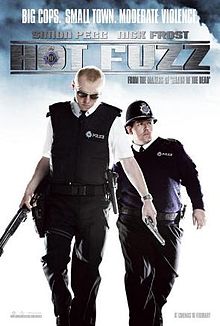
In updating the television show for today’s audiences, screenwriter Michael Bacall (who developed the story with its star, Jonah Hill) combines the police procedural format with conventions from the buddy cop genre, “high-concept” action movies, and even high school-set comedies about social hierarchies. This genre mixing suggests that the film’s intended audience is very cine-literate. As a buddy cop movie, 21 Jump Street has less in common with the classics Lethal Weapon (Richard Donner, 1987) and Point Break (Kathryn Bigelow, 1991) than it has in common with the recent fan-boy favorites Hot Fuzz (Edgar Wright, 2007) and The Other Guys (Adam McKay, 2010), which are both parodies and legitimate entries of the genre. For the later films speak the same language, positioning their respective “odd couple” policemen of inaction as the triumphant heroes of Michael Bay’s explosion-laden cinema. The early scene in which Schmidt and Jenko pursue drug dealers while on the beat in a public park, the action cut between their frenzied bicycle-riding in close-up, set to a rocking score, and their more languid rolling over the grass in a medium shot (without music), at once expresses the partners’ frustration with their jobs (it is not as heroic as they would wish) and their desires to live in a Michael Bay-type action film. Later in the film, they chase after the same drug dealers, this time on the ramps of a painfully obvious Southern California freeway, commandeering a number of vehicles (including a student driver car with two steering wheels and a baby pink VW bug) and turning their heads at almost every maneuver because they expect their efforts to have resulted in explosions. Whereas the first scene in the park is subtle, this later car chase scene is like a Saturday Night Live skit run amok.

Thankfully, most of 21 Jump Street‘s comedy derives from its deconstruction of high school’s social hierarchies. Other than Never Been Kissed, the film also references such classics as Sixteen Candles (John Hughes, 1984) and The Breakfast Club (Hughes, 1985) and even the resplendent TV series created by Paul Feig, Freaks and Geeks (1999-2000). Having been popular back in the day, Jenko advises his partner and friend with a number of key behaviors that will ensure he fits in, chief among them: make fun of people who “try too hard.” When Jenko demonstrates this on their first day, still in the parking lot, he receives a rude awakening. He calls one of the popular kids “gay” for riding a moped, and when accused of gay-bashing, Jenko reacts by punching the kid, who just happens to be gay. Thus the put-upon popular kid and his friends accuse Jenko of hitting him because he is gay, which Jenko of course couldn’t have known. Meanwhile, Schmidt makes the observation that everything that made him uncool in school, such as his cultural sensitivity, staunch environmentalism, and awkward sense of humor, is now in vogue. Things have changed in the less than ten years since they were in high school, and these changes precipitate an identity crisis for each.

21 Jump Street is not exactly like the teen comedies based on Shakespeare’s plays, including Never Been Kissed (As You Like It) and Gil Junger’s 10 Things I Hate About You (The Taming of the Shrew, 1999), but it does use misidentification as a starting point for comic hijinks. Since neither Schmidt nor Jenko studied their fake profiles before enrolling, they fail to identify correctly as their assumed identities in the principal’s office. This means that the dumb hunk Jenko winds up with Schmidt’s class schedule, which is heavy on the sciences (where Dickson thinks the drug’s makers are convening). The shy and awkward Schmidt is saddled with Jenko’s less academically challenging but more artistic and social courses. It’s in his drama class that he becomes close to Molly (Brie Larson), a pretty, funny girl who non-exclusively dates Eric (Dave Franco), the popular kid who took Jenko to task for bullying his gay friend. Not surprisingly, Eric is soon revealed to be the high school’s number one dealer of HFS, thereby requiring Schmidt to get close to him.

Meanwhile, Jenko uses the nerds in his science class to trace Eric’s phone calls on his mobile. He may become friendly with them, inviting the small group to a party that Schmidt hosts at his parents’ house in spite of Dickson’s forceful reminder never to do so (Schmidt has moved back in with his parents along with Jenko to keep up the charade that they are brothers new to the neighborhood). And Jenko may enjoy science more because of their tutelage of him, but of the two, Jenko grows the least as a character. Unlike Schmidt, who must get over his fear of firing his gun (definitely a sexual handicap), Jenko doesn’t have any real challenges. He hardly has low self-esteem, but hearing his best friend make fun of his intelligence with Schmidt’s new-found popular classmates takes its toll on their relationship. In the end, though, Jenko’s fun science experiments with the gang help him stop the drug dealers from getting away. He effectively builds and hurls a bomb, made with alcohol and batteries, at their runaway vehicle. Cue explosion. Schmidt eventually becomes a man of action when, in puerile, penal fashion, he shoots the drug supplier, the jocky Mr. Walters (Rob Riggle), in the crotch. Upon shooting the P.E. teacher and track coach’s dick off, Schmidt announces that Mr. Walters “peaked in high school.” Talk about rewriting the social rules of high school.

But this begs the question: should Schmidt and Jenko have grown more as characters? On the one hand, I think character development would certainly have improved the story. But on the other hand, I appreciate how the filmmakers eschew traditional storytelling methods. As I previously mentioned, Schmidt and Jenko become friends in a flash while at the academy, with the tacit assumption that Jenko had already become less of a jerk in the years they spent apart. This means that the film neither tracks the development of their relationship, from enemies to best friends, nor their own transformations. Perhaps the protagonists’ not having major narrative trajectories is exactly the point. Sure, Schmidt must learn to take risks (it’s part of his job!), and he does. When it comes to women, his becoming popular has little to do with it. Molly doesn’t like him because he hangs out with Eric; she arguably prefers him for his awkward sense of self. They feel a connection because they have a similar sense of humor. As for Jenko, hanging out with science geeks may make him one by association, but he doesn’t metamorphize into a genius. Besides, that’s impossible to convey in fewer than 120 minutes. In this way, they merely grow together from being inept cops to being fully capable of bringing the bad guys to their knees. Ooh, did I just write that in digital ink?

By way of conclusion, here are some odds and ends to 21 Jump Street that I really enjoyed. Hill and Tatum have tremendous chemistry, and Tatum proves he can deftly handle comedy, as when he tries to intimidate one of the drug dealers in the beginning with, “Hey, you want me to beat your dick off?”

As a big fan of the TV series Parks and Recreation (2009-present), I loved seeing Nick Offerman cameo as the deputy police chief who transfers the bumbling idiots to the undercover bureau. His description of the program as a rehashing of the past because the higher ups lack creativity in catching criminals constitutes a witty meta-commentary on the business of filmmaking today, what with the prevalence of sequels and reboots.

Furthermore, the characterizations of the adults at the school (weirdly named Sagan High… after Carl Sagan?) are clearly meant to make fun of archetypal teachers and principals who are ignorant of their students’ problems. For example, Principal Dadier (Jake Johnson from New Girl) and drama teacher Mr. Gordon (Chris Parnell) regularly say that they should care more about their students than they do. Mr. Walters, the creep that he is, had to have been a douche bag when he was in school because he simply never left. Perhaps the funniest situation arises because Jenko’s science teacher (Ellie Kemper) is overly flirtatious. She is physically conflicted over her desire for Jenko, both making her body available for ogling and saying she just can’t entertain the thought of crossing the line between teacher and student. The good news is that Jenko never takes advantage of her or any other woman who flings herself at him.

On the downside, the filmmakers waste that well-hidden cameo by Johnny Depp. At the end of the film, his Tom Hanson from the original series, along with partner Doug Penhall (Peter DeLuise), appears as an undercover cop who has lived with the drug dealing gang for years, going so far as to get tattoos and wear prosthetic makeup around the clock. When a gunfight breaks out between Schmidt and Jenko and the drug dealers, Hanson and his partner are caught in the cross-hairs and die gruesomely after professing their love for each other. This being a Jonah Hill movie, of course there is bromance. But doing away with these characters in this manner seems insensitive and outlandish. But what really explains this maneuver? Maybe the filmmakers weren’t expecting any fans of the original show to see the movie.

Long Take: Sherlock Holmes: A Game of Shadows Is Not Worth Playing

Viewed June 25, 2012

Sir Arthur Conan Doyle’s greatest literary creation, the private detective Sherlock Holmes, is everywhere these days. If he’s not appearing in the over-hyped BBC series Sherlock (2010-present) as a fast-talking, tech-savvy eccentric with a Dr. Watson who’s a PTSD-afflicted veteran of the war in Afghanistan, then he’s gearing up for a fall CBS show, Elementary (from 2012), where his sidekick will be a woman. Coincidentally, the star of the former program is Benedict Cumberbatch, who co-starred last year in director Danny Boyle’s innovative stage-play Frankenstein for the National Theatre with Elementary‘s lead Jonny Lee Miller. But Warner Bros. has pumped the most money, special effects, and star power into their Sherlock Holmes-as-action-hero franchise, and the sequel to the 2009 revisionist adaptation, Sherlock Holmes: A Game of Shadows (Guy Ritchie, 2011), is boring and tedious. As always, spoilers follow.

Robert Downey, Jr. and Jude Law reprise their roles as Holmes and Watson, respectively, in order to foil the criminal mastermind James Moriarty’s (Jared Harris) plot to instigate and manipulate a world war through the purchase and control of several industries, including the manufacture of machine guns. Downey and Law have a lot of chemistry, because after all it is a bromance. To my mind, the homo-eroticism is more pronounced in A Game of Shadows than in the first film, what with Holmes, disguised as a woman, surreptitiously joining Watson on his honeymoon with the long-suffering Mary (Kelly Reilly). (You’ve seen this sight gag in the trailer.) Of course, Holmes cites Moriarty’s vow to kill Mary and the only person Holmes cares about for the reason that he just had to crash the couple’s much needed alone-time. That, and stopping Moriarty from succeeding in carrying out his plan is simply more important. Holmes perfectly times the moment he pushes Mary off the train so that she lands in the river below the bridge, where his brother Mycroft Holmes (Stephen Fry), making his first appearance in the series, can safely retrieve her. Talk about bride flight.

There is no room in this (b)romance for Mary, but at least Ritchie and his married screenwriters Kiernan and Michele Mulroney write this subtext into Holmes’s and Watson’s dialogue. Watson eventually accepts Holmes’s melodramatic gestures, once he realizes that his and Mary’s assassins are on the train, blowing holes through the walls in pursuit of their prey. Crucially, however, he expels pent-up rage at his best friend, who clasps Watson’s head between his thighs. Remember, Holmes is wearing a dress. Ordinarily I would shriek with delight at this juxtaposition, but the nudge-nudging here is bruising.

On closer inspection, you can see that women just have no place in this world. Irene Adler (Rachel McAdams), Holmes’s iconic love interest and intellectual sparring partner, resurfaces after her disappearance in the first film, only to fall victim to her employer’s schemes within the first ten minutes or so. (I forgot about that; I guess Moriarty wants to get rid of two people Holmes cares about.) It may be a byproduct of McAdams having so little time on screen, but she and Downey have nowhere near as sparkling a chemistry as Downey and Law do. And that is the point. Other than Mary, the only other Englishwoman to grace us with her presence is Holmes’s daft landlady Mrs. Hudson (Geraldine James), who has a brief stint at 221B Baker Street before the real action begins. The scene in which the dandy Mycroft, who is someone indispensable to the British government but without a clearly defined role within it, walks around his house buck-naked, ordering his decrepit butler around and informing Mary of her husband’s whereabouts (received via telegram) despite her discomfort with his nudity, makes it very clear that the boys have a lot more fun without any girls around.

Even Holmes and Watson’s new partner in crime (fighting), the gypsy fortune teller Madam Simza Heron (Noomi Rapace in her first English-language role), hardly gets any play. From the moment of her introduction (Holmes winds up saving her from an assassination attempt before she goes underground in France, where he and Watson later track her down), her part is marginalized. Though she treks all the way to Switzerland with the pair for the climactic event, you barely know she’s there. The guys ostensibly keep her around because she will lead them to her brother, Rene, a member of a revolutionary group that she was once a part of and which Moriarty now controls. Madam Simza coaches them on how to dress less conspicuously as they cross national borders, assists Watson in literally bringing Holmes back to life after Moriarty captured and hung him up by a hook in his shoulder, and identifies Rene at the international summit in Switzerland despite his extreme cosmetic surgery. (I didn’t tell you that this movie is ridiculous?) Since she spends most of her time with Watson, she cannot be a romantic interest for either of the men. While this is refreshing (for once, a woman doesn’t exist in a “manly” action film for the sole purpose of affirming the hero’s masculinity), I’m afraid the screenwriters Mulroney just don’t know what to do with her. Hell, even after the smoke has cleared in the end, there is no follow-up with Madam Simza.

Back in 2009, Sherlock Holmes was billed as an inventive rehashing of a familiar story. For in it, Holmes is literally a man of action, not some aloof intellectual. He’s “edgy,” participating in bare-knuckle fights. It was during this film that audiences first witnessed “Holmesavision,” his deconstruction of hand-to-hand combat, narrated in voice-over so as to grant viewers access to his mind, to his ingenious plans for how to tackle each of his opponents (“Holmesavision” is actually the name of a featurette on the sequel’s DVD about this very storytelling device). Unfortunately, I cannot share in the filmmakers’ enthusiasm for this kind of indulgence. It is tedious and boring how we’re made privy to his particular, slowed-down way of seeing the physical threat before him and then subjected to watching him carry it out in real time. In later scenes, such as when Holmes, Watson, and Madam Simza are running through the forest with Moriarty’s henchman hot on their tail and blazing bullets, the action slows again. Why are people constantly trying to adapt The Matrix (Andy & Larry Wachowski, 1999)? Doesn’t it strike anyone else as passe?

Admittedly, I am biased against action movies. This is why I find the narrative emphasis on Holmes’s fighting ability, at the expense of showcasing his intellectual prowess and highly evolved deductive reasoning skills, so disheartening. As much as I find Mark Gatiss and Steven Moffat’s Sherlock grating, pompous, and too slick for its own good, I can concede that at least the show’s makers get Holmes’s astounding puzzle-solving skills right; his “Holmesavision” zeros in on the teeny tiny details others can’t see because they don’t know where to look. His view of the world is grounded in logic, or at least the logic of his own universe. Thus, when in the end of A Game of Shadows, Holmes defeats Moriarty in Switzerland over a game of chess and reveals how he uncovered his arch-nemesis’s plan to destroy the world, at the same time explaining all to the audience, the fun of watching a brilliant mind at work is already spent. Quite literally. He connected all the dots beforehand, never even letting on to his companions that he has already figured everything out and planned ahead, sending word to Mary in London in order to ensure the public discredits the mild-mannered and secretly evil Professor Moriarty. Well, gee, Mr. Holmes, I’m sure glad you brought me along for this crazy ride. This makes Holmes no different from the hero of other it’s-the-end-of-a-major-plot-to-destroy-the-world movies and almost diametrically opposed to the Holmes that has fascinated us so for 125 years. I’m all for reinvention, but this tactic is just uninspired.

Although the story of A Game of Shadows itself is original, I believe, the ending–in which Holmes and Moriarty fall to their death at the Reichenbach Falls, conveniently located across from Moriarty’s balcony–is drawn from Conan Doyle’s 1891 attempt to kill off his hero. According to Wikipedia, the fans weren’t having it, and so the author was goaded into bringing back Sherlock in a series of prequels. The point is, this is how Holmes dies. Like Sherlock‘s final episode of the second season, titled “The Reichenbach Fall,” in which Watson also witnesses his BFF’s death (Moriarty kills himself instead), Holmes later appears in a cliffhanger. Whereas in Sherlock, he watches from afar as Watson grieves over his grave, in A Game of Shadows, he disguises himself as an armchair in Watson’s study, right before his eyes if only Watson knew to look. Warner Bros. preemptively assumes that audiences want more of this Holmes character, and the studio would do well enough to leave him alone. Trompe-l’œil, indeed.

Steven Soderbergh: Workman’s Competence

Yesterday, the U.S. Supreme Court ruled 5 to 4 that President Obama’s Patient Protection and Affordable Care Act of 2010 is in fact constitutional, thereby cementing his legacy. I was so excited to hear this news, as it will ensure that millions of presently uninsured Americans will get the affordable healthcare that they rightly deserve. Yep, the country is starting to look a little different, the future a little brighter, after June 28th.

But this probably has more to do with the fact that today marks the premiere in theaters of Steven Soderbergh’s Magic Mike (2012), which is being hyped as possibly the greatest male stripper movie ever made. (Have we forgotten all about Peter Cattaneo’s sleeper hit The Full Monty, from 1997?) The movie review aggregator site Rotten Tomatoes lists Magic Mike‘s rating as 82% fresh. Despite the cheesy marketing ploys–one of which saw star Channing Tatum, whose own experience as a stripper inspired the story, lead a flash mob during his Today Show appearance–it looks as if Magic Mike might be more than just the sum of its “beefcake” parts. This is important, for how else am I going to convince my dad to take me to see it? (I don’t drive, and I live nowhere near a theater, if you can believe it.) Apparently, the fact that serious auteur Steven Soderbergh directed it isn’t enough of a reason. But it should be.

Here’s why: this week, in anticipation of the film’s release, I kept thinking about what would influence Soderbergh to pursue this kind of project. He’s hardly ever made anything as campy; the Ocean’s Eleven trilogy (2001, 2004, 2007) is fun because the biggest movie stars in the world gamely make fun of themselves, all while strutting around in impeccably tailored clothes, in beautiful locales, to David Holmes’s smooth and funky score. Come to think of it, that doesn’t sound too dissimilar from his newest effort.

On a more serious note, what I recognized while going through Soderbergh’s filmography is that most of his films are concerned with the characters’ professional work. This is not to say that he is Ken Loach, who has made many films about working class British men’s work lives. I’m thinking of The Gamekeeper (1980), Riff-Raff (1991), and The Navigators (2001) in particular, not to mention his films about nationalist revolutions (Land and Freedom, 1995; The Wind That Shakes the Barley, 2006) and even U.S. labor unions (Bread and Roses, 2000).

But work in Soderbergh’s movies is more nuanced than in your average film, if the average film is now either a romantic comedy (in which the female lead inevitably works at a women’s fashion and lifestyle magazine) or an actioner along the lines of Die Hard (John McTiernan, 1988), in which a police officer successfully foils a terrorist’s plot, but not without a few explosions going off to highlight just how extraordinary his dayjob is. The point is that, sure, what the characters do for a living is important to the story in virtually all films, including ones in which the protagonist does not work. There’s usually a reason for that.

The director Steven Soderbergh. Photo courtesy of IMDb.

But consider this: Soderbergh’s first feature after the Cannes success sex, lies, and videotape. (1989) was Kafka (1991). I haven’t seen the film, but I can imagine that, given the author’s biography (his writing provided an escape from his hum-drum workaday life as a clerk for an insurance company), work is not just an important facet of Kafka’s identity, but also a setting much explored in the film.

Arguably his first studio film, Out of Sight (1998) centers in part on the romantic entanglement of a US Marshall (Jennifer Lopez as Karen Sisco) and bank robber-turned-prison escapee Jack Foley (George Clooney in a star-making turn), thereby subverting the narrative conceit of the pursuit that is essential to her line of work. The year 2000’s Erin Brockovich famously transformed Julia Roberts into a Best Actress Oscar winner for her portrayal of a real-life legal clerk and environmental activist. The film chronicles Brockovich’s investigation of Pacific Gas & Electric Company’s cover-up of groundwater contamination in a local community whose residents have become gravely ill. Her efforts take a toll on her relationships with her family and boyfriend, and she also confronts death threats because of what she has uncovered.

Based on a British TV series from 1989, Traffic, also from 2000, takes a more dynamic approach to its inside story of the illegal drug trade: through the interweaving perspectives of a Mexican police officer battling widespread corruption in his force, a conservative American judge/politician whose own daughter is an addict, and the wife of a drug lord going to extremes to protect her family from the law and the cartel. Again, this film, for which Soderbergh won the Oscar for Best Director, would not work without an emphasis on the conflict between each character’s personal and professional lives.

Last year’s underrated Contagion (2011) takes a similar multi-perspective approach to the recounting of a mysterious virus’s spread across the globe. Matt Damon’s part as a new widower, immune to infection, trying to keep his teenage daughter safe may have a pathetic advantage when you consider that the other story lines revolve around the work lives of scientists and public health officials. However, Contagion is compelling, both as a horror film and thriller, precisely because we see these people at work: epidemiologists trying to contain the virus (Kate Winslet) or investigating its point of origin (Marion Cotillard), the head of the Centers for Disease Control and Prevention (Laurence Fishburne) juggling the supervision of others’ tasks as well as being the face of an organization mired in controversy, and a CDC scientist (Jennifer Ehle) toiling away in the lab in order to develop a vaccine. In the end, we understand that business travel is the reason it immediately spread from Macau, near Hong Kong, to places as far-flung as the Minneapolis suburbs and Paris (if I’m not mistaken). Global business and culture are conduits through which more than just money, goods, and services are transferred.

Even Soderbergh’s more experimental, low-budget features explore the world of work. The improvised Bubble (2005) stars non-professional actors in a murder mystery set in a depressed town’s doll factory. The porn actress Sasha Grey takes top-billing in The Girlfriend Experience (2009) as a NYC high-end call girl who specializes in providing clients with the titular fetish. I would even argue, alongside LA Weekly film critic Karina Longworth, that this past January’s release, Haywire (2011), fits into this category of Soderbergh’s ouevre. He built a film around the mixed martial artist Gina Carano, casting her as a double-crossed secret agent/assassin hell-bent on exacting revenge against her employer and one-time lover (Ewan McGregor). Carano’s body and the way she uses it, effectively propelling the action around the world, is a piece of performance art. She does all her own stunts, and much of the story is communicated through her victorious hand-to-hand fights with men like Channing Tatum, Michael Fassbender, and McGregor. In other words, we see Carano’s Mallory Kane excel at work despite the unfair treatment she endures in the workplace.

The director, who, I might add also serves as the cinematographer on his pictures, under the pseudonym Peter Andrews (is that gesture meant to hide his work or call attention to it?), has also made films about the actor and writer Spalding Gray: 1996’s Gray’s Anatomy and And Everything Is Going Fine (2010). The first is more accurately a filmed monologue, essentially capturing Gray at work as the performer of staged autobiographical storytelling, whereas the second is a more conventional documentary about the life and work of the artist, who allegedly drowned himself in New York’s East River in 2004.

The theme of work pops up in Soderbergh’s other films, including The Informant! (2009), Che (2008), and Solaris (2002). Even his foray into television, alongside oft-collaborator and co-producer George Clooney, K Street (2003), concerns the work of lobbyists and politicians. This is nothing to say of the projects that he has worked on as just a producer. Unscripted (2005), for instance, follows three real actors around Los Angeles as they scramble to book gigs and catch their big break.

Thus, it is not so strange to see that Steven Soderbergh, who has just renewed fears that he’s quitting movie-making forever, again, has directed a film about male strippers and how the world they inhabit at work dictates how they perceive and are perceived by those outside of it. From the first trailer, it appears as if Magic Mike (Channing Tatum) has aspirations of a career in furniture design. Interesting, eh? Anyway, his co-worker and friend (Alex Pettyfer) has a sister (Cody Horn) who’s made it her mission to get the guys out of the heavily exploitative business. The actress recently acknowledged that her character might be unpopular with female audiences, but that she reveled in watching the guys, including Matthew McConaughey in “the role he was born to play,” act and dance in g-strings while on the set. Since I am interested in cinematic representations of the male body’s desirability–in an academic sense, I swear!–and how audiences, men and women alike, read these images, I have been following coverage of Magic Mike pretty closely, and from the get-go I found it intriguing that Soderbergh would tackle this subject, but now I understand that it’s all about the work.

Long Take: John Carter, Stuck on Mars & in the Past

Viewed June 15 & 16, 2012

Unless you live on Jupiter, you already know that Walt Disney Studios’s $200+ million gamble on animator Andrew Stanton’s first live-action feature, John Carter (2012), proved disastrous. That’s putting it mildly. The filmmakers infamously bet that an aging “built-in” fan-base for author Edgar Rice Burroughs’s rollicking sci-fi adventures set on the Red Planet, having first been published approximately one hundred years ago, would flock to the theater, bring their children and in some cases their grandchildren, and opt for tickets to see the picture in 3D. Since Vulture’s Claude Brodesser-Akner has already done all the research and spoken to the right folks, I’m not going to recount how the studio’s marketing decisions “doomed” the film right out of the gate. John Carter may be destined to be remembered for costing studio chairman Rich Ross his job, but I like to think of it as an ultra-expensive exercise in needless film-making. In other words, Disney will probably think twice before handing its keys over, again, to a fanboy director who’s adapting an obscure source. Here’s another friendly warning: even if you have never seen the film, I am going to spoil it down below.

Based on the initial novel in the series, A Princess of Mars, the heavily CGI’d spectacle chronicles the Martian adventures of John Carter (Taylor Kitsch), a Confederate cavalryman-turned-aspiring treasure hunter. Through a chance encounter with a “thern,” he comes into the possession of a medallion that accidentally transports him to Mars, which the natives refer to as “Barsoom.” He’s arrived at the worst possible time (or is it the best?) because the warrior class of Barsoomians from Zodanga (headed by Dominic West as Sab Than) mean to rage war against all others on the planet, especially the peaceful science-enthused city of Helium. It’s obvious that the disaffected Civil War veteran has embarked on a journey that will make it impossible for him to stay neutral. In the end, he manages to unite the Helium kingdom with the green, giant, and clan-like Tharks (who had initially imprisoned him) against Sab Than. Oh, and he marries the Helium princess Dejah Thoris (Lynn Collins), too.

Co-writer/director Andrew Stanton mentions on the behind-the-scenes documentary included on the DVD that the hardest part about adapting the story was condensing into a two-hour-long film a narrative that had previously unspoiled over the course of several novels. This is a fundamental mistake, because the greatest challenge is presenting John Carter of Mars, as it was initially known, as fresh, original. That same documentary captures the observations of writers, scientists, and other filmmakers, as they talk about how Burroughs’s novels are foundational texts within the sci-fi fantasy genre, having influenced the likes of Ray Bradbury, Carl Sagan, and perhaps most noticeably George Lucas. I am no Star Wars fan (I was as a kid), and I have never read a Superman comic or seen any of the property’s cinematic iterations, but I have consumed enough popular American culture to know that John Carter the film is wholly unoriginal. It has really shitty visual effects, too.

From the outset, it hit me that John Carter is a blend of multiple genres, the sci-fi fantasy and the western being the most prominent. Aside from the scrummages across the desert-like surface of Barsoom, John also faces dust-ups with Apaches and the Union Army before his defection to the fourth planet from the sun; the latter had unsuccessfully attempted to enlist him, given his excellent skills as a cavalryman. There is also a fair amount of romance, what with his partnership with the runaway Dejah Thoris, a sword-wielding scientist. It was most striking to see the costumes of the Red People of Barsoom (those of Zodanga and Helium alike), because the actors look as if they just walked off a sword-and-sandal picture, or in the very least Starz’s Spartacus sex and death series. Finally, John Carter morphs into a war movie for the last act, when John convinces the Tharks to join him on his counterattack mission to Helium, which is about to be invaded Trojan-style. What’s worse is that John gives a rousing speech to potential Thark recruits covered in blue goo, the innards of a beast he had just slaughtered, thereby intentionally resembling Mel Gibson’s anachronistic William Wallace from Braveheart (Gibson, 1995). Talk about a beast that just won’t die.

Despite these stylistic references, John Carter definitely reminded me more of other recent live-action Disney adventure movies, such as the National Treasure films (Jon Turteltaub, 2004 & 2007), The Sorcerer’s Apprentice (Turteltaub again, 2010), and especially the box-office dud Prince of Persia: The Sands of Time (Mike Newell, 2010). Like National Treasure and its more ridiculous sequel, there is a treasure-hunting element to John Carter, which is framed by a subplot involving John’s nephew, conveniently named Edgar Rice Burroughs (Daryl Sabara), reading about his uncle’s secret Barsoomian adventures in his diary. Compared to Prince of Persia, John Carter also emphasizes fate/destiny in the story and is set in a similar landscape. It’s another planet, sure, but there’s a lot of sand.

More compelling, however, is the observation that the film is another example of contemporary pop culture’s fascination with romanticizing the Confederacy, which isn’t just a dangerous practice but possibly also a morally reprehensible one. In this way, John Carter joins the ranks of the runaway successes True Blood (2008-present) on HBO, the History Channel’s Hatfields & McCoys (Kevin Reynolds, 2012), AMC’s Hell on Wheels (2012-present), and even Anthony Minghella’s Cold Mountain (2003) Oscar bait, among others. Maybe I am being too hard on these products since the Civil War ended 147 years ago, but anything that sugar-coats this horrific period of American history, especially when it comes to slavery, necessitates a wider perspective. In John Carter, we get the sense that he is a reluctant war hero, a rebel within an organized rebellion, who stands for nothing but having the freedom to do whatever he wants. That just happens to be gold-digging, of the literal kind. The Union Army, while doubtless infallible, is presented as a band of coercers and torturers (they killed his wife and daughter during the war). In this sense, his rugged individualism is portrayed as expressions of political revolution, grief, and capitalism, thereby romanticizing his character as fundamentally American. Even in this day and age, I recognize no part of myself in John Carter.

Like Prometheus (Ridley Scott, 2012), John Carter leaves a lot to be desired when it comes to story, and there are many plot holes, such as how the earthling can breathe on the planet. Another element that is never explained is John’s ability to bound along the surface of Barsoom, eventually scaling impossibly tall heights, from the ground to floating warships and back again. This skill, if you will, though it is more an innate ability, certainly saves his life a number of times and ultimately empowers him to save all of Barsoom. It is what convinces the Thark chief Tars Tarkas (voiced by Willem Dafoe) to spare his life, even after having taken him prisoner. But on a more basic level, it’s clear that this “gift” likens him to Superman, and therefore in 2012, his prowess seems unimaginative to the common spectator.

How is it that there are two kinds of Martians Barsoomians, the human-like personages from Zodanga and Helium as well as the fifteen-foot-tall Tharks, who each sport four arms (and are thus computer-generated)? How did these different beings evolve? Although the Tharks more closely resemble the American Indians of the southwest, given the foreign language they speak, identification with living off the land, domestication of horse-like creatures, and complex cosmology, those from Zodanga and Helium are called “the red people.” It is a descriptive term, since their skin is incredibly tan and covered in tribal tattoos scribbled in red paint. In this way, the filmmakers have divorced the derogatory connotation from the history books on relations between colonists and Native Americans, which is disrespectful in its revisionism. I can’t recall whether or not Tharks ever have epithets wielded at them.

Burroughs probably wrote the story so that the peoples of Helium and Zodanga anatomically resemble humans on Earth, but I couldn’t help thinking how different watching the film would be if John had fallen in love with a princess of a demonstratively different race. In this post-Avatar age, it is easier than it has ever been for audiences to accept a romance between an earthling and a more exotic-looking being. Then again, my more progressive ideas on love and relationships are too out-there. After all, Jake Sully (Sam Worthington) chooses to inhabit his avatar forever so that he may live as a Na’vi and continue to romance Zoe Saldana’s Neytiri in Avatar (James Cameron, 2009), thereby adopting the host culture completely.

Returning to mapping the major plot holes of John Carter, it is important to point out how the mystical energy source that Matai Shang (Mark Strong) bestows upon Sab Than presents its own set of unanswered questions. As a thern, or an angel-like being in the service of the Goddess Issus, Matai Shang ensures that everything in space and time goes according to plan. He’s a lot like John Slattery or Anthony Mackie in The Adjustment Bureau (George Nolfi, 2011), only he is one bad dude. I wonder, then, is Matai Shang’s gift to Sab Than all part of Issus’s plan for Barsoom? If that is the case, then that makes the Goddess malevolent, especially toward the devout Tharks.

It’s also worth mentioning that Dejah Thoris, the princess from Helium, was on the verge of presenting to the science academy a device she had developed that created a synthetic form of the same energy source Sab Than abuses. (The filmmakers give the energy source a name, but I don’t remember it, and it’s not in my notes.) Her father, Tardos Mors (Ciaran Hinds), reluctantly arranges the marriage between Dejah and Sab Than in order to protect his kingdom. Dejah secretly runs away, looking for help, and happens upon John when he is in mid-air. Dejah reveals herself to be not just beautiful, smart, and disobedient; she is also skilled in the art of battle, kind of like Princess Leia. Sound familiar?

Anyway, part of Dejah’s narrative arc involves an existential crisis. As a scientist, she is skeptical of Issus’s existence, but when she accompanies John into a temple that harnesses the mystical energy source located on a sacred a river (a setting that recalls ancient Egyptian mythology as well as ancient Anatolian geography), she recognizes Issus exists. She also acknowledges that therns, of which she originally thought John was one, are real and use Issus’s power. Unfortunately, like Dr. Elizabeth Shaw’s in Prometheus, Dejah’s crisis of faith isn’t resolved; while she no longer denies Issus’s existence or writes off Tharks’ religious beliefs as legend, she does not convert. But this may be the case because she mostly throws her weight behind John, the embodiment of free will, who trumps the fate or destiny that Matai Shang seeks to carry out. This begs another question: is Issus, then, a benevolent goddess after all, if she foresaw that John would be the key to foiling Matai Shang’s destructive plot?

John Carter is overlong and rather boring. Despite its fantastical and mysterious aspects, it has no sense of levity and is completely humorless. As I previously mentioned, the expensive special effects are the opposite of spectacular, blending poorly with the live-action elements. The wooden acting from leads Taylor Kitsch and Lynn Collins only exacerbates this problem.

By way of conclusion, I’d like to discuss two more issues: the floating cities and the banths. In a nutshell, they represent what’s alternately intriguing and irrelevant about Burroughs’s vision today. First, John Carter’s opening looked promising, introducing the notion of floating cities on Mars so as to portray the planet’s cultures as diametrically opposed to those on Earth. Owing to my older sister’s professional interest in the history of the built environment, I am something of an amateur enthusiast when it comes to the design of cities. Unfortunately, the filmmakers don’t explore the implications of a floating city, particularly in terms of identity, industry, and war. I haven’t seen any of the Star Wars films in well over a decade, but I believe the metaphor that a spaceship is representative of a whole society is embedded in the story of the dueling Death Star and the Millennium Falcon.

Second, sometimes the banths, which are giant creatures that resemble the abominable snowman from Monsters, Inc. (Peter Docter, 2001) with a very bad case of the rabies, are unimaginatively called “white apes.” When you finally see an example, you understand that not only is everyone from Tars Tarkas to Dejah Thoris dead wrong when they call John a “white ape” (for they can’t possibly know that humans are descended from apes), you also realize that Burroughs, in his finite creativity, couldn’t come up with a better linguistic alternative, relying too heavily on what we know from the human, earthbound experience of the animal kingdom. Taken together, the floating cities and the banths demonstrate the limits of John Carter as a film, unable to recognize the opportunity to say something interesting about what it means to be human.

Long Take: Storytelling Fails to Evolve in Prometheus

Viewed June 12, 2012

It’s almost July. That means Marvel’s The Avengers (Joss Whedon, 2012) more than adequately kicked off the summer blockbuster season, as everyone expected it to, and spectators have the final chapter of Christopher Nolan’s Batman trilogy, The Dark Knight Rises (2012), to look forward to when it hits theaters in just a few weeks. But this also means that Prometheus (2012), director Ridley Scott’s first foray into sci-fi territory since 1982’s Blade Runner and one of the most hotly anticipated movies of the summer, has already come and gone. In IMAX 3D, no less. If you haven’t seen it at a theater by now, you’re probably not going to.

As a new convert to Blade Runner fanaticism, I couldn’t wait to see Prometheus, because it has been characterized as sophisticated hardcore sci-fi for months leading up to its release. Unfortunately, I didn’t re-watch any of the four films from the Alien franchise, including Scott’s inaugural one of the same name (1979). Whether or not Prometheus is intended as a prequel to Alien has been hotly debated. As far as I know right now, Scott has reasserted that it is a prequel, after having denied this for some time while the film was in post-production, I believe. Apparently, it now barely shares its “DNA” with the series. Having seen the picture, that’s a hard argument to make. I suppose this is as good a place as any to warn: yes, there be spoilers ahead!

Prometheus is set in 2093 on the eponymous spaceship that is jetting a crew of 17 to the moon of a distant planet. They’re journeying to another solar system, all because Dr. Elizabeth Shaw (Noomi Rapace, in her first lead role in the English-language) and her boyfriend, Dr. Charlie Holloway (Logan Marshall-Green, who bears more than a passing resemblance to the busy actor Tom Hardy), believe that humans’ “makers” come from this corner of the universe.

The scene that establishes these characters, particularly their motivations and methodology, is severely problematic. After all, it is the whole movie that is premised on the following discovery: after having found a thousands-of-years-old cave drawing somewhere on the Isle of Skye that features a celestial leitmotif, which occurs across other ancient civilizations, Dr. Shaw, a devout Christian, is convinced that humans’ ancient alien ancestors painted them. Her reasoning is crazier than and distinct from that of any wacko on the History Channel’s Ancient Aliens series who might suggest that aliens came from outer space and built, say, the Great Pyramids of Egypt. The human-like figures in the drawings represent those who made contact with these ancient alien beings that Shaw and her fellow crew members insist on calling their “makers.” Big mistake. The “makers” are not even depicted; a cluster of heavenly bodies in the upper-left-hand corner of each image that Shaw documents stands in for the aliens. I’m sure that no archaeological society would accept such proof of their existence, so screenwriters Jon Spaihts and Damon Lindelof would have done well to try for at least some professional plausibility. Of course, no one would interpret what Shaw has found as an “invitation” to those stars (her oft-repeated words) in order to find some ancient aliens. Instead, if Shaw and Holloway had found physical instruments made of a foreign material in the cave, then that would have been something. Some crew members don’t even buy the archaeological discovery that the film story is predicated on; they come to resent that they have risked their reputations–not to mention, their lives–to go on this mission based on a hunch. Oops!

After all, the crew has spent two years in cryogenic deep sleep to get to this faraway post. Along the way, a robot named David (Michael Fassbender) has steered the spacecraft on-course, filling the hours by performing regular maintenance, deconstructing ancient alien languages, and watching and re-watching Lawrence of Arabia (David Lean, 1962).

In fact, for an intellectual yet insentient being, David sure does know how to model himself after someone–and not even a “real” someone he knows from personal experience. He isn’t so much captivated by the true historical figure T.E. Lawrence as he is by Peter O’Toole, in his portrayal of the man. David regularly quotes the movie hero’s lines, but he also bleaches or dyes his roots so as to more closely resemble O’Toole’s impression. (It’s unclear what his cosmetic intentions are: it looks as if he is bleaching his roots, but throughout the rest of the film, they are dark. I have interpreted this to mean that, in an effort to be more human than human, David wants to keep up the appearance of having lightened his hair color like so many people do.) But inserting Lawrence of Arabia into the story is an obvious reference. For the irony must not be lost on David that he, like T.E. Lawrence, is playing the part of mediator between rivaling civilizations. It is significant that he chooses to model his behavior (especially his physicality) based on an actor’s portrayal of a real person, thereby blurring the line between fact and fiction when it comes to historical interpretation.

You might even say that casting Fassbender as David deliberately draws attention to the parallels between his celebrity and that of O’Toole. They have more in common than simply being from Ireland. Although Lawrence of Arabia was not the young O’Toole’s first big screen performance, it is what unequivocally made him a big star. And while Fassbender’s part as David is nowhere near as grandly important (despite Scott’s best efforts, such as shooting with 3D cameras, Prometheus doesn’t measure up to the flat yet deep scale of Lean’s earlier 70mm work), many are wondering whether this role will finally catapult him to superstardom.

I have another gripe about this vision of the not-too-distant future: the gender disparity aboard the Prometheus. Of the 17 stated team members, only three are women: Shaw, the commander Meredith Vickers (Charlize Theron), and Dr. Ford (Kate Dickie), whose scientific occupation is so ill-defined that she mainly just appears to be a lackey first for Shaw and later for David and his schemes. (More on that in a bit.) That’s just about 18% of the crew’s population. In almost one hundred years, you mean to tell me that we still won’t have balanced this out? Sure, Shaw is arguably the main character in this ensemble, and Vickers is ostensibly in control while on this mission funded by the Weyland Corporation. In this way, they have inherited the DNA of Ellen Ripley (memorably portrayed by Sigourney Weaver), but it’s not enough. Especially since the two of them pale in comparison to Ripley, vis-a-vis feminist icons in cinema history.

Vickers is presented as a cold, ruthless bitch. She wears her golden hair in a severe ponytail tied down at the nape of her neck. She is on a constant power kick, either wrestling control away from Shaw, whose scientific theories after all are guiding the mission to investigate life on this moon, or going tete-a-tete with David, who is secretive and seems to have his own agenda. (He does.) The charismatic southern captain, Janek (Idris Elba), manages to flirt his way into her pants skin-tight jumpsuit by just suggesting that she needs a lay. Further down the road, once Shaw’s Charlie becomes ill from being infected by an alien specimen (thank you, David!), she is hellbent on torching him so as to stop the spread of infection. This may–and should–be considered good managerial skills, but Shaw’s loss is nonetheless devastating. To add insult to injury, when Vickers scrambles to eject herself from the mission toward the end of the film, after they’ve encountered hostile alien lifeforms that threaten to destroy Earth (more on that later), the commander suffers the iniquity of meeting death by being flattened by a runaway spacecraft part, if my memory serves me right. Ouch.

As for Shaw, I’m not sure what to make of her. She’s a mixture of various contradictions. It doesn’t make sense that an empiricist looking for the beings from which humans are descended (in other words, an evolutionist, albeit of an inter-universal kind) would be a devout believer in god. I know, I know, she’s just meant to be a substitute for the conflicted rationalist in the audience. What’s worse, though, is that Spaihts and Lindelof dumb down Shaw’s crisis of faith, hinging it all on her spiritual talisman: her late, beloved father’s necklace which bears a cross. When team members confront her naivete (the geologist Fifield, embodied with a little punk attitude by Sean Harris, calls her a “fuckin’ zealot”), she never has much of a reply. She’s just so wishy-washy. Which is why I think her attachment to the cross is more sentimental than religious.

Prometheus, while it has so much potential, really is a flawed thing. Crucially, its heroine is so poorly conceived that even through the so-called development of her character, the film falls apart. It gets a lot wrong.

The confusion of science and religion that the film projects through Shaw is its ultimate undoing, and this is further borne out in her choice of words. Once they have surveyed a cavernous depot on the moon where they see signs of life and have extracted what turns out to be the decapitated head of a human-like alien, to take back to the ship and to run tests, Shaw, with Ford and David’s assistance, discovers that the alien’s genetic makeup matches that of humans. (Right…) In any case, within the diegesis of the film, the appropriate response should be that the subject who partially lays on her examination table is an “ancient genetic ancestor” to humans. Instead, Shaw goes around pronouncing him (the being looks male, but of course, who really knows?) her “maker.” Since god historically has been called the maker of life, her diction is misleading. “He” didn’t make her. She is evolved from him. Big difference.

After this, events transpire in which David, on his own secret mission into the heart of the cave, unearths compelling evidence that suggests these beings are “engineers,” astronauts/soldiers whose own mission thousands and thousands of years ago was to explore various reaches of the universe. He hides the fact from his human colleagues that he has found a deep-sleeping engineer in the cockpit of the spaceship (for it’s not a cavern, after all) and reports back to the Prometheus’s hideaway passenger: capitalist and too-good-to-be-true benefactor Peter Weyland (Guy Pearce in horrific old, old-age makeup), whom everyone else thinks died while they were traveling.

When it comes to light that Weyland has been stowed away this whole time, he makes it very clear that this endeavor was always meant to find a “fountain of youth” (my words). His reason for wanting to meet his “maker,” as Shaw puts it, is undoubtedly to extract genetic material or the like in order to perform experiments that would empower him to elongate life on Earth. He wants to play god, which he already does as David’s creator and master.

Here’s another tangent: you might think Weyland would name his “son” Adam, but I think “David” connotes Michelangelo’s ode to perfection, that gargantuan statue preserved in Florence with the same name. According to the Trivia page for Prometheus at the Internet Movie Database, David’s name simply follows a pattern coursing through the Alien films. He marches in the footsteps of the alphabetically ordered androids Ash (Ian Holm in Alien), Bishop (Lance Henriksen in Aliens and as Bishop II in Alien3), and Call (Winona Ryder in Alien: Resurrection). I like my explanation better.

But we mustn’t forget that Weyland has also created life in a more traditional, biological sense. Vickers, we learn toward the end, is his skeptical daughter who literally commandeered the ship in order to challenge his authority, which, of course he undermined anyway. Her rebellion is almost as tense as the replicant Roy Batty’s (Rutger Hauer) uprising against and eventual murdering of his maker/father/god Dr. Eldon Tyrell (Joe Turkel) in Blade Runner, which is a far superior film. But the filmmakers on Prometheus never go far with this, though it is easy to read the tension between Vickers and David as a kind of sibling rivalry.

David, the good servant that he is, leads Weyland, Ford, and even a sick Shaw (more on that below) down to wake up the lone engineer. Unsurprisingly, Shaw continues to misinterpret the signs. Still believing that this engineer represents her “maker” by virtue of sharing his genes (rather than just an ancient genetic ancestor), she is convinced that he is dead-set on decamping his military installation on this moon because he aims to destroy his creation, the humans (presumably alongside other lifeforms) on Earth. At this point while watching the film, I just wanted to shake Shaw’s shoulders and scream at her, “Do you understand evolution at all?!” How can she not see that the engineer is essentially pre-programmed to fulfill this long-delayed mission? It’s impersonal, because he did not create humans.

Besides, who’s to say that he is even supposed to blow up Earth? Because he rips David’s head and shoulders off his frame, knocks Weyland and Ford dead, and later chases after Shaw, all the way to the commander’s self-contained module? (It fell to the ground when Vickers failed to take off.) Couldn’t it be that he was scared, and that David’s translation services did absolutely nothing to explain who these strange creatures were, standing in his spaceship, and what they wanted of him? They are, after all, on his territory, so it follows that he would act defensively.

Prometheus is largely focalized through Shaw’s experience, and nowhere does that become more immersive for the audience than when she climbs into a surgery pod to initiate a mechanical Cesarean just a smidge earlier in the film than the climax I have deconstructed above. But how did she get there? The short answer is because Scott felt the need to top the iconic scene in Alien wherein an alien bursts through John Hurt’s chest. And boy did he ever! The longer answer goes as follows: as I mentioned before in an aside, David, in doing his bidding for Weyland, infects Shaw’s lover, Dr. Holloway, with some alien organism. The parasite nuzzles into its host, who’s unaware of his changing status and has sex with Shaw in celebration of her genetic “maker” find. He also fucks her because she’s depressed that she cannot “make” life herself. Just wait!

Later, after Vickers scorches Holloway, someone sedates the hysterical Shaw, and when she comes to, she learns that she is pregnant. While not exactly an immaculate conception, her pregnancy nevertheless presents its own challenges. Which leads to her racing into the pod–and to attendant  squirming in auditorium seats at the film screening. How Shaw managed to survive uninfected, what with the alien baby bursting through the amniotic sac, leaking fluids onto her sliced open abdomen, is a mystery to me. This scene gives new meaning to the words deus ex machina: her infertility and improbable pregnancy is so conveniently tacked on that its conclusion must be an act of god. Perversely, when she emerges from the pod and encounters David and Weyland in the hallway on their way to wake Sleeping Beauty, no one seems to bat an eyelash once he realizes what she’s been through. I bet Weyland had David infect Holloway in anticipation that the lovers would have sex and solve her infertility problem. This way, he could at least run tests on her (surviving) alien baby.

Speaking of alien babies, perhaps now is a good time to discuss the design of Prometheus‘s marquee monsters. Her newborn (or is it “eewborn”?) hardly resembles John Hurt’s “offspring” in Alien. It’s more like a squid. But when we glimpse it again, after it’s rapidly matured, it recalls a flesh-toned octopus. Only it has more tentacles. And on its underside, to complement these overtly phallic appendages, it has slits that at once look inspired by the venus fly traps and the vagina (dentata). In fact, its vagina-like hole ingests its prey, not too dissimilar from the fully evolved creature at the end of The Thing (Matthijs van Heijningen, Jr., 2011). Eventually, the awakened engineer, in pursuit of Shaw, meets his end within her grown baby’s clutches. Death by sex. And their union produces a curious hybrid, which emerges during the last moments of the film looking a helluva like the aliens we recognize from the franchise. I don’t remember any of the Alien films aside from the aforementioned chest-explosion scene and Ripley’s “Get away from her, you bitch!” Weren’t there also clones, in at least some of the pictures? Are aliens partially descended from humans in the other films? ‘Cuz this alien stranded on the moon is only twice removed from humans!

Despite all of these obstacles, Shaw defies expectations and manages to survive the mission and its catastrophic undoing. Once the engineer locked himself in his chair, at the helm of his archaic yet more technologically advanced spaceship, I assumed no one would leave the moon alive, including–or emphatically so–Shaw. Captain Janek, in his righteousness, sense of duty, and rationality, sacrifices himself and his navigation team, crashing into the engineer’s ship upon take-off. Unfortunately, Scott, Spaihts, and Lindelof don’t give Shaw as heroic an out. Instead, she teams up with the dismembered David, who has convinced her that he can help her get off the moon. Since he’s unable to feel disappointment–or even boredom–I have to wonder: where does he get his survivalist instinct from? In any case, this odd couple–to say the least–continues to search for her “maker,” meaning the genetic ancestor of the engineer and so on. She still hasn’t learned that simple biology lesson. Given how uncommitted the filmmakers are to thoughtfully engaging Shaw’s paradoxical beliefs in science and religion, I would argue that she is driven more by an empirical urge to answer a question that illuminates the purpose of life rather than by a spiritual quest to do the same. She is dead-set on figuring out why humans’ creators would make “us” only to destroy us.

The open-endedness of Prometheus obviously hints at the possibility of a sequel, but the haphazard writing that I have nitpicked here actually makes me think that the film would have been better as a television series or miniseries on a channel such as HBO. It would have allowed a steadier pace and the opportunity to delve deeper into the faux science as well as the various characters’ lives. Perhaps then they would not have been such lazy archetypes, and the robot could then have some competition for the title of the most complex and beguiling crew member. As an added bonus, maybe more time to explore this truly intriguing premise would also permit a clearer explanation of the prologue, in which an engineer purposefully ingests some organism that mutates his genes as he flings himself off a waterfall, contaminating the landscape below. Where is this place? Is it Earth? Is it meant to be Iceland, where indeed the filmmakers shot the scene’s aerial views, or the Isle of Skye, where we meet Shaw in the next shot? Or is it another planet? What is the prologue’s purpose other than to show the self-sacrifice and mutation of the engineer? If it is meant to explain the origin of (human) life, then that is unclear.

I’m apparently not the only one with questions. Critic David Edelstein of New York and his cohorts Kyle Buchanan and Amanda Dobbins over at Vulture have some questions, too, and they offer up theories different from those that I have posited in this piece, including the significance of what I have called the prologue.

Regarding the technical achievements of the film: the special effects are what you would expect of a film on this scale, with as much financial backing as Scott was able to obtain for his return to Alien specifically and sci-fi more generally. Unfortunately, I didn’t get much out of the 3D projection; its most spectacular use was during the prologue. But, man, do I want to go to Iceland.