Movie Travel Diary: Paris

View of the Eiffel Tower from Montmartre, near the Sacré-Cœur Basilica. Photo by the author.

The romanticization of Paris is so much a part of our popular culture that we hardly question it. We decorate our homes with mass produced Eiffel Tower table lamps, hang black-and-white commercial photo prints of the Arc de Triomphe on our walls, and build 3D models of the Cathedral of Notre Dame. People from all over the world make the pilgrimage to the Louvre and stand in line for hours just to get a glimpse of the Mona Lisa (they will probably try to snap a photo of it, too). Known as the City of Love, Paris must also host a dizzying number of newlyweds on their honeymoons. And in what other film setting could American audiences fall in love with Woody Allen’s cinema all over again or root for an animated rat who wants to be a top chef? The movies help perpetuate this romantic notion of Paris, and I am not immune to its evocative power, either.

To mount a comprehensive list of films set in the French capital is damn near impossible and way out of bounds for Movie Travel Diary. But I have to begin somewhere. When I was a kid, my cinema diet kept Forget Paris (Billy Crystal, 1995), French Kiss (Lawrence Kasdan, 1995), and Everyone Says I Love You (Woody Allen, 1996) in heavy rotation. Surely, they weren’t the first and only views of Paris that circulated in our house, but they certainly made an impression (see the comments section of “Tell Me That One About Kenny G Again” for more information). All three of these movies traffic in what I like to refer to as “Paris porn,” travelogue shots of Parisians going about their daily lives in the picture-perfect cityscape, sometimes with landmarks like the Eiffel Tower, Arc de Triomphe, or Notre Dame in the background. In both Forget Paris and Everyone Says I Love You, a couple walks along the Seine and talks about the film that made an indelible imprint on their imaginations: Vincente Minnelli’s An American in Paris (1951), a grand MGM musical shot—of course—on sound-stages in Culver City, CA. For Billy Crystal and Debra Winger in the former and Woody Allen and Goldie Hawn in the latter, the Gershwin-tuned musical represents a romantic ideal, and finding themselves on the Seine offers them the opportunity to, respectively, sing or dance out this fantasy of being “an American in Paris.” In French Kiss, Meg Ryan doesn’t let an intense fear of flying or a prejudice against the French keep her from jetting to Paris to win back her fiance. Things don’t go according to plan, to say the least, and though the history teacher is constantly under duress, she never gets to make a comforting glance at any of the Parisian monuments reflected on glass surfaces or apparent through train windows (mainly for the benefit of the swooning audience).

This is nothing to say of the French-language motion pictures that contributed to my fascination with Paris, everything from À bout de souffle (Jean-Luc Godard, 1960) and Subway (Luc Besson, 1985) to Les amants du Pont-Neuf (Leos Carax, 1991) and—dare I say it—Amélie (Jean-Pierre Jeunet, 2001). Not long before I visited Paris with my sister in December 2006 and January 2007 (after bashing around London), I saw François Truffaut’s semi-autobiographical debut Les 400 coups (1959) for the first time. Riding the Eurostar train to Paris’s Gare du Nord from London’s Waterloo station, I was uncomfortable. Someone in our London hostel room stepped on my eyeglasses and split them in two, right at the bridge, and I feared I wouldn’t be able to read signs for information while we were in France—a logistical problem since only I could read and speak the language. I tried to relax on the train, looking out the window and recalling the opening credits sequence of Truffaut’s film: the camera seemingly takes the vantage point of a child riding in a car, gazing up at the nearby Eiffel Tower, awed (the dreamy score underlines this). Dejection may set in as the sequence draws to a close, by now the Eiffel Tower way out of sight. But like Antoine Doinel, I was going to explore Paris and make it my own, kinda.

My sister and I did do touristy things in Paris, but we also tried to mimic the locals. First we got my eyes examined and outfitted with a new pair of frames at an optical shop on the Champs-Élysées. Talk about shopping for souvenirs. Every morning, we purchased fresh baked goods from the boulangerie, and I walked around with the baguette slung under my arm, to imitate Woody Allen in Everyone Says I Love You. We rode the Métro all around town, becoming so familiar with the different lines and stations we could recite their names along with the automated conductor’s calm female voice. “Châtelet. Châtelet.”

Being cinephiles, we paid homage to Henri Langlois and his efforts to build a film archive with a visit to the Cinémathèque Française. We also went to the movies—twice. First we saw the farce Le grand appartement (Pascal Thomas, 2006) at the MK2 cinema near the Bibliothèque François Mitterrand site. It didn’t matter that the film was in a language neither one of us was fluent in; film connoisseurship being so integral to French popular culture, I suggested we see a movie as the locals do. I recommended Le grand appartement because I knew it wouldn’t get a North American release. Besides, it has one of my favorite actors in it: Mathieu Amalric. Then, to ring in the New Year later in the week, we saw Darren Aronofsky’s The Fountain (2006) at an old movie palace. Thankfully, it wasn’t dubbed in French, and I got a kick out of comparing the French subtitle translations with the actual spoken dialogue.

As tourists, we hewed to closely to the beaten path: Notre Dame, the Louvre (no Mona Lisa, though), the Georges Pompidou Centre, the Musée d’Orsay. It was difficult deciding what time of day to climb the Eiffel Tower; eventually, we opted for seeing the city lit up at night, but rain kept us from attempting the elevator ride to the top. (Later, we saw Paris from on high at the Grande Arche de la Défense). We found the place where, in the quirky romance named for its shy heroine, Nino spots a disguised Amélie for the first time through a viewfinder stationed near the summit of Sacré-Cœur in Montmartre. We snapped photos of ourselves together in front of the Arc de Triomphe, managing to get most of our heads in the frame and thus doing one better than the lovers of Forget Paris, who have a passerby act as their portrait photographer. Stopping in at Shakespeare and Company, the famously cramped but cozy English-language bookstore across from the Île de la Cité and incidentally where Celine and Jesse reconnect in Before Sunset (Richard Linklater, 2004), I purchased a French-language daily planner to keep as my 2007 journal. Naturally, the diary carries these cinematic connotations with it. We also made a daytrip to the Château de Versailles. Months later, when I saw Sofia Coppola’s clever biopic Marie Antoinette (2006), which was shot on-location, I had an incredible sense of déjà vu. I must have driven my friend nuts, leaning over and whispering in her ear stuff like “I’ve been there!” and “It really does look like that!”

Now, this last part might sound like a cliche. It wasn’t until almost a year after my journey to Paris that I saw the film that best encapsulates my experience of the city: the omnibus Paris, je t’aime (2006). Featuring five-minute-long shorts set in eighteen of the metropolis’s twenty arrondissements by directors such as Joel and Ethan Coen, Gurinder Chadha, Sylvain Chomet, and Tom Tykwer, Paris, je t’aime is Paris porn par excellence. By virtue of containing almost two dozen love stories, the film definitely presents a hyper-stylized and hyper-real version of the city, but it doesn’t whitewash racial and economic tensions completely.

Many of the Parisian landmarks I have already discussed make appearances in the film, particularly in the transitional montages between shorts, but there are at least two more that specifically echo what we saw on our tour of Paris. I recognized the Marais district straightaway in Gus Van Sant’s contribution, with the area’s characteristic clash of cultures. Set within the historic aristocratic neighborhood are the thriving Orthodox Jewish community and dozens if not hundreds of art galleries and art printing and framing businesses, one of which is where Van Sant’s scene takes place. Given France’s history during World War II, it was pretty powerful to see up-close on our own stroll through the Marais stores proffering goods in Judaica and signs scribbled in Yiddish. Moving on, Wes Craven’s snippet, shot in Père Lachaise Cemetery, also reminded me of the Paris I came away knowing. Like Emily Mortimer’s character, we wanted to find Oscar Wilde’s grave and elaborate tombstone—but not to kiss it! Unfortunately, we weren’t successful, and we settled for Jim Morrison’s instead (which was incredibly busy at the time, of course).

But more than these, Alexander Payne’s short, which memorably concludes the film, best sums up our tourist experience in Paris, and, I suspect, that of many other visitors to the city. For his segment set in the fourteenth arrondissement is about falling in love with Paris. The criminally underrated Margo Martindale plays a mail carrier who recently took a dream vacation to Paris, seule. Payne frames her story as an essay exercise in the character’s off-screen French language course, and as she reads from it in class—with confident fluency, a heavy accent, and a mixture of simple and complex grammatical structures—we see her adventure play out on-screen. I could easily relate to her experience, everything from expecting better food to asking passersby questions in French (only to get responses in English). The ending is like a Fellini film, where she admits to feeling “joy and sadness” at the same time, as she sits on a park bench and reflects on how she came to Paris alone but felt “alive” while there. It’s worth quoting her last lines in full, uttered as the camera outwardly turns from facing her and then pensively scans the park scene from her position: “That was the moment I fell in love with Paris. And I felt Paris fall in love with me.” It really does happen like this. If you just let the city envelope you in its arms. No wonder we romanticize Paris, at once real and imagined.

Coming up: another entry of Movie Travel Diary. But let’s keep busy; tell me about your movie-related experiences in Paris. Which film(s) best sums up the Paris you know from your own adventures?

Movie Travel Diary: Edinburgh

Approaching Edinburgh Castle along High Street (aka the Royal Mile), near sundown, as captured by the author.

Edinburgh. Edinburgh. Edinburgh. Say that three times fast, pronouncing the Scottish capital’s name just as the natives do (nowhere near “burg” and slightly clipped away from the longer “burra”). If only the incantation were like the one in Beetlejuice (Tim Burton, 1988), except it would transport me. When my sister and I came to Edinburgh, after a few days in Glasgow and before making our way to London in December 2006, my expectations were as high as the Castle, which sits above the city as if it were a crown or the cherry atop a hot fudge sundae. In the city center, it’s virtually impossible to look up without seeing Edinburgh Castle. This undoubtedly leaves a rather picturesque impression on the mind, long after you have gone.

Running tangential to my rampant Anglophilia (and the equivalent for Ireland, whatever its name may be), is my even more ravenous hunger for all things Scottish. I cannot pinpoint exactly where and when it began. I’m sure members of my family would tell you that it started consuming me when I first rented on VHS the new, much buzzed-about indie hit Trainspotting (Danny Boyle, 1996) at the tender age of ten. (What can I say? I have two of the most permissible parents on the planet when it comes to thematic content in film.) However, I don’t think that is entirely true, for I must have already had an intense interest in Scotland to have even heard of such a film about a cadre of heroin addicts and to seek it out for screening. But truth be told, it lay the groundwork for my passionate exploration of Scotland, through movies, music, history, literature, politics, comedy, etc., which continues unabated to this day. Trainspotting represents for me one of my most formative experiences of cinephilia, and thus warrants its own future post. But suffice it to say that when I arrived in Edinburgh, I wanted to see how it matched up with the hundreds of Trainspotting viewings I had enjoyed already.

I wasn’t expecting much overlap in scenery, actually. Trainspotting had been shot mostly in Glasgow. I remember a Glaswegian telling me in an anonymous online chatroom (remember those? how quaint!) that the Taxi Driver-themed nightclub where Mark Renton (Ewan McGregor) meets Diane (Kelly Macdonald) is—or at least, was—located in his city. I’m not sure that the filmmakers even used Irvine Welsh’s inspired setting, Leith, when they shot the picture. And in retrospect, I regret not riding the bus out there, especially after having read much of the Trainspotting author’s oeuvre set in the (once-)depressed municipal port north of the city.

Not being big shoppers, my sister and I knew that we still had to see Princes Street, the main thoroughfare in Edinburgh, which divides New Town from the Old (and vice versa). In the opening scene of Trainspotting, Renton and his best bud Spud (Ewen Bremner) run down this avenue, cops in hot pursuit. Iggy Pop’s “Lust for Life” provides the propulsive score to the action. Eventually, Renton’s voice-over intones why people “choose life” and why he explicitly hasn’t. These audio and visual ingredients are iconic on their own, but when mixed together, they ensure the film’s cult status right out of the gate. Which is exactly why I had to make a pilgrimage to Princes Street (it’s not hard to do, the train station’s right there). This scene is practically the only one shot in Edinburgh; they couldn’t easily double Glasgow when introducing the city with this kind of iconic shorthand.

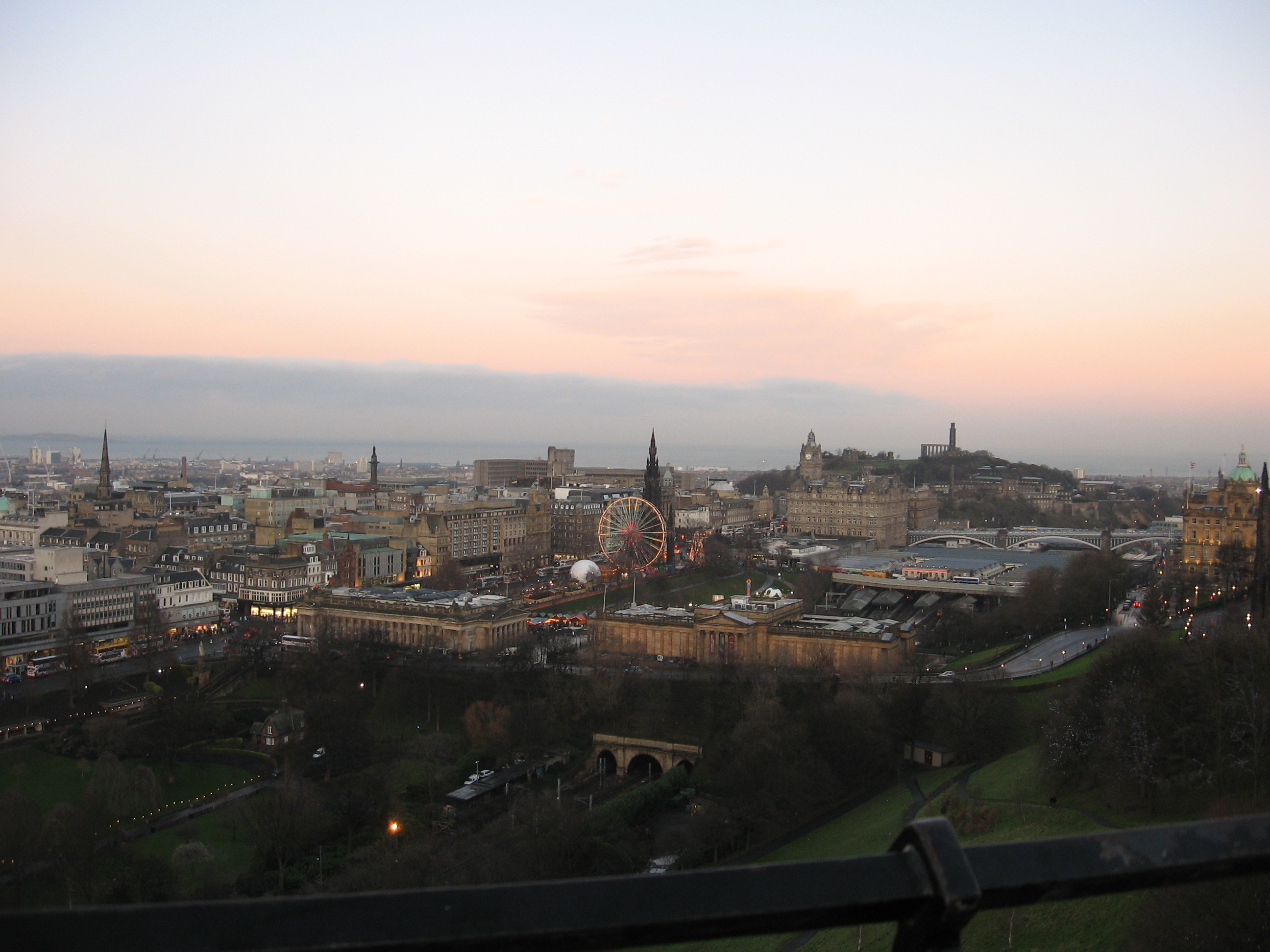
The view from Cockburn Street (if memory serves) of Princes Street. The Royal Scottish Academy and National Gallery of Scotland are in the foreground, with Waverley Train Station in the middle, and off in the distance is Calton Hill. Photo by the author.

There aren’t many films set—let alone shot—in Edinburgh, as film industries favor the more populous Glasgow for its urban Scottish stories (don’t get me started on Highland film settings). Shallow Grave (Danny Boyle, 1994) and One Day (Lone Scherfig, 2011) are notable exceptions, and they both capture Edinburgh as the beautiful, historic, lived-in city that I dreamily wandered around for days. But 16 Years of Alcohol (Richard Jobson, 2003) and Driving Lessons (Jeremy Brock, 2006) provide more specialized glimpses of the capital city that I recognize from personal experience.

The first, billed on a poster as “Trainspotting Meets A Clockwork Orange” (it’s like neither of those two), has a memorable scene set on Calton Hill, where the reformed skinhead protagonist (played by Kevin McKidd, of Trainspotting fame) seeks redemption. Standing on a hillside walkway, where I snapped the above picture, I remember feeling overjoyed at the sight of Calton Hill in the faraway distance, its unfinished early 19th century Parthenon and Nelson Monument (the tower that looks like an upside down telescope) presiding over the city. I recalled both landmark structures from my viewing of the little-seen 16 Years of Alcohol, which underscores their deeply symbolic position to quiet but melodramatic effect. The film also has many scenes set in closes, or steep streets that connect the Royal Mile to streets down below. Although I remember giddily exploring one or two of these dark passageways, I regret not taking a haunted tour of Edinburgh that used them as occasions to tell macabre stories about the city’s past.

Driving Lessons takes place mostly in England, but the wacky actress Julie Walters dupes her assistant Rupert Grint into chauffeuring her all the way to Edinburgh for a speaking engagement. Much of the Edinburgh action hews closely to the area around Princes Street, but the characters stop in at a pawn shop on the Royal Mile, not far from the chintzy souvenir shop where I purchased a Royal Standard of Scotland (you know, the golden flag with a red lion). I later found out it wasn’t the real thing (the lion on my flag didn’t have a blue tongue, probably because the unauthorized production and display of the royal family’s rampart is punishable by law). Whenever I see Driving Lessons, I’m reminded of this… fact. And until fairly recently, the flag’s inauthenticity always made me feel dejected whenever I looked up at it, hanging on the wall above my bed. So I finally replaced it with the Scottish national flag, the Saltire (or St. Andrew’s Cross), which my sister gifted me for my birthday a few weeks ago. Her message? “Let your Scottish freak flag fly!”

No film could prepare me for Edinburgh. When we first arrived, the air smelled delicious, of smoked hot dogs. Later, when my sister and I sampled different varieties of Scotch whisky at Edinburgh Castle, we realized the city’s aroma was the byproduct of numerous nearby distilleries. To this day, when I think of Edinburgh and inevitably yearn to return there (specifically to live), I can’t help but smell it. Even if the whisky burned my throat.

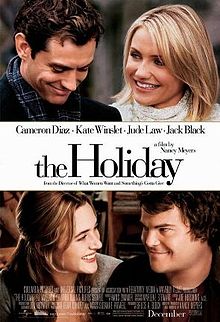
I woke up one morning in Edinburgh with a sore throat, but it wasn’t because of the whisky. I had stupidly gone to sleep with damp hair the night before. At the time, it spoiled my memory of the previous night, which came to me as an utter surprise. Not knowing how to spend the evening after dinner (my sister and I aren’t big on bars or nightclubs), I allowed her to drag me to see The Holiday (Nancy Meyers, 2006). As you might recall, she’s really into romantic comedies, and I am not. In any case, I rather enjoyed the film and its romantic sense of adventure. It made me wish I could meet a sensitive and sexy Scot while on my travels, just as Cameron Diaz’s unemotional-to-a-fault workaholic falls into bed with the mysterious cad-turned-superdad played by Jude Law. Oh well. Such romantic fantasies are just made for the screen (pun intended). After all, my real love affair was with Edinburgh, who made such a euphoric impact on all of my senses, including, most of all, my sense of self. This is going to sound really cheesy, but it’s true. Since I had romanticized the city for years, I hoped against hope that I would fall in love with the place and never want to leave. This dream did indeed come true, but I also had to make the painful realization that the days I spent in Edinburgh were not nearly sufficient enough for me to really get to know the city. Instead, Edinburgh is like a soul mate you meet all-too-briefly before you go your separate ways. No matter where I am or what I do, I can’t shake the memory of Edinburgh’s cheeky smile, traumatic and triumphant life experiences, and a self-confidence that set me at ease. I can’t wait for us to meet again.

Up next: another entry of Movie Travel Diary. But until then, tell me about your movie-related experiences in Edinburgh. Which film(s) best represents the Edinburgh you know from your own travels?

Movie Travel Diary: London

A view askew of Tower Bridge, from the southbank. Photo by the author.

It wasn’t until about a month after my mini-break weekend in Dublin, once my sister had flown in from Los Angeles to ride the rails all over Britain with me (we were on our winter holidays away from school), that I finally saw London. I’ve been an Anglophile for as long as I can remember. As such, I have always found the movies to be the perfect instrument to satisfy my intense interest in all things British. There are simply too many films set in London to name, but suffice it to say that before arriving in town (after a three-hour-long train ride from Newcastle in the Northeast), I had seen the city of my dreams represented in such classics as Alfie (Lewis Gilbert, 1966) and A Clockwork Orange (Stanley Kubrick, 1971), through to more contemporary fare, like Wonderland (Michael Winterbottom, 1999) and About a Boy (Chris & Paul Weitz, 2002). But none of these films captures the London that I experienced around Christmas in 2006.

Instead, we searched for the blue door of Hugh Grant’s travel book shop in the eponymous neighborhood of Notting Hill (Roger Michell, 1999), knowing full well the owners had repainted it to prevent passersby from peeking in. We strolled along the titular street of Brick Lane (Sarah Gavron, 2007) and wound up in a McDonald’s rather than a curry palace. We shopped for souvenirs from the open-air market stalls in Camden, which are on display in Mike Leigh’s comedy-drama Happy-Go-Lucky (2008), but the stench of pot and incense drew us away. Opting for the bus only once and using the tube to get everywhere, we did an awful lot of walking around London during our week or so in the city. And on December 25, when all of London—especially these public transportation networks—shut down, we were unable to leave our hostel to perform our yearly ritual: Chinese food and a movie.

You’ve seen this one before: the view from the Tate Modern across the Millennium Bridge. Image courtesy of http://www.wikipedia.org.

My sister and I explicitly chose not to do “touristy” things. (Don’t ask why, we were stupid and cheap and wanted to avoid crowds as much as possible.) We didn’t tour the Tower of London or see Big Ben up-close. We double-backed on hitching a ride aboard the London Eye (that’s really something I regret). No Westminster Abbey, Leicester Square, or Houses of Parliament for us, I’m afraid. We mainly kept to museums, like the British Museum and National Gallery—yes, both of which entice visitors with offers of free admission. The Tate Modern was on the top of our must-see list, and from there we strolled across the Thames on the not-so-new Millennium Bridge, toward St. Paul’s Cathedral. This part of London—Southwark, it’s called—is frequently represented in film: everything from Bridget Jones’s Diary (Sharon Maguire, 2001) to Salmon Fishing in the Yemen (Lasse Hallström, 2011) features its protagonist on this at one time eye-catching bridge, either making a resolution or having an existential epiphany. Well, nothing as lofty as that happened while I was on it.

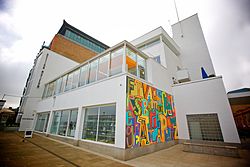
Not too far from the Tate, on the south bank, is the reconstruction of William Shakespeare’s Globe Theatre, and even farther down, just east of Tower Bridge is the Design Museum, whose exhibitions focus on 20th and 21st century design across various industries. I remember never having heard of it before my sister suggested we go there, and it turned out to be one of the highlights of our trip. I can’t remember exactly what we saw, but after days of walking around London and feeling as if we weren’t “seeing” anything, I felt warm and fuzzy, a real sense of accomplishment. Stupidly, I thought we’d visited a place so far off the beaten path that it wasn’t on most international tourists’ radar. After all, it’s not as busy as the Victoria & Albert Museum.

The Design Museum in 2010. Image courtesy of http://www.wikipedia.org.

I’ll never forget our approach to the Design Museum, trekking through a disorienting labyrinth of buildings that all looked the same and climbing a tiny incline right at the end, stepping lightly on the cobblestone street the whole time so as to avoid twisting our ankles. Aside from the Design Museum, which at the time was painted a bright white (I’d be willing to bet that it still is), all of the other buildings at Butler’s Wharf are brick warehouses with arched doorways and, according to Wikipedia, were once considered derelict. Gradually, over the past thirty years or so, the late 19th century shipping district has been home to luxury flats and a happening restaurants and arts corner. (Bridget Jones and her lascivious boss Daniel Cleaver dine here.) I should mention that we could hear the lapping of the river even if we couldn’t see it while walking along Shad Thames, the area’s main street.

Almost one and a half years later, I saw Run Fatboy Run (David Schwimmer, 2007) in the theater with my dad, and early on in the film I recognized one of its shooting locations straightaway: the Butler’s Wharf/Shad Thames warehouse district. “Pathetic excuse for a man” Dennis (the always charming Simon Pegg, who rewrote the script) has his ex-fiancee and mother of his child pick he and the boy up from the police station (he got caught buying scalped theater tickets), and she brings her new handsome, super-successful American boyfriend along with her. After putting Libby (Thandie Newton) and Jake (Matthew Fenton) in a cab, Dennis and his rival Whit (Hank Azaria) walk along Lafone Street, making awkward conversation and being generally passive-aggressive toward one another. Besides Bridget Jones’s Diary, I had never seen this part of London on-screen before (I didn’t even know what it was when I first saw that rom-com), and since “discovering” it on my way to the exemplary Design Museum, it has always felt like “my London.” Thus, despite being set in North London (but mainly shot in the East, according to The Worldwide Guide to Movie Locations), Run Fatboy Run memorably takes place in parts of the city that I most identify with.

As you may already know, Run Fatboy Run revolves around Dennis as he trains for the Nike River Run, a fictional stand-in for the London Marathon. He aims to prove to everyone—including Libby, Whit, Jake, his friend and coach (Dylan Moran), and the landlord to whom he owes a lot of back rent—but especially himself that he can commit to finishing something, after having ditched a pregnant Libby at the altar years ago (he has always loved her, though). Of course, there are many obstacles to achieving this goal; the greatest is having to hobble the long distance on a severely sprained ankle. It takes him all day and all night. Notably, the marathon route commences near the financial district in the City of London where Whit works, the Gherkin a stone’s throw away (that, we saw up-close), and finishes just outside St. Paul’s Cathedral. To get there—you guessed it—Dennis must cross the Millennium Bridge from the south side, his entourage of fans and a sports reporter cheering him on as they follow close behind. His journey reminds me of my own. Now, I cannot claim to have completed a marathon as Dennis has done in fourteen hours, but because my sister and I spent a long and tiring but wonderful day in Southwark walking from landmark to landmark, I can claim to have conquered them in my own way as a tourist. After all, the views were free.

Tomorrow: another entry of Movie Travel Diary. But while we’re waiting, tell me about your movie-related experiences in London. Which film(s) best encapsulates the London you know from your own travels?

Movie Travel Diary: Dublin

Look closely: it's the Ha'penny Bridge lit up at night. Photo by the author.
Look closely: it’s the Ha’penny Bridge lit up at night. Photo by the author.

I spent my third year of college studying abroad at Lancaster University in Northwest England. From there, one of my earliest trips was to Dublin with two of my friends. We rode the ferry from Holyhead in North Wales to Ireland’s capital city. I have very fond memories of that weekend, such as my first (half-)pint of Guinness stout, the friendliness of the people, and the sight of the Ha’penny Bridge lit up at night. And although I didn’t see it until after I came home, months after it was released in U.S. theaters, the intimate musical romance Once (John Carney, 2006) reminded me of the place I have come to think of as “my Dublin.”

I had seen countless films set in Dublin before, everything from The Commitments (Alan Parker, 1991) and The General (John Boorman, 1998) to InterMission (John Crowley, 2003) and Rory O’Shea Was Here (Damien O’Donnell, 2004). But by virtue of being about a musician who busks on Grafton Street for pocket change from tourists, Once invariably represents a Dublin that I, as a tourist, came into contact with. Many of the scenes in the film take place on that pedestrian thoroughfare, Dublin’s high street or main shopping district. This was where, after nearly two months in the British Isles, I spotted the first Starbucks, an occasion so momentous—even though I didn’t drink the stuff—that I snapped a photo of it from the cobblestone street (the major coffeehouse chain over there is Costa Coffee).

Once was produced on a shoestring budget, and it has a very improvisational quality to it. From what I understand, it wasn’t so much scripted as it was outlined, and nowhere is this on-the-fly, gritty documentary feel more pronounced than in the scenes on Grafton Street, where the unnamed guitarist (played by The Frames’ bandleader, Glen Hansard) meets the young Eastern European pianist (Markéta Irglová), before they embark on their pseudo-romance and journey toward self-discovery while they collaborate on a few original songs. From what I can remember, director John Carney and his tiny crew shot the unprofessional actors unobtrusively, allowing real passersby to walk in front of the camera. This explains why some of the protagonists’ exchanges aren’t clearly audible. When I was on Grafton Street, I remember feeling claustrophobic, trapped among seeming multitudes of people and their bulky shopping bags, as everyone walked in different directions. The busyness of the area represented on-screen in Once reminded me of my brisk walk down the street. I didn’t know where I was headed, my friend chasing after me in the crowd, but eventually I wound up at the northwest entrance to a city park, St. Stephen’s Green. Similarly, in one scene, Hansard’s character runs after Irglová’s, too, and they take the exact same route as my friend and I had done. Strange how someone else’s art imitates your life. (I should note that Lance Daly’s black-and-white 2008 film-story about a pair of runaways from abusive homes, Kisses, is also partially set in this corner of the city, rendering it even more menacing, full of real terror for children.)

When I watched Once for the first time in late 2007, I recognized straightaway a particular landscape beyond Grafton Street. Since my sojourn in the city, I have associated Dublin with rows and rows of brick townhouses that have brightly colored front doors, alternating among blue, yellow, green, and red. The movie Once merely reinforced this picture of the city for me. Although we see such dwellings throughout the film, I still can’t shake the image of the woman standing outside one of these houses—or poking her head out of her second-story window, I can’t be sure—and gazing up at the sky because she knows her songwriting partner should be in the air, on his way to London. This scene speaks volumes to me, as I would love to return to Ireland someday and spend more time in the city.

But don’t fret; I did much more than feel stifled on Grafton Street and admire the lushly painted doors on houses. Like any well-informed tourist, I frequented Temple Bar, the trendy arts district lined with restaurants and galleries, visited the National Gallery of Ireland for an exhibit on native son Francis Bacon, and stopped by Dublin Castle (which was, to my surprise, a mishmash of architectural styles) and Trinity College. I regret I was too cheap to pay the admittance fee to see the Book of Kells up-close while at the university, especially since an inventive animated movie inspired by the illuminated manuscript, The Secret of Kells (Tomm Moore and Nora Twomey, 2009), would come out of nowhere years later and earn an Oscar nomination. When I stop to think about it, I realize that much of my Dublin jaunt has movie-related anecdotes.

For one thing, the weekend I was in Dublin was the weekend that Tom Cruise and Katie Holmes (remember TomKat?) were wed in Italy. I remember seeing photos of the actress’s demented smile, as she nuzzled her cheek into Tom’s at the altar, splashed across the front pages of the tabloids while walking from the hostel to downtown Dublin.

Furthermore, I can’t think of the film Little Children (Todd Field, 2006) without being reminded of Dublin, because that is where I saw it—with one of my companions, Denise. I’ll never forget the morning—November 18th, it was—that we were walking along O’Connell Street (the Champs-Élysées of Dublin), near the “Stiffy by the River Liffey,” and came across a multiplex that advertised that it was screening the American indie picture about two suburban stay-at-home parents having a hot summer fling. Talk about making playdates.

Later that night, after dinner and during the film, I couldn’t stop thinking about how odd this movie-going experience was at the time. Here I am in Dublin, with my German friend, and we’re watching an American indie movie set in a resolutely American milieu and ennui at a giant multiplex on O’Connell Street. I bet I’m the only American sitting in this theater, I said to myself, as if mentally detached enough from the goings-on in the auditorium and up on the screen that I could see myself sitting in the back row. For all I know, the Cineworld in Dublin may have been the closest theater to where I lived (in Lancaster, England!) that was playing the film. Ever since having this “out-of-body, out-of-mind” experience while watching a movie in another country, I have sought to replicate it everywhere I go.

Stay tuned for a similar episode in a future edition of Movie Travel Diary. But in the meantime, tell me about your movie-related experiences in Dublin. Which film(s) best exemplifies the Dublin you have visited?

Jump Cut Series: Movie Travel Diary

Cinema is transportive. It takes you many places, real and imagined, and acquaints you with characters that are familiar and strange. Films, especially ones shot on-location rather than on a sound-stage, grant you glimpses of people’s everyday lives, their cultures and subcultures, their language, traditions, food, politics, religion, and aspirations—all through a complex storytelling apparatus beyond the camera and what’s in front of it (I’m referring to style choices as well as writing, framing, and editing scenes). In much the same way that reading throughout the centuries has ignited passions and spurred imaginations by providing escapes to faraway lands, movies, in little more than one hundred years, have brought worlds closer, too. As a film historian, I am interested in how place and identity are represented on-screen for audiences at home and abroad. How do these cinematic images inform what we know of others and, perhaps more crucially, of ourselves?

But as anyone will tell you, it is not enough to read books and watch movies to understand the world and your place in it. Travel, so the wisdom goes, is essential to producing a well-rounded individual, particularly someone who can emphasize with others. Although I have lived and traveled abroad and have even lived in this country’s two most populous cities, I don’t have as many stamps in my passport or frequent flyer miles to my name as I would like. And while I don’t have the money to bankroll more excursions in the near future, I can reflect on where I have been already.

So, without further ado, I’d like to present my Movie Travel Diary, a series of Jump Cuts to be published daily from August 26 through September 1, 2012 (if all goes according to plan). Each day, I will write about a film or group of films set in a city that I have spent some amount of time in (whether for a couple of days, a week or so, or even a year or two). Each film discussed presents the city in a way that I recognize from my own personal experience, since cities and films are mutable objects that are what they are because of what each of us brings to them (I’m not talking about toothbrushes and buckets of popcorn).

As always, I invite you to share your impressions of cities that you have visited, first through film and then in person. Once your feet were on the ground, how did the metropolises compare to the expectations you had going in, based your previous viewing of films set in those cities?

Movie Travel Diary entries:

Sunday, August 26th: Dublin

Monday, August 27th: London

Tuesday, August 28th: Edinburgh

Thursday, August 30th: Paris

Thursday, August 30th: Los Angeles

Friday, August 31st: New York City

Saturday, September 1st: Washington, DC

Contrary to One Man’s Opinion, Hollywood’s Not Killing Opera

I am no expert on opera. Far from it, in fact. But Zachary Woolfe’s editorial in The New York Times with the self-explanatory title, “How Hollywood Films Are Killing Opera,” caught my attention. In it, he argues that films such as Moonstruck (Norman Jewison, 1987), Pretty Woman (Garry Marshall, 1990), and even Margaret (Kenneth Lonergan, 2011) have “damaged” the art form by perpetuating an ideal experience that audiences have come to expect if and whenever they do attend an actual performance. Although Woolfe rightly recognizes that opera companies around the U.S. have struggled to stay economically viable for decades before the 2008 financial crisis, he misguidedly accuses these films of keeping opera companies from producing lesser known repertory works for the stage, with dynamic direction and innovative set and costume designs to boot. According to Woolfe, “the typical production style is blandly nostalgic escapism rather than vibrancy or relevance.”

Director Kenneth Lonergan behind the scenes of Margaret (2011). Image courtesy of http://www.nytimes.com.

Now, I have never been to the opera, so I cannot speak from personal experience on what a “typical production style” looks like. Even if I had, I wouldn’t pretend to know what a “typical” one is, either. Instead, I would defer to this expert critic, but I find many points in his argument totally unconvincing. Read on if you wish to learn How Hollywood Films Can’t Possibly Be Killing Opera.

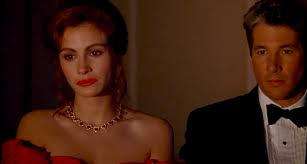
First of all, in generalizing about the state of opera today, Woolfe says that it’s all about putting on old favorites by Puccini and Verdi in order to get butts in seats, butts whose owners have come to think of a night at the opera as a special, gown-wearing event (given Julia Roberts’s wardrobe choice). The problem is, Woolfe offers no statistical data to support this claim. He provides no quantitative analysis to measure where and how often the “popular” operas are put on these days. Likewise, he offers neither the bottom lines from box office receipts nor demographic surveys of the audiences. Just who does he think is going to the opera? Only Moonstruck fans? Without the cold, hard numbers to prove that movies such as Pretty Woman have dictated opera companies’ programs and opera-going audiences’ tastes, Woolfe can hardly blame Hollywood for ruining opera.

Woolfe’s polemic appeared online August 16th, and since then The Washington Post‘s Philip Kennicott published a feature story on the wide-ranging, lesser known works that the Santa Fe Opera has selected for production to satisfy the “serious” opera-lover. Understandably, the company is world-famous and attracts big names for starring roles, and thus it probably costs a small fortune to attend one of their productions. Someone who is a season ticket-holder at Santa Fe probably doesn’t care about the scenes in Moonstruck wherein Nicolas Cage and Cher go to the opera. In any case, Kennicott’s piece serves as an in-depth corrective to Woolfe’s foolish generalization that the opera “landscape is overwhelmingly drab.” So, cheer up, Woolfe. It doesn’t look that bad.

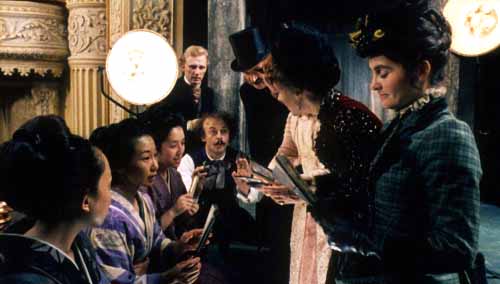
Moreover, Woolfe’s implicit definition of Hollywood is also problematic, for Margaret, which he spends the second half of his article lambasting (full disclosure: I haven’t seen it yet), is emphatically not a “Hollywood” picture. If he was going to include films produced outside the American film industrial complex anyway, Woolfe should have taken a look at Mike Leigh’s opulent costume drama Topsy-Turvy (1999), which chronicles the production of Gilbert & Sullivan’s 1885 comic opera The Mikado. If that film doesn’t give the spectator a deeper appreciation for all the minute decisions that go into making an opera—everything from searching for inspiration and blocking stage movements while dressed in unusual costumes to rehearsing difficult-to-pronounce lyrics—then I don’t know what will. Besides, all the films that Woolfe invokes are not about opera; they merely contain a scene or two depicting the protagonists attending an opera and/or feature operatic leitmotifs on the sound track. So why does he let these film scenes ruin opera for him?

The cast and crew seek the help of some Japanese actresses in rendering Gilbert & Sullivan’s comic opera The Mikado in the Mike Leigh film Topsy-Turvy. Image courtesy of http://www.brightlightsfilm.com.

Woolfe doesn’t like that the date nights at the opera featured in Moonstruck, Pretty Woman, and Margaret lead film audiences to assume that opera-going is only an occasion for dressing up to the nines, to escape the everyday. While he doesn’t find the opera performance in 1986’s Hannah and Her Sisters “exactly innovative” (it’s Puccini again), he wishes that other filmmakers would follow Woody Allen’s lead in representing opera attendance as “no big deal,” something as banal as going to the movies, say. This seems counter-intuitive to me. Clearly, opera and opera-going are very “big deal[s]” for Woolfe. Shouldn’t he be pushing for more evocative scenes in films that showcase opera in a heretofore different light? Furthermore, if good art should inspire a transcendental experience in those who encounter it, maybe even going so far as to help a person forget she’s had a bad day, then why is Woolfe decrying film’s representation of opera as “escapist”? Why does he want opera and opera-going to appear in film just as any other interest or activity does? How will that make opera an any more relevant or essential experience we should seek out?

Corporate raider Richard Gere takes his low-class prostitute to the opera, which proves to be an emotional experience for the Pretty Woman. Image courtesy of http://www.operafresh.blogspot.com

Besides, don’t tell me it’s socially acceptable to wear jeans and a t-shirt to the opera. Going to the opera isn’t like attending a baseball game or even a musical play. It’s still largely cost-prohibitive, I bet. So going to the opera is a special occasion.

I didn’t grow up in a home that waxes rhapsodic about the virtues of opera, but I can appreciate them from afar, on an intellectual level. I may not know anything about individual operas (I defer to my dad on the subject whenever the category appears on Jeopardy!), but I know enough to know that opera is not as it is portrayed in Moonstruck and Pretty Woman. So don’t be so condescending, Woolfe.

But what do you think? Is Woolfe exaggerating the effect movies have on opera today?

Jump Cut: Doppelgängers

Having seen so many movies, made note of your favorite directors, and developed crushes on certain actors and actresses, do you ever watch a movie convinced that one of the performers on-screen is—contrary to the credits you’ve just read—another actor entirely? You’re not alone. What follows is a completely subjective list of acting doppelgängers, people who, to my eyes, bear more than a passing resemblance to one of their cohorts. I call some sets “twins,” and it’s been a bit of a struggle finding photos that can accurately show you how I could ever mistake them for each other. Admittedly, though, I’m so familiar with some of these performers that it’s impossible for me to confuse them with anyone else. Most of the pairs below represent struggles I had in my childhood identifying who’s who. Please feel free to sound out in the comments section below the pairs who regularly confuse you, too. (For the record, I extracted these photos from Google Images after conducting basic searches.)

Let’s start things off with a pair of actresses whose heydays were in the 1980s. Honestly, I couldn’t have asked for better photos to bring out the physical similarities between Kathleen Turner (left) and Kelly McGillis, as she hangs on Top Gun (Tony Scott, 1986) co-star Tom Cruise. They’re both sporting off-the-shoulder tops, accentuating their wavy hair. Both stars were sex symbols in their day. Turner made her big-screen debut as a femme fatale in Body Heat (Lawrence Kasdan, 1981) and later embodied the curvaceous cartoon Jessica Rabbit with just her husky voice in Who Framed Roger Rabbit? (Robert Zemeckis, 1988). Besides Top Gun, McGillis was in Witness (Peter Weir, 1985), as Harrison Ford’s Amish love interest, and in The Accused (Jonathan Kapaln, 1988), as the attorney for Jodie Foster’s brutal rape victim, a decidedly less sexy role. I should note that I only think they look alike when they were younger, as today the women couldn’t look any more different. Presently, we don’t see either actress much, particularly McGillis since she came out of the closet in 2009. Turner, who suffers from rheumatoid arthritis, has been busy walking the floorboards, notably starring in a theatrical production of Who’s Afraid of Virginia Woolf? in 2005.

Next we have the British actor Ben Miller—not to be confused with Ben Miles of Coupling fame—and his lookalike the Welsh comic Rob Brydon (right). I first spotted Miller in Johnny English (Peter Howitt, 2003) as Rowan Atkinson’s sidekick Bough, and since he’s made a name for himself playing super-serious corporate or governmental honchos, including James Lester on the silly BBC sci-fi series Primeval (2007-2011). Rob Brydon, on the other hand, I’m much more familiar with. He starred in the 2000-2003 series Marion & Geoff as a taxi driver who records confessional monologues while stalking outside the residence his ex-wife, Marion, shares with the man she left him for, Geoff, of course. You might know Brydon as “Himself” in the Michael Winterbottom classics Tristram Shandy: A Cock and Bull Story (2005) and The Trip (2010), opposite Steve Coogan, who also plays a version of himself in those movies. It may not be easy to tell from these thumbnail photos (the only way I could publish images of all the doppelgängers), but Miller and Brydon look so much alike that when you search Google Images for pictures of either one, “Ben Miller Rob Brydon” is a suggested search term. Hell, even I needed to look multiple times to identify who’s who in this image that I found online with the actors already juxtaposed:

Ben Miller (left) and Rob Brydon, or so I believe.

Speaking of Steve Coogan, I think he looks a lot like Jack Davenport (right), from the Pirates of the Caribbean blockbusters. He played Commodore Norrington who so wanted Keira Knightley’s Elizabeth Swan but lost out to Orlando Bloom and Johnny Depp’s swashbucklers. He’s currently on the NBC backstage musical soap opera Smash (2011-present), which I’ve never seen. As a fan of Steve Coogan’s work, including I’m Alan Partridge (1997, 2002) and Saxondale (2006-2007) to name but a few, I should make it clear that I don’t actually mistake these actors for each other. Searching for comparable photos was tricky, as Coogan typically has long, wavy hair these days, and Davenport has short and spiky hair. There’s something about the way they play pompous or clueless that makes me sense a closeness. At right, Davenport appears in character as the immature Steve from the British comedy series Coupling (2000-2004), and Coogan, at left, is the arrogant TV presenter Tony Wilson in Winterbottom’s 24 Hour Party People (2002), which is my favorite film.

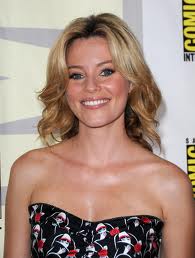
My sister is going to shake her head when she reads this: I continually mistake two actresses who are on the rise, Rachel McAdams (left) and Elizabeth Banks. My sister thinks I’m crazy, but hear me out. It has to do with their toothy grins, broad jawlines, and wide foreheads. It doesn’t help any that they regularly appear as blondes (I believe they’re both natural brunettes) and balance their filmographies with pretty much equal helpings of comedy and drama these days. In other words, when I watch a film that stars either one of them, I imagine that the other may have also been on the casting director’s list of actresses for the same role. For example, despite writer-director Woody Allen’s more pointed search for actors to fill parts in his almost yearly produced movies, I can see Elizabeth Banks as Inez, Owen Wilson’s shrill and obnoxious fiancee in Midnight in Paris (2011), a role that McAdams played. Similarly, isn’t it possible to see McAdams in Man on a Ledge (Asger Leth, 2012) or People Like Us (Alex Kurtzman, 2012) instead of Banks? Or is my sister right; am I crazy?

Let’s move Down Under and take a look at Noah Taylor (left) and Ben Mendelsohn. These Aussie actors are hardly ever up for the same parts nowadays, their physiognomies seemingly worlds apart. Mendelsohn makes for a much more imposing presence now, having played baddies in the superb 2010 Australian crime family drama Animal Kingdom (David Michôd) and the straight-to-DVD Nicolas Cage-Nicole Kidman starrer Trespass (Joel Shumacher, 2011), whereas Taylor looks like he’s withering away nowadays, as evidenced in Tim Burton’s Charlie and the Chocolate Factory (2005) and Richard Ayoade’s fun directorial debut Submarine (2010), movies in which he played each of the teen protagonists’ withdrawn dad. When I was younger, I used to mistake them for each other all the time (it’s in their mouths and speech!), but now they probably couldn’t be any more different. By the way, to add to the confusion, they have both appeared in the same films, including The Year My Voice Broke (John Duigan, 1987) and The New World (Terrence Malick, 2005).

In much the same way that time has made Noah Taylor and Ben Mendelsohn look less and less alike, so too has it placed the doppelgängers Henry Thomas and Jeremy Davies on opposite ends of the spectrum. I guess what I’m trying to say is that today, the skinny child-star Thomas (left) has put on weight, particularly in his face, while Davies seems only to have gotten thinner and thinner. But look at them in these old photos; don’t they at least look like brothers? At least grant me that Thomas looks more like Davies than he does Brad Pitt or Aidan Quinn, who both played his older siblings in the classic melodrama Legends of the Fall (Edward Zwick, 1994). We haven’t seen much of Thomas lately, but Davies plays the sniveling snake Dickie Bennett on FX’s Justified (2010-present), a show whose just-aired third season I tried several times to watch but just couldn’t get into. I think these guys resemble each other because they have the same face shapes and they have been in films where they weren’t, shall we say, the manliest of men. See how soft-spoken Thomas is in I Capture the Castle (Tim Fywell, 2003) and Davies is in CQ (Roman Coppola, 2001).

The next pairing arrives courtesy of my dad, who hit the nail on the head when he said that the English actresses Gabrielle Anwar (left) and Emily Blunt look an awful lot alike. It’s impossible to mistake them, really, as there are more than thirteen years between them, but the similarities in their features are striking. It all hinges on their mouths, though Anwar may have a greater overbite than Blunt (sorry, there’s no nicer way of putting it!). If you do a Google image search for each woman, you will see how they both prefer to pout when posing on the red carpet, and neither likes to give big, toothy smiles (yes, these stills are something of a rarity on Google). Anwar had a bigger film career in the 1990s, appearing in such hits as Scent of a Woman (Martin Brest, 1992) and The Three Musketeers (Stephen Herek, 1993), which was beloved in my childhood. She has since re-found fame on the USA TV series Burn Notice (2007-present). Blunt, on the other hand, has been on the ascendant since her breakout role in The Devil Wears Prada (David Frankel, 2006).

A few nights ago, I caught, again, Dutch writer-director Marleen Gorris’s Oscar-winning Antonia, better known in English as Antonia’s Line (1995). Watching Jan Decleir, the famous Dutch actor (left), I couldn’t believe how much he looks like the beloved English actor Jim Carter, probably best known as Mr. Carson, the butler of Downton Abbey (2010-present), ITV and PBS’s pop culture phenomenon about the fading British aristocracy at the beginning of the 20th century. But oh, how do I love Jim Carter! He’s in everything: Shakespeare in Love (John Madden, 1998); Cranford (2007, 2009), which is one of my favorite British miniseries; and Bright Young Things (Stephen Fry, 2003), where he makes a hilarious cameo. I haven’t seen even the smallest percentage of Decleir’s many credits, but I remember him especially from Character (Mike van Diem, 1997), which also took home the Academy Award for Best Foreign Language Film (for the Netherlands). The actors are roughly the same age (Decleir is two years older); isn’t their resemblance uncanny?!

So far, all of these acting doppelgängers have been contemporaries. They have all lived in the same era (our current time). But now I want to offer a different kind of comparison. Turner Classic Movies has featured Englishman Leslie Howard in marathons of his movies every Tuesday night this month. Although his credits span from the 1910s up to 1942 (his last movie was the Howard-directed R.J. Mitchell biopic The First of the Few aka Spitfire, which premiered in the U.S. less than two weeks after he died, his plane shot down by Germans), I see a lot of the actor Michael Fassbender in him. Catching the hilarious comedy Stand-In (Tay Garnett, 1937) on TCM, I was struck by how Howard’s uptight New York-based banker, out of his element as the head of a struggling movie studio in Hollywood, reminded me of Fassbender’s suave British Lieutenant Archie Hicox in Inglourious Basterds (Quentin Tarantino, 2009). They’re very different characters, but the way they carry themselves seemed very similar to me. And the more I studied Howard, who I might add, is probably most recognizable as Ashley in Gone with the Wind (Victor Fleming, et. al, 1939), the more I could discern Fassbender’s affinities to him: they both have very long, narrow visages with tall foreheads; extra slim, long, and narrow torsos; and when Fassbender plays posh Englishmen (or androids), as in Basterds or Prometheus (Ridley Scott, 2012), he sounds a lot like Howard, who also directed and starred in Pygmalion (1938) as the condescending Professor Henry Higgins. My DVR is virtually full of Howard movies; I’m as drawn to him as I am to the magnetic Fassbender.

Since I’m in an historical mood, I thought I would point out that I have actually confused the younger versions of Karen Allen (left) and Brooke Adams. Allen is probably most known for playing Marion Ravenwood in Raiders of the Lost Ark (Steven Spielberg, 1981), a role she later reprised in Indiana Jones and the Kingdom of the Crystal Skull (Spielberg, 2008), and Jeff Bridges’s alarmed wife in Starman (John Carpenter, 1984). Adams is two years older and has more credits from the 1970s, including her starring role in Terrence Malick’s debut Days of Heaven (1978). I could never remember that it was Adams in Heaven and not Allen, Allen in Starman and not Adams. Both actresses have widely spaced eyes, wide faces with high cheekbones, and dimples in their chins. Not to mention, they both have pretty low voices. They don’t look so alike these days, and they haven’t been productive in recent years.

This last pair of celebrity lookalikes aren’t actors. Well, one is: Robert Carlyle (left), the prolific Scottish thesp best known for his stunning turn as Begbie in Trainspotting (Danny Boyle, 1996), which is incidentally one of my favorite films of all time. His doppelgänger? Hockey great Wayne Gretzky! From 1979 to 1999, he played with one of the four following teams: the Edmonton Oilers, LA Kings, St. Louis Blues, and NY Rangers. If you cannot see the resemblance, I don’t know what to say. But a little back-story is in order. I really should credit my dad with this comparison because he refers to Carlyle, jokingly, as “Wayne Gretzky.” He learned of Carlyle when the actor starred in the 1997 British sleeper hit The Full Monty (Peter Cattaneo), where he wore his hair blond, thereby more closely resembling a young Gretzky. So whenever he catches a glimpse of him today, usually on my TV screen, he’ll ask, “Who’s in this? Oh, Wayne Gretzky!” even though Carlyle, to my knowledge, hasn’t been blond since. You can currently check him out on ABC’s Once Upon a Time (2011-present), where he looks like the ghost of his former self. Whereas Carlyle has turned hauntingly thin, Gretzky, who’s less than four months older, has filled out more in middle age.

Long Take: Dreaming of Joseph Lees Has Many Pleasures

Viewed July 9, 2012

Thank goodness for friends who have access to an HBO Go account. Without such a person I wouldn’t have been able to see the very hard-to-find Dreaming of Joseph Lees (Eric Styles, 1999). I had once seen a teeny bit of the film many years ago when it aired on a cable channel in the middle of the night. Since then, I have never forgotten about it. So when my sister announced its temporary availability (through July 15) on the subscriber-only online streaming service, I jumped at the chance. Boy, am I glad that I did! Given its scarcity on the DVD (and even VHS) market, I kind of regret that I must spoil the film’s story in my analysis, but I hope that my enthusiasm for its representation of female desire and pleasure will convince you to put it on the top of your must-see list, if it’s not already there. (Amazon.com allows you to rent or buy a digital copy.)

A British production shot on the Isle of Man and distributed in the U.S. by Fox Searchlight Pictures in 1999, Dreaming of Joseph Lees is actually all about desire: the act and emotional and mental states of wanting as well as the wish to be wanted right back. Samantha Morton, in one of her early film roles, plays Eva, a young woman living in rural Somerset, England, in 1958 with her aloof father (Frank Finlay) and much-younger siblings Janie (Lauren Richardson) and Robert (Felix Billson). As her voice-over narration states from the get-go, she has been in love with her second cousin, the geologist Joseph Lees (Rupert Graves), since she was fourteen years old. Presumably, WWII and the subsequent reconstruction of displaced or otherwise ravaged lives have a lot to do with separating them. However, thirteen years out, the war is never so much implied. Instead, Joseph loses one of his legs in a marble quarry accident while doing research in Italy, a tragic event that delays his return home and his re-entrance into distant family affairs. Having given up the hope of ever reuniting with her childhood crush, Eva allows local pig farmer Harry (Lee Ross) to aggressively pursue her. Defying the expectations of her family, she even moves in with her possessive paramour. And that’s when Joseph re-emerges, to shake up her life.

The story is divided into two sections, pre- and post-Joseph’s reappearance. The first chronicles Eva’s day-to-day existence, working as a clerk in a sawmill, looking after her family, attending a life-drawing class some evenings, and even helping Harry’s adult sister, Maria (Holly Aird), learn to read and write. Anytime someone at home mentions Joseph, his injury, or his whereabouts, Eva is overcome with emotion. Morton uses her characteristically expressive face to relate Eva’s all-consuming infatuation, her eyes looking as if they’re on the verge of tears at just the mention of his name. Father doesn’t quite understand her fascination with a distant cousin whose name he can barely remember, but Janie knows all about Eva’s private longing. In fact, demonstrating the pleasures of sharing a secret with someone close is part and parcel of the film’s overall representation of female desire. Not to mention its affecting portrait of the intimate friendship between sisters.

During the first (approximate) half, Eva explores her passionate yet pent-up sexuality in the absence of her beloved. Eva accompanies Maria, who encourages her lovesick brother to seduce her friend, to the boxing gym where Harry and Maria’s own crush train. In a reversal of the male gaze, so dominant in mainstream narrative cinema, the women peek through the window to ogle the male nude bodies in repose following arduous physical exercises. Although eventually caught, Eva feels no shame. If anything, glimpsing the affable and unpretentious Harry in this space may comfort her in her subsequent decision to date him. After all, he had previously tried wooing her outside the sawmill by suggesting he “take [her] to heaven and back,” a proposition she first rejected because she not only views his euphemism for sex as immature, but she also would rather take Joseph as her first lover.

However, Harry and Eva’s first official date to watch a boxing match foreshadows their incompatibility. At the sporting event, Eva, goaded on by Maria, attempts to get close to the action, to be nearer the “blood and gore.” I have interpreted this to mean that she is interested in the male form in masculine settings, but the violence of the sparring and the encroaching crowd prove too much for her. Harry may come to her rescue, but not much can be helped. The fact that Harry’s nose bleeds whenever he’s nervous around Eva, spontaneously echoing the brutality of the fight, suggests that their burgeoning romance is unstable and unsustainable.

Despite this, their relationship intensifies. Later, she reflects that, even though she moved to his nearby farm and entered into a fully sexual relationship with Harry, she knew that she would never marry him. For the film spectator, this probably constitutes the most confusing decision Eva makes; why move in with him, in 1958, if you never wanted to marry him? It’s equally surprising that her father, who initially protested, allows her “to follow [her] heart,” perhaps believing that their cohabitation would later lead to marriage. However, it is clear that, at the beginning of their new living arrangements, Eva feels a sense of freedom, unbound by social restrictions and familial commitments. This release is no better expressed than through Harry’s masturbating Eva on the bed, under the frill of her skirt. This is the first of a few sex scenes in which Eva’s pleasure is highlighted—almost to the exclusion of her individual partners’.

Soon, things are far from tranquil on the farm. Harry’s possessiveness and emotional instability are too much for Eva to handle, but whenever he threatens violence against her or himself, she feels she cannot abandon him. (Late in the film, he kills his three dogs when, out of frustration, she pleads for him to get rid of them, meaning to shoo them out of the house. His misinterpretation of her feelings convinces her to leave, but she stays because he threatens suicide.) Thankfully, Janie arrives with good news that changes Eva’s life: the whole family’s been invited to a cousin’s wedding where she is sure to bump into Joseph, finally. The sisters embrace, Eva kissing Janie’s forehead in a tacit acknowledgment of their shared secret.

Although the audience has glimpsed Joseph before in scenes establishing his rehabilitation in Italy as well as through Eva’s memories of him, the wedding presents the first instance he appears contemporaneously. Sitting in the church pews, Eva looks over her shoulder as he enters the building, and at the wedding reception, she and Janie watch him from across the room, the camera assuming their perspective. Inter-cut with shots of Joseph are shots of Eva fidgeting with her earring, looking longingly and deep in thought. Janie is so desperate to see her older sister end up with Joseph that she rejects a man’s dance invitation to Eva and nudges her to go over to Joseph. If not now, when? is the thinking. You might expect a clumsy exchange, with Eva making an ass of herself. But that’s not the case. She skips greetings, and at first Joseph turns down her request to dance, citing his physical disability, but when she persists, he agrees. A tinkling lullaby-like score replaces the up-tempo song that the live band plays as they slow-dance on the floor with other couples bouncing around them. It is as if they are of another time and place, but the audience is made privy to their instant (re)connection. The melodramatic change on the sound track emphasizes the granting of Eva’s—and by extension, our—wish fulfillment.

In the next scene, my fear that Joseph would not remember Eva proves unfounded; they strike up an easy rapport, reminiscing about the past, and they both resent Eva’s father for tearing her away, as the party wears down. Their attraction extends beyond the event, with Janie mailing a postcard inviting him to the family home and his sending Eva coffee-table books on Italian art that she later pours over, as if looking for Joseph within their pages. Of course, Harry becomes jealous, throwing her book in the mud. He makes amends the next morning by cleaning and returning the book to its proper owner, but not without attaching a guilt-inducing line about how he would die if she didn’t love him.

Thus, even after we have met Joseph, he remains at a distance. An unnamed film reviewer in The Hollywood Reporter is frustrated that Joseph “remains an enigma” throughout the film. The supposed underdevelopment of his character is beside the point because we know Joseph as Eva’s Obscure Object of Desire. The pleasure of seeing him on-screen is bound up in the realization that Eva’s fantasy is finally made real and he is made flesh. For example, in the sex scenes between Eva and Joseph (which take place after she temporarily leaves Harry and surprises Joseph on his doorstep), Eva never appears naked on-screen, but Joseph’s skin is regularly exposed. The camera objectifies his body as Eva caresses it with kisses, particularly when, in bed with her straddling his torso, Joseph tells Eva the harrowing story of how he lost his leg. His vulnerability turns her on. So, although the short scene following the wedding party demonstrates his own sentimental attachment to his distant cousin (he rummages through photo albums and scrapbooks), it may not even be required. For it is enough that Joseph exists to reciprocate her feelings and want her as much as she wants him. Then again, I may be biased: I have enjoyed watching the actor Rupert Graves perform on-screen ever since 1996’s Different for Girls (Richard Spence), and I find him very attractive.

The thorn in their side, though, is Harry, who becomes increasingly more manipulative. His dangerous behavior lures a concerned Eva back home, a measure that Joseph understands and supports. To cut a long story short, Harry, who, I might add, had cheated on Eva before she ever left, disappears and worries his sister. Using Eva’s guilt over having wanted someone else, Harry traps her into staying with him because he breaks into the sawmill where she works and cuts off his left leg below the knee. Superficially, his act of mutilation suggests that he believes Eva will only love him if he is (anatomically) more like Joseph, but it more accurately recalls the disorder of his bleeding nose.

One might argue that the film isn’t feminist (enough) because Eva suffers for having desires and for seeking out their attendant pleasures, consigned to the position of Harry’s caregiver. I would argue, however, that it is feminist because the whole film is an exercise in fantasy-building. In other words, following feminist film theorist Elizabeth Cowie’s influential reasoning in “Fantasia,” the ending is satisfying for the (female) spectator of this romantic melodrama because identifying with and watching Eva’s desire unfold may actually be more pleasurable than the desire itself. It does not matter whether or not Eva and Joseph live happily ever after. The fact that she even had a desire (which Joseph reciprocated) is enough is please or “makes it all worthwhile.” Better to have loved and suffered than never to have loved at all.

But who is to say that our hope-against-hope lovers won’t end up together after all? The film closes with Joseph paying a surprise visit at the farm, which obviously stirs up a whirlwind of emotions in Eva. She still wants Joseph; he knows this. He has come to take her away, but she refuses to budge for the sake of Harry’s well-being. Her sacrificing their happiness wounds both lovers. And when Joseph loiters outside the house after their exchange, Eva, sensing his presence but assuring Harry she’s not leaving, steps outside. The camera lingers on their hearty embrace, which suggests that they are trying to savor each other’s presence, fearing a long-term and potentially permanent separation. (He’s going to Italy again for work.) Janie steps out of the house, smiling as she looks on. It is in this moment that her role as a stand-in for the film viewer comes full-circle. Throughout the film, we the audience have lived somewhat vicariously through Eva’s dreaming of Joseph Lees, which Janie has played an instrumental part in shaping.

Despite Janie’s approving smile, I still think the filmmakers leave their future open-ended. Maybe that’s just me. After all, I prefer romantic dramas to romantic comedies because I like being reminded that loving someone is, for lack of a better word, hard. Emotionally draining. Conflicting. Perhaps even dangerous. My sister, a rom-com connoisseur, thinks the hug between Eva and Joseph at the end means they do wind up together. I just don’t think it’s that easy. Besides, believing that their longing for each other will persist in perpetuity may actually be more pleasurable than seeing or imagining them, say, cutting into a wedding cake.