To Each Her Own Cinephilia; Or How I Failed to Connect to Silver Screen Fiend

Cover Image of Silver Screen FiendI finished reading Patton Oswalt’s second memoir, Silver Screen Fiend, days ago but I’ve been struggling to find something to say about it ever since. That’s when it hit me: my not having much to say is indicative of how I feel about this book. It’s neither good nor bad. It’s mostly just underwhelming. As a film fanatic myself, I was very excited to read the newly released Fiend, whose subtitle is Learning About Life from an Addiction to Film. I thought it would offer me insights into how I might balance my career ambitions (whatever those are) with my chronic hunger to watch and analyze films and TV shows. Instead, Oswalt leaves it until the last chapter to bestow wisdom on this topic: “Movies—the truly great ones (and sometimes the truly bad)—should be a drop in the overall fuel formula for your life. A fuel that should include sex and love and food and movement and friendships and your own work. All of it, feeding the engine. But the engine of your life should be your life” (161, emphasis in original). I already knew all that. Thanks, Patton. What’s worse, he comes to the realization that the Movies have taken over his life only once The Phantom Menace profoundly disappoints him, and you know how I feel about Star Wars and George Lucas. At least I have never seen a film so terrible that it shook the very foundation upon which my cinephilia is built: I will never stop consuming films, because I want to better understand what effects they have on our lives, on our cultures.

Silver Screen Fiend briefly recounts the four years between 1995 and 1999 when he obsessively attended film screenings at the New Beverly Cinema and other repertory theaters playing classic films, in the hopes that feeding his addiction as much as possible would make him a (great) film director someday. At the same time, he also became a member of the alternative comedy scene in Los Angeles, and he wrote for MADtv for a short spell before the producers finally realized that his lackluster skits just weren’t cutting it. I’m not being harsh. Here is Oswalt himself on the subject of his being fired: “It also didn’t help that my writing at the time was so fashionably half-assed. I hadn’t even developed my distaste for typos, which made all the sketches I turned in look like I’d written them while being chased by Turkish assassins on a drifting steamboat” (133-4). There are amusing if not exactly laugh-out-loud funny scenes sprinkled throughout, such as his experience shooting Down Periscope (his debut film role, which also earned him a SAG card) and the legal trouble he and his friends faced when they tried to stage a table reading of Jerry Lewis’s controversial, never-publicly-shown Holocaust drama The Day the Clown Cried. What they wound up performing turned out to be a creative collaborative success: a series of sketches about their not being able to perform the screenplay itself due to a producer’s issuance of a cease-and-desist letter.

Although I could relate to his experience as a cinephile—and in particular, a desire to see films in the theater as part of an audience—I couldn’t connect with him in the way that I wanted to (that is, to learn about life through an addiction to film). The book itself starts in an off-putting way: he writes as if he is in conversation with the reader, who is either a friend or an acquaintance, outside the New Beverly, someone he “bulldoze[s] right over… and keep[s] gabbing” away about Billy Wilder’s Sunset Boulevard and Ace in the Hole. I get it; his mind runs sixty miles an hour when you get him started on a film about which he feels really passionate. The problem is that throughout most of the book, he mainly just mentions film titles, ones that appear in the handwritten and poorly duplicated calendar that begins most chapters. Occasionally, he reminds the reader that he uses five film encyclopedias to keep track of what classics he should see, and he marks each entry with a note in the margin describing how and when he saw a particular film. An appendix at the back of the book lists all of the films he saw between May 20, 1995 and May 20, 1999. It’s 33 pages long and quite impressive, but ultimately not very useful. What am I supposed to get out of it? In addition to a decades-old film stub collection, I’ve kept a film journal for almost ten years as well as an alphabetical index of its contents. I can’t imagine that anyone else would ever want to look at such a document or the information it contains. (I started journaling and indexing as a way to keep tabs on what I’ve not only seen but written about as well.) So scanning the wide assortment of titles listed in his appendix, all I could think was, for example, “Ooh! I wonder what he thought of Trainspotting.”

Actor, stand up comic, and author Patton Oswalt.

Oswalt’s film addiction and comedy scene shenanigans are probably given equal “screen time” in the slim volume, but his stories about the latter were more exuberant, filled with more personalities. I think I know why this is, and it’s not because he’s a lazy writer. (If anything, he may be too energetic, especially when it comes to philosophizing about Vincent van Gogh’s creative genius, from which Oswalt draws great and sometimes confusing inspiration.) It is because, as he implies throughout, it is sometimes difficult for a rabid film fanatic to translate her enthusiasm for a film in a way that someone not as interested in it will understand and appreciate. In the chapter “You Can, Unfortunately, Go Home Again,” he writes about meeting a high school friend for a movie while they were both home for Thanksgiving in 1996. Sitting down to the Bruce Willis western Last Man Standing, he geeks out about how the “movie is based on [Dashiell Hammett’s] Red Harvest, but it got there by way of [A] Fistful of Dollars and Yojimbo” (120). This fun fact lodges itself in his companion’s brain so deeply that Oswalt ruins the experience of watching Last Man Standing for the man, because he thinks he’s seen a version of a samurai film. Although I don’t condone binge drinking, this may be the best description Oswalt offers to illuminate the divide between people like us and people like his friend:

Movies, to him [meaning his old high school buddy] and the majority of the planet, are an enhancement to a life. The way a glass of wine complements a dinner. I’m the other way around. I’m the kind of person who eats a few bites of food so that my stomach can handle the full bottle of wine I’m about to drink. (122)

Owing to my gigantic sweet tooth, allow me to paraphrase this treatise using a dessert analogy instead. Some people I know don’t eat dessert or only do so on rare occasions, whereas I always eat dinner in order to have dessert. Since I’m in a confessional mood, I will also admit that sometimes I forgo dinner altogether and dash straight to dessert.

Early on in Silver Screen Fiend, Oswalt defines the film subculture he belongs to as one consisting of “sprocket fiends,” those who dwell in the “subterranean dimension” of repertory theaters, who travel through space and time at the will of a director and his/her vision (7-8). I learned on my first or second day in the Cinema Studies department at NYU that the rest of the Tisch School of the Arts referred to us as moles, because once we burrowed in the ground we were content to stay in the dark. Like Oswalt, I love the sound of celluloid passing through a projector. It makes me feel alive. That’s why the “First Epilogue,” written as a tribute to the owner and manager of the New Beverly Cinema, Sherman Torgan (to whom the book is also dedicated), is the best part. In it, Oswalt shows off his classic film knowledge in a highly imaginative and dexterous manner: he curates a 30-day festival of films that were never made but will hopefully entertain Sherman in the great beyond. If only Hal Ashby could have wrangled John Belushi and Richard Pryor for an adaptation of John Kennedy Toole’s A Confederacy of Dunces. I especially love the quick mention that a young Frances McDormand, one of my favorites, costars as Myrna Minkoff and is, in a word, “Sublime” (172).

Long Take: Hector and the Search for Happiness Finds Nothing to Be Happy About

Viewed March 5, 2015

Movie poster for Hector and the Search for HappinessHector and the Search for Happiness (2014) came and went late last summer in limited release, but I don’t recall it ever coming to a theater near me. Which is just as well, because it is horrible. Ostensibly a comedy, the biggest laugh that the film story elicits occurs when a French woman struggles to pronounce the word “happiness.” The titular character, though embodied by Simon Pegg (one of my favorites), and all those who surround him are so criminally underdeveloped that it is difficult to care much about anyone in the film except in a more theoretical way that the filmmakers don’t support. What’s worse, the representation of the bored British psychiatrist’s journey around the world to find out what makes people happy paints multiple far-flung cultures in broad, caricatured brushstrokes. There is virtually no cultural specificity in any of the places that he visits, and when director and co-writer Peter Chelsom and crew attempt to add critical dissections of serious impediments to people’s general health and well-being in these places, these issues are wiped under the rug, never to be disturbed again. In case you are new to Hector and the Search for Happiness, be warned that I am going to spoil it now. And while you’re at it, take a peek at the film’s trailer to see how much potential the filmmakers wasted.

I have not read the original source novel by French psychiatrist François Lelord, but apparently its raison d’être is to educate a general readership about the psychology of happiness and to offer tips on finding it in everyday life. This explains why, after almost every interaction with someone throughout his international adventure, Hector jots down in his journal maxims such as “Happiness is knowing you’re alive” and “Happiness is not always knowing the full story.” These words are scrawled across the screen in order to keep a running tally of all the lessons learned, as if the film is a PowerPoint lecture. Hector also fills the pages of his notebook, which sexy and domineering girlfriend Clara (Rosamund Pike) gifted him upon his departure, with cutesy doodles of what his childish imagination encounters abroad. The main lesson he must learn is that losing Clara, even though she smothers him with a routine (always the same breakfast; she clips his toenails and packs his bag), would make him really unhappy. That’s right: he goes on this purportedly life-changing adventure only to realize that he likes his life just as it is. Although the couple’s Skype conversations widen the chasm between them more and more throughout, as the film drags on, there is never any doubt as to the fate of their relationship.

And this is why Hector’s first stop in “China” is so perplexing. He never gives any reason as to why he starts there (and isn’t it the tiny kingdom of Bhutan that is regularly cited as the happiest place on earth?) or what he is going to do once he arrives. But Hector doesn’t need a plan when he has filthy rich businessman Stellan Skarsgård to act as his guide in an unnamed Shanghai. It truly boggles the mind as to why Skarsgård’s Edward, so annoyed by Hector on the plane ride over from London, would take the ridiculous man under his wing and show him a good time. For, unbeknownst to Hector, Edward has secured the services of a prostitute named Ying Li (Ming Zhao) to keep Hector company in the nightclub and beyond. Although Clara gave Hector permission to fool around while on his trip, he winds up falling asleep before Ying Li can even get into the bed. At lunch the next day, believing he’s falling in love, Hector discovers the truth when her pimp whisks her away. Hector tries to do the honorable thing and stand up to him, but, despite calling her john “nice,” Ying Li hits Hector on the head and rides away. She doesn’t want his help. So in one fell swoop, Hector goes from ruminating that perhaps happiness is being in love with two women at the same time to realizing that he’s happier not knowing Ying Li’s full story. I never expected the film to engage the topics of prostitution and sexual tourism in Shanghai, but since the filmmakers did, I find it morally reprehensible that Hector, a psychiatrist, would find it so easy to disengage. It’s not as if Ying Li was happy to see her pimp, to return to her life as a sexually exploited woman. She seemed confused as to how she felt about Hector, as if wondering whether or not he could provide an escape. I wouldn’t have wanted to see a film about a white male tourist “saving” a Chinese prostitute. Nevertheless, I didn’t like how the experience of falling for a woman, no matter her profession, had exactly no consequences on Hector’s outlook other than admitting he rather just be ignorant of the circumstances of her life.

Hector and Ying Li get up close and personal. Photo courtesy of Relativity Media.
Hector (Simon Pegg) and Ying Li (Ming Zhao) get up close and personal. Image courtesy of Relativity Media.

But it only gets worse. From Shanghai, Hector treks through the Himalayas to a remote Buddhist monastery. No one mentions the place by name, but it is easy to assume that he has entered Tibet, to seek the advice of Togo Igawa’s Old Monk (the filmmakers couldn’t even give him a name), who mainly just speaks in rhetorical loop-de-loops to help Hector arrive at the lesson that always avoiding things that make you unhappy is no surefire way to attain long-lasting happiness. He spends all of five minutes there, without ever contemplating how the Chinese government’s suppression of Tibetan statehood might affect the happiness of the people living and working there.

Then he moves on to “Africa.” I found this section the most offensive, beginning with the filmmakers’ failure to name a more specific region or country. Perhaps they left the place intentionally unidentified so as to not incur the wrath of people and governments of a particular place or area. But this lack of cultural specificity effectually purports that Hector’s “Africa” stands in for a whole continent, dominated by warlords foreign-born and native alike, backward villagers who travel with their chickens on prop planes, and “Western” organizations that provide humanitarian aid. In fact, Hector spends two weeks helping his medical school friend Michael (Barry Atsma) at the clinic he runs with his African boyfriend. Embarrassingly, it takes him a full two weeks to recognize that Michael and Marcel (Anthony Oseyemi) are romantically involved, coming to the delightful conclusion that “Happiness is when you are loved for who you are.” Unfortunately, just as Michael’s work is merely the conduit through which Hector can explore “Africa,” the former’s sexual relationship with Marcel exists purely as a way for Hector to learn this widely shared belief. Hector doesn’t seem to care about the challenges that the mixed-race, homosexual couple—his friends—must face in this setting. And nor do the filmmakers.

You wouldn't know it from this photo, but Michael, Hector, and Marcel are cruising in a war-torn
You wouldn’t know it from this photo, but Michael (Barry Atsma), Hector (Pegg), and Marcel (Anthony Oseyemi) are cruising in a war-torn “Africa.” Image courtesy of Relativity Media.

Hector continuously acts the fool, and he even comes to the aid of a local warlord named Diego Baresco (Jean Reno). Despite warnings from Michael and Marcel about warlords in the area, Hector proves his goodness to Baresco, who suspects him of working for an international peace-keeping outfit that swoops in only to leave before seeing their work through. Hector reviews the prescriptions that Baresco’s beloved wife takes and makes revisions to her regime, thereby instilling some peace of mind in Baresco. They get drunk together, and on his ride back to the clinic, Hector fails to recognize that his taxi cab has been hijacked by two armed rebels, because all black men look the same to him. He’s soon taken hostage, destined to rot in a cell with one rat as his friend. It’s unclear as to how long he is held captive, and of course we have no idea what the rebels seek to accomplish with their violent acts. We’re just supposed to accept this, because isn’t that what happens in Africa? According to this film, white European and American tourists go missing all the time and are swept into guerrilla warfare. Hector uses Baresco’s pen to negotiate his release, for his captors fear retribution from Hector’s powerful “friend.” They abandon Hector on a country road, and “Happiness is knowing you’re alive” is emblazoned on the screen. Yes, absolutely, but did we need such an extreme scenario to demonstrate this? Especially since nothing becomes of it? Hector doesn’t suffer any post-traumatic stress, and we never witness Michael’s or Marcel’s worry over Hector’s abduction. Before moving on to Los Angeles to meet his former med school flame Agnes (Toni Collette), Hector experiences the gloriousness of sweet potato stew, which a baby-swaddling woman on the prop plane promised to prepare for him once they landed safely in “Africa.” It’s supposed to be physically and emotionally fulfilling, but we viewers never see it. The filmmakers can’t even commit to showing us a traditional “African” dish.

Having survived being held hostage by an indistinguishable
Having survived being held hostage by an indistinguishable “African” rebel group, Hector celebrates by cooking sweet potato stew with local women. Image courtesy of Relativity Media.

In Los Angeles, Hector takes part in Professor Coreman’s (Christopher Plummer) neuroscience study to map emotions such as happiness, sadness, and fear across different parts of the brain. After breaking up with Clara over the phone because his traveling to Los Angeles has finally signaled for the couple that Hector still longs for Agnes, Hector exhibits all three emotions in the scanner, lighting up Coreman’s screen with a rainbow of colors that the professor has assigned to each emotional state. Is this the payoff we’re supposed to receive from Hector and the Search for Happiness? What makes Hector special is his ability to feel happiness, sadness, and fear at the same time when recalling a wide range of events in his life? Having been rebuffed by Agnes, a happily married psychologist with a third child on the way, Hector determines that he must get back to London to be with Clara. As I said before, they live happily ever after. He’s more emotionally available and compassionate towards his patients, and Clara finally realizes that, yes, she wants to have a baby with Hector.

What and whom they always wanted. Clara (Rosamund Pike) and Hector finally tie the knot. Image courtesy of relativity Media.
What and whom they always wanted. Clara (Rosamund Pike) and Hector finally tie the knot. Image courtesy of Relativity Media and MovieStillsDB.com.

The one bright spot in this mess is the chemistry between Simon Pegg and Rosamund Pike. Although their relationship isn’t exactly desirable (she takes great pride in clipping his toe nails!), they have an appealing, silly rapport in scenes where they interact in person. In fact, most of their exchanges occur over video conferencing calls. Notably, Hector and the Search for Happiness may be implying that staying connected through this kind of technology is no substitute for human contact (when Hector tries to tell her that he’d been kidnapped, she fails to register the gravity of the situation). Even phone conversations do not go well between them. There is simply a lack of communication between the lovers, and isn’t that a definite sign of their incompatibility? Clara cannot make up her mind regarding Hector’s up and leaving her for an indeterminate period of time. Hector needs to leave the person he loves in order to realize that happiness lies in a life made with her. This is not an earth-shattering revelation, especially since we watch him come to this conclusion under the most ridiculous of circumstances. As I said before, I am a huge fan of Pegg’s, and it was disappointing to see him attached to such bone-headed and culturally insensitive material. I wonder what attracted him to it in the first place: Hector’s childhood love of The Adventures of Tin Tin, maybe? Then again, shooting a film about happiness around the world does sound really exciting. If only the film wasn’t so concerned with checking off the lessons in the original source novel and instead let the characters interact with each other in more plausible, organic ways.

Adventures in Co-dependent Film-going

The results are in: The Washington Post Magazine has finally published the winners of their Humor Writing Contest, conducted this summer. My little ditty—a 1000-word “true memoir” (the editors’ words)—didn’t make the cut. Having previously alluded to entering the competition, I am now going to make good on my promise to publish it here. Fair warning: the humor is self-deprecating, but the story fills me with pride. It’s also very personal, but as we’re all cinephiles, I think it’s universal, too. Please note that some movie titles may seem “old” or at least not representative of what’s now in theaters because I wrote this in July.

——————–

The auditorium isn’t as cold as it usually is. Many of the seats are filled, pairs of eyes transfixed on the animated ball bouncing across the screen. More people file in, looking up at the rows of chairs laid out stadium-style, trying to spot enough consecutive seats to accommodate the adults and children of their respective parties. From my perch in the back, I observe that most of the families here resemble my own. Like the other children in this theater waiting to see Brave, I have come with my dad. The only difference is that I am almost twenty-six, and my “peers” in this context are twelve and younger. How did I get here?

Well, my dad drove us here. Ever since I moved back home from New York City, I have depended upon him to get places because I never got my driver’s license and, in case you are wondering, I have no plans to get it now, either. So stop nagging. Living in suburban Washington, D.C., about ten miles away from the nearest movie theater, I see so few new releases these days, I get depressed. In fact, giving up the easy access to dozens of multiplexes and art-houses all around New York was the hardest part of my move; in spite of the economic crisis, I gleefully quit my dead-end retail job and toxic living arrangement. I traded them for eight months of unemployment and petty fights with my younger lay-about brother.

Going to the movies has always been my favorite pastime, especially when I lived in NYC on my own. On average, I would see two new films a week, sometimes on days before I was due at work. That’s how I spent my discretionary income. I hardly ever bought clothes or dined out. But I didn’t splash out on these movie-going experiences; I sought bargain matinee prices at a nationwide theater chain and, if permitted, flashed my student ID at the art-houses’s box offices. I went to the movies alone, a practice that I learned at work and school made me strange (my reason for moving to New York in the first place was to get a master’s degree at NYU in film theory and history, of all things). My co-workers would raise their eyebrows when I answered that I had seen Thor and The Tree of Life by myself. For them, going to the movies is an event that doesn’t happen all too often, and when it does, they prefer it to be a social experience that they share with their family, friends, or lovers.

OK. Let’s get this over with: in New York, I didn’t have many friends. And I had absolutely no lovers. (Come to think of it, not much has changed since then.) I loved going to the movies alone simply because I could. Just as I can’t get anywhere alone outside a three-mile radius now, so I couldn’t while growing up. Plus, as someone who likes to plan her activities days ahead of time so that they coincide with a film’s release, going to the movies alone meant I wasn’t beholden to someone else’s schedule. And nothing, aside from a headache or a bout of lethargy, could stop me. For example, on the day I received the essay questions for my comprehensive master’s exam, which I needed to pass in order to graduate, I went early to see the newest version of Jane Eyre. I knew that putting off seeing it for a whole week would distract me from the task at hand. Nor did I let an early morning fire raging next door deter me from my plans to see Beginners. I had waited long enough.

Other than last December’s double bill featuring The Artist and Shame, which I took a bus to see because silent pictures and Michael Fassbender’s penis do very little for my dad, I never go to the movies alone now. Unfortunately, no one I live with shares the same enthusiasm for movies and the movie-going experience. I miss being able to watch a new movie the weekend it premieres. I miss sitting alone in the dark with a bunch of strangers, most of us equally rapt in the shadowplay taking place onscreen. I miss the whir of the celluloid film projector sitting behind me (I prefer to be all the way in the back, left of center). This last gripe has probably less to do with my movie-going frequency and more to do with the fact that theaters are installing digital, 3D-ready projectors at an overwhelmingly rapid rate. Then again, just think of how many films on celluloid I missed the chance to see because I couldn’t get to them in time. I feel like my whole identity is in flux since I’m no longer experiencing the cinema every week.

I love my dad. He puts up with my neuroses, such as my fear of driving and lack of motivation in finding a job. Have you looked at the numbers lately for people my age? My future looks so bleak, I gotta crawl into bed. But my dad isn’t the best movie-going companion. For starters, he almost always falls asleep in the theater, and then he proceeds to judge a film’s worth based on whether or not it kept him awake. Siskel and Ebert we aren’t. Even getting him to agree to see a movie is a feat in and of itself. Originally, he refused to see Brave, citing his last attempt at watching a Pixar movie as reason enough not to go: he—you guessed it—fell asleep during Ratatouille. Recognizing how important it was to me to see Brave, Dad relented. He still fell asleep during it, but I loved the story about a fiery princess whose fairytale trajectory doesn’t track her steps toward the altar but rather her emotionally complex relationships with her mother and kingdom.

Now I’m trying to convince Dad to take me to Magic Mike.

Long Take: The Hunger Games Panders to a Built-In Audience and Squanders Its Narrative Potential

Viewed September 21, 2012

For months leading up to its March 2012 release, The Hunger Games (Gary Ross, 2012) was billed as the next franchise based on a series of young adult novels set to break box office records, and it delivered. I stayed clear of the theater when it came out because news reports on TV showed the books’ fans camping out days ahead of time, and I will do pretty much anything to avoid a crowd. When I finally learned the premise (children and teens from “districts” all over a future dystopian North American nation are ritually forced to fight each other to the death in an annual televised event), I quickly identified the parallels with the once-banned Battle Royale (Kinji Fukasaku, 2000). One Saturday, my dad came home from services at shul and related that his young rabbi used The Hunger Games and a crucial plot twist from the third act to make a point in his sermon (my dad told me what it was). The film effectively spoiled, I took my time seeking it out, which I only did because, as a film historian, I am interested in what people watch. Having now seen it, I can tell you that The Hunger Games was made with only its built-in audience of fanatical readers in mind: the teenagers and their parents as well as the child-free adults under 40 who never encountered a pop culture trend they didn’t like (see Fifty Shades of Grey for more proof). I can’t comment on Suzanne Collins’s trilogy, having never even read a single sentence from any of the novels, but isn’t it telling that as one of the screenwriters, the author allows co-writer-director Gary Ross to water down the disturbing conceit with a boring and self-conscious indictment of our popular culture that I’m not sure any of the rabid fans fully understands? As always, there be spoilers ahead.

Sometime in the distant future, an oppressive government in Panem institutes a sacrificial blood-letting of Olympic proportions: as penance for a past rebellion, one boy and one girl from each of the nation’s twelve districts is chosen from a lottery (called a “Reaping” and, per my dad, resembling the Nazis’ rounding up of European Jews) to train and compete in the eponymous competition. The film begins as the 74th Hunger Games get underway. Our heroine who’s handy with a bow and arrow, Katniss Everdeen (Jennifer Lawrence), lives with her good-for-nothing mother (Paula Malcolmson) and darling younger sister Primrose (Willow Shields) in the impoverished District 12. A mining and milling community with sanitation systems straight from the 19th century and simple, drab clothing that contrasts sharply with the out-there fashions of other Panem citizens, District 12 brings abject Appalachia to mind (these scenes were shot in North Carolina). At the Reaping, Primrose’s name is called in what amounts to an interminable, super-serious scene that ends in Katniss becoming the first-ever voluntary participant. Like the actress’s character in Winter’s Bone (Debra Granik, 2010), for which Lawrence received an Academy Award nomination for Best Actress, Katniss is a teenage survivor who lives and is willing to die for her sister. Yes, of course, the scene is appropriately dour, but it tries too hard, what with the cartoonish appearance and overly enthusiastic pronouncements of emcee Effie Trinket (Elizabeth Banks) and the audience’s failure to applaud for the Capitol-produced introductory propaganda video or the selection of Katniss and Peeta Mellark (Josh Hutcherson). And this is just the tip of the iceberg. Katniss and Peeta are whisked away to the Capitol for the Games, and that’s ostensibly where the action begins, only it actually stalls.

While screening the movie on DVD, I wrote in my notes (in all caps, mind) that The Hunger Games is “indulgent”: “It takes its time [introducing characters and situations] because the filmmakers know their built-in audience has memorized everything in the book and wants to savor these characters and scenes” as much as possible. Hence Haymitch Abernathy’s (Woody Harrelson) languorous introduction as the teens’ reluctant mentor (he’s a cynical drunk who thinks neither one has got what it takes to survive and win). So much of the scene that revolves around Haymitch, on the high-speed train ride from District 12 to the Capitol, does just that: it revolves around and barely includes him. Katniss and Peeta scrutinize his character and debate whether or not they should trust his guidance, occasionally allowing a somewhat flamboyant Harrelson to participate. To me, this is storytelling as clumsy and lazy as Ross’s shooting Katniss’s earlier hunt for deer meat is cliched (with a rough, jump cut-laden, shaky documentary style). In other words, Ross proves he is not an inspired director of action (remember, he previously directed the wholesome and straight-forward Pleasantville and Seabiscuit, from 1998 and 2003 respectively).

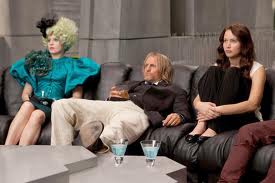
Effie, Haymitch, and Katniss look as bored as I was while watching their movie. Not much happens in the first hour or so. Image courtesy of http://www.collider.com.

The indulgence in establishing Haymitch carries over to other characters, only their purposes remain enigmatic for the uninitiated. For example, who exactly is Effie Trinket and what does she do, other than wear grotesque 1940s-inspired skirt suits? Introduced as a villain at the Reaping, she appears to be part of District 12’s trusted team. But there is no explanation or demonstration as to why or how she can make this transition. Moreover, Cinna (Lenny Kravitz) doesn’t have a clearly defined role, either. I assume that he’s merely a stylist, choosing for Katniss dresses that shoot fiery flames out of their skirts (so that she comes across as both dangerous and, well, hot). Apparently, Kravitz’s casting in this part angered many die-hard fans of the books, because he doesn’t physically conform to the Cinna of their imaginations. Meaning: they were disappointed that Cinna is played by a black man. Since Cinna is given so little to do, I don’t understand how anyone could get upset by that. If anything, the filmmakers should have cast someone who can act. Of course, one solution to this problem (that Cinna needn’t have even appeared in the film), however, is impossible: Cinna, in order to appease the fans, just has to be there.

Speaking of dresses that “light” up, let’s discuss the schizophrenic production and costume designs. As I previously mentioned, District 12 is so depressed as to be imprisoned in another century. When Effie, so far the only blatant anachronism in District 12, escorts Katniss and Peeta onto the bullet train, we ogle the 1930s interior design of the space, which coincidentally is one of the best sets. Side note: it is telling that they don’t fly to the Capitol, for the train is historically a potent symbol for modernity. Unsurprisingly, it literally transports them to another era. And what do we find at the Capitol upon arrival? As you peer through the poor visual effects, trying to make sense of the setting, you glimpse traces of Washington, DC (there’s a Mall with a reflecting pool) and vaguely neo-classical postmodern architecture. Honestly, it looks like a fascistic version of any and all representations of the mythic underwater civilization Atlantis (and maybe the Bahamian resort, too). The hordes of people gathered to watch live TV interviews are clearly dressed to go to a rave, decked out as they are with neon-colored clothes and hairstyles. There may have been glow sticks, I can’t be sure. One of the Games commentators/TV interviewers, Caesar Flickerman (Stanley Tucci), wears glittery suits and purple hair pulled up into a ponytail. Since everyone looks utterly ridiculous (and has an incredibly stupid name), it’s difficult to take the proceedings seriously, and the routinely oppressed’s struggle isn’t all that palpable. The filmmakers exaggerate both the built environment and the “bizarre” fashions of Panem’s citizens so as to link the inauthenticity of this world to our own celebrity-obsessed and reality TV-centric culture. From an intellectual standpoint, I get it. But as it is executed, it comes across as pained, heavy-handed, and too self-conscious. As if to say, Just look at how horrible these people are. You know, we’re not that much different… There’s nothing wrong with this message, but I’m afraid that because it is so over-the-top yet matter-of-fact, it produces a lot of noise and very little contemplation in the pandered-to viewer.

The Hunger Games being gladiatorial bloodsport, it makes sense that each district’s team rides in on the back of chariots here, in this fascistic square, their long procession resembling the parade of nations that is part of the Opening Ceremony at the Olympics. Image courtesy of http://www.mtv.com.

Despite the book being billed as a treatise on the horrific violence of war, which we send our innocent children to fight in the spirit of freedom (talk about a paradox), the film only spends the last hour or so of the 142-minute running time depicting the Games. (Collins is often reported as saying that the juxtaposition of TV channels showcasing young people alternately competing on a reality TV show or fighting in Iraq and Afghanistan inspired the story.) Instead, so much of it is devoted to the players’ Reaping, training, gaining of sponsorships (I still don’t understand how they work), and winning the audience’s favor. Again, Collins, Ross, and co. highlight how unreal (our) reality TV is through Haymitch’s packaging Katniss and Peeta as star-crossed lovers for the media, especially as we learn about it the same way that Katniss does: watching Peeta confess to Casear Flickerman that winning the Games would be a bittersweet victory. For surviving would mean that his crush would have to have died. For much of the film, they can barely tolerate each other. Katniss holds a grudge against Peeta because he once threw a loaf of bread into the mud as she sat starved nearby in the rain. He resents that she’s a more highly ranked player (scoring 11 out of ten points) and that everyone pays more attention to her. Despite their differences, they support each other during the Battle in the Woods, and in the end, they perform their roles as younger lovers for the pervasive cameras. It’s just, are they only keeping up appearances or do they fall for it, too? It’s an interesting idea, but the filmmakers expend no energy in developing it except in the second-to-last scene when they both enjoy a hero’s welcome (I’ll get to how that’s possible in a moment) and she finds her friend/boyfriend, Gale Hawthorne (Liam Hemsworth), out in the crowd. The expression on her face reads: “Oh shit, I forgot about him.” (And it’s easy to see why: this character consists of so little, he only watches the soap opera that is Katniss and Peeta’s romance unfold on TV and thus exists to make it harder for Katniss and Peeta to really become lovers.)

The movie’s PG-13 rating is really no indication that The Hunger Games tones down the violence implicit in its central conceit. Besides, similarly rated films with graphic displays of violence also get past the censors at the MPAA (language and sexuality are the real sticking points, and that’s a discussion for another time). I don’t seek out film reviews, but since his write-up was sent to my inbox as part of a daily roundup of entertainment news articles that I subscribe to, I read David Edelstein’s, originally published in New York. Horrified that the on-screen carnage of kids killing kids didn’t visibly “devastate” the hungry audience of which he was a part, Edelstein attacks director Gary Ross for framing the children’s inevitable deaths with “restraint” and “tastefulness” (as if that’s commendable!), which according to him, Ross has been praised for doing. I agree with Edelstein to an extent (the editing is fast and uncontemplative), but I still found the brutality of the participants profoundly unsettling: like, for instance, the way one girl shoots Katniss’s attacker in the back with a bow and arrow from far away, not out of solidarity but because killing him is merely a means to an end (killing Katniss).

More than this, The Hunger Games falls short of producing an effective commentary on war. The filmmakers fail to develop any of the Games participants other than Katniss and Peeta (with the lone exception of Rue, played by Amandla Stenberg, who comes to Katniss’s aid in the beginning before being snuffed out herself). And since we can’t even grieve for the fallen children-soldiers, you might ask, What is the point? Really, all we’re capable of, in Edelstein’s words, is this: “When a child dies, we breathe a sigh of relief that the good guys have one less adversary, but we rarely go, ‘Yes!‘” The greatest missed opportunity in this regard involves the character Cato (Alexander Ludwig), who scowls at everyone during training and basks in the glory he has inherited from previous champions who overwhelmingly hail from his District (1). Cato has been gearing up for the event seemingly all his life, and in the end, before he falls back onto the ground to be ravaged by demonic dog-like creatures, he hints to the spectator that he has a form of post-traumatic stress disorder as he indignantly whines, “Killing is all I know!” So just before he falls, we can reflect that he’s been robbed of a proper childhood and is subsequently doomed. The worst of it all is that this is the full extent of the filmmakers’ engagement with the subject of how being trained or programmed to kill has wrecked their psyches. Pitiful.

Katniss doesn’t bury Rue, her sister/daughter surrogate, but she gives her the only funeral any of the children can hope to receive. Image courtesy of http://www.mockingjay.net.

But of course they’re doomed. That’s the exact point of this exercise and the dramatic irony of the oft-spoken motto, “May the odds be ever in your favor.” Because beyond manipulating diegetic viewers’ emotions with stories about Katniss’s sacrificing herself to protect her sister or Peeta’s heretofore unconfessed love for Katniss, the producer of the Games, Seneca Crane (played by Wes Bentley), influences the actions of the participants as if he were a film director (he certainly carries himself like Michael Bay). When Katniss hides out in an unpopulated corner of the playing field, he burns it down so that she runs toward those who are out to get her. The dogs that eat up Cato spontaneously appear thanks to Seneca’s puppet-mastering; he wants to up the tension and kill off Katniss if he can. Most of all, he approves of an explicit rule-change after riots break out in the predominantly black District 2 following Rue’s (televised) death: two people can win the Games so long as they are on the same team. He later rescinds the offer once Katniss and Peeta are the only ones left standing. And here’s where my dad’s rabbi supposedly spoiled the plot: the so-called lovers vow to take their lives rather than follow the renewed rules of the old game. Fearing more reprisals, Seneca allows them to be dually victorious. The scenes which demonstrate how Man has overtaken Nature through computer programming and how Katniss and Peeta repeatedly challenge the rule of law at the Games are of a piece with the central message of The Hunger Games and probably constitute its finest expression: re-evaluate the truthfulness of “reality TV.”

One of the greatest unresolved mysteries of the film is the prize that the winner(s) receive(s). Obviously, living to see another day is rewarding in and of itself, but what do they gain otherwise? Fame? Fortune? At the victory ceremony held at the Capitol, the president of the totalitarian regime, Coriolanus Snow (Donald Sutherland), crowns Katniss, thereby complementing the beauty pageant-like interviews she endured earlier in the picture before the Fight to the Death commenced. Paradoxically, when she returns to District 12 triumphant, she doesn’t reunite with Primrose. (Instead, we see her look out onto Gale, confused.) As a melodrama studies scholar, I couldn’t believe that the filmmakers failed to include such a scene. If we can’t see Primrose embrace her virtuous older sister and perennial protector, then what is the point of her sacrifice anyway? Everyone, including Primrose, knows what is at stake.

This brings me to my final point. Much has been made about Katniss Everdeen as a feminist icon. Writing of the novels, Lauren Osborn of the online zine Vagina claims that, “Katniss—as a fiercely independent, loyal, and capable young woman—stands as a symbol of feminism in modern literature.” I guess she would if your only point of comparison is Bella Swan from the Twilight YA series. In her examination of this year’s female film characters (women and girls alike), Washington Post film critic Ann Hornaday praises The Hunger Games for being one of the satisfying “girl-powered fantasies” to come out recently (on the other hand, she’s disappointed that adult women are not represented as strong or compelling as their younger female counterparts). In my opinion, Katniss isn’t so much a feminist warrior as she is an amalgamation of different idealized femininities. She’s maternal, as she volunteers for the Games to spare her sister from a 100% certain death and mourns the younger Rue. (Later, Rue’s District 2 partner Thresh, played by Dayo Okeniyi, stops short of killing Katniss out of respect for her honoring Rue in death.) Despite her attitude toward the government and the Games, which she thinks makes her totally unlikable, Katniss wins over everyone because of her beauty. That flame-throwing dress works wonders. And if you think her skill with a bow and arrow makes her decidedly unfeminine, think again: she’s an archetypal Amazonian. Romance may not be a priority for Katniss, as Osborn argues, but she is nevertheless at the center of a love triangle, and neither suitor deserves her. Such is always the case.

I couldn’t find an adequate photo of Katniss in her flaming dress, so please pardon the text, though it does say it all, doesn’t it? Image courtesy of http://www.theapod.com.

I give the filmmakers credit for not belaboring how The Hunger Games continues into the sequel Catching Fire. (I swear, everyone is in a tizzy about who will direct it and who will play additional characters with unbelievably ridiculous names.) The scene of Katniss and Peeta’s heroes’ welcome is cut between Seneca’s forced suicide (punishment for having failed to keep the Games under control) and President Snow’s sorrowful glance down on the Capitol from a balcony on high. The film fades to black after he turns his back and steps into the building, subtly portending his downfall. I don’t know much about the other two novels, but I assume that Katniss will lead a revolution against Snow’s highly structured Reign of Terror. Perhaps future installments will be more action-packed and ultimately less boring. Perhaps there will be more to the characters’ social interactions besides a “will-they-or-won’t-they” storyline, preferably along the lines of race and class, which The Hunger Games sets up but barely engages. What I’m saying is, perhaps viewers who have not read the books will be given a reason to give a damn. But I’m not holding my breath.

Long Take: The Crimson Petal and the White Makes for Compelling Feminist Melodrama

Viewed September 12 & 14, 2012

CINE FEEL YEAH is all about the cinema, this much is true. But sometimes it is necessary to cast a glance at moving images more broadly defined. Case in point: director Marc Munden’s BBC Two miniseries adaptation of Michel Faber’s 2002 novel of the same name, The Crimson Petal and the White (2011), is so filled to the brim with less than reputable but intriguing characters, compelling melodrama, and enough symbolism to captivate any humanities major that I just couldn’t ignore it. Besides, the dramatic miniseries neatly fits the bill of one of my favorite subgenres, which centers around (usually historical) women rebelling against the dictated norms of her contemporary society. I caught the four-hour-long program when it aired on American premium cable television earlier this month, divided into two parts rather than its original four, and I cannot verify otherwise if the American telecast differs at all from the British standard. Either way, it is long and slow in some parts, but never so dull as to discourage continued viewing. It is also one of the more cinematic miniseries I have seen, featuring a more modern and eclectic score and a number of dizzying edits that are not the bread and butter of literary adaptations for TV. Before I forget: I have to warn you that I’m going to spoil pretty much everything.

The enviously prolific Romola Garai stars as the infamous teenage prostitute Sugar, but as she warns you in her voiceover narration, she is “far from sweet.” The story takes off in 1874, as she plies her trade at Madam Castaway’s (Gillian Anderson, looking a lot like a redheaded Gina McKee to me), a brothel tucked deep inside the dodgy end of London, where poverty, hunger, and disease persist. After hearing raves about Sugar from his friends who only wish they could have her, the feckless William Rackham (Chris O’Dowd), both the heir to a soap-manufacturing company and an aspiring novelist, seeks out her company. Their unproductive encounter, shall we say (drunk, he passes out and wets the bed before they can even begin), sets everything in motion: from that point on, he is hopelessly drawn to her, eventually buying her exclusivity, then moving her to her own apartment and finally into his family home. Right, I must mention that William is married to Agnes (Amanda Hale), who is psychologically disturbed after enduring years of sexual abuse and trauma. Don’t jump to conclusions too quickly there; I will discuss this subject in due course. There is a robust cast of supporting characters, including William’s pious brother Henry (Mark Gatiss), the reformer of prostitutes and tuberculosis sufferer Mrs. Fox (Shirley Henderson), and Mrs. Fox’s brother and Agnes’s physician, Dr. Curlew (Richard E. Grant).

But The Crimson Petal and the White belongs to Garai and, to a lesser extent, O’Dowd. I have watched the English actress seemingly grow up on-screen, and I haven’t always been a fan. Though I love I Capture the Castle (Tim Fywell, 2003), I freely admit that Garai’s central performance is sometimes unpolished, but she has consistently gotten better in everything she has done, from Angel (François Ozon, 2007) to The Hour (2011-present). I don’t wish to be so gushy, but she really excels as Sugar, particularly in presenting her as a confident and pragmatic woman who starts out with ambiguous intentions but eventually earns our sympathy completely by miniseries’ end. It’s a bravura performance. As for O’Dowd, it is strange to see him in a non-comedic role, and in a costume drama to boot! I almost always find him a likable (OK, adorable) countenance, but because his character develops negatively, he gradually becomes less and less attractive. William is pompous, sexist, vulnerable, and brutish.

I haven’t read the book (all of its 800+ pages), so I cannot comment on it, but The Crimson Petal and the White reminded me of certain classic works of English literature and their own screen adaptations, including Jane Eyre by Charlotte Brontë, Tess of the d’Urbervilles by Thomas Hardy, and pretty much anything by Charles Dickens, for it is a coming-of-age story about upward mobility (albeit centered on a woman who doesn’t achieve it). The comparison to Jane Eyre is obvious enough: our heroine enters a household to work as a governess for the child of her lover; who cares if she’s a prostitute and knows the mad wife already exists? William is no Rochester. He’s more like Alec from Tess, as he throws out the woman he seduces and impregnates. Through displays of moral courage and indescribable suffering, Sugar, like Tess, is redeemed. And let us not forget that the title comes from Alfred, Lord Tennyson’s poem “Now Sleeps the Crimson Petal,” which at one point Sugar reads aloud to her charge. I am no expert on poetry, but I think its stanzas speak to the dualism of Sugar’s and Anges’s lives.

The miniseries, and presumably Faber’s tome, is undoubtedly feminist, as it deconstructs how prostitution manifests in many different forms. And I don’t just mean as a comparative analysis of the various hierarchical venues that Sugar inhabits (i.e. the brothel and seedy taverns, the kept apartment, and finally the family home where she works as a governess and serves as William’s mistress and secretary). The Crimson Petal and the White, as adapted by Lucinda Coxon, makes clear that marriage is also a kind of prostitution, and this point is explicitly made through the juxtaposition of Sugar’s and Agnes’s individual experiences.

Whereas Sugar is sexually mature, having been pushed into prostitution at age 13 by her own mother (that’s right, Mrs. Castaway herself! but don’t worry, I haven’t spoiled anything you don’t learn within the first 80 minutes) and gained years of experience in giving men exactly what they desire, Agnes is sexually immature. She is locked in a young, almost prepubescent state, signified by her blonde ringlets, constant nightie-wearing, and, most importantly, fevered anorexia, which curtails her regular menstruation. On top of it all, becoming a mother eight years prior profoundly scarred Agnes’s psyche, so much so that she cannot accept that she ever gave birth in the first place. Thus her postpartum depression is so severe and permanent that William ensures that Agnes never sees their daughter, Sophie (Isla Watt), whom he keeps in another part of the house. Dr. Curlew visits Agnes weekly, using physical examinations as a pretense for violating her body. Ascribing a poor and poorer prognosis surely keeps up appearances, but it is also accurate. Agnes must get worse before she can ever get better.

Long before William set Sugar up her in own flat, she shadowed the man she did not yet trust, to his work and his home. (How ironic it is that he should own a soap-making factory, given his indiscretions.) One day, when Agnes looks out the window and finds Sugar on the street, staring back at her, Agnes becomes convinced that the stranger is her guardian angel come to rescue her (the small feathered wings stitched onto Sugar’s leather jacket help lend this impression). Once William confides in his mistress that his wife is having such delusions (obviously unaware that Sugar is Agnes’s “angel”), Sugar begins to interact with Agnes, either from a distance or on the condition that Agnes not look at her face. Things come to a head when William employs Sugar as Sophie’s governess and the women come face-to-face, usually when Agnes is in distress.

A shut-in from society, Agnes looks out her window and looks for her guardian angel, whom she doesn’t know is actually her husband’s mistress. Image courtesy of http://www.isserleylovesbooks.tumblr.com.

Out of pity (not jealousy), Sugar comes to Agnes’s aid and plots Agnes’s flight in the middle of the night. By this time, William has turned inattentive and cruel, and so I view Sugar’s planning Agnes’s disappearing act as one made out of female solidarity. Perhaps Sugar once wanted to replace Agnes, to bear William the son and heir he always wanted, but it’s clear that William’s raping Agnes one evening, to Sugar’s horror, encourages her to break Agnes out of the prison that is her marriage, which has traumatized her for over eight years and caused her to lose her mind. Thankfully, Agnes flees just in time, before William and Dr. Curlew have her committed. While letting a mentally disturbed woman loose unto the world may be inadvisable, Sugar’s determination to help is unambiguously romantic, possibly even an expression of her own desire to escape. Later, through a case of mistaken identity, William is led to believe he is a widower, and only Sugar knows that the river-ravaged corpse that washed ashore can’t possibly be Agnes because she cut her hair short before departing without a trace. The miniseries ends with no update on Agnes’s whereabouts, again lending a romantic air to Sugar’s emotional and intellectual attachment to Agnes and her gender struggle.

There is never any doubt that Agnes is a pathetic character and therefore deserving of our sympathy. On the other hand, before Sugar fulfills her promise as a guardian angel, she presents a more complex portrait. Having taught herself to read and write, Sugar keeps what she calls a “Hate Book,” which is either a tell-all memoir or a semi-autobiographical novel—it’s hard to say. She fills it with fantasies of exacting revenge on the men who have taken her innocence, and even as she gets to know William she conjures scenes in which she slits his throat or stabs his chest. Although it is clear that these are just her imaginings, the spectator might begin to wonder just what she is capable of. It is only after he takes Sugar away from Mrs. Castaway’s and encourages her to counsel him on business affairs that she begins to see her new client differently (he grants her more space and power than any other has ever done). That Sugar’s livelihood, particularly once William buys exclusive rights to her body, allows her time to write in the “Hate Book” is in stark contrast to William’s fledgling literary career. At Sugar’s urging, he throws himself into his job at the soap factory, choosing to express his masculine identity not through words but through accumulating wealth. More crucially, the “Hate Book” represents an escape, and it is telling that Sugar gives up writing in it as she becomes ever more entrenched in William’s family life, especially as Sophie’s governess. This leads me to the final point of comparison between Sugar and Agnes: it hinges on motherhood.

As I have already described, Agnes is literally unfit to be a mother. Her fragile emotional and mental state won’t allow it, and in her absence, Sophie has been reared by a strict disciplinarian nurse named Miss Cleave (Wendy Nottingham). When Sugar moves into the house and assumes her duties as governess, her predecessor warns that Sophie is a horrible, manipulative child. Nothing could be further from the truth. Within a minute, Sugar understands that she will look after Sophie differently; it’s clear the outgoing woman never gave Sophie a chance and shares William’s view that it is pointless to educate girls (then what does that make you, Miss Cleave, eh?!). In short, Sugar and Sophie form a tight bond, Sugar acting as both the mother Sophie never had as well as the mother she wishes she herself had. In case Sugar’s empathy towards Agnes doesn’t fully redeem her character, her devotion to Sophie does. When they profess their love for each other, it is the only time either one has ever heard those words spoken to her. But then their love is thrown asunder. Late in the miniseries, William casts Sugar out of his home and his life when he learns from Dr. Curlew that she is with child. Desperate, she takes Sophie with her. And that is how it ends.

Sugar and Sophie. Image courtesy of http://www.neovictorianthoughts.wordpress.com.

I am not crazy about Sugar’s kidnapping Sophie. I feel this way not only because she has committed a crime, but because this conclusion reaffirms that (even a fallen or, in Sugar’s words, “pushed”) woman’s role is as mother. Perhaps this is too harsh, given the emotional and psychological torment that biological motherhood bestowed upon Agnes, which was aggravated by the men’s sexual mistreatment of her. After all, she abandons her child forever when she makes way in the night, so being a mom isn’t for everyone. Moreover, I sure am glad that The Crimson Petal and the White doesn’t end tragically, with Sugar dead, say, and by William’s hand no less. In fact, I rather like the actual terms through which Sugar and Sophie’s escape takes place. Sugar tells Sophie to pack for an “exploration,” thereby echoing an earlier scene in which the budding cartographer Sophie asks if she can grow up to be an explorer. “I don’t see why not,” Sugar, ever the retroactive feminist, tells her. Sophie, who at age eight understands she is a second class citizen by virtue of her sex, assumes then that she will only be able to explore places that men do not or will not go to. How can I argue with this kind of language? While technically Sophie won’t be as materially well off as if she were still at home, there is no denying that she will be better loved and raised by Sugar. It is also noteworthy that in the final scene, as they wait for a train to take them far away, Sugar begins to write again, this time on a new pad of paper (the wind blew away pages from the “Hate Book” in their escape and they wind up in William’s befuddled possession).

I didn’t have much use for the subplot involving a tentative romance between Henry Rackham, William’s older brother, and Mrs. Fox of the Rescue Society. It does, however, serve to show that men are so easily crippled or undone by their (repressed) sexual passions. (Henry cannot reconcile his lust for an ailing Mrs. Fox with his desire to become a clergyman and so dies in a fire while fantasizing about her.) Women, on the other hand, are stronger and more resourceful, as evidenced by Mrs. Fox unexpectedly making a full recovery from consumption. As Dr. Curlew’s sister, she also points out how members of the same family can be advocates of diametrically opposed causes: he devotes his time to molesting his female patients while she selflessly labors to rehabilitate women and girls away from their previous lives of sexual exploitation. If only she knew of her brother’s misdeeds.

The Crimson Petal and the White isn’t only graphic in terms of representations of sexuality, it doesn’t pull punches when it comes to bodily functions either. That is, it doesn’t shrink from showing us what bathing, going to the bathroom, and miscarrying might have been like for women in the late nineteenth century. In fact, the scenes in which Sugar, having lost all hope in a future of wedded, familial bliss with William, fails to induce an abortion, first by administering chemicals and next by flinging herself down the stairs, are particularly harrowing. Later, when she hemorrhages at William’s soap factory in front of Sophie, it is a truly gut-wrenching sight. But there still is a sense of relief. And this is all of a piece with the filmmakers’ commitment to impressionistic realism. I know this might sound like a contradiction in terms, but I use “impressionistic” to clarify that the brutal realities of Sugar’s and William’s Londons are filtered through her unique perspective, steeped in abjection and ambition. Also, there is something refreshing about Sugar’s scars, undoubtedly the result of abuse at the hands of her former clients, always being on display, along with patches of irritated skin and her chronically chapped lips. It reminds us that living is hard, and this is especially the case for the sexually exploited.

News Clip: Before Midnight Can’t Come Soon Enough

The ending of Before Sunset (Richard Linklater, 2004) presents a litmus test, a method for separating the romantics from the skeptics in the audience. Being a logical person, however, I have always thought Jesse’s satisfied smile as he answers, “I know” to Celine’s playful admonishment, “Honey, you’re gonna miss that plane” meant their remaining together—perhaps even in Paris—was a sure thing.

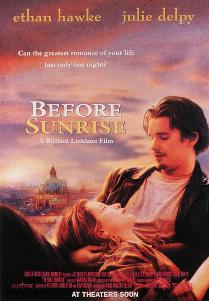
Before Sunset is one of those rare “franchise” films in that it’s actually better than the originator of the series, Before Sunrise (Linklater, 1995). The later film, edited so that Jesse and Celine’s chance reunion over the course of one afternoon unravels in approximate real-time, is wistful in tone and very adult in theme. By virtue of their having a history (and our being privy to it), it’s much more intimate than Sunrise. And who could resist the opportunity to see the idealistic twentysomethings (who, as strangers, once shared a formative romantic night together in Vienna) all grown-up and cynical, processing that rendezvous and how it has shaped their lives since. That’s why, combined with the supposed ambiguity of Before Sunset‘s conclusion, we fans have hoped that director Richard Linklater and stars Ethan Hawke and Julie Delpy would bring these vivid characters back to the big screen again.

Aside from wanting to fulfill their own creative energies and desires to shoot another picture about Jesse and Celine, I would imagine that the creators also want to please the fans who can’t let the characters go. Like many others, I have followed the possibility of a third film coming to fruition, reading everything from an online interview over here to a newspaper profile over there. Recently, everyone involved has kept the details of the (pre)production close to the vest, only ever going so far as to say something to the effect of “we’re working on it, we’re working on the script.” Well, good news, friends: they’ve done us even better by finishing the shoot just yesterday! Mike Fleming of Deadline New York reports that Before Midnight wrapped production in Greece Tuesday night (I guess Hawke’s title suggestion, Before We Go Crazy, didn’t make the cut). Fleming quotes a written statement from the co-writers, which offers nothing in terms of the story or plot of the new film. In other words, it’s still unclear if Jesse and Celine have stayed together since Paris or are reconciling yet again. Hell, they may have even dated and split up in the interim. We have to wait a little bit longer to find out.

But what a coup, huh? How marvelous that everyone managed to fool us all into thinking that the film hadn’t even gone into production yet. Here’s to a swift post-production and not-too-distant release date!

News Clip: What Possessed People to See The Possession?

It’s true, I haven’t been to the movies in over three weeks, since my birthday on August 11th. And even then, just choosing something to see was difficult to do. It’s been a really crappy summer for movies (I don’t care what you say; superhero/comic book movies are boring), so let’s hope the year improves as studios start rolling out their prestige pictures, their awards bait. But that’s not the point of this post. Instead, I would like to comment on the overnight success of The Possession (Ole Bornedal, 2012), which is all set to win the Labor Day weekend box office—with an unimaginative title and poster to boot. According to Pamela McClintock of The Hollywood Reporter, Lionsgate estimates that the exorcism film-story will bring in $21.3 million for the mini major, making the movie the second highest grossing Labor Day weekend box office winner ever recorded on the books (in inflated dollars, of course).

That a horror film, even during summer (or the last days of it), can scrounge up so much money isn’t surprising (McClintock reminds us that 2007’s Halloween, directed by Rob Zombie, currently holds the record for the biggest box office overhaul for any Labor Day weekend with $30.6 million in tickets sold). I’m just wondering why audiences have, for lack of a better word, “flocked” to see this film. Admittedly, I am biased against pictures that revolve around exorcisms (and, while we’re at it, horror films in general) and would never in a million years pay to see this in the theater, but I read Bilge Ebiri’s review of The Possession, anyway. You can click to read it yourself; he doesn’t spoil anything. And that’s exactly the point: you can’t spoil what happens in any of these formulaic movies. As Ebiri notes, “Demon-possession movies are now so ubiquitous that we don’t really expect any dramatically new shocks from them.” Granted, he seems to have liked this one more than he was expecting to, for dramatic reasons that have little to with the scary, climatic scenes.

This being a think piece that aims to ask questions about genre and audience appeal, I still want to know why The Possession is on track to actually exceed studios’ expectations. Is it because there’s really nothing else out there worth seeing? That can’t be, for Mike Birbiglia won’t stop tweeting about all the dozens of Q&As he’s hosting around the country for his directorial debut Sleepwalk with Me (2012). Is it because, for a change, The Possession centers not on a Catholic-tinged Satan overtaking a family’s young daughter but on an ancient Jewish demon entering the same kind of girl? A premise, it should be noted, that isn’t alienating Hispanic viewers as Ray Subers of Box Office Mojo predicted it would. (McClintock reports, “The film also is over-indexing in Hispanic Catholic markets.”) Is it because Matisyahu, the Hasidic reggae musician, plays the exorcist? (I know that alone would draw my brother in.) If it’s not quite clear, I am being facetious. I know why horror movies, no matter how generic they are, are so “ubiquitous” (to borrow Ebiri’s term) and wildly popular. In short: they’re cheap to produce (not too many stars demanding hefty paychecks), and they reliably offer the spectator a sort of interactive thrill ride, complete with jumps in seats, shouts at the screen, and peeks at the screen through fingers laced across faces. In fact, it’s these kinds of conventions that ensure the genre’s popularity, and word-of-mouth has a lot to do with it (this is undoubtedly the case for The Possession, too).

Besides, Sam Raimi produced it. For the horror fan, that might lend it some credibility. More pertinently, however, I wonder what the appeal of this particular film is for the young women who went to see it. McClintock writes that the audience this weekend is mostly female: “[Women] made up 59 percent of the audience, while 54 percent of those buying tickets were younger than 25.” Which means the production company’s marketing strategy that McClintock alludes to (ie. targeting girls and young women) has paid off handsomely. Is it typical for exorcism movies to be marketed toward this demographic? I really have no idea what the advertising campaign consists of, and McClintock doesn’t clue me in, but I am curious about this. For horror films have, historically speaking, been either geared toward young men or toward neither sex in particular (once studios realized women like these kinds of scares, too!). Though I haven’t seen it, I understand that Jennifer’s Body (2009), as devised by screenwriter Diablo Cody and director Karyn Kusama, was supposed to be a feminist-inflicted mash-up between demon possession movies and slasher flicks. I guess I should see it to find out why this film tried to reach a diverse audience—but especially women, I would think—and failed. Wait, don’t tell me. It probably has to do with Megan Fox, right?

Movie Travel Diary: Washington, DC

A view of the Capitol Building and Pennsylvania Avenue from the Newseum. To the left, there’s the Canadian Embassy, and to the right, the East Wing of the National Gallery of Art. Photo by the author’s sister, or so she claims.

The time has come to close the book on Movie Travel Diary—for now. Selecting the last city to round out the week was somewhat difficult. I thought about Chicago, but I couldn’t think of a film that shows off the city that I know. Not even the cult classic Ferris Bueller’s Day Off (John Hughes, 1986), with its touristy locations, can evoke the place for me. Equally true of San Francisco. What could I have chosen? The Conversation (Francis Ford Coppola, 1974)? Nine Months (Chris Columbus, 1995)? Nah.

So I choose Washington, DC. The thing is, this happens to be the nearest city to where I grew up and where I currently live. Regrettably, I don’t go downtown as often as I would like, and when I do, I usually stick to visiting my favorite museums: the National Building Museum, National Gallery of Art, Smithsonian American Art Museum, and the National Portrait Gallery, all within striking distance of the National Mall. In other words, when I am in DC, I am a tourist. The streets aren’t as easily navigable for me as the ones in Manhattan. Washington is relatively small, but it’s impossible to see even just a few of the diverse neighborhoods throughout the city over the course of a couple of days. Hell, I have lived nearby almost my entire life, and there are still sections I have never been to. Disgraceful, I know, but in my defense, allow me to say that I live thirty minutes by car from the nearest Metro station that will bring me into the city, and not everything within the DC city limits is easily accessible by train.

But when it comes to movies, unfortunately—and I have always felt this way—the District of Columbia, as the capital of the free world, is severely under-represented. Most of the films that take place here are about politics in some way. You have big budget action adventures, like Independence Day (Roland Emmerich, 1996), where the end of the world is signaled by aliens blowing up the White House, and Live Free or Die Hard (Len Wiseman, 2007), which actually uses Baltimore to stand in for much the District. There are innumerable spy movies that are partially set in DC, but to my mind, they generally just feature aerial establishing shots of the CIA headquarters in Langley, Virginia (I’m thinking of the Bourne franchise in particular here). When it comes to films in other genres, notable titles include The American President (Rob Reiner, 1995), a romantic comedy in which Commander-in-Chief Michael Douglas dates environmental lobbyist Annette Bening, Jason Reitman’s satiric debut Thank You for Smoking (2005), about the tobacco industry’s spokesman on Capitol Hill and the trouble he regularly gets into, and Burn After Reading (Joel & Ethan Coen, 2008), a wacky comedy about supposed CIA secrets, stupid and lonely personal trainers, and a horny charlatan played by George Clooney.

I know what you’re thinking. What about Minority Report (Steven Spielberg, 2001)? That isn’t so much about politics, and it’s a sci-fi police detective thriller. Honestly, I just remember how the filmmakers use the Los Angeles Metro as a double for DC’s, which has a very distinctive design, seen below. Along Came a Spider (Lee Tamahori, 2001), the second adaptation of James Patterson’s Alex Cross book series after Kiss the Girls (Gary Fleder, 1997), hilariously deploys San Francisco’s rapid transit system and has Morgan Freeman running all over town without an eye focused on geographic verisimilitude. Come to think of it, of the major releases set in and around DC, only Thank You For Smoking dares to show the iconic 1970s-built DC Metro, in a blink-and-you’ll-miss-it cameo by the source novel’s author Christopher Buckley, who reads the newspaper while waiting on the station platform at Farragut North.

The Gallery Place – Chinatown Metro stop, just one of the 86 stations that make up Washington, DC’s Metro system. Image courtesy of http://www.transportationnation.org.

Whenever I lament the sorry state of picture-making in Washington (the generic variety is rather limited), I have to remember that one of the best romantic comedy-dramas takes place here: Broadcast News (James L. Brooks, 1987). Sure, it doesn’t show the city in a very evocative light, as most of the action takes place inside the production studio and editing rooms of the TV network’s DC bureau. But one of the ways Brooks’s screenplay aims to establish DC as a lived-in city is by making Holly Hunter’s character an obsessive know-it-all when it comes to the city’s street geography (I don’t remember it enough to grade for accuracy). Memorably, though, the narrative climax takes place at BWI, Baltimore Washington International Airport, which is probably the farthest of the region’s three airports from where Holly Hunter originally is in DC; it would make more sense for her to meet William Hurt at Reagan National or Dulles, both of which are in Virginia. Strangely enough, BWI, with its characteristic red-tiled columns, also appears in Home for the Holidays (Jodie Foster, 1995). In that film, Holly Hunter’s art restorer based in Chicago flies out of BWI to go home for Thanksgiving—in Baltimore! So, you see, we Washingtonians are used to seeing the city’s geography—as well as that of the surrounding area—warped in the movies. Granted, this makes it no different from any other place in the world, but when it is your city that is being misrepresented, fragmented and subordinated, it is natural to feel self-righteously possessive. Feeling offended is not recommended.

James L. Brooks’s most recent film, How Do You Know (2010), returns him to DC. I’m just not sure why, since there’s nothing intrinsically DC about its story. Is it because this is the only place where he could strike a deal with a Major League Baseball team, as Owen Wilson’s character is a pitcher? The only scene set at Nationals Park in Southeast is rendered, to my eyes, with some appallingly bad green screen effects. Unfortunately, this overlong, tedious, and criminally unfunny romantic comedy doesn’t make the most of its capital location, and according to the movie’s filming locations page on the Internet Movie Database, quite a bit of it was shot in Philadelphia.

Cinematography of national monuments and landmarks, such as the Capitol, Washington Monument, Lincoln Memorial, or any one of the Smithsonian museums, do not a “DC-set film” make. Sorry, Shawn Levy and Ben Stiller of Night at the Museum: Battle for the Smithsonian (2009) and Robert Zemeckis and Tom Hanks of Forrest Gump (1994) fame. There simply is more to DC than these structures. There are life-stories beyond those of the President and his Cabinet, Congresspeople and their staffers, CIA managers and their field operatives. Thankfully, there are independent films set in and around DC that promise a different side of the city. These include Paul Schrader’s The Walker (2007), about an escort to politicians’ and other power-brokers’ wives; Kasi Lemmons’s Talk to Me (2007), a biopic about the radio DJ/civil rights activist Petey Greene; Emily Abt’s Toe to Toe (2009), about the rivalry between two students—one poor and black, the other white and rich—at an elite prep school; and Nicholas Panagopulos’s Five Lines (2001), about strangers whose lives converge on the DC Metro (by far the smallest production of the bunch). With the exception of Talk to Me, I haven’t seen any of these motion pictures, so I can’t say whether or not they present a DC that I recognize. I should probably start a marathon of these movies, huh?

So, after going on about how films, when they do take place in DC, are almost always about politics in some shape or form, consistently bend city geography to their every whim, and otherwise stay focused on the movers and shakers of Capitol Hill, let me finish with a personal reflection. Growing up, I loved St. Elmo’s Fire (Joel Schumacher, 1985) and its oddly mixed group of friends all in love with one another. They are recent graduates of Georgetown University, but the filmmakers shot the one scene set on campus at my alma mater, the University of Maryland in College Park. In it, a wistful Rob Lowe returns to his old stomping ground to play football with current undergraduates. This example may get the closest to representing the DC I know—even if it’s emphatically not DC and I only once set foot on Frat Row. But this is, in a nutshell, DC in the movies: ever out of reach.

Well, that’s it: the last entry of Movie Travel Diary. But why don’t we talk about DC some more? Tell me about your movie-related experiences in the capital. Which film(s) shows off the Washington that you know from your own wanderings around the city?

Movie Travel Diary: New York City

The first photo I ever took in NYC, it’s of the Washington Square Arch in the park of the same name. The fence around it expresses how unwelcoming we found the city to be in May 2008. Just over one year later, I would start studying at New York University, also in Greenwich Village.

Alongside London and Paris, New York City is one of the most cinematic cities in the world. It is such a frequent backdrop for film-stories that you might be tricked into thinking that you know the place from these audiovisual documents alone. Directors such as Martin Scorsese, Woody Allen, and Spike Lee have, until recently, made their names producing movies set there, and in turn, they have vividly shown us what life in the Big Apple is or can be like. Perhaps owing to its density and diversity, New York City is a versatile setting for different kinds of films: police detective stories, romantic comedies, post-apocalyptic sci-fi actioners, period costumes dramas, family melodramas, coming-of-age character studies, and corporate thrillers, to name but a handful. Hell, NYC has even hosted a western: The Cowboy Way (Gregg Champion, 1994). So, you see, there is no one definitive handle on New York City.

That being said, it’s time to take stock of how the city I know from personal experience has been represented on-screen. Before moving there in August 2009 to attend graduate school at New York University, I had only been to New York twice: first in May 2008 (the week-long trip with my sister was a college graduation gift from my father) and later in July 2009 with my dad to find a place to live there. Coming of age, I was embarrassed that I had never been to “The Greatest City in the World,” or so says practically everyone in our society. Eventually, I embraced the irony (for I like to think of myself as an urban rather than suburban person) and learned to laugh at my “cultural handicap.” Although New York’s only 225 miles away from home and Los Angeles is over 3,000 miles west of it, I had been to the latter city first!

Honestly, the only scene on our 2008 trip that I remember being awed during was when the huddle of skyscrapers came into view as our bus slowly approached the Holland Tunnel. Oh, I was so excited to finally set foot in New York City! But for whatever reason, my sister and I were unimpressed with NYC. It probably had to do with the heat and humidity, the horrendous stench that follows you everywhere you go (the one thing I said, upon moving away from NYC, that I would never miss), the exorbitantly high cost of living, and the unfriendly residents. Wait! I take it back; I also don’t miss the appallingly bad customer service. Being un-enamored with NYC came as both a shock and a disappointment to us. My sister and I, fancying ourselves city people, thought we would fit right in. We weren’t going to let the fast-paced lifestyle deter us from making the most of our trip. And it didn’t; if anything, New Yorkers and other tourists don’t move fast enough for us (this observation really dawned on me once I started living, working, and going to school there). To top it all off, the sandwiches at Katz’s Delicatessen on the Lower East Side, where Meg Ryan and Billy Crystal memorably dine in When Harry Met Sally… (Rob Reiner, 1989), were anything but orgasmic. I don’t even have many photos of that 2008 trip, and I have absolutely zero from all the time that I lived in the city.

I didn’t have what she’s having: Meg Ryan and Billy Crystal dine at Katz’s in When Harry Met Sally…. Image courtesy of http://www.gothamist.com

The following isn’t so much about New York’s on-screen appearance in the film as it is about what the city symbolizes within the movie’s narrative. There is only one scene set in New York in Greg Mottola’s Adventureland (2009): Jesse Eisenberg appears on Kristen Stewart’s East Village doorstep, soaked from the pouring rain. Though his spot at Columbia’s journalism school is no longer guaranteed, he risks the financial security of living at home and leaps toward achieving his dreams of living in the city he’s long romanticized as a bastion of creative independence. It doesn’t hurt that she lives there, too. Anyway, I remember sitting in a movie theater in Burbank, CA, my sister nudging me every time NYU’s name was mentioned in the film. I was generally apprehensive about moving to New York, the cost of the master’s program the greatest deterrent. So the question became, do I have the balls to try to make it in the Big Apple, too? I grappled at answering this for a long time and eventually let my father and sister’s shared enthusiasm for the opportunity given to me influence my decision to try.

The director Woody Allen. Seems about right. Photo courtesy of http://www.waitalia.tripod.com.

But what of the films that are mostly set in New York? Which ones speak to me and how I have lived my life there? Well, for starters, Woody Allen looms large in our house. Not only has his oeuvre informed me throughout the years of what to expect in certain pockets of the city (admittedly rather restricted pockets), it has also shaped who I am as a person. In a word: neurotic. Anyway, upon moving to the Upper East Side in August 2009, I recognized straightaway the cinematic universe of Woody Allen. Everything from the rich old biddies in their fur coats to the quiet, tree- and brownstone-lined streets. Living on the East River, about fifteen minutes from the 77th Street station, I got to know the wide, pedestrian-friendly sidewalks very well (downtown, there really aren’t such luxuries). When I first moved to the city, I hated my commute, but eventually I came to revel in it. It was one of the few times I genuinely savored my loneliness, and I would often reflect on how strange it was that I was living on Woody Allen’s Upper East Side, an old-timey blues score playing in my head. Throughout his filmography, there are many seemingly trivial scenes set on these sidewalks, the characters either entering or leaving ritzy doorman-appointed apartment buildings. But I think of Manhattan Murder Mystery (1993) whenever I specifically think of the sidewalks of the Upper East Side. An even weirder coincidence emerged between the movies and real-life when I found out that my roommate at the time worked at the school where Woody Allen’s children are enrolled. She had seen him on a few occasions, either picking them up from school or hosting a Q&A there, ostensibly for the benefit of the children but adults crowded the standing-room-only venue.

I only lived on the Upper East Side for about four and a half months, and I barely went out—apart from attending classes in Greenwich Village, grocery shopping at the Trader Joe’s in Union Square, and working and going to the movies in the area around Lexington and 86th Street. Then I moved to Prospect Heights in Brooklyn, where the rents were (somewhat) cheaper and the available space more generous. Regrettably, I barely explored Brooklyn during the roughly two years that I lived there (December 2009 to November 2011). Living on the 2/3 Seventh Avenue express line, however, I soon became very knowledgeable of the city’s west side, which, aside from the couple of times I wanted to show Lincoln Center to my visiting sister or dad, I largely ignored beforehand. In fact, I now spent so much time on the west side—whether working in Tribeca, walking to school from the subway stop in the West Village, or going to the movies on the Upper West Side—that I began telling people, “I eat and sleep in Brooklyn, but I live in Manhattan.” At the risk of sounding like the execrable women of Sex and the City (1998-2004), I loved Manhattan (it made sense to me, culturally and geographically) and thought Brooklyn was overrated.

As you already know, going to the movies is my favorite pastime. I frequented theaters all over Manhattan (if you need further proof of my preference for this borough over Brooklyn: the only theater I ever went to in Brooklyn was BAM Rose Cinemas). They include—but are by no means limited to—Cinema Village, aptly named for Greenwich Village and where the screens are no bigger than most bedroom walls; Village East Cinema, where I took advantage of their $7 student tickets every Tuesday (you get a free small popcorn, too); Film Forum in the West Village, where the programming is superb but the physical layout of the auditoriums are not for the vertically challenged like myself; Landmark Sunshine Cinema on the Bowery/Lower East Side, where I saw Almodóvar’s two latest features; and the IFC Center in the West Village, where I was a member for a period of time (the price of the Red Riding roadshow event convinced me to join). I even braved throngs and throngs of tourists in Times Square to go to the movies. But none of these great and not-so-great theaters was my favorite. That distinction belongs to the AMC Lincoln Square on Broadway at 68th Street, a stone’s throw away from Lincoln Center. I was hooked the first time I attended a show there; it was Fantastic Mr. Fox (Wes Anderson, 2009), and I saw it with my sister in the largest non-IMAX theater. We sat in the balcony. Yes! the balcony! Unlike most multiplexes, this outpost of the national chain doesn’t distinguish its auditoriums by number. It gives them names that recall the golden age of Egyptian- and neoclassical-themed movie palaces (like “Loews,” “Kings,” “Paradise” and “Olympia”), a motif that runs rampant on the entrances to individual screening rooms and on the mural-filled walls in the lobby.

In fact, these exact details helped me identify the AMC Lincoln Square as the theater where Meg Ryan and Greg Kinnear have a confrontation in You’ve Got Mail (Nora Ephron, 1998). That the filmmakers used this location isn’t so surprising since the Pride and Prejudice-tinged romantic comedy, a more technologically advanced (and now equally quaint) adaptation of Ernst Lubitsch’s Budapest-set The Shop Around the Corner (1940), is basically Ephron’s love letter to the Upper West Side neighborhood. Full disclosure: when my sister and I first came to NYC in May 2008, we made a pilgrimage here, specifically to Zabar’s, the specialty grocery store where the bookstore rivals Meg Ryan and Tom Hanks meet again—awkwardly and with terse words. (Note: If you do a Google images search for “Zabar’s” and “You’ve Got Mail,” you get tons of the movie’s fans standing outside the establishment.) Much later, after I began coming to the area regularly (to see a new film at least once a week), I couldn’t help but notice the irony in the nearby Barnes & Noble permanently closing its doors sometime last year or in late 2010. After all, Tom Hanks’s Fox Books is a thinly veiled stand-in for Barnes & Noble, and Meg Ryan’s children’s bookshop owner goes out of business after mounting an attention-grabbing smear campaign against Tom Hanks’s ruthless businessman. That is, of course, as they fall in love as anonymous online pen pals. It’s funny, but because of You’ve Got Mail, whenever I think about the Upper West Side, I always imagine it as it is during autumn, with colorful leaves strewn about, the scent of “bouquets of sharpened pencils” in the air. When I think about it, I remember that, though I was alone in New York, I wasn’t always lonely. I wrapped myself up in the city’s happening film culture, the one part of the city I truly miss the most.

The entrance to Zabar’s on the Upper West Side, where Tom Hanks and Meg Ryan trade passive-aggressive insults in You’ve Got Mail. Photo courtesy of essential-new-york-city-guide.com.

I’ve been all around Manhattan—up and down, east and west—in pursuit of entertaining film-viewing experiences, educational museum exhibitions, and cheap and delicious meals, but the Upper West Side, and to a lesser extent its eastern counterpart, emerges as the section of the city I most associate with my life in New York City. As I stated at the top of this article (and which should come across as a running theme throughout Movie Travel Diary), it is impossible to know a large city through film and travel alone, though this guy aims to traverse every street in the five boroughs and take portraits of the people he meets. Still, you can’t even rely on a combination of film and travel, for we’re limited by what filmmakers choose to put on screen, and I couldn’t visit every block on every street in NYC even if I wanted to. But maybe this is more so the case for some cities than it is for others. For example, while Paris, je t’aime (2006) may have captured so many cultural reaches of the titular city that I experienced myself, New York, I Love You (2009), the second entry in the franchise, barely presents a New York I recognize. It relies too much on stereotypes when establishing place, thereby rendering boundaries ill-defined, the built environment stolidly the same. Then again, I might just be unfairly comparing the films (due to their similar approach to framing a city) because I merely visited Paris as a tourist whereas I lived in New York for over two years. I lived in New York for over two years? You’ll have to pinch me, because I can barely believe it. In fact, this disbelief overcame me often, even as I lived there. It usually hit me while I was on the subway (I felt like I was always on the subway), listening to music and reading a book, in my own world. That reminds me: I love seeing how (in)accurate New York geography is represented in the movies. Off the top of my head, When in Rome (Mark Steven Johnson, 2010) is one of the most egregious in this respect, sending Kristen Bell running from work at the Guggenheim Museum to Columbus Circle, and Shame (Steve McQueen, 2011) has a continuity error that puts Michael Fassbender riding the 6 train through the same station twice in a row. Oops!

By way of conclusion, I’d like to offer another movie-related New York moment. I recently wrote a true memoir about the independent film-going habits that I fostered while living in New York, and I submitted the essay to a humor writing contest (which explains why I haven’t published it on CINE FEEL YEAH). I didn’t specifically mention this episode in the piece, but I can recall that the first film I saw in New York on my own was Der Baader Meinhof Komplex (Uli Edel, 2008) at City Cinemas 1, 2, 3 on Third Avenue between 59th and 60th. Other than in LA, where I relied on my sister to get places (particularly to art-house cinemas), I had never felt so fortunate to see a foreign film in the theater, for they always play about twenty miles away from my hometown. Unfortunately, this one wasn’t any good. But that’s not the point of this anecdote. This is: on my last day of work at a high traffic Starbucks in LA, one of my favorite customers gave me $10 to spend on a movie ticket. She said that when she moved to Paris, someone else had done the same thing for her. Touched that her gesture pays cinephilia forward, I rushed at the chance to use it on Der Baader Meinhof Komplex. Looking at my ticket stub now, I see that I had to shell out an extra $2.50 for the ticket. I hope to one day do the same for a cinephile about to embark on a similar life-changing journey.

Tomorrow: the last entry of Movie Travel Diary. But I’m not ready to leave NYC just yet; tell me about your movie-related experiences in the city. Which film(s) shows off the New York that you know from your own jaunts around the metropolis?

Movie Travel Diary: Los Angeles

Is this what you see when you think of LA? A view of the ocean from Santa Monica, without submerging your feet in the sand. Photo by the author.

In Jim Jarmusch’s omnibus film Coffee and Cigarettes (2003), Steve Coogan, playing a version of himself (as he is wont to do), says that “Los Angeles is a nice place to visit; it’s an even nicer place to leave.” This sentiment pretty much sums up how I always imagined the city to be, too. Before my sister moved out there in 2005 to begin a PhD in urban history and planning at the University of Southern California, I never wanted to go there. The collage of images plastered in my mind featured stereotypical scenes I couldn’t see myself playing out: hard-bodies sunning themselves on the beach a la Baywatch, snobby Beverly Hills salesgirls turning away Hollywood Boulevard prostitutes from their designer fashion boutiques, and members of warring gangs killing each other and innocent bystanders in drive-by shootings—in John Singleton’s Boyz in the Hood (1991), Edward James Olmos’s American Me (1992), and more crucially, on TV news broadcasts. But overall, I thought Los Angeles was teeming with vapid and superficial people; they don’t call it La La Land for nothing. It’s where every aspiring film actor goes to realize his or her dream of becoming famous, and they still won’t admit it’s nowhere near coming true even as they’ve slung espresso drinks at Starbucks or waited tables for years.

Now my idea of the metropolis is (almost) completely changed. Believe it or not, not everyone in Los Angeles works in the film industry or even wants to. And people actually are born and raised in the city; they don’t just disembark from buses that originated in far-flung places. Aside from the year I lived in LA with my sister, I have been to LA on several occasions. The most recent was in May of this year. I have come to know the city as more than just a tourist would, even if I still can’t get my head around the linkages between freeways. You take the 101 to the 405 to the what? Oh, forget it. I leave all of that for my sister to parse, as she knows the freeways and “surface streets” like the back of her hand.

When I first came to LA in June 2005 with my dad and sister to help her find a place to live, we stayed in a budget hotel not far from MacArthur Park so that we could be near the USC campus and within striking distance of the other parts of the city we wanted to see. The area surrounding the park caters mostly to Spanish-speaking residents originally from Mexico and Central America, a reality you know is there but is hardly ever represented in the media. In fact, the movies present a Los Angeles that is overwhelmingly white, and growing up I relied on such pictures as  Speed (Jan de Bont, 1994), Clueless (Amy Heckerling, 1995), and The Truth About Cats & Dogs (Michael Lehmann, 1996) as well as prime-time TV soap operas like Beverly Hills, 90210 (1990-2000) and Melrose Place (1992-1999) to understand citylife in LA. I’m happy to tell you there’s far more to it than this limited purview would have you witness. That being said, my family could think of nowhere else to go on our first day other than the ocean (pictured above). So we went to Santa Monica, even though none of us likes the beach.

My sister eventually settled at Sunset Junction, where Sunset and Santa Monica Boulevards converge in Silver Lake, a one-time street-car suburb (if you can believe it!) and now a happening neighborhood lined with cafes, shops, and gay nightclubs. It’s situated between Hollywood and downtown (if that means anything to you). Yes, hipsters are here, but most of them don’t live here. When she moved in, one of the ways she described her apartment’s location was by saying that the laundromat where Claire Danes meets Jason Schwartzman in Shopgirl (Anand Tucker, 2005) was just across the street on Sunset. That’s all well and good, but I’d never been to that part of the city before. In December of 2005, I visited Silver Lake for the first time, recognizing landmarks such as the laundromat (it’s no longer in business) and marveling at just how real the city became as a result of my sister and best friend now living here. I got rather acquainted with Silver Lake over the course of a few trips west, and suddenly, “my Los Angeles” popped up in movies everywhere. If you look closely, you will also see regular neighborhood businesses featured in The Last Word (Geoffrey Haley, 2008), though the eatery Town and Country is now the eatery Forage; I Love You, Man (John Hamburg, 2009), wherein Paul Rudd drives by a bio-diesel fueling station at Sunset Junction on his way to work (it’s moved since then); and Beginners (Mike Mills, 2010), when the newly out-of-the-closet Christopher Plummer cruises Akbar and hears house music for the first time. Cute.

The LaunderLand where Claire Danes and Jason Schwartzman meet-cute in Shopgirl. It no longer exists, so you can’t expect to find them there anymore. Photo by the author or her sister—I can’t recall exactly who.

Although Silver Lake is someplace very different from Laurel Canyon, I came to associate the bohemian atmosphere on display throughout Lisa Cholodenko’s Laurel Canyon (2002) with the laid-back attitude of Silver Lake. While living in England, I repeatedly watched the loose rock ‘n’ roll meets uptight intellectualism culture clash drama because at the time it reminded me of home (wherever my sister is). I savored the opening credits sequence set to Mercury Rev’s symphonic song “On a Summer Day” and featuring stunning aerial cinematography of the LA freeways (clearly their entanglements come to symbolize the painful and dysfunctional relationships between and among the film’s characters). Furthermore, whenever I apply a certain daily moisturizing body lotion with a very distinctive scent, I immediately think of the LA I remember from my late 2005 trip because that’s where I first required it. The vision I have, no matter how incongruous it is to my lived experience? Laurel Canyon‘s opening montage.

A few months after this trip, my sister moved to another Silver Lake apartment, one where you can see the Hollywood sign from the window. After graduating from college in May 2008 and with a dour outlook on job prospects, I joined my sister there and didn’t leave until July 2009. So far, it’s probably been one of the best years of my life. When we weren’t at work or school, we spent practically every waking moment together. We walked around the neighborhood as often as we could to gain exercise, and we started the tradition of waving and shouting, “Hi, Steve!” whenever we passed by the 4101 Bar on Santa Monica at Sunset Junction—whether on foot or by car—because that’s exactly where Steve Coogan gets knocked out in the little-seen comedy Lies & Alibis (Matt Checkowski & Kurt Mattila, 2006). We went to the movies religiously, alternating among a national multiplex’s outpost in Burbank, a regional chain’s art-house location in Pasadena, and even ArcLight Cinemas in Hollywood. We dined out at our favorite restaurants: Mako in Los Feliz (RIP), California Chicken Cafe in Hollywood, Spitz in Little Tokyo, and The Oinkster in Eagle Rock, to name but a few. What can I say? We got around!

We ventured to the west side less often, mainly just keeping to Century City’s shopping mall or the Hammer Museum in Westwood (near UCLA). You don’t typically see these places on-screen, but Ruby Sparks (Jonathan Dayton & Valerie Faris, 2012) caught my attention earlier this summer when I saw that Paul Dano’s reclusive author participates in a Q&A at the Hammer that’s hosted by his mentor, who’s played by none other than Steve Coogan. For someone who apparently doesn’t like LA, he sure can’t get enough of it, eh? Anyway, I also recognized Skylight Books on Vermont Avenue in Los Feliz as the bookstore where Dano gives a reading from his new book, which is all about his experience with a made-up girlfriend (and that incidentally forms the basis of the film, too). Additionally, Dano meets Alia Shawkat for a meal at Figaro Cafe on the same street. For some strange reason, this section of Vermont is perceived as so indistinctly LA that it doubles for New York in Made of Honor (Paul Weiland, 2008) and Seattle in Grey’s Anatomy (2005-present). I’ll never forget Sandra Oh either giving or receiving directions while standing across the street from the Figaro and the orientation being completely inaccurate. (It may supposed to be Seattle, but couldn’t they at least maintain Vermont’s north-south directional axis?)

No matter how long I lived in LA or how often I’ve visited, before the family’s May 2012 trip out there (to attend my sister’s graduation), I never managed to see the historic Bradbury Building located downtown. On our very last day in the city, I made sure that we made pilgrimage there and paid homage to Blade Runner (Ridley Scott, 1982), which you may recall is one of my favorite movies. The Bradbury, one of the oldest, continuously occupied buildings in downtown LA is where J.F. Sebastian (William Sanderson) squats in the movie’s future dystopic LA. From the photo below, you can easily see that it is far from being the squalid skyscraper on display in Blade Runner. More recently, it has appeared in (500) Days of Summer (Marc Webb, 2009) and The Artist (Michel Hazanavicius, 2011), both of which lend it a more romantic varnish. Hey, that’s how I’m going to remember it, too.

Although I have lived here, I have only begun scraping the surface. As my sister would be quick to point out, LA is so goddamn expansive and diverse, it’s impossible to know it inside and out, but that shouldn’t stop you from trying. Unlike with Dublin, London, Edinburgh, and Paris (to an extent), there isn’t even just one or two “LA movies” that best frame my LA experience. They’re all over the place. Speaking of which, I would really like to view Thom Andersen’s approximately three-hour-long documentary Los Angeles Plays Itself (2003) some time, preferably in the city. Wouldn’t that make the montage of movie scenes set in LA all the more hyper-real?

The majestic Bradbury Building in downtown Los Angeles. This is where Rick Deckard never saw natural light, only floating jumbotron screens. Photo by the author.

In roughly 24 hours (hopefully): another entry of Movie Travel Diary. But let’s discuss this city some more; tell me about your movie-related experiences in Los Angeles. Which film(s) shows off the LA that you know from your own wanderings around the metropolis?