Quick Edit: What is There to Learn From A Price Above Rubies?

Viewed September 8, 2012

I love movies about women who defy societal expectations, who refuse to conform to the gender role they’re supposed to play without question, and who fight for their own political and financial autonomy. I’ve noticed that an inordinate number of my personal favorites in this subgenre is set in the past and therefore retroactively feminist, including Dangerous Beauty (Marshall Herskovitz, 1998) and Shakespeare in Love (John Madden, 1998). And so I went into Boaz Yakin’s A Price Above Rubies, also from 1998, with pretty high hopes that it would emotionally and intellectually satisfy me just as well. I had wanted to see this film for years, long believing it wasn’t available on DVD (until I recently discovered this isn’t the case), and when I randomly caught on cable a pivotal scene in which the heroine pushes back against her devout husband and a religious leader, I knew two things: first, I must DVR this picture when it airs again, and that if this scene is anything to go by, the rest of A Price Above Rubies has got to be awesome.

The truth is, I wish this were actually the case. The sophomore effort from Yakin, who made a critical splash with his ghetto-based crime debut, Fresh (1994), and has since moved on to write and/or direct action movies such as this year’s Safe (yes, really), A Price Above Rubies is rough around the edges, strange and slightly confusing. More crucially, however, though Renée Zellweger as Sonia is easy to root for, it’s her situation that is poorly developed. Spoilers to follow.

Sonia Horowitz, the daughter of a prominent ultra-Orthodox Jewish jeweler does her parents proud, having married a rising scholar at the Yeshiva named Mendel (Glenn Fitzgerald). When we meet her as an adult, she gives birth to a son, whom Mendel insists they name after the rebbe (the leader of their Hasidic community) rather than her deceased brother Yossi. Following the infant’s emotionally traumatic bris (for Sonia, that is), the young family moves into a Hasidic community in Brooklyn to be nearer Mendel’s extended family and the Yeshiva. Stifled by postpartum depression, Mendel’s obsessive study and inattention to her needs, and a crisis of faith that makes her blood boil, Sonia struggles in her role as stay-at-home mom. Then, one day, Mendel’s sinful older brother, Sender (Christopher Eccleston), invites her to run his jewelry shop nearby. The promise of being able to travel, to buy pieces from jewelers all over Manhattan while exercising her exacting eye for evaluating gemstones, is just the kind of liberation she desires. As such, her business dealings bring her into contact with people outside the incredibly insular community, and one liaison in particular wreaks havoc upon her marriage and familial relationships.

From the get-go, the film comes across as amateurish, like a made-for-TV movie, complete with a hokey, melodramatic score. Alarmingly, the first ten minutes or so also traffic in many Jewish stereotypes, which thankfully recede as the narrative marches on. In the prologue scene set when Sonia is a little girl, she listens to her beloved Yossi (Shelton Dane) tell a bedtime story that takes place in—you guessed it—the shtetl. In another early scene, which incidentally introduces the Hasidic community and establishes Sonia’s uneasiness with her religion and culture, she resents having to stand by and watch her son’s ceremonial circumcision from afar. Furthermore, the characters’ identities are laid on thick through their unambiguous and broad New York Jewish accents. We can’t fault the filmmakers for shooting in English, for it is more accessible and infinitely more commercial than Yiddish (which is the language most ultra-Orthodox Jews speak), but the actors do sound ridiculous.

But why is A Price Above Rubies so strange? It’s sexually confused, for one thing, leading me to believe that Yakin can’t empathize with Sonia’s sexual frustration. Sex with Mendel is passionless because he doesn’t want to offend god with any impure thoughts or actions. Then, a little later on, as Sonia suffers from a particularly severe panic attack, she kisses Mendel’s pushy sister Rachel (Julianna Margulies) as she tries to soothe her. In this moment, you might think Sonia is unfulfilled because she is a lesbian. Not so, and it remains a mystery as to why she hit on her sister-in-law.

Moreover, there are elements of magical realism that don’t quite fit. Following their uncomfortable and perplexing sexual encounter, Rachel takes Sonia to meet with Rebbe Moshe (John Randolph), to whom she relates that she’s convinced the intense burning sensations she’s felt all her life indicate her body contains no soul. Later, it’s revealed that her passionate confession caused the rebbe not only to amorously seek out his long-suffering wife but to also die in the midst of their love-making. For igniting this fire in her husband, the rebbe’s widow (Kim Hunter) is eternally grateful to Sonia. I know what you’re thinking, and that’s not all! Sonia hallucinates throughout the film, imagining Yossi is at her side while she eats a non-kosher lunch in a Chinatown park and when Mendel eventually kicks her out of the house for her supposed indiscretion (more on that in a moment). She converses with Yossi as well as with a beggar woman (Kathleen Chalfant) who impossibly follows her all around the city. It’s unclear if she only appears to Sonia, but notwithstanding one interaction with another woman, I believe the beggar lady is supposed to be a figment of Sonia’s imagination. But this isn’t the only instance of narrative confusion. In fact, there’s a lot more.

For instance, Sonia’s motivations are sometimes unclear. She doesn’t so much as embark on a love affair with her brother-in-law/employer, Sender, as she allows him to take advantage of her sexually. It’s clear in their early scene at the family seder that they have a powerful connection (his touch sends her into a tizzy) because they’re both more cynical than their devout family members. And so it’s awesome that Sender rescues her from the doldrums of her everyday existence with a business proposition. But it’s genuinely disturbing that Sender essentially rapes her before he leaves and she allows this behavior to continue long after the fact. At first, I hesitated to call it rape, but as we should all know by now, “rape is rape.” It may appear as if she consents to his sexual aggression willingly (and maybe she does because she wants to feel something that her husband doesn’t provide), but I think it’s more an expression of her subservient position which has been culturally ingrained in her and other ultra-Orthodox women she knows. Anyway, I kept wondering why Sonia, who we’re supposed to believe is strong-willed and desirous, would consent to such an arrangement. Does she honestly believe that it—their affair and the sex itself—will get better? When she finally comes to her senses and realizes, after she’s been ostracized, that she will never be free so long as he demands favors from her for protection, I couldn’t help thinking, This is all too little too late.

But just why is she ostracized, you ask? Well, already alienated by Sonia’s lack of faith in their religious leaders (she says at marriage counseling officiated by a rabbi that he has no right to tell her what she should think or do), Mendel asks Sender to trail her, and so he vindictively spreads the rumor throughout the Hasidic community that Sonia is having an affair with a Puerto Rican in the Bronx. Obviously, this is not the case. Ramon (Allen Payne) is merely a sculptor and jewelry designer whose pieces are among the most beautiful she’s ever seen, especially an intricately carved 22-karat gold band with an open setting for a gemstone. She spends a lot of time in his basement workshop after she commissions and sells his work (which he labels a mere “hobby”). To make a long story short, everyone—starting with her husband—excommunicates Sonia overnight: Mendel changes the locks on the door, and Rachel refuses to hand over her son and warns Sonia that her own mother has disowned her. Sender welcomes her to a Lower East Side apartment where he can keep tabs on her (this is when she finally refuses his form of “freedom”), so she winds up squatting for a few hours with the beggar woman before the vision of Yossi leads her to Ramon’s, where she falls into his arms and into his bed. But even this illicit tryst produces few fireworks. In fact, when Ramon, who was skeptical of Sonia just the other day, confesses that she is his elusive muse and leans in to kiss her, I couldn’t believe it. (I thought Ramon was gay, anyway!)

More problematic, however, is Yakin’s rushing this conclusion. Why is he so hellbent on establishing Sonia’s abject position literally overnight—only for Mendel to undo it the next morning? A Price Above Rubies ends on a more optimistic note because he invites her to visit their son often, even as she figures out her next steps (she’s not staying with Ramon, that much is clearly stated and in its utterance, supposedly breaks Ramon’s heart). This softened resolution leaves the wrong impression: it says that the shunning was only painful for one night and gives false hope that the community will be more accommodating than we’ve been previously led to believe.

The title refers to a biblical quote that Sender recites atop Sonia, post-coitus. The gist is that women of fortitude, who, of course, obey their husbands, are worth more than precious jewels. Through her rebellion, to achieve a sort of personal virtue and integrity that is at odds with ultra-Orthodox Judaism, Sonia pays “a price above rubies” for her freedom, which indexes not only humiliation and excommunication but also the forced abandonment of her child (she never cries over this, mind you). During their reconciliation, Mendel gifts her a ruby, her birthstone, which during the end credits fits neatly into Ramon’s band in extreme closeup. Neat, right?

Although A Price Above Rubies boasts some strong performances, particularly from Renée Zellweger, I had a difficult time understanding just what I am meant to get out of the film. As I stated before, Sonia is a very sympathetic character, but her journey is poorly conceived and realized. I wish she had been led on another path, because it’s too convenient for her to find a fledgling romance with Ramon—and wholly unnecessary. While the script delves into ultra-Orthodox Jewish life, the magical realist element keeps it at a distance, and Sonia’s childhood trauma (the loss of her brother) should have been explored more, for after all it precipitates her crisis of faith and identity. Too bad the feminist struggle I was looking for was just so damn fleeting.

News Clip: What Possessed People to See The Possession?

It’s true, I haven’t been to the movies in over three weeks, since my birthday on August 11th. And even then, just choosing something to see was difficult to do. It’s been a really crappy summer for movies (I don’t care what you say; superhero/comic book movies are boring), so let’s hope the year improves as studios start rolling out their prestige pictures, their awards bait. But that’s not the point of this post. Instead, I would like to comment on the overnight success of The Possession (Ole Bornedal, 2012), which is all set to win the Labor Day weekend box office—with an unimaginative title and poster to boot. According to Pamela McClintock of The Hollywood Reporter, Lionsgate estimates that the exorcism film-story will bring in $21.3 million for the mini major, making the movie the second highest grossing Labor Day weekend box office winner ever recorded on the books (in inflated dollars, of course).

That a horror film, even during summer (or the last days of it), can scrounge up so much money isn’t surprising (McClintock reminds us that 2007’s Halloween, directed by Rob Zombie, currently holds the record for the biggest box office overhaul for any Labor Day weekend with $30.6 million in tickets sold). I’m just wondering why audiences have, for lack of a better word, “flocked” to see this film. Admittedly, I am biased against pictures that revolve around exorcisms (and, while we’re at it, horror films in general) and would never in a million years pay to see this in the theater, but I read Bilge Ebiri’s review of The Possession, anyway. You can click to read it yourself; he doesn’t spoil anything. And that’s exactly the point: you can’t spoil what happens in any of these formulaic movies. As Ebiri notes, “Demon-possession movies are now so ubiquitous that we don’t really expect any dramatically new shocks from them.” Granted, he seems to have liked this one more than he was expecting to, for dramatic reasons that have little to with the scary, climatic scenes.

This being a think piece that aims to ask questions about genre and audience appeal, I still want to know why The Possession is on track to actually exceed studios’ expectations. Is it because there’s really nothing else out there worth seeing? That can’t be, for Mike Birbiglia won’t stop tweeting about all the dozens of Q&As he’s hosting around the country for his directorial debut Sleepwalk with Me (2012). Is it because, for a change, The Possession centers not on a Catholic-tinged Satan overtaking a family’s young daughter but on an ancient Jewish demon entering the same kind of girl? A premise, it should be noted, that isn’t alienating Hispanic viewers as Ray Subers of Box Office Mojo predicted it would. (McClintock reports, “The film also is over-indexing in Hispanic Catholic markets.”) Is it because Matisyahu, the Hasidic reggae musician, plays the exorcist? (I know that alone would draw my brother in.) If it’s not quite clear, I am being facetious. I know why horror movies, no matter how generic they are, are so “ubiquitous” (to borrow Ebiri’s term) and wildly popular. In short: they’re cheap to produce (not too many stars demanding hefty paychecks), and they reliably offer the spectator a sort of interactive thrill ride, complete with jumps in seats, shouts at the screen, and peeks at the screen through fingers laced across faces. In fact, it’s these kinds of conventions that ensure the genre’s popularity, and word-of-mouth has a lot to do with it (this is undoubtedly the case for The Possession, too).

Besides, Sam Raimi produced it. For the horror fan, that might lend it some credibility. More pertinently, however, I wonder what the appeal of this particular film is for the young women who went to see it. McClintock writes that the audience this weekend is mostly female: “[Women] made up 59 percent of the audience, while 54 percent of those buying tickets were younger than 25.” Which means the production company’s marketing strategy that McClintock alludes to (ie. targeting girls and young women) has paid off handsomely. Is it typical for exorcism movies to be marketed toward this demographic? I really have no idea what the advertising campaign consists of, and McClintock doesn’t clue me in, but I am curious about this. For horror films have, historically speaking, been either geared toward young men or toward neither sex in particular (once studios realized women like these kinds of scares, too!). Though I haven’t seen it, I understand that Jennifer’s Body (2009), as devised by screenwriter Diablo Cody and director Karyn Kusama, was supposed to be a feminist-inflicted mash-up between demon possession movies and slasher flicks. I guess I should see it to find out why this film tried to reach a diverse audience—but especially women, I would think—and failed. Wait, don’t tell me. It probably has to do with Megan Fox, right?

News Clip: A Welcome Kind of Family

Wow. According to Sandra Gonzalez over at Entertainment Weekly, the ABC Family cable network has ordered a drama series about a “multi-ethnic family made up of both foster and biological kids, all of whom are being raised by two moms.” Well, color me impressed. Apparently, Jennifer Lopez has signed on to executive produce The Fosters (as it is currently known), whose creators are Bradley Bredeweg and Peter Paige (the latter of whom wrote and directed 2006’s Say Uncle, which explores why a busybody mom cries “pedophile!” when a middle-aged man regularly visits the neighborhood playground because he misses hanging out with his godson). No word yet on when the heavy-lifting pilot will premiere on ABC Family. (Seriously? Gay moms, biological and foster kids, and ethnic diversity? Better not be hammy!)

Anyway, this news couldn’t come at a more coincidental time. Just the other day, I lamented to my sister over the phone that, despite the critical and commercial success of The Kids Are Alright (Lisa Cholodenko, 2010), we still don’t have any TV shows about gay women running a household together, raising kids. “And that’s gotta change,” I told her. Sure, we have Cameron and Mitchell on ABC’s comedy phenomenon Modern Family (2009-present), and in just a few weeks we’ll be able to watch the premiere of The New Normal on NBC, in which two gay men invite their baby’s surrogate mother into their lives during her pregnancy (and presumably, beyond). I’m genuinely intrigued by that one, too. As a general rule, anything that challenges the traditional definition of family piques my interest.

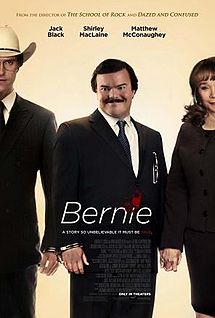
Quick Edit: How Do You Solve a Problem Like Bernie?

Viewed August 21, 2012

Director Richard Linklater originally made a name for himself with film-stories set in his native Texas, everything from Slacker (1991) and Dazed and Confused (1993) to SubUrbia(1996) and The Newton Boys (1998). Even his beloved European-set Before Sunrise “franchise” has a Texas connection: Ethan Hawke’s writer, who in some small part might be based on Linklater himself, also hails from the southwestern state. The comedic true crime story Bernie (2011) returns Linklater to Texas for the first time since 2006’s Fast Food Nation and reunites him with the star of 2003’s The School of Rock, Jack Black, as well as early muse Matthew McConaughey.

I passed on Bernie when the film hit select theaters in late April of this year, not because I wasn’t interested in the story of a much fawned-over gay assistant funeral director shooting dead his 81-year-old multi-millionaire companion, the small town’s wicked witch, but because I already knew all of its plot details. I had read a New York Times Magazine article by Joe Rhodes, the nephew of the victim Mrs. Marjorie Nugent, and learned that for nine months Bernie kept up the pretense that Marjorie, stuffed in a freezer, was alive while he spent millions of her dollars, “generously” gifting people all over town. Despite Bernie’s, uh, indiscretions, Rhodes, like practically everyone involved, seems to find him the more sympathetic character. It’s a fascinating story, but I wonder if Bernie‘s storytelling format was the best choice. In any case, I heartily recommend Rhodes’s examination of the events leading up to and following Bernie Tiede’s killing Mrs. Nugent that, as the movie’s tagline says, constitutes a story “so unbelievable it must be true.” You just might want to see the movie first, because it does spoil the plot. As does this review of the film Bernie.

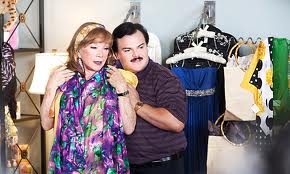
East Texas. The date? I’m not quite sure, as the true events took place in the 1990s. But while the production and costume design seem to indicate this period, Bernie (played by Jack Black) has an iPhone, which wasn’t released until summer 2007. So what can you do? Anyway, as the assistant funeral director in Carthage (approximately 7,000 inhabitants strong), Bernie is well-known for his attentive care of the recently bereaved (particularly elderly widows), and his boss especially values his employee’s superb up-selling skills. Bernie manages to thaw Marjorie’s (Shirley MacLaine) cold, miserly heart following his supervision of her bank-owning husband’s funeral (which actually took place in 1990). From that point on, they are virtually inseparable. They travel everywhere together, go on extensive shopping sprees, and eat at the finest restaurants as well as the local, rustic watering holes. (Hilariously, in one scene, Marjorie pesters Bernie to help her pick out a nice dress for dinner, forcing him to stop whatever he was doing at the time he received her call. Then, in an unfussy cut, it’s revealed that they’re only dining at a chintzy Mexican cantina in town). People speculate that Bernie has to be supplying sexual favors in order to receive that kind of lavish, undivided attention from Marjorie, who has alienated everyone who has ever come in her path, including her family members. Marjorie becomes so attached to Bernie that she demands to know where he is and what he is doing at every hour. In his defense, the word that Bernie constantly uses to describe Marjorie’s dependency on him is “possessive.” Then, in an impulsive move one day in 1996 (again, according to actual events), Bernie takes the shotgun for killing pesky armadillos and shoots Marjorie in the back four times, the symbolism not lost on the audience. Immediately remorseful, Bernie prays, but instead of alerting the police, he packs her into the freezer in the garage and goes about life as if she is merely the house-bound victim of a series of strokes. No one else likes to see or talk to her, anyway—except for her nosy stockbroker (Richard Robichaux), who’s onto Bernie’s misdeeds.

As they grow closer, Marjorie defers to Bernie on all matters of fashion. She even starts to wear her hair down. Image courtesy of http://www.nytimes.com.

No matter how overly prepared I was to watch Bernie, I never expected that Linklater, who co-wrote the script with Texas Monthly crime reporter Skip Hollandsworth, would choose to frame the narrative as a docudrama, complete with historical reenactments starring Black, McConaughey, and MacLaine; numerous talking head interviews with real townspeople; and title-cards that read “Who is Bernie?” and “Was Bernie gay?” One might even be tempted to label the film a mockumentary, for it gently pokes fun at the residents’ bigotry and simple-mindedness. For instance, knowing Bernie to be an outstanding Christian for all his involvement in church activities, including orgiastically singing hymns and paying for a new prayer wing (with Marjorie’s money, of course), the people of Carthage refuse to believe Bernie killed the town’s least popular resident—even after he confesses to the crime once Marjorie’s financial adviser and family members start investigating his trail of lies. In fact, Bernie is so well-liked for his caring and easygoing demeanor that District Attorney Danny Buck Davidson (McConaughey, made comically un-handsome and outfitted with shirts—baggy ones, at that—big, round eyeglasses, and short, matted hair) successfully motions for Bernie’s murder trial to be moved 50 miles away to ensure that selected jurors are unbiased. In the end, he’s sentenced to life in prison, and according to Rhodes, he will be eligible for parole in 2027, when he is sixty-nine-years-old.

One of the real, colorful townspeople of Carthage gives us a handy-dandy geography lesson, enumerating the cultural differences among almost all of the republics of Texas. Image courtesy of http://www.largepopcorn–nobutter.blogspot.com.

In exploring the surreal circumstances of Bernie and Marjorie’s relationship, the film regrettably relies too much on the testimonials of real Carthagians. It’s unclear if their lines are scripted, improvised, or unrehearsed. But the warm, burnt cinematography by Dick Pope seamlessly blends their one-sided conversations (with the documentary lens) with the scenes featuring the trio of the top-lining professional actors and their supporting cast. In other words, despite the fragmented structure of Bernie, Carthage comes across as a fully realized universe and lived-in place, even if Black, McConaughey, and MacLaine barely share any screen-time with the “real” people. However, though all three turn in captivating performances (particularly Black, who dials his trademark zaniness way down), I couldn’t help wishing that Linklater and co. had given the stars more to do. Earlier, I labeled their scenes “historical reenactments” because they mostly just serve the narrative as related by practically everyone in town. They seemingly act out scenes in order to support the Carthagians’ arguments about how gregarious a fellow Bernie was (cue Jack Black, in character, directing and performing in a high school production of The Music Man) and how downright nasty Marjorie was (see MacLaine throw a Hispanic family’s mortgage loan in the garbage as soon as they leave the bank).

Admittedly, one of the best scenes integrates the documentary and comedy-drama bits and, unsurprisingly, unfolds at the very end, allowing the story to come full-circle: one of Bernie’s real-life apologists visits him in jail, still in denial, and reiterates her request that he sing at her own funeral, whenever it is. Touched, Bernie tries to tell her that it’s impossible, as he doubts he’ll ever get permission. But she’s just not hearing him. When their time together is forced to close, the camera follows Bernie contentedly walk back toward his cell, eventually staying put to capture his receding presence—and slightly sashaying hips. As if to say again, “Can you believe this man is a convicted murderer?” This isn’t to say that the filmmakers think Bernie is innocent. He is most definitely not. Having formed my first impression of Bernie Tiede based on Joe Rhodes’s interpretation of his aunt’s life partner-turned-killer, I can see that the filmmakers find him just as sympathetic as Rhodes does. We’re meant to perceive Bernie as simply a good person who snapped and did a very bad thing. More tellingly, to some degree, I think the storytelling structure of Bernie precludes the spectator from strongly identifying with Marjorie. That is, representing the real townspeople’s overwhelmingly sentimental observations about Bernie does very little to redeem Marjorie; no one comes to bat for her. To add insult to injury, MacLaine’s limited screen presence means her character isn’t as fleshed out as Jack Black’s Bernie, leading my dad to comment that her bickering Marjorie recalls her performance as a grumpy and difficult First Lady to Nicolas Cage’s secret serviceman in Guarding Tess (Hugh Wilson, 1994).

It was only during my Google search for images to accompany this article that I made the connection that Bernie has a premise not-too-dissimilar from the one guiding Weekend at Bernie’s (Ted Kotcheff, 1989), wherein Andrew McCarthy and Jonathan Silverman live large at their horrible boss’s vacation home after the titular schmuck (Terry Kiser) dies unexpectedly during their stay; like Bernie, the pathetic stooges pretend their employer is still alive and try to outrun the cops (among others). But whereas Weekend at Bernie’s takes a slapstick approach to defiling the sanctity of the human corpse, Bernie explores the all-too-realness of this possibility. It’s an intriguing little story, and it’s shocking that Carthage still sings his praises. Just what exactly is in the well-water over there? I wonder how the town’s residents responded to the film, too.

Long Take: Mirror Mirror, Off the Wall

Viewed August 18 & 19, 2012

Two “subversive” re-hashings of the fairytale Snow White and the Seven Dwarfs premiered in theaters this year, Mirror Mirror (Tarsem Singh Dhandwar) in late March and Snow White and the Huntsman (Rupert Sanders) in early June, the studios’ schedules leaving barely two months between their releases. In the battle for my interest, the latter prevailed. At the time, I found its darker vision more intriguing, the welcome prospect of meeting an active—even kick-ass—heroine more certain, despite dull-as-wood Kristen Stewart’s playing the part. Mirror Mirror, on the other hand, appeared to be a campy, self-conscious comedy that tries-too-hard. Having now seen it on DVD, I can say that looks aren’t deceiving in this case.

At first glance, it’s easy to identify the colorful, other-worldly mise-en-scène of Mirror Mirror as exactly what we have come to expect from “visionary director” Tarsem (as he is usually credited), whose earlier works include The Cell (2000), The Fall (2006), and the extremely loose adaptation of the Theseus-starring Greek myth Immortals (2011). On closer inspection, however, Tarsem’s characteristic style-over-substance M.O. impresses the observation that Mirror Mirror looks as if Tim Burton had made it as a sort of companion piece to the 2010 revisionist megahit Alice in Wonderland, as both films attempt to give their young heroines more feminist agency while on their journeys toward adult womanhood. There’s just one caveat: the new Snow White adaptation, unlike any Tim Burton film, doesn’t take itself seriously. It is a pastiche of styles and attitudes, mixing a prologue featuring porcelain-like puppets with an epilogue that consists of a Bollywood musical dance number. It’s overwhelmingly cynical but hopelessly romantic at the same time. Crucially, too, the film’s less-than-spectacular special effects are no match for its opulent, golden production and costume design (the latter of which comprises legendary designer Eiko Ishioka’s last on-screen effort).

Mirror Mirror turns the all-too-familiar fairytale upside down—especially its story structure. Unfortunately, though, it doesn’t subvert the form and instead reaffirms the romantic ideal, even after doing so much to tear it down. If I haven’t already spoiled it for you, I’m definitely going to do so now.

Julia Roberts, as The Queen and evil stepmother of Snow White (a likeable if thickly browed Lily Collins), narrates the tale from her perspective, asserting that it is her story. Most likely responsible for the King’s presumed death when Snow was a little girl, the beauty-obsessed Queen tyrannically reigns over the kingdom in his absence, for more than a decade by the time the film story begins. Cash-strapped and insecure, she keeps a now teenaged Snow White locked up in her room, demands exorbitant taxes from the destitute commoners to pay for gala events and chemical peels, and desires a new rich husband to ensure her lavish spending habits continue unabated. On her eighteenth birthday, Snow White finally leaves the castle to see what the Queen’s rule has subjected her people to, and en route to town, she encounters the arrogant but handsome Prince Alcott of Valencia (Armie Hammer) and his valet Renbock (Robert Emms). Strung upside down on the branch of a tree in the frosty forest, the men are so ashamed to be the victims of a mugging by a band of dwarfs on stilts that Alcott insists they are commoners. Sparks fly after she cuts them free, and they go their separate ways.

Snow White and Prince Alcott meet again later that night—this time as themselves—at the ball that the Queen throws in his honor, an over-the-top attempt to woo him since he comes from a country with lucrative industry and trade. Jealous of the attention he bestows upon her stepdaughter, the Queen demands that her “executive bootlicker” Brighton (Nathan Lane) abandon the girl in the woods so that the mythic but very real beast gobbles her up. Brighton goes so far as to bring Snow White to the forest, but he sets her free. She eventually happens upon the hideout of the seven dwarf bandits and convinces them to let her stay. Her heretofore untainted moral compass directs her to make-over their image by returning to the commoners, in the dwarfs’ name, the Queen’s tax collection that they stole, thereby elevating the social rejects’ status in the eyes of the people. That’s one mission accomplished. By turning the bandits into Robin Hoods, Snow White invites them to transform her into a member of their gang, a partner in arms against the indignities of the Queen. A Karate Kid-like training montage ensues as the leader Butcher (Martin Klebba) intones maxims on thieving. Yep, this sure isn’t your Disney-bred Snow White. But this is just one trope that Mirror Mirror turns on its head; most of them hinge on Snow White’s relationships with the Queen and Prince Alcott.

According to Tarsem, the Queen isn’t “evil; she’s just insecure.” I beg to differ (for reasons already enumerated), but there is something to be said for her vanity. One of the most amusing scenes revolves around her intensive beauty regimen before the gala. All kinds of disgusting “creams,” including animal dung, and insects that burrow in her bellybutton are applied. The Queen, reclining with her eyes covered, admonishes her attendants for taking pleasure in her revolting appearance. It’s unclear, given her quips and the servants’ smiling-to-frowning faces, whether the Queen delivers or receives the brunt of the joke about the ugliness of beauty’s upkeep. After all, she still comes out looking like Julia Roberts, whose casting is definitely meant to be a meta-commentary on the Hollywood edict that proclaims women of a certain age (or women who are not as desirable as they were when they were younger) utterly useless. In Snow White and the Huntsman, thirty-seven-year-old Charlize Theron plays the equivalent role, but rather than exploit her beauty for money (to buy things), Theron’s vampiric Ravenna uses it to usurp power and make everyone suffer under her rule because she has been abused by kings the world over. This constitutes a hyperbolic but provocative feminist assertion, that a woman subverts the culture’s idealization of femininity through an aggressive, albeit aberrant (or murderous), sexuality. Mirror Mirror‘s representation of power is cartoonish by comparison. So Tarsem may want to believe that the Queen’s vanity isn’t her motivation and that it doesn’t make her evil, but he forgets that insecurity and vanity are two sides of the same coin and together they make the Queen commit copious crimes.

If looks could kill, it’d be a much shorter movie. The unambiguously evil despot Ravenna in Snow White and the Huntsman. Image courtesy of http://www.ew.com.

And this is what makes troublesome Prince Alcott’s motivation in visiting the kingdom: to explore the prospect of marriage to the much older Queen. He hasn’t come to seek Snow White’s hand; in fact, before they meet at the ball, equally ridiculous dressed as a swan (Snow White) or rabbit (Prince Alcott), the prince seems to have no idea that she has ever existed. This is probably because the Queen has kept her beautiful stepdaughter under lock and key, but that doesn’t answer the question why Prince Alcott would ever be moved to pursue the Queen. Hasn’t he ever heard stories of the horrible treatment she inflicts on her people? Doesn’t he know that she’s bleeding money and wouldn’t have much to offer his country by way of wealth or prestige? Does he just not care about her character because she’s supposed to be the fairest of them all (of course, due to a little magic)? This isn’t the first time Prince Charming has ever come across as superficial, but Tarsem and screenwriters Marc Klein and Jason Keller are dead-set on deconstructing the character as an avatar of masculinity and an expression of women’s wish fulfillment. To his credit, the actor Armie Hammer is pretty game.

For starters, Prince Alcott’s shirtlessness at various points throughout the film offers more than just a little comic relief. His arrogance so inextricably linked to his body, whenever he is half-naked he feels vulnerable and emasculated (hence why he won’t admit that dwarfs overpowered him and stole his clothes). The scene of his meeting the Queen, who’s distracted by his nudity, reminded me of the scene in Brave (Mark Andrews, Brenda Chapman & Steve Purcell, 2012) wherein the queen and princess look at each other from afar while sizing up the grotesquely muscular would-be suitor standing before their thrones. Similarly, it’s clear from Prince Alcott’s introduction as a beautiful man whose body is on display for each of the warring women (as well as for the audience) that Mirror Mirror aims to turn the fairytale upside down by sexually objectifying the prince. But that’s not the only way the filmmakers degrade the character.

Prince Alcott, as seen from the Queen’s perspective, makes quite an alluring first impression. Image courtesy of http://www.mynewplaidpants.blogspot.com.

As I previously mentioned, Prince Alcott arrives at the Queen’s ball (which itself made me wonder whether the filmmakers were confusing Snow White with Cinderella) outfitted with over-sized bunny ears. The Playboy/Playgirl aesthetic wasn’t lost on me, but his costume serves more to humiliate and endear him to Snow White, who is portentously dressed as a swan (although never an ugly duckling, she’s bound to come into her own as a confident woman). As if this didn’t sufficiently make Prince Alcott feel like a giant ass, the filmmakers’ story calls for further debasement. Midway through the film, the Queen seeks a magic love potion from her twisted psyche, which only manifests in the mirror where she sees a version of herself that as calm, wise, and, notably, unwrinkled. Predictably, things go awry, and Prince Alcott, by now in love with the Snow White who lives with the dwarf robbers, becomes hopelessly enamored of the Queen in the same way that a dog is loyal to his master. For a good fifteen minutes or so, the six-foot-five Hammer gets to act like a tiny lap dog, complete with heavy panting, tongue wagging, and non-diegetic yapping and whimpering sounds. At first annoyed by the mix-up in her plan, the Queen accepts this brand of fealty, memorably shooing him away, out of the castle, with a game of fetch.

The Puppy Love Potion cleverly demonstrates how easily Prince Charming is manipulated according to the Queen’s and Snow White’s individual needs and desires. The Queen just needs him to be present for their wedding, but when news first gets out that Prince Alcott has agreed to marry the Queen, Snow White kidnaps him. Notably, rather than use this language (or even “take hostage”), everyone, including both women, says that “Prince Alcott has been stolen,” thereby suggesting his objectified status as both moneybags and lover. And this is where one of the most perplexing instances takes place in the film’s rewriting of the Brothers Grimm fairytale.

Poor Prince Alcott. Napoleon has at him, but only Snow White has the antidote to the Queen’s Puppy Love Potion.

To break the spell, Snow White and the dwarfs try all manner of things: knocking him on the head, slapping his cheek, tickling his sides, whatever will inflict pain. Mainly, it’s just an excuse for the angry woodsmen to exact revenge on the pompous prince who has constantly belittled them. Eventually, Snow White deduces that a kiss will return him to her. OK. We get it, this Snow White is active and not passive, a sexual being rather than a rape victim (a fairytale situation made even more complex in novelist Julia Leigh’s debut feature from 2011, Sleeping Beauty). Upon hearing that this puckering up will constitute her first kiss, one of the dwarfs, Napoleon (Jordan Prentice), splashes powder on her face, reddens her lips with strawberries (didn’t the fruit make an appearance somewhere in the 1937 animated Disney feature?), and ties up her long black locks. It’s unclear whom this gesture is meant to arouse, because Prince Alcott for all intents and purposes is still a dog tied up in a chair. In fact, this scene is incredibly cringe-inducing because Snow White essentially violates the man, despite his emphatic protestations. So instead of Snow White requiring an unsolicited sexual overture to bring her back to consciousness, in Mirror Mirror she is the sexual predator who gets to act out this fairytale wish on the unconscious man of her dreams. And voilà! It works! This isn’t exactly what I had in mind for subverting the kissyface portion of the fairytale.

Honestly, the filmmakers lay thick throughout the picture how hopelessly smitten with Snow White one of the dwarfs is that I wish their romantic union could have had more of a shot. Sure, all seven of them come to love and respect her. But Half Pint (Mark Povinelli) in particular desires a romantic future with her, about which his family of friends wishes he would stop dreaming. Very tellingly, he’s heartbroken that Snow White chooses Prince Alcott over him, and at the dinner table when they all learn that the prince is to marry the Queen, some of the dwarfs wonder aloud how she could love such a jerk. Recalling Prince Alcott and Snow White’s sword-fighting duel, Chuckles (Ronald Lee Clark) says, “But he tried to kill her yesterday” simply because she’s in cahoots with the woodsmen who are the bane of his existence. Napoleon’s reply? “Exactly.” In this way, accepting Prince Alcott’s violent behavior from the day before as indicative of their belonging together makes for a extreme case of gendered playground role playing. Apparently, this is no different than a boy, who likes a girl, pushing her down in the sandbox because expressing interest and concern in girls isn’t manly behavior he wants to replicate in front of everyone. I know that the dwarfs act as a unit and therefore not a single one of them could ever make a play for Snow White’s affection. But imagine a story in which this romantic entanglement does take place. The comedy and/or drama could emerge from the friction between Snow White and the others. They might feel threatened by her presence; she might Yoko the band. And maybe she would have difficulty adjusting to his rustic way of life. Oh, to dream of the movies not yet made.

Snow White and her merry band of misfits. Would-be paramour Half Pint’s to the right of her face, in the red cap. Image courtesy of http://www.teaser-trailer.com.

The dwarfs build a charming collective. Racially diverse, with different interests and opinions, they complicate past representations of the group. They may have strange or slightly offensive names (Butcher? Half Pint? Chuckles? Wolf? Grimm? Grub?), but at least they are portrayed by dwarf actors. The dwarfs of Snow White and the Huntsman, you may recall, were played by such British heavyweights as Bob Hoskins, Ian McShane, Ray Winstone, and others, whose heads were digitally super-imposed on those of dwarf actors. But enough about that; it’s puzzling why in the end the dwarfs throw all of their weight behind Prince Alcott. Touted as his personal army, they never actually fight beside him. Especially since Snow White locks Prince Alcott and her friends inside their hillside hut because, as she says, she wants to rewrite the fairytale ending by not relying on Prince Charming to rescue her from the evil forces of her stepmother. Hilariously, Prince Alcott pleads that she not change the story structure; it’s been “focus-grouped” to death and thus satisfies audiences. If only Snow White had remained so ardently independent through to the end of the picture.

After their “special” kiss, the vengeful Queen arrives in the forest hell-bent on killing them all. She sicks the beast on them, and later, once he has our heroine within his grasp, Snow White understands how the Queen can control him. She uses her father’s dagger to cut off the beast’s half-moon necklace, the exact same style that the Queen wears about her neck. In the slow resolution of this scene, I assumed that the Queen would reveal herself to be the beast, as if all the magic at her disposal has only ever gone toward presenting her in Julia Roberts’s pretty form. Nope. Nothing so cool. Instead, the beast is Snow White’s father, who morphs back into his human self (Sean Bean). He goes on to officiate Snow White and Prince Alcott’s wedding in the next scene. Rather than going on to rule benevolently and independently, as the triumphant Kristen Stewart does in Snow White and the Huntsman, in one fell swoop, Snow White’s relationships with the men in her life are redefined yet again. At once, she is an adult, married woman who has proven herself a brave and capable ruler, as well as a subordinate daughter. When I told my sister how much of a letdown I found this ending to be, she chastised me for wishing the King had stayed dead. “Wouldn’t you rather have your dad than be queen?” she asked. Well, yes, I would, but I wanted Snow White to remain free and powerful!

Finally, the last Snow White and the Seven Dwarfs trope that Mirror Mirror unravels concerns Snow White’s vanquishing of the Queen. The villainess attends the wedding ceremony as a peasant hag and gifts Snow White a poisoned apple. Her voice and cryptic diction give her away, and before Snow White takes a bite, she cuts a slice and offers it to the hag, telling her, “It’s important to know when you’ve been beaten.” That’s the exact phrase the Queen used to silence her stepdaughter early in the film. In this way, Snow White gives the Queen a taste of her own medicine, which this time proves lethal. So ding dong, the witch is dead! As if that wasn’t going to happen. Then the Queen, as narrator of the film-story (from beyond the grave?), concedes that it has been Snow White’s tale all along. Again, tell me something I don’t know.

Long Take: Winchester ’73 Shows How the West Was Won Still Fascinates Us

Viewed August 9 & 16, 2012

Like some—maybe even many—people of my generation, I didn’t grow up with a fondness for the western. This kind of picture wasn’t widely produced when I was a youngster. Since genres go through cyclical periods of (often frenzied) popularity and then disuse, to put it simply, timing is important, but not everything. Although my father is a fan of the classic westerns of the 1940s and 50s, he never instilled in us kids an enthusiasm for movies set in the Old West, centered on macho disputes over land, women, and personal freedom that are couched as epic battles between good and evil. It’s only been in recent years, after being forced (yes, forced) to watch them and analyze their deeper meanings, that I have come to appreciate the western. And in an effort to clean out my nearly full DVR this summer, I submitted to Anthony Mann’s Winchester ’73 (1950) and found a mythologizing film-story set in 1876 about how the titular gun “won the west” and conquered the popular imagination (thus, the film is also a study in American material culture). You’re about to enter Spoiler Territory ahead. Consider this your first and final warning. Then again, the movie’s sixty-two years old. The statute of limitations has been lifted for quite some time now.

Jimmy—sorry, James—Stewart stars as Lin McAdam, a highly skilled rifleman who rolls into Dodge City, Kansas, with best friend and sidekick Frankie “High Spade” Wilson (Millard Mitchell) on the centennial Fourth of July, a day that the town celebrates by hosting a shooting competition. The prize is one of one thousand priceless, perfectly manufactured Winchester repeating rifles, Model 1873. Sheriff Wyatt Earp (Will Geer) confiscates McAdam’s and High Spade’s guns as soon as they enter town, since Dodge City is a no-gun zone. This means the only way McAdam can best his arch-nemesis Dutch Henry Brown (Stephen McNally), who is also in town, is to beat him at this game, which he does with a lot of panache. In one of those now recognizably racist representations of American Indians, McAdam pays little money for a Indian spectator’s tribal necklace so that he may break off one of its medallions and blow a hole through it after Sheriff Earp throws it up in the air. Covetous of McAdam’s (fully operational) trophy, which McAdam declines to have engraved with his name for lack of time (a maneuver that makes for convenient story plotting), Dutch and his men ambush the winner, steal it from him, and ride out of town without collecting their own guns from the sheriff’s brother, Virgil. McAdam and High Spade are hot in pursuit.

Dodge City Sheriff Wyatt Earp, center, presides over a shooting competition between the just Lin McAdam, left, and the outlaw Dutch Henry Brown, right. Earp has no idea what his contest has set off. Image courtesy of http://www.listal.com.

Synopses of Winchester ’73 typically relate that the film tracks the journey of the rifle, as it is passed from one person to the next. Dutch loses it in a card game to the Indian trader Joe Lamont (John McIntire) while seeking to refuel and arm his men at a saloon on the border with the Indian territory. Later, Lamont refuses to offer Young Bull (Rock Hudson in one of his earliest screen credits) the Winchester ’73, a rifle like the ones that Lakota Chief Crazy Horse (alongside Sitting Bull) and his men used to defeat Lt. Col. George Custer at the Battle of Little Big Horn just months ago. In a deal gone wrong, Young Bull strips Lamont of the gun and then kills and scalps him off-screen. In this way, both sides want the rifle for protection and conquest, but it’s impossible to read their awed faces when in its presence without acknowledging that they have all bought into the myth that the gun, at least in retrospect, is “The Gun that Won the West.” In each man’s eyes, it’s his own ticket to greatness, infamy, legend. Not only will the Winchester ’73 help him reach all of his goals, it will bestow special god-like powers. (Yes, having a murderous streak running through you will make you believe you’re a god when you have the power to kill people from far away, without having to continually reload your weapon.)

For some of the men, like Steve Miller (Charles Drake), who gets it in the aftermath of an impromptu battle against Young Bull, the gun could potentially transform him from coward to brave hero. Except, it doesn’t. He doesn’t have it for more than a day. A supposed friend, the psychopathic Waco Johnny Dean (a charismatic Dan Duryea) shoots Steve dead in front of his fiancee, the former Dodge City saloon girl Lola Manners (Shelley Winters), whom Steve previously and temporarily abandoned when Young Bull chased their wagon the day prior, leading them to seek refuge at the camp of inexperienced U.S. cavalrymen led by Sergeant Wilkes (a funny Jay C. Flippen). It should be noted that during this hideout, McAdam and High Spade also happen upon the army’s makeshift outpost and, thankfully, successfully guide everyone in battle. McAdam rides away before Sgt. Wilkes discovers Young Bull’s rifle, and so he gives it to Steve, a golden opportunity for him to later, fatally, prove his manhood. Very fetishistic, indeed. (It’s worth noting, too, that Wilkes couldn’t have known that it’s McAdam’s rifle; he just wanted to thank him for his superb reinforcements. The historical paper trail on the gun’s provenance runs cold when one looks for the owner’s name on the engraving, which therefore suggests that the mythic Winchester ’73 belongs to everyone and no one at the same time. But, of course, as film-viewers, we know it belongs to one man specifically.)

The eponymous repeating rifle that belongs to McAdam, but from the look of it to everyone and no one in particular. Image courtesy of http://www.derekhill.wordpress.com

And that’s just it. Winchester ’73 is about men and their toys. Or so it would seem. From the beginning, we understand that McAdam and High Spade have been hot on Dutch Henry Brown’s trail for a long time for a specific crime he once committed, though we don’t know what it is. That he took off with the priceless rifle McAdam deservedly won is just an excuse to keep pursuing him. So, while I like to think of Winchester ’73 as a film that examines how a single material object shaped the lives of all those who came in contact with it, in the process both deconstructing and perpetuating the legend that the gun played a vital role in settlers’ so-called “civilized” domestication of the Wild West, I can’t help but notice that the gun itself is a MacGuffin. Sure, it’s not an empty plot device a la the eponymous Maltese Falcon in John Huston’s film noir from 1941; the Winchester is loaded with symbolism in cultural, historical, and political terms. However, McAdam doesn’t seem to want or need the gun to feel complete. He just really wants Dutch dead.

Things heat up once all parties reach Tascosa, Texas, where Dutch and his men botch a bank robbery. Waco Johnny Dean, a would-be co-conspirator, has brought with him Lola Manners. For when you take away a man’s life in outlaw country, you take with you his gun and his bride. Anyway, seeking information about Dutch’s whereabouts from Waco Johnny, McAdam has no choice but to kill his uncooperative informant, thereby releasing Lola from her prison of implied sexual slavery in one fell swoop. She’s grazed by a bullet from the gunfire in the street (following Dutch’s ill attempt at robbing), a hooker with a heart of gold because she tried to get a child to safety. McAdam chases after Dutch to the hills outside of town. Director Anthony Mann uses parallel editing to cut between the action in town and on the rocks. In this climatic scene, High Spade illuminates for Lola—and by extension, the audience—the reason for McAdam’s lust for Dutch’s blood: turns out they’re brothers, and Dutch (né Matthew) killed their upstanding father when he refused to offer shelter to his thieving son. For added pathetic emphasis, High Spade says Dutch shot his dad in the back. OK. We get it, he’s one spineless, evil dude, contractually bound to get his narrative comeuppance.

Honestly, the revelation that McAdam and Dutch are brothers is so contrived, a crucial piece of the story’s puzzle lazily tacked on before the super-imposed title card flashes “The End.” Definitely, if we knew of their familial connection early on in the film, which my father is convinced is the case (I swear to you, it’s not), the narrative would lose some of its suspense. But not much of it. In fact, if their backstory were more fleshed out throughout the picture, then the stakes would have been upped exponentially, kind of like how the paternal melodrama of Red River (Howard Hawks, 1948) plays out between cattle rancher John Wayne and his adopted, rebellious son Montgomery Clift: will Wayne really make good on his promise to kill Clift in the end for his mutinous betrayal? In the very least, with an improved development of the brothers’ individual motivations in Winchester ’73, we wouldn’t have to rely on first impressions alone to size up Dutch’s character before he even makes a break for McAdam’s prize. Come to think of it, how did they manage, in that hotel room scuffle, not to hint at their relation? No warring brothers could plausibly accomplish that. Then again, if Mann and screenwriters Robert L. Richards and Borden Chase had taken the route I’m retroactively proposing, McAdam’s quest for the rifle would be even more transparently about beating his brother at a childish game of war and less about how “The Gun Won the West.”

In this promotional still for the movie, the self-aggrandizing sexual power that the Winchester ’73 gives off is completely unambiguous. That’s Lola in McAdam’s crotch, nursing a war wound. Image courtesy of http://www.hollywoodsgoldenage.com.

But the filmmakers themselves can’t make up their minds about what to do with the gun. (Or maybe I’m just projecting my own intellectual frustrations. That seems more likely.) Because in the end, after inevitably killing his brother, McAdam wins the war and takes back the spoils that are rightfully his. With the ruckus caused by the snatching of his toy now settled, he is also rewarded the love of a woman (who has proven herself good). Sure, she’s a flirt, but she’s also a defiant survivor clearly bedazzled by McAdam’s shooting skills and respectful interaction. He treats her like a lady, not a tramp. (In an earlier scene, before Young Bull’s not-so-surprise ambush, McAdam gifted Lola his six-shooter, and his gentlemanly gesture wasn’t lost on her: she was to shoot herself before letting any Indian take her captive.) So it appears as if there has been some underlying anxiety over McAdam’s masculinity, after all. In other words, regaining the Winchester ’73 does complete his own transformation. Implicitly, but not-so-subtly, he couldn’t settle down with a woman (preferring High Spade’s company to anyone else’s, it has to be said) before he successfully vanquished his brother. And now that he has his rifle prize back, his righteous, unambiguously heterosexual manhood is restored and he can aggressively pursue romance with Lola. That’s just about what you would expect from any and all westerns, but Winchester ’73 more explicitly weds generic trademarks (such as the domestication of redemptive rogue souls) to the complex processes of mythologizing the Wild West in popular American culture. It does this, my friends, by harnessing the emotive and symbolic power of the titular gun.

Long Take: Hope Springs, Not Exactly as Promised

Viewed August 11, 2012

This past Saturday was my birthday, and in my family—as in many families, I would suspect—we go to the movies to celebrate before dining out. We’re just not that creative. Unfortunately, there were slim pickings to choose from this year. I had no desire to get confused during The Bourne Legacy (Tony Gilroy, 2012) or to catch up by seeing last month’s The Dark Knight Rises (Christopher Nolan, 2012). So I opted for Hope Springs (David Frankel, 2012), the sweet little comedy about a couple in their sixties rekindling the romance and spicing up their sex lives after thirty-one years of marriage. When I told my film critic friend Gabe of my plans to see this movie, he joked, “I had no idea you were a sixty-something sex-starved housewife with zero interests.” My response? “Now you do!”

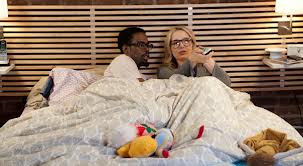
It’s not that I regret my choice, but Hope Springs did very little to impress me. I wasn’t expecting much, as I had somewhat foolishly read reviews beforehand, positive and negative alike. In particular, I knew not to expect a zany battle-of-the-sexes-type romantic comedy that the trailers and TV spots implied. In fact, while Hope Springs is not without its funny moments, it should be more accurately classified as a drama, for it treats Kay (Meryl Streep) and Arnold’s (Tommy Lee Jones) lack of physical and emotional intimacy in their marriage as a deathly serious problem. And that’s fine by me. When a couple that has been together for over thirty years and raised two children (who are now out of the house), sleep in separate rooms and barely talk to each other, getting them to reconnect is serious business. Washington Post chief film critic Ann Hornaday claims, “Hope Springs is a minor miracle of a movie,” as it tackles its subject “with a degree of integrity and candor rarely seen in American movies.” I agree, but to an extent. Here’s why. Fair warning: spoilers follow!

Omaha, Nebraska. We meet Kay and Arnold right around their thirty-first wedding anniversary. And that’s the first of many implausibilities. Given their socially conservative backgrounds, having met and married when Kay was in college or just graduated, they should be married for longer and with older kids, too. Anyway, stuck in a deep rut wherein they sleep in separate rooms (owing to Arnold’s years-old back injury) and gift each other a new cable subscription, Kay intends to break free, taking Arnold with her. A retail clerk at a Coldwater Creek fashion outlet for conservatively inclined middle-aged women shoppers, she takes what little money she’s saved over the years and splashes out on a week of intensive couple’s counseling sessions with Dr. Bernard Feld (Steve Carell as subdued as ever) in Great Hope Springs, Maine. (I imagine that screenwriter Vanessa Taylor grants Kay this job so as to distance her from earlier iterations of this sad-sack character. In other words, Kay isn’t simply a fed-up homemaker, she’s a fed-up former housewife who in recent years as reentered the workforce, albeit only the service industry.) From the beginning, and throughout most of their sojourn, Arnold is hostile to Kay’s expensive, faraway effort to save their marriage, but of course he gradually becomes more game, more willing to open up to Kay, at Dr. Feld’s insistence.

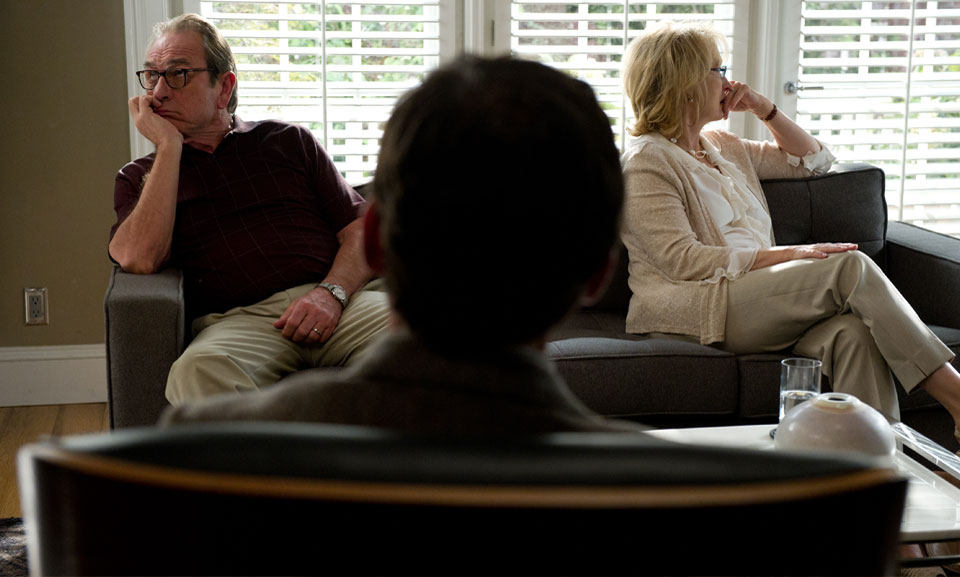
Arnold and Kay, as seen from Dr. Feld’s perspective, before they inevitably get back together in the end. First step: turning around to look at one another. Image courtesy of Sony Pictures and http://www.hopesprings-movie.com.

Hope Springs is highly uncinematic and not at all like the promotional image seen directly above. It mainly cuts between long scenes set in Dr. Feld’s office, where he prods each with questions about his or her sexual history and fantasies, and short scenes that take place around the small, idyllic town, whether at the staid motel room, kitschy diner, bar, or lighthouse museum. Director David Frankel, who previously worked with Streep on her Oscar-nominated role in The Devil Wears Prada (2006), adds no flourishes. What he’s produced is an awfully boring film whose scenes—let alone frames—hardly look different from each other. It doesn’t help matters that cliched pop songs dominate the soundtrack, everything from Annie Lennox’s “Why” to Al Green’s “Let’s Stay Together” (the latter of which sounds during a failed attempt to have sex). The instrumental score is almost non-existent; I noticed it in only one scene. Bad form.

But what of these therapy sessions? Although I have never seen either program, I suspect that the HBO series The Sopranos (1999-2007) and In Treatment (2008-2011) more innovatively shoot conversations between a therapist and his or her patient, appropriately heightening the tension between them. To the contrary, everything in Hope Springs is straight-forward. I can only recall one interesting editing technique in all of the scenes at Dr. Feld’s: we hear him ask Arnold questions he doesn’t want to answer, and the camera focuses on Arnold’s anguished face in close-up as he listens to Dr. Feld. Then again, I also appreciated those zoomings in on Kay’s face as she listens to Arnold’s confessions. Whereas my dad liked that Steve Carell managed to reel in his trademark goofy mania, I endlessly tried to come up with names that could play the part with more… oomph. This is not to say that Carell turned in a weak or bad performance, as it probably has more to do with the way Taylor wrote Dr. Feld and how Frankel interpreted the character from her script. What if Dr. Feld had been less calm? Hell, what if he had a sense of humor?

Speaking of casting, let’s address Streep’s and Jones’s performances and their characters. A living legend, Streep predictably embodies her character to the fullest (at least as fully as she can, given the limited script), complete with timid mannerisms and speech and an incredibly dowdy hairstyle. But like Hornaday, I couldn’t help wishing that “her sweet, naive character had just one more layer to make her sharper and more complex,” like her character in It’s Complicated (Nancy Meyers, 2009). As the instigator of the project to rebuild their marriage, Kay begins as the more sympathetic of the pair. We root for her to get what she wants; after all, her desires are more than reasonable. But when Dr. Feld coaxes her sexual fantasies out of her, and she comes up short, not only did I feel sorry for Kay (who claims that she has only ever wanted Arnold, in vanilla-flavored sexual positions and scenarios), I wondered, what is the point? Why should I care about this woman if she doesn’t want something, for lack of a better word, interesting? It’s not enough that, after Dr. Feld’s encouraging her to experiment and act on her fantasies, she attempts to give Arnold a blow job in a movie theater. “Attempts,” being the operative word there. She’s too embarrassed, uncomfortable, and ill-experienced to finish, and she crawls away in shame. What’s worse is that she only ever wants to please Arnold. Other than wanting him to kiss and touch her in innocent ways, she never asks for him to pleasure her in any way. Presented entirely for laughs, Kay doesn’t realize that oral sex isn’t just performed on the man; I wanted to pull my eyes out. Ugh. Compounding all of this is the final scene during the end credits: at the pair’s vow renewal ceremony on the Maine beach a year later, with Dr. Feld and family gathered, Kay pledges to keep her hair long because she knows that Arnold likes it that way. So much for wishing that the original trip had given her a backbone and an independent spirit, which was in evidence when she first boarded the plane in Omaha without Arnold (who showed up, hemming and hawing, at the last possible moment).

Kay and Arnold during one of Dr. Feld’s “intimacy homework assignments.” Woozy. Image courtesy of http://www.washingtonpost.com.

Admittedly, one of the reasons why I had not wanted to see Hope Springs was because I found Tommy Lee Jones unappealing as Meryl Streep’s romantic lead. I didn’t think his on- and off-screen persona meshed well with the demands of what I thought at the time was a romantic comedy. But now I am happy to say that his casting and performance are spot-on. He’s less the grizzled lawman in No Country for Old Men (Joel & Ethan Coen, 2007) or The Fugitive (Andrew Davis, 1993) and more the grizzled businessman in The Company Men (John Wells, 2010). Whereas the chameleon-like Streep alters her voice and appearance when playing Kay (looking older and mousy), Jones looks the same as he always does, except his principal prop is a suitcase rather than a shotgun. As an avatar of a chiseled and mythically strong American masculinity—aging but active, a maverick for the greater good—it’s interesting to see how easily Jones transfers this to his portrayal of Arnold, who’s emotionally stunted, uncommunicative, non-confrontational, and angry. New York‘s film critic, David Edelstein, proposes that Kay’s withholding sexual favors for years frustrated Arnold to the point where he never returned to the bedroom, even after his back got better. As if to say, you did it to yourself, Kay. Ouch. Having said this, though, Jones easily earns the most laughs since he’s the only one, say, really uncomfortable discussing his sex life with a complete stranger. He comes up with many wisecracks, memorably about Dr. Feld’s monotone approach to sexuality (if you’ve seen the trailer, you know what I mean), and Jones is a gifted physical comedian. Who knew?!

According to the movie’s trivia page on the Internet Movie Database, Jeff Bridges was originally offered Jones’s role. When my sister brought this little factoid to my attention, I contemplated how different the movie would be. It definitely would have been more pleasant to sit through the sex scenes (more on those in a moment), since Bridges is a considerably more attractive man. We can’t know why Bridges turned it down unless he ever publicly addresses the question, but we can take comfort that he co-starred in a much more sophisticated romantic drama (with comedic elements) in 1996: The Mirror Has Two Faces, with director-star Barbra Streisand. While Columbia University professors Gregory Larkin (Bridges) and Rose Morgan (Streisand) may be unmarried when the film begins, The Mirror Has Two Faces similarly tracks their platonic relationship as it morphs first into a platonic marriage and later, once she’s had enough of a shared life without passion and romance, a fully-fledged sexual marriage. Granted, I don’t approve of how Rose’s third-act makeover from ugly duckling to stunning swan fixes the sexual intimacy problem of their marriage (in fact, Gregory and Rose marry late in life because they’ve finally found their intellectual equals), but The Mirror Has Two Faces doesn’t shy away from addressing a middle-aged couple’s sexual desires and fantasies. Rose is a fiercely intelligent, neurotic, cosmopolitan, and desirous woman. So much easier to relate to than the bland Midwestern housewife Kay. (By the way, shouldn’t Nebraskans be offended that the Coasts, both East and West, continue to culturally belittle them?)

Actually, now’s a good time to look at those Hope Springs sex scenes. I bet that the filmmakers and the studio behind it think they pushed the envelope simply by making a movie about a husband and wife in their sixties trying to rediscover each other and themselves sexually. Oh, whatever. They don’t go very far. Yes, they push the PG-13 rating, but only in terms of language. For example, Dr. Feld asks if Kay ever wishes they assumed more than just the missionary position during sex. Would she, he asks, prefer to try out anal sex? Blushes and hand-waving ensue. Out of the question. But when sex between Kay and Arnold is represented on-screen, after a romantic dinner at a high-class restaurant in town (for a change!), we see no sexagenarian flesh. Just a lot of fully-clothed groping. Even when Arnold gets on top of her, their clothes stay on completely. I hate it in movies when characters have sex fully dressed. Unless you’re in public and having sex standing up, there is no excuse. How confrontational and realistic do the filmmakers—and I’m talking about those of Hope Springs specifically now—think they are when these sex scenes leave so much to be desired? Maybe I’m being too harsh. It is, after all, a big studio picture that clearly wants to appeal most to Middle American viewers of a certain age, who should find Kay and Arnold hopelessly familiar.

Still, after years of watching films from around the world about people—young and old alike—desperately trying to make a (sexual) connection with someone else, Hope Springs simply comes up short. Ann Hornaday mentions in her Washington Post review that the film is “like the more cheerful, reassuring and commercially palatable version” of a story similar to Michael Haneke’s Palme d’Or-winning Amour (2012), about an elderly man faced with losing his terminally ill wife. I haven’t seen Amour yet, but somehow I just can’t imagine this to be the case. A more appropriate “world cinema”/”art-house”/auteurist comparison is Andreas Dresen’s Cloud 9 (2008), a small, German character study in which a sixty-something-year-old woman, after thirty-odd years of a happy if routine marriage, embarks on a torrid affair with a man in his seventies! With disastrous consequences, of course. As if that were not enough, the director shows the adulterous couple, who, I might add, are nowhere near as glamorous or fit as Streep or Jones, fornicating in graphic detail, their flabby flesh rolling all over each other. It may not be a pretty sight, but it’s certainly more frank, and in its frankness, a beautiful thing. And when you turn to more commercial (read: simply American) output, even It’s Complicated provides a more nuanced view of people approaching 60 who let go of their inhibitions and assert their sexuality in aggressive ways. It’s not for nothing that Alec Baldwin says to his ex-wife Meryl Streep that their affair is like something out of a French film.

Can Female Film Characters Rise to Their Potential?

For the past week or so, one image has stuck with me. It’s of a woman riding alone in a tiny space capsule, hurtling ever closer to the outer reaches of the earth’s orbit. It’s unclear where she’s going and what she will do there upon arrival. I imagine she has a purpose; I just don’t know what it is. No matter how many times she returns to me as a vision, during the day and at night, I can’t see what’s ahead of her or what she’s left behind. I want to know her story. I think it might be potentially interesting.

Despite being unable to develop the lone astronaut’s narrative, I can easily trace the different threads of information that likely led to her appearance in my mind’s eye. First and foremost, the first American woman in space, Dr. Sally Ride, died on July 23 at the age of 61, after quietly suffering from pancreatic cancer for more than a year. After her groundbreaking trips on the shuttle Challenger in 1983 and 1984 and their attendant media circuses, she lived out of the limelight, retiring from NASA in 1987 and then pouring all her energy into teaching and running the company she founded in 2001, Sally Ride Science. Ride’s high school classmate and sometime book collaborator Dr. Susan Okie recounts in The Washington Post her driven friend’s company mission to promote science and technology as “cool” for middle school students and their teachers, to inspire young girls especially to pursue careers in these fields. I don’t have a scientific or mathematical mind (I really wish I did!), but I so deeply respect Sally Ride and all of her accomplishments.

The pioneering American astronaut Sally Ride. Photo courtesy of NASA, via Agence France-Presse — Getty Images. Accessed at The New York Times.

Then I read, before the August 1 premiere at Georgetown University, about a show titled History Matters/Back to the Future, Scenes by Historic Women Playwrights: Read by Luminaries of the Stage. I’m no authority on the theater, but I know enough to understand where the event’s organizers are coming from: there is an alarming disparity between the number of produced plays written by men and those by women. Washington Post reporter DeNeen L. Brown opens her account of the theatrical production, which coincides with the university’s Women and Theatre Program’s yearly conference, stating the cold, hard truth:

It is a peculiar distinction in the world of playwrights: Works written by men are often called plays. But works written by women are often categorized as “women’s plays.”

“There is a notion in the canon, when men write plays, they speak to the entire human condition, and plays written by women speak to women,” said actress Kathleen Chalfant, a 1993 Tony Award nominee for best actress in a play for her role in Angels in America: Millennium Approaches.

Even plays written by men that are “particularly masculine and talk about issues particular to men, are never called ‘men’s plays,’ ” she added.

Now, I don’t envision the lone astronaut’s narrative trajectory taking place on the stage (I don’t think in terms of the theater). But Brown’s and Chalfant’s observations made an impression on my psyche. Specifically, Chalfant’s choice of words really struck a chord with me, when she argues that there is a perception that plays written by men “speak to the entire human condition” whereas ones by and/or about women can only hope to speak to women, as if the woman’s experience is less than or at least incapable of elucidating the human experience for everyone. Certainly, this isn’t a new controversy or even one confined to the theater. There is a persistent gender bias across all art forms, manifest in libraries and bookstores, museums and galleries, and—most precious to me—cinemas. I think the image of the female space cruiser appeared to me unconsciously as a direct response to the bone-headed notion that women playwrights can’t, in Chalfant’s words, “speak to the entire human condition.” The drive to explore the worlds beyond our own and the desire to comprehend our purpose and beginnings are characteristically human. I know the lone astronaut’s journey of self-discovery is something of a hyperbole, but what if her story could capture for men and women alike a uniquely feminine take on the human experience?

Admittedly, I can’t wave any sci-fi geek flag, having never read Isaac Asimov, Philip K. Dick, George Orwell, or even Ray Bradbury. (But tell me, does Aldous Huxley’s Brave New World grant me at least a few colors? ‘cuz I loved that as a teen.) I’ve only ever seen two episodes of Star Trek, and that number indexes all iterations of the series. I’ve never cracked open a comic book, let alone picked one up. However, I can and do appreciate smart, sophisticated, hard-core sci-fi movies, particularly the kinds that tackle what it means to be human. This is why I love Blade Runner (Ridley Scott, 1982) and will never tire of it. I also like Duncan Jones’s directorial debut Moon (2009), starring the criminally underrated Sam Rockwell as the lone astronaut on a three-year-mission stationed on the massive titular rock. While I don’t suspect the female space explorer of my imagination is ultimately on a quest to discover her true identity in the same way that Rockwell’s Sam Bell does (see, I’m trying not to spoiling anything!), I see her journey as equally alienating, mundane, but also extraordinary.

Most importantly, I envision her story as one that doesn’t hinge on her relationships with men or children. She isn’t escaping a tumultuous love affair, or searching for her true love on another planet, for that matter. She isn’t trying to put her life back together because she lost a child or because she can’t have one. Don’t get me wrong: she’s not without her problems, but her problems don’t define her. And I’ll be damned if I ever base her entire identity on whether or not she has a significant other and/or whether or not she is a mother. After all, wife and mother are historically the only culturally acceptable roles prescribed to women. And in the cyclical culture wars about women’s place in society, debates about the constitutionality of accessible birth control measures and the (im)possibility of a woman “having it all” (meaning: balancing a rewarding career with a family) abound today. Just look at the uproar new Yahoo! CEO Marissa Mayer caused when she announced that she plans to return to work soon after the birth of her first child. The first hot-button issue affects me directly, whereas the conversation about rich white women’s struggles to negotiate their seemingly opposed desires for a career and family addresses me in no way at all. I have no career to speak of and, as of right now, I would be happy never to have children.

——————————

The roles afforded women in movies are no better. We’ve heard this a million times before. Writing an op-ed piece for The Washington Post, Melissa Silverstein, the founder and editor of the Indiewire blog Women and Hollywood and the co-founder and artistic director of the woman-centric Athena Film Festival, argues that the upper echelons of the American film industrial complex, aka “Hollywood,” should be more accommodating to stories about women because they represent half the ticket-buying public in the U.S. (she cites data from the Motion Picture Association of America). Silverstein writes,

Imagine the successes if there were more female characters onscreen than the 33 percent that appeared in the 100 top-grossing films in 2011. And imagine if more than 11 percent of those movies had female protagonists.

I find it alarming that the films she uses as evidence that female-driven movies can be resounding box-office successes include Sex and the City (Michael Patrick King, 2008), Mamma Mia! (Phyllida Lloyd, 2008), and Twilight (Catherine Hardwicke, 2008) as well as its first sequel. Especially since this is coming a little more than two months after she published a short editorial about how purging “chick flicks” from our culture is absolutely necessary. I know, I know, she’s merely pointing out that there is a “hungry, underserved female audience” for movies about women, but all of these examples represent just what she wants to see banished:

You know the kind of movies I mean. They inevitably star Kate Hudson or Katherine Heigl. Most involve a wedding, a boyfriend or, usually, both. And they’re often just bad movies.

Arguing that even Oscar-winning films like Terms of Endearment (James L. Brooks, 1983) and Thelma & Louise (Ridley Scott, 1991) are tainted with the label “chick flick,” Silverstein opines, “I want Hollywood to stop making these formulaic films and branding all movies starring women, good and bad, as chick flicks.” I definitely agree with this sentiment, and if we return to Silverstein’s first op-ed piece I mentioned, I also concur that having more women directing, producing, writing, photographing, and editing films would help alleviate the problem. Though, when you look at her three examples for women-focused blockbusters, Mamma Mia! and Twilight are both written and directed by women. Yikes.

I will say this: Silverstein sure does like to invoke Bridesmaids (Paul Feig, 2011) and its approximately $170 million domestic overhaul. But she fails to draw attention to the fact that its star, Kristen Wiig, wrote the screenplay with her old friend from their days with the improv group The Groundlings, Annie Mumolo. You’ve read me attest to Bridesmaids‘s assets before, so I won’t indulge in too much praise here now. Suffice it to say that, despite a subplot involving Wiig’s romantic dalliances with two diametrically opposed males, the film is actually about female friendship, as Wiig the maid of honor and Maya Rudolph the bride must adjust their long-term intimacy in expectation of the latter’s nuptials. Moreover, I think remembering that Wiig, the darling of Saturday Night Live from 2005 to 2012 and the scene-stealer from the likes of Knocked Up (Judd Apatow, 2007) and Adventureland (Greg Mottola, 2009), co-wrote her own breakout role isn’t just necessary, it is also a starting point when examining the trend making the rounds this year in film and on television.

——————————

Of course, I’m talking about actresses making their debuts as produced screenwriters in order to address the dearth of quality film roles for women. Within the last two weeks alone, indie starlet Zoe Kazan has released Ruby Sparks (Jonathan Dayton & Valerie Faris, 2012), her critical dissection of the Manic Pixie Dream Girl archetype that men often write for their male protagonists, and just two days ago Rashida Jones went against type in Lee Toland Krieger’s Celeste and Jesse Forever (2012). A regular from my favorite TV comedy, Parks and Recreation (2009-present), Jones acknowledges in an interview with Melena Ryzik of The New York Times that she usually plays “the dependable, affable, loving, friend-wife-girlfriend,” and that as co-scribe with former boyfriend-turned-best-friend Will McCormack, she was finally able to star as “a character that’s maybe less than likable.”

French-American actress Julie Delpy’s fourth feature, the sequel to 2 Days in Paris (2007), hits theaters next Friday. 2 Days in New York (2012) may not be her first film as writer-director-star, but like Kazan and Jones, she aims to write a “real” woman, not a fantasy that men have of (French) women, she tells Karina Longworth of LA Weekly. In the new film, she co-stars with Chris Rock as a successful, artistic/intellectual couple forging a blended family, and the arrival of her father, sister, and former lover from France threatens to upturn what they’ve built, albeit comically so. Casting Chris Rock as her romantic lead may provide a pointed commentary on race in contemporary America, especially since neither Marion nor Mingus make a big deal of their interracial coupling (it’s presented matter-of-fact, according to Longworth), but you might even say that as much as the role is a welcome leap for Rock, it may also bring fans of his raunchy stand-up into the art-house.

Mingus and Marion in bed, trying to overcome the vagaries of adult life in 2 Days in New York. Image courtesy of http://www.girls-can-play.blogspot.com.

I wish to avoid analyzing a film I have yet to see (for the record, though, I really like 2 Days in Paris), and I want to acknowledge Delpy’s frustration with being categorized as a woman filmmaker: “By making it obvious that it’s rare, you also minimize my work.” In this way, she echoes Nora Ephron, who, of When Harry Met Sally… (Rob Reiner, 1989) and You’ve Got Mail (Ephron, 1998) fame, died June 26 of pneumonia at age 71 (she had suffered from acute myeloid leukemia). As recounted in Charles McGrath’s obituary in The New York Times, Ephron wrote in I Remember Nothing, one of her book of essays, that she won’t miss panels on Women in Film when she dies (sorry, Melissa Silverstein). Although Ephron’s films are dominated by female protagonists and might even have been branded “chick flicks,” her screenplay for When Harry Met Sally… is such a cultural touchstone that men and women often agree that the film is, in the words of Vulture’s editors, “arguably the greatest rom-com of all time.” In conversation with All Things Considered‘s Audie Cornish on NPR, Rashida Jones interpreted the interviewer’s observation that Celeste and Jesse Forever resembles Ephron’s beloved story about friends turning into lovers, although in reverse, as “the biggest compliment.” I haven’t seen Jones’s film yet, so I cannot weigh in on that score.

Upon their arrival in New York, Sally and Harry enjoy a bite at Katz’s—much to Sally’s memorable delight. Image courtesy of http://www.impassionedcinema.com.

But are these women of summer, written and actualized in each case by the same woman, really a step in the right direction? According to The Washington Post‘s chief film critic, Ann Hornaday, that answer is “no.” She recently published a critical inventory of the season’s female characters, girls and women alike. While she finds much to celebrate when it comes to young women defying stereotypical roles, she finds the women leave much to be desired. And I quote:

At the box office, the summer of 2012 may be about breaking records with movies about boys and their toys (“Hulk smash,” indeed). But culturally, the season’s been all about the girls. Beginning with Snow White and the Huntsman, continuing through Brave and with a dash of talk-worthy premium cable thrown in, girls seem to have taken over screens both large and small, their inner struggles magnified into mythic battles, their most mundane problems examined with probing, disarmingly frank intimacy.

Hornaday also reminds us that Tim Burton’s version of Alice in Wonderland (2010) and this spring’s mega-hit The Hunger Games (Gary Ross, 2012) also feature strong-willed female teens who don’t need a Prince Charming to rescue them, as they fight epic duels on their respective quests to right evil social injustices. By comparison, the female leads of Ruby Sparks and Celeste and Jesse Forever, for example, are pathetic. In particular, Hornaday writes,

But as clever as Ruby Sparks is in puncturing the male wish-fulfillment fantasy of unconditional acceptance and worship, Kazan’s Ruby never gets to be her own fully realized character, instead playing a role similar to that of the Magical Negro, who exists chiefly in order to help the white male hero find transcendence, meaning and the happy ending that was somehow never in doubt.

As you might recall, I had similar misgivings about the conclusion of Ruby Sparks; it upholds the convention of other love stories featuring Manic Pixie Dream Girls when the narcissistic novelist finally releases his titular creation from his magical spell and later goes on to meet the girl of his dreams who resembles his ideal far too much. When it comes to Celeste and Jesse Forever, Hornaday laments that Jones’s eponymous character, a

put-together and on-track young woman who, as she navigates a complicated relationship with the far less directed man in her life (played by Andy Samberg), is made to look either uptight, witchily judgmental or miserably alone — before she sees the light and realizes that she’s the problem, what with her intelligence and high expectations and all [emphasis in original].

Celeste and Jesse Forever: a couple tries to stay best friends through a painful divorce. Image courtesy of http://www.cnn.com.

Certainly, I cannot just take this one critic’s word as the gospel truth. I will see these movies, eventually, to make up my own mind, but I can understand what Hornaday is saying. After all, both Ruby and Celeste are characters defined by the relationships that they have with the men in their lives. Marion of 2 Days in New York, which Hornaday doesn’t discuss, also fits the bill, and she’s also a mom.

But there’s one last facet to this trend of actresses writing their own parts: overwhelmingly, their chosen genre is the romantic comedy, which is historically perceived as a woman’s form (even though, of course, it has more male writers than it does female ones). As if men don’t enjoy movies about the pursuit of love and that very special happy ending! (There are enough movies focalized through the heterosexual male point-of-view, such as Annie Hall [Woody Allen, 1977] and Knocked Up, which are both written by men, to warrant a future article about the so-called masculinization of the romantic comedy.) To cut a long story short, I would like to see more female filmmakers work in other idioms and elevate female film characters to be more than just the wife and mother, the Madonna or the Whore. How about a chilling thriller or detective story? or a smart and sophisticated actioner? I would love a provocative sci-fi movie, too. I know what you’re thinking, doesn’t Another Earth (Mike Cahill, 2011) qualify? Well, star Brit Marling may have co-written the script about the possibility of finding redemption as if in a parallel universe, but—spoiler alert!—her character winds up having a sexual affair with the man whose family she killed in the car accident, an irreparable act for which she seeks forgiveness as a means of escape. This plot point is hardly original, as it falls into that same class of tropes I can’t stand.

There is some hope, though, that more complex female characters will continue to spring up. I would venture that at the moment only Girls, the controversial HBO comedy-drama series created by its star Lena Dunham (who also writes and/or directs some episodes), presents a convincing and nuanced vision of (young) women’s relationships—to men, parents, work, culture, and friends. The program follows the runaway success of Dunham’s first full-length motion picture, Tiny Furniture (2010), which she also wrote, directed, and starred in; it’s an acerbic and poignant study of the post-college malaise and the attendant struggles to understand the world and be understood within it. Girls may ostensibly be an urban exploration of recent college grads’ experiences with love and sex, tracking their conflicting desires for independence and dependable partnership, but in actuality it is a brilliant love story about two best friends, Hannah (Dunham) and Marnie (Allison Williams), who live together and grow apart while trying to make it big in the city.

Hannah and Marnie are Girls and best friends who try hard not to let their dealings with men dictate who they are as individuals. Image courtesy of http://www.trippedmedia.com.

In the fall, Mindy Kaling, a staff writer, producer, and regular cast member of The Office (2005-present), will premiere her own show, entitled The Mindy Project (check out the trailer here). Yeah, I sincerely hope that as the program’s creator, producer, and writer, she changes the name before it first airs; as it stands, the title makes it sound like the comedy series, in which she plays a gynecologist, is a celebrity-hosted reality show or stand-up special. The trailer demonstrates that the self-professed lover of romantic comedies has deployed many generic conventions in creating this universe of characters and situations, including, but not limited to a drunken toast at an ex-boyfriend’s wedding, women’s anxiety over aging, and a female sidekick who tells her, “Your life is not a romantic comedy!” I know, I probably shouldn’t be looking forward to this, but I like Mindy Kaling, and I hope that her show—in the very least—offers an interesting critique of socially acceptable behavior for women. If not that, then maybe I’ll watch it just to dissect it.

——————————

Let’s return once more to the image I have of a woman astronaut gliding through space alone. I’m still nowhere closer to developing her back-story or devising her narrative purpose. Right now, she just represents the potential of female characters in fiction, but films in particular, who have interesting, fully realized inner lives that eschew all the narrative tropes that heretofore define women. She’s out there, doing it her own way, and if she comes back, maybe then I can make sense of her. Perhaps she will fulfill my fantasy and teach us something about what it means to be human—and not just a woman.

Long Take: In Defense of Ruby Sparks

Viewed July 26, 2012

For months, I’d been looking forward to seeing Ruby Sparks (2012), a quirky romantic comedy by directors Jonathan Dayton and Valerie Faris, their first film since 2006’s runaway indie success Little Miss Sunshine. But on the eve of its release, I became slightly less interested after I read a surprisingly spoiler-less interview with the film’s screenwriter and titular star Zoe Kazan. In it, not only does she dismiss the label Manic Pixie Dream Girl from any talk about her character, she also, in my opinion, makes a bone-headed argument about why the term “should die.” I can appreciate that Kazan finds the term misogynistic, that it smacks of men failing to see women (or, in this case, female film characters) as fully fledged people with rich, inner lives who shouldn’t be reduced to their tastes in music and clothes. However, it’s misguided for her to believe that because a random “blogger” (she means the film critic Nathan Rabin of The A.V. Club) coined the term, it has no creative clout. Surely she must understand that critics and creatives are in constant dialogue with each other, if not explicitly, then implicitly. (She is, after all, relating her views to an entertainment reporter.) Ultimately, though, Kazan’s argument falls apart because even she acknowledges that “sometimes filmmakers have not used their imagination in imbuing their female characters with real life.” Yes, that’s what Rabin lamented, too. The Manic Pixie Dream Girl (herein MPDG) persists as an archetype in film production and criticism, especially on the webpages of Vulture, with whom she granted the interview, despite critics’ and audiences’ frustration with repeatedly seeing this kind of female character. (Pop culture website Flavorwire recently posted a supercut montage purporting to capture, with mock enthusiasm, 75 years of cinema’s MPDGs.)

Having now seen Ruby Sparks, I am disappointed that, when asked by Vulture if she sees Ruby as a MPDG, Kazan did not say that, yes, in fact she is one because this film is a deconstruction of this archetype and thus explores why this kind of male fantasy is not only degrading and realistically implausible but also potentially dangerous. But just what is the Manic Pixie Dream Girl, and how does Ruby Sparks tackle it as a subject? I’ll warn you now: there are spoilers aplenty ahead.

According to The A.V. Club’s Rabin, who first used the term to describe Kirsten Dunst’s flight attendant in Cameron Crowe’s Elizabethtown (2007), the MPDG is a polarizing figure, inducing film spectators to either want to marry them (for real) or murder them because they are so annoying (not for real). These happy-go-lucky, good-looking, kooky young women are never the main protagonists in films and “[exist] solely in the fevered imaginations of sensitive writer-directors to teach broodingly soulful young men to embrace life and its infinite mysteries and adventures.” As Rabin rightly points out, Natalie Portman’s Sam in Zach Braff’s directorial debut Garden State (2004) neatly conforms to this supposed ideal, bouncing across the screen all carefree, her love bringing Braff’s depressive TV actor out of a personal and professional rut. Because she’s cute. And the love of a cute woman is really all you need to solve your problems.

Well, Kazan takes a different approach in her first produced screenplay, which she admits she only started writing as a vehicle for herself and her boyfriend, the actor Paul Dano, after he suggested, upon reading the first pages she produced, that it would be a good idea for them to collaborate on their own film project. In Ruby Sparks, Dano stars as the novelist Calvin Weir-Fields, a prodigious “genius” who hasn’t been able to follow up his remarkable debut from ten years ago. Spurred on by a writing task that his psychologist Dr. Rosenthal (Elliot Gould) assigns him, he finally harnesses some inspiration and begins writing about a twenty-six-year-old high-school drop-out from Dayton, Ohio, who doesn’t drive. He finds all of these tiny details hopelessly romantic; I find them alarmingly sexist, as he fantasizes about a helpless girl. Calvin confesses to Dr. Rosenthal that he has fallen in love with her, which Rosenthal encourages so that his patient might finally finish a novel. Then, one day, after finding women’s intimates strewn all throughout his modern bachelor pad, Ruby (Kazan) suddenly appears in his kitchen, behaving as if they are in a serious, long-term relationship. Is this Pygmalion crazy or just plain lucky?

At first, Calvin is convinced he’s going insane. But once he realizes that other people can see her, too, he’s less concerned about his sanity, and he begins to question the ethics of the situation. Can he date his creation, a woman who has inhabited his dreams, sprung from his spilled ink? Calvin’s older brother and only friend, Harry (Chris Messina), had originally admonished him for writing a one-dimensional character, asserting that real women aren’t like Ruby Sparks because they have problems and ambitions, changing moods and opinions. They don’t exist to stroke your ego, to love you unconditionally. Harry, as a stand-in for the audience, speaks from his own experience with his wife, which has its ups and downs. He hasn’t so much settled as he has learned to compromise. This is not to say that Harry doesn’t embrace fantasy as a natural, healthy expression of desire; he wants to live vicariously through whatever sexual encounters—real or imaginary—that Calvin has to speak of. However, when he meets Ruby and helps Calvin innocuously manipulate her to comic effect, inserting Ruby’s French fluency into his little brother’s manuscript, Harry thinks Calvin is the luckiest man alive because, as her author, he can make her do anything… especially in bed. This scene is in the trailer, which, when I first saw it, rubbed me the wrong way. Harry’s sexist sense of wonder offended me to no end, but once I saw it in context, I understood that screenwriter Kazan includes his juvenile reaction to Calvin’s magical realist luck simply to subvert it. In other words, that Ruby Sparks is a film written about a man by a woman shouldn’t be taken for granted.

Calvin gets to know his Galatea before they take a dip in the pool fully clothed, a quintessential first date for Manic Pixie Dream Girls and their beaus. Image courtesy of http://www.laweekly.com.

Like (500) Days of Summer (Marc Webb, 2009), Ruby Sparks is a heterosexual romance focalized through the man’s point-of-view. In both movies, the woman is a MPDG and exists as something of an enigma to the man in her life. In the earlier film, Joseph Gordon-Levitt reflects on his now-defunct relationship with a spunky co-worker played by Zooey Deschanel, an actress most associated with the controversial archetype, having appeared as a MPDG in The Hitchhiker’s Guide to the Galaxy (Garth Jennings, 2005), The Go-Getter (Martin Hynes, 2007), and Gigantic (Matt Aselton, 2008) to name but a few. (It should be noted that she stars opposite Paul Dano in Gigantic as an eccentric, mystery woman named Happy Lolly. I kid you not.) As Gordon-Levitt’s Tom Hansen goes through his sunny memories of their time together, he sees things he never noticed before, such as early signs of Summer’s emotional withdrawal from him. Due to the fragmented, non-chronological storytelling structure ofthe film, the viewer really only knows Summer through what Tom remembers and shows us. Summer‘s scribes are two men, Scott Neustadter and Michael H. Weber, and they purposely keep her at a distance, but characterizing her so that she conforms to all of the MPDG’s contours is arguably lazy writing. In an interview with Tasha Robinson of The A.V. Club, screenwriter Kazan mentions that Neustadter and Weber’s keeping Summer’s interior life outside of the margins of their narrow focus partly inspired her to examine the process by which men imagine and write idealized women, making “it textual, rather than subtextual” in Ruby Sparks. Thus, in her script, there are shades of Summer in Ruby: as part of a montage, Ruby rides around on her bicycle much like Summer does, and she’s sexually adventurous, tempting Calvin into public sex with her confession on the dance floor that she took off her underwear (Summer persuades Tom to try a difficult sexual position in the shower).

Ruby is the girl of Calvin’s dreams. But why does he fantasize about someone like her? He’s looking for someone to draw him out of his shell, now that his new terrier Scotty has disappointed him so. (He had pinned all his hopes on using Scotty to meet people in the park, but he’s embarrassed that his male pooch squats to pee and wonders aloud who could like such a dog. In his dream, Ruby, of course, does, as would any mature human being.) Calvin’s an old fuddy-duddy, resistant to change. For a man of twenty-nine years, he has some strange affectations. For instance, he shuns working on a computer, opting for a typewriter instead. He appears to have rummaged through Woody Allen’s closet. And just look how at odds he is with his own environment: he lives in a sleek, modern open-plan house in the hills of Los Angeles, surrounded by white walls and wooden floors. The indoor staircase railings mimic the one leading down to the outdoor swimming pool, and vice versa. He is so socially inept that it’s as if he could never take advantage of turning his house inside out before Ruby’s magical appearance.

I am always drawn to a film’s set design, interested in how a character’s living quarters reflect his or her personality (or not) and how other personages respond to it, too, and the filmmakers behind Ruby Sparks didn’t disappoint here. Nor when Calvin begrudgingly takes Ruby to meet his mother (Annette Bening) and her lover (Antonio Banderas) in Big Sur. Gertrude and Mort live in a kind of Eden, a sprawling estate overtaken by all types of vegetation and built with recycled materials. Mort, a sculptor who works with wood, has designed the house himself, much to Gertrude’s delight. Ruby gets along with everyone attendant for the weekend, but Calvin retreats to the tree-house and seems withdrawn during dinner. He treats the hosts’ shared lifestyle with contempt because he sees his mother’s radical change from preppy subservient housewife to outspoken hippie artist as a betrayal against his deceased father. He refuses to see how happy his mother is. As a man literally in control of his girlfriend’s actions and emotions, it’s safe to assume he just doesn’t care.

Ruby Sparks takes a dark turn after the improbable lovers’ Big Sur getaway. Ruby asks for more space between them, to which he reluctantly agrees. Missing her on nights that she spends at an art class or with friends, Calvin breaks his own rule and begins rewriting her. First, he casts her as “miserable without him,” but when her clinginess proves too depressing, too suffocating, he adds another line that puts her in a constant state of ecstatic joy, which is unbearable, too. Eventually, he writes for her to be herself, to act and feel as she would on her own. Later, at a book party, the lecherous author Langdon Tharp (Steve Coogan, typecast again!), who is also Calvin’s mentor, hits on Ruby and talks her into stripping down to her underwear and getting in the pool. Catching her before she dipped her toe in the water, Calvin blows up. At home, he reveals that he can control her with his printed words. The fight that ensues is truly upsetting, as Calvin maniacally sits at his desk, pounding away humiliating scenarios that Ruby has no choice but to act out. The ominous score, as if plucked from a super-serious sci-fi picture and thus so out of place in a romantic comedy, melodramatically highlights the torture of this scene. It’s in this moment that, if you have not already begun to dislike Calvin’s manipulative mean-streak, then you might totally turn against him. Ruby is no longer his creation or a MPDG; by the time this scene rolls around, you sympathize with her and what she is going through. When the bombast finally settles, she locks herself in his room, and he rewrites the ending, releasing her from his influence and his life. I was so worried that something magical would happen overnight and she would instead choose to stay with him because she loves him. I was relieved that in the morning, Calvin awoke to find her gone.

The film inches toward its conclusion as Calvin buys a computer and begins work on a novel based on his magical realist romance with Ruby, published to great success as The Girlfriend. He returns to Dr. Rosenthal and pleads with the doctor to understand that he doesn’t need to believe his nutty story and that he, Calvin, doesn’t need to comprehend how it happened in order to move on with his life. At first, what happens next, in the last scene, ruined the film for me. Like Washington Post film critic Ann Hornaday, I argue that “Kazan winds up indulging in the very wish-fulfillment she initially sets out to deconstruct” when, walking in the park with Scotty, Calvin bumps into a young woman who is Ruby’s spitting image. She’s ditzy like her, wondering aloud how she might know him since he looks strangely familiar; after listening to her wishy washy evaluation of The Girlfriend, which she is reading when Scotty runs over to her, he opens the back of the hardcover book and points to his picture on the flap. Palm-face! They hit it off, and we’re meant to believe that they have a future together.

Calvin meets a girl who uncannily resembles his creation Ruby Sparks. Image courtesy of http://www.vulture.com.

This is the wrong ending to an otherwise acute examination of fantasy, control, and wish-fulfillment. For starters, Calvin isn’t deserving of a woman’s love. Not yet. He hasn’t fully redeemed himself, in my eyes, after constricting Ruby’s independence. He may have let her go because he loves her, but he may easily have done so because their relationship was no longer tenable. Writing The Girlfriend barely atones for his maltreatment of Ruby; he’s still using her for inspiration and is now actually profiting from it. Plus, this conclusion bears too close a resemblance to the end of Eternal Sunshine of the Spotless Mind (Michel Gondry, 2004). In it, the one-time lovers Jim Carrey and MPDG Kate Winslet independently undergo a procedure that erases his or her memories of the other. In the end, however, they meet again as new strangers, and we’re led to believe that they’re both fated to be together and to repeatedly break each other’s heart. I’m sure that Hornaday had Eternal Sunshine in mind when she griped that Kazan isn’t brave enough to follow through with her otherwise biting critique. Funnily enough, though, Calvin’s new romance with a Ruby lookalike also echoes the ending of (500) Days of Summer. At the close of that film, Tom has finally gotten over Summer and meets an attractive, interested brunette at a job interview. Sure, she doesn’t look like Summer, but her name is Autumn, representative of a new cyclical beginning.

In fact, the more I thought about the last scene of Ruby Sparks, the more I became convinced that Kazan is really hinting that a union sprouts between Calvin and the Ruby lookalike along the lines of the one in Summer rather than a reconciliation between Calvin and Ruby, her memory of him swiped clean because of his last words about her. Specifically, there is some ambiguity as to whether Calvin and Ruby’s love story ever happened to begin with. Calvin’s conviction that he doesn’t need his psychologist to understand that it was real to him or necessarily comprehend how it could have ever possibly occurred suggests Calvin is either in denial, crazy, or imaginative. I like to think it’s the last option, for The Girlfriend represents the novelization of the film story we have, until that moment, seen unfold on-screen. In this way, it’s possible that Calvin’s relationship with Ruby as we have seen it is actually confined to the page. The fact that the redhead in the park never introduces herself—and certainly not as Ruby—encourages the interpretation that she is someone new a la Autumn from (500) Days of Summer. Contrary to what we’re initially led to believe, Calvin’s only just met in the flesh the girl of his dreams/book. While this reading of the end is ultimately more satisfying than my first reactions, it’s still problematic because it means that his immature fantasy comes true after all. This mystery woman stuns Calvin when she says that she likes Scotty just as he is, neutered urinating position and all. Really, Calvin? That remains a sticking point with you? Your dream girl must not only look and act like the Ruby of your book, she must also shower affection on the dog you’re so ashamed to own?

David Edelstein of New York rejects Ruby Sparks on the grounds that it’s merely “a thesis film, with one joke and one variation” (he’s referring to Gertrude’s happy co-dependence with Mort here). First of all, Stephen Holden of The New York Times definitely disagrees, cooing as he does about how the film is “a sleek, beautifully written and acted romantic comedy that glides down to earth in a gently satisfying soft landing.” But I have to ask, what’s wrong with a thesis film? Ruby Sparks isn’t perfect, but it is entertaining and emotionally and intellectually involving. It is more than, in Edelstein’s words, “a fairly engaging parable about the crap men project on their wives and girlfriends, the sort of controlling fantasies that wreak havoc on a woman’s sense of self.” It is a necessary deconstruction of the Manic Pixie Dream Girl archetype, a woman-powered corrective to the prevalent on-screen desire for, as Harry puts it in the movie, “The quirky, messy women whose problems make them appealing [and who] are not real.” More than this, Calvin’s experience with Ruby demonstrates how such a dream girl becoming a real-life partner is not only an unsustainable situation but ultimately an undesirable one, too (he may not tire of her completely, but at least he recognizes that her resistance to his power makes him unfit to be with her and that’s why he lets her go). You should want a real person, not an archetype or fantasy. Ruby Sparks is about how, when your wildest dreams come true, your reality and fantasy lives become unfulfilling.

When Nick Pinkerton writes in LA Weekly that Ruby Sparks “aspires to” “the sort of middle-of-the-road, battle-of-the-sexes comic fantasy” that is Nancy Meyers’s What Women Want (2000), in which a sexist pig played by none other than Mel Gibson miraculously gains access to women’s unexpressed thoughts, it’s clear that he, like Edelstein, has failed to grasp Kazan’s message. Is this because these critics, but perhaps men in general, may not like being told that even fantasizing about a one-dimensional woman who represents a panacea to all their problems is wrong, especially when they probably are mature enough to never really want such a woman? I couldn’t help sensing Edelstein’s and Pinkerton’s underlying sexism when they each referred to the four-year relationship screenwriter and star Kazan shares with leading man Paul Dano. Edelstein begins his review describing Ruby Sparks as “Written by actress Zoe Kazan for her and her boyfriend, Paul Dano…,” circumstances which suggest that it was all the more easy for him to brush the movie off as “not a great movie.” (Remember, he called it a “thesis film.”) Pinkerton is worse, coming across as skeptical of Kazan and Dano’s off-screen connection when he writes that they are “apparently ‘romantically linked.'” It should be added, too, that he thinks that, since Kazan wrote the script, which he accuses of having “missed opportunities and withholdings,” it “begs interpretation as a frustrated actress’ commentary on the way that even ostensibly serious writers write women—that is, for maximum convenience.” The first missed opportunity he mentions? Potentially hilarious sex scenes. This reminds me of directors Daryl Wein and Zoe Lister-Jones’s grumbling that (older) male critics just couldn’t understand and appreciate their newest film, Lola Versus (2012), about a young woman confronting her messy life.

It’s true that Jonathan Dayton and Valerie Faris’s direction isn’t anything to write home about. I can agree with Edelstein and Pinkerton on that front. But are the expectations that the whiz kids behind Little Miss Sunshine will deliver a masterpiece too damn high for some? I prefer Ruby Sparks to that not-so-original comedic family melodrama. I like to think that Calvin’s struggle to pen another book in the same league as his stunning debut imitates Dayton and Faris’s attempt to avoid a sophomore slump. Apparently, they’re really picky when choosing projects and love working with first-time screenwriters. So take that!

Long Take: Dreaming of Joseph Lees Has Many Pleasures

Viewed July 9, 2012

Thank goodness for friends who have access to an HBO Go account. Without such a person I wouldn’t have been able to see the very hard-to-find Dreaming of Joseph Lees (Eric Styles, 1999). I had once seen a teeny bit of the film many years ago when it aired on a cable channel in the middle of the night. Since then, I have never forgotten about it. So when my sister announced its temporary availability (through July 15) on the subscriber-only online streaming service, I jumped at the chance. Boy, am I glad that I did! Given its scarcity on the DVD (and even VHS) market, I kind of regret that I must spoil the film’s story in my analysis, but I hope that my enthusiasm for its representation of female desire and pleasure will convince you to put it on the top of your must-see list, if it’s not already there. (Amazon.com allows you to rent or buy a digital copy.)

A British production shot on the Isle of Man and distributed in the U.S. by Fox Searchlight Pictures in 1999, Dreaming of Joseph Lees is actually all about desire: the act and emotional and mental states of wanting as well as the wish to be wanted right back. Samantha Morton, in one of her early film roles, plays Eva, a young woman living in rural Somerset, England, in 1958 with her aloof father (Frank Finlay) and much-younger siblings Janie (Lauren Richardson) and Robert (Felix Billson). As her voice-over narration states from the get-go, she has been in love with her second cousin, the geologist Joseph Lees (Rupert Graves), since she was fourteen years old. Presumably, WWII and the subsequent reconstruction of displaced or otherwise ravaged lives have a lot to do with separating them. However, thirteen years out, the war is never so much implied. Instead, Joseph loses one of his legs in a marble quarry accident while doing research in Italy, a tragic event that delays his return home and his re-entrance into distant family affairs. Having given up the hope of ever reuniting with her childhood crush, Eva allows local pig farmer Harry (Lee Ross) to aggressively pursue her. Defying the expectations of her family, she even moves in with her possessive paramour. And that’s when Joseph re-emerges, to shake up her life.

The story is divided into two sections, pre- and post-Joseph’s reappearance. The first chronicles Eva’s day-to-day existence, working as a clerk in a sawmill, looking after her family, attending a life-drawing class some evenings, and even helping Harry’s adult sister, Maria (Holly Aird), learn to read and write. Anytime someone at home mentions Joseph, his injury, or his whereabouts, Eva is overcome with emotion. Morton uses her characteristically expressive face to relate Eva’s all-consuming infatuation, her eyes looking as if they’re on the verge of tears at just the mention of his name. Father doesn’t quite understand her fascination with a distant cousin whose name he can barely remember, but Janie knows all about Eva’s private longing. In fact, demonstrating the pleasures of sharing a secret with someone close is part and parcel of the film’s overall representation of female desire. Not to mention its affecting portrait of the intimate friendship between sisters.

During the first (approximate) half, Eva explores her passionate yet pent-up sexuality in the absence of her beloved. Eva accompanies Maria, who encourages her lovesick brother to seduce her friend, to the boxing gym where Harry and Maria’s own crush train. In a reversal of the male gaze, so dominant in mainstream narrative cinema, the women peek through the window to ogle the male nude bodies in repose following arduous physical exercises. Although eventually caught, Eva feels no shame. If anything, glimpsing the affable and unpretentious Harry in this space may comfort her in her subsequent decision to date him. After all, he had previously tried wooing her outside the sawmill by suggesting he “take [her] to heaven and back,” a proposition she first rejected because she not only views his euphemism for sex as immature, but she also would rather take Joseph as her first lover.

However, Harry and Eva’s first official date to watch a boxing match foreshadows their incompatibility. At the sporting event, Eva, goaded on by Maria, attempts to get close to the action, to be nearer the “blood and gore.” I have interpreted this to mean that she is interested in the male form in masculine settings, but the violence of the sparring and the encroaching crowd prove too much for her. Harry may come to her rescue, but not much can be helped. The fact that Harry’s nose bleeds whenever he’s nervous around Eva, spontaneously echoing the brutality of the fight, suggests that their burgeoning romance is unstable and unsustainable.

Despite this, their relationship intensifies. Later, she reflects that, even though she moved to his nearby farm and entered into a fully sexual relationship with Harry, she knew that she would never marry him. For the film spectator, this probably constitutes the most confusing decision Eva makes; why move in with him, in 1958, if you never wanted to marry him? It’s equally surprising that her father, who initially protested, allows her “to follow [her] heart,” perhaps believing that their cohabitation would later lead to marriage. However, it is clear that, at the beginning of their new living arrangements, Eva feels a sense of freedom, unbound by social restrictions and familial commitments. This release is no better expressed than through Harry’s masturbating Eva on the bed, under the frill of her skirt. This is the first of a few sex scenes in which Eva’s pleasure is highlighted—almost to the exclusion of her individual partners’.

Soon, things are far from tranquil on the farm. Harry’s possessiveness and emotional instability are too much for Eva to handle, but whenever he threatens violence against her or himself, she feels she cannot abandon him. (Late in the film, he kills his three dogs when, out of frustration, she pleads for him to get rid of them, meaning to shoo them out of the house. His misinterpretation of her feelings convinces her to leave, but she stays because he threatens suicide.) Thankfully, Janie arrives with good news that changes Eva’s life: the whole family’s been invited to a cousin’s wedding where she is sure to bump into Joseph, finally. The sisters embrace, Eva kissing Janie’s forehead in a tacit acknowledgment of their shared secret.

Although the audience has glimpsed Joseph before in scenes establishing his rehabilitation in Italy as well as through Eva’s memories of him, the wedding presents the first instance he appears contemporaneously. Sitting in the church pews, Eva looks over her shoulder as he enters the building, and at the wedding reception, she and Janie watch him from across the room, the camera assuming their perspective. Inter-cut with shots of Joseph are shots of Eva fidgeting with her earring, looking longingly and deep in thought. Janie is so desperate to see her older sister end up with Joseph that she rejects a man’s dance invitation to Eva and nudges her to go over to Joseph. If not now, when? is the thinking. You might expect a clumsy exchange, with Eva making an ass of herself. But that’s not the case. She skips greetings, and at first Joseph turns down her request to dance, citing his physical disability, but when she persists, he agrees. A tinkling lullaby-like score replaces the up-tempo song that the live band plays as they slow-dance on the floor with other couples bouncing around them. It is as if they are of another time and place, but the audience is made privy to their instant (re)connection. The melodramatic change on the sound track emphasizes the granting of Eva’s—and by extension, our—wish fulfillment.

In the next scene, my fear that Joseph would not remember Eva proves unfounded; they strike up an easy rapport, reminiscing about the past, and they both resent Eva’s father for tearing her away, as the party wears down. Their attraction extends beyond the event, with Janie mailing a postcard inviting him to the family home and his sending Eva coffee-table books on Italian art that she later pours over, as if looking for Joseph within their pages. Of course, Harry becomes jealous, throwing her book in the mud. He makes amends the next morning by cleaning and returning the book to its proper owner, but not without attaching a guilt-inducing line about how he would die if she didn’t love him.

Thus, even after we have met Joseph, he remains at a distance. An unnamed film reviewer in The Hollywood Reporter is frustrated that Joseph “remains an enigma” throughout the film. The supposed underdevelopment of his character is beside the point because we know Joseph as Eva’s Obscure Object of Desire. The pleasure of seeing him on-screen is bound up in the realization that Eva’s fantasy is finally made real and he is made flesh. For example, in the sex scenes between Eva and Joseph (which take place after she temporarily leaves Harry and surprises Joseph on his doorstep), Eva never appears naked on-screen, but Joseph’s skin is regularly exposed. The camera objectifies his body as Eva caresses it with kisses, particularly when, in bed with her straddling his torso, Joseph tells Eva the harrowing story of how he lost his leg. His vulnerability turns her on. So, although the short scene following the wedding party demonstrates his own sentimental attachment to his distant cousin (he rummages through photo albums and scrapbooks), it may not even be required. For it is enough that Joseph exists to reciprocate her feelings and want her as much as she wants him. Then again, I may be biased: I have enjoyed watching the actor Rupert Graves perform on-screen ever since 1996’s Different for Girls (Richard Spence), and I find him very attractive.

The thorn in their side, though, is Harry, who becomes increasingly more manipulative. His dangerous behavior lures a concerned Eva back home, a measure that Joseph understands and supports. To cut a long story short, Harry, who, I might add, had cheated on Eva before she ever left, disappears and worries his sister. Using Eva’s guilt over having wanted someone else, Harry traps her into staying with him because he breaks into the sawmill where she works and cuts off his left leg below the knee. Superficially, his act of mutilation suggests that he believes Eva will only love him if he is (anatomically) more like Joseph, but it more accurately recalls the disorder of his bleeding nose.

One might argue that the film isn’t feminist (enough) because Eva suffers for having desires and for seeking out their attendant pleasures, consigned to the position of Harry’s caregiver. I would argue, however, that it is feminist because the whole film is an exercise in fantasy-building. In other words, following feminist film theorist Elizabeth Cowie’s influential reasoning in “Fantasia,” the ending is satisfying for the (female) spectator of this romantic melodrama because identifying with and watching Eva’s desire unfold may actually be more pleasurable than the desire itself. It does not matter whether or not Eva and Joseph live happily ever after. The fact that she even had a desire (which Joseph reciprocated) is enough is please or “makes it all worthwhile.” Better to have loved and suffered than never to have loved at all.

But who is to say that our hope-against-hope lovers won’t end up together after all? The film closes with Joseph paying a surprise visit at the farm, which obviously stirs up a whirlwind of emotions in Eva. She still wants Joseph; he knows this. He has come to take her away, but she refuses to budge for the sake of Harry’s well-being. Her sacrificing their happiness wounds both lovers. And when Joseph loiters outside the house after their exchange, Eva, sensing his presence but assuring Harry she’s not leaving, steps outside. The camera lingers on their hearty embrace, which suggests that they are trying to savor each other’s presence, fearing a long-term and potentially permanent separation. (He’s going to Italy again for work.) Janie steps out of the house, smiling as she looks on. It is in this moment that her role as a stand-in for the film viewer comes full-circle. Throughout the film, we the audience have lived somewhat vicariously through Eva’s dreaming of Joseph Lees, which Janie has played an instrumental part in shaping.

Despite Janie’s approving smile, I still think the filmmakers leave their future open-ended. Maybe that’s just me. After all, I prefer romantic dramas to romantic comedies because I like being reminded that loving someone is, for lack of a better word, hard. Emotionally draining. Conflicting. Perhaps even dangerous. My sister, a rom-com connoisseur, thinks the hug between Eva and Joseph at the end means they do wind up together. I just don’t think it’s that easy. Besides, believing that their longing for each other will persist in perpetuity may actually be more pleasurable than seeing or imagining them, say, cutting into a wedding cake.