Reading Role Models by My Role Model, John Waters

I’ve loved reading for as long as I can remember, and I have a huge personal library to prove it. However, the shelves are mostly filled with books I’ve yet to read, for the rate at which I purchase books far outpaces the speed at which I read them. To make matters—well, not worse but different—I’ve also gotten back into the habit of borrowing books from the library. Newly transplanted to Kansas City and without being able to run through the breadth and depth of my own book collection, I have used the splendid public library here to both acquaint me with my new city and to keep my reading eyes and imagination busy.

Role ModelsNow add my ears to the list, too. Recently, I listened to an audiobook for the first time. Ironically, it was a recording of a paperback that sits in my room back home: Role Models by cult filmmaker and artist John Waters. My siblings and I have been fans of the Baltimore-based director since we were kids, having grown up watching Hairspray (1988), Serial Mom (1994), and Pecker (1998) repeatedly. Although my extremely permissive parents probably would have had no problem with our watching his infamous classic Pink Flamingos (1972), I waited until I was ready, in college, to partake in the mondo-trashiness of Divine’s diegetic exploits to secure her place as the world’s “filthiest person alive.” Around the same time, about ten years ago, my sister and I were the first in line to attend a comedic performance by John Waters on campus. I can’t remember everything that he covered that night, but I do remember that that is how I learned of his interest in attending local court trials. And that he is not a fan of blossoms. I still like to quote him, mimicking his cadence and emphasizing the pauses and “S” sounds that he makes: “Limits. We all have our limits.” My beloved button pin, which cheekily states, “Reading is sexy,” inexplicably confounds a lot of people, but I paraphrase something that Waters said that night to explain what I mean by wearing it: “You should never go to bed with someone who doesn’t read.”

John Waters has been an idol of mine for decades now, and I am so glad that I listened to Role Models, his memoir about the multiple individuals, in and out of the spotlight (however big), who have inspired him. I’m certain that I would have heard his distinctive voice in my head while reading it myself, but there is nothing like listening to him actually tell these hilarious and often heart-warming stories about perversion and subversion. The experience, which I shared with my sister in the car, largely as we drove the three hours to Omaha and back, was the closest I will probably ever come to feeling as if John and I really are best friends.

Role Models is divided into ten chapters, each tackling a different subject or topic. He touches on everyone from Johnny Mathis and Little Richard to Leslie Van Houten and Tennessee Williams. In researching the book, he even met the first three aforementioned people, among others. The seventh chapter, “Little Richard, Happy at Last,” recounts John’s early fascination with the influential R&B singer and the disappointing experience he had while interviewing his idol for Playboy magazine in 1987. The “screaming, flamboyant black man” whose voice had so shocked John’s parents in 1957 when he stole, blasted, and danced along to Little Richard’s latest record in the living room unfortunately turned out to be a royal pain in the ass (183). Since Little Richard was the inspiration behind John’s signature pencil moustache, I was surprised that he waited to introduce this idol so late in the book. But his experience having a candid conversation with Little Richard, who wanted approval over whatever John was going to write about him, posed a hard lesson.

John wonders, “But are there some role models you should never meet?” (184). Expressing that sentiment, so early in a book called Role Models, would have been such a bummer in the first chapter—even if Little Richard was instrumental in helping John define his identity. As a child growing up, John had always wanted to be Little Richard, to “somehow climb into [his] body, hook up his heart and vocal cords to [John’s] own, and switch identities with him” (183-4). John’s cautionary tale is exactly why I don’t follow my favorite celebrities on Twitter or other social media networks. I would rather remain blissfully unaware of the stupid or offensive things that they tweet or post to Instagram. However—and this is what I love about John, he’s so forgiving of people’s faults—he still idolizes Little Richard, “the undisputed king in my book” (197).

John Waters, my hero.

Role Models is also about the fashion, art, books, and pornography that have inspired John and brought joy into his life. In my favorite chapter, “Outsider Porn,” John meets one of his favorite pornographers, a man who literally lives in a pigpen, with rats, dogs, and chickens, to boot. Bobby has fallen on hard times; after selling the rights to his videotapes a long time ago, he doesn’t know how his porn videos, featuring heterosexual Marines masturbating and/or receiving fellatio from Bobby himself, are distributed today. Listening to John describe his discomfort in Bobby’s indoor/outdoor house is a riot, but he is also sympathetic to Bobby’s plight, desiring to take him out to dinner to a nice restaurant. John says that Bobby “is a great artist but doesn’t know it,” and that his video work and hundreds of artfully composed Polaroids of his Marine conquests belong in contemporary art galleries (201). That’s probably the only way I would ever see them. “Outsider Porn” isn’t just hilarious and somewhat upsetting (I wish Bobby’s situation wasn’t so dire); it’s also pretty hot. Listening to John describe several characteristic scenes from Bobby’s porn, without being able to actually see it, certainly invites you to use your imagination in the most fantastic sense. It’s no different than reading really graphic erotic literature.

John Waters hasn’t made a movie in over ten years. Since writing and directing A Dirty Shame in 2004, he’s been busy with a number of other projects: touring with his one-man comedy show (which was later turned into a documentary, This Filthy World, in 2006); putting on a comprehensive multimedia art show (I caught Change of Life at the Orange County Museum of Art in December 2005); watching Hairspray, his most commercial film, transform into a Broadway musical and later a film starring John Travolta as Edna Turnblad; hosting a tongue-in-cheek legal drama ’Til Death Do Us Part on Court TV from 2006 to 2007; and writing two memoirs, 2010’s Role Models and last year’s Carsick: John Waters Hitchhikes Across America.

Given John’s background, it should come as no surprise that Role Models isn’t a conventional memoir. While he does mention some of his collaborators throughout (chiefly Divine and Pat Moran, his longtime casting director and associate producer), he holds off on telling any salacious stories about Johnny Depp, who starred in 1990’s Cry-Baby. Role Models isn’t so much about John’s working life—or his personal one, for that matter. Although you do learn that he has “roommates”: pieces of his extraordinary contemporary art collection that are strewn across his Baltimore home and his New York apartment. I don’t care that John didn’t elucidate his filmmaking practices. I would rather hear him recount a particularly perverted airline passenger’s horrifying antics on an international flight that John wasn’t aboard himself. Just to hear him say “turd” over and over is a dream.

Cinecurator Alexandra Frank as John Waters. Photo of Waters's mouth by Greg Gorman.
Cinecurator Alexandra Frank as John Waters. Photo of Waters’s mouth by Greg Gorman.

Opening the final chapter, “Cult Leader,” John laments, “I’m so tired of writing ‘Cult Filmmaker’ on my income tax forms. If only I could write ‘Cult Leader,’ I’d finally be happy” (273). It’s true: “cult filmmaker” isn’t enough to identify him, and this is what makes John so special to me. Unlike other auteurs like Quentin Tarantino or Steven Spielberg, John isn’t just known for his films. He expresses his personality and sensibility in other art forms, and as a diehard fan, Role Models delivers, because it perfectly encapsulates the Pope of Trash’s worldview. Also in “Cult Leader,” John preaches about “a filth movement for the next century,” imagining that readers can choose to join his crusade against those who decry bad taste as the end of civilization (274). What an empowering message, because, once you get past his faux-insistence that you change your name or go topless in public, all he is really saying is that you should let your freak flag fly. Don’t let anyone else define who you are or dictate what you can and cannot do. Growing up with a fixed diet of John Waters movies and still wanting nothing more than to be best friends with the man, I have really taken this advice to heart.

Listening to Role Models, though, inspired me to reflect on other people whom I idolize. It’s been a long time since I was so obsessed with a celebrity that I purchased every magazine he or she appeared in. At ten, I was obsessed with the rock band Bush, and I recall lifting hundreds of issues of Tower Records’ free in-store magazine in order to mail copies to other fans dispersed around the world (this was before the Internet was readily available). I can still sing along to songs on Sixteen Stone, but I no longer think of Gavin Rossdale as my future husband. I was also a card-carrying member of the Christian Bale fan-club as a child, but now I waver in my enthusiasm for his acting. (I can’t wait to rent Exodus: Gods and Kings on DVD and laugh at it.) However, in almost twenty years, my passion for all things Trainspotting has never dissipated. Sure, I donated my copy of Ewan McGregor’s unauthorized biography a long time ago (it wasn’t well written), but I’m never getting rid of my rare Trainspotting movie poster, the one where Begbie has his hand in his pants. John would approve.

I’m not so sure that listening to audiobooks will ever replace my reading of tangible hard copies. I don’t spend much time commuting in the car or on the bus, where reading is nauseatingly impossible. My sister and I started listening to a piece of historical fiction, which spans thirteen compact discs and over sixteen hours of audio. It wouldn’t take me that long to read it, and my mind too easily wanders while listening to the actress read the story. But I know that listening to John Waters’s Carsick while on the road with my sister would be ideal.

Long Take: Unraveling the Psychosexual Trauma of It Follows

Viewed March 28, 2015

It Follows movie posterI had never heard of the indie horror film It Follows until I spotted its poster hanging in the hallway of a local art-house cinema here in Kansas City, announcing its imminent showcase. Using familiar iconography of American teenage rebellion, the minimalist printed advertisement poses two attractive young people in the midst of a backseat tryst in a classic car parked in the middle of the woods. A smoky footlight from within illuminates the interior of the car parked on this Lovers’ Lane. Without a tagline, the poster for It Follows relies on a quote from The Dissolve to entice spectators: “One of the Most Striking American Horror Films in Years,” which isn’t quite the same as saying it is the most striking American horror film in years. However, the beguiling film title is the viewer’s most helpful guide to interpreting the poster scene (and, by extension, the film it represents): what is “It?” Could “It” be me, as I look at this intimate moment between two people? The voyeuristic film poster perfectly encapsulates the dueling yet complementary senses of dread and yearning that the 2014 film, written and directed by David Robert Mitchell, instills in the audience.

Given the film’s strong word-of-mouth marketing campaign and sizable box office gross, distributors RADiUS-TWC scrapped plans to release the film via video-on-demand and instead rushed it to more theaters around the country. Even though I routinely eschew horror films (unless there are vampires; don’t ask why!), I determined that I had better see this thing, to judge for myself how “striking” it is. I couldn’t see It Follows at the Tivoli Cinemas in Westport now; when the film’s distribution widened ahead of the theater’s advertised opening day, Tivoli put on alternate programming instead. Wishing video-on-demand was still an option, I entered into an agreement at an AMC multiplex, voluntarily giving away control, allowing myself to be scared out of my mind. After all, if New York film critic and self-proclaimed “horror-movie freak” David Edelstein could barely handle It Follows, how was I ever going to walk away un-traumatized? Apparently, the film had frightened him so much that he left with a “so-upset-I-feel-sick kind of amorphous dread.” Yikes.

And here is where I must insert my common refrain: there be spoilers ahead. But if you are like me and avoid torture porn, slasher movies, and possession flicks, then you should know—if you’re even considering seeing It Follows—that the film is not scary! That’s right: to my pleasant surprise, It Follows isn’t scary in the least. That doesn’t mean there aren’t any jump scares (there are a few) or that the plotting doesn’t create and alleviate some violent tension. The sole “hideously gory image” that Edelstein can’t wipe from his memory arrives early, but it is no more traumatizing to look at than any of the so-called elegant murderous tableaux featured on the network drama Hannibal. (I admit: I watch that, but never before or after eating and only during daylight hours.)

By now, you probably know the premise of It Follows. A pretty but nice girl, Jay (Maika Monroe), has sex with a quiet but nice boy, Hugh (Jake Weary). Afterwards, he chloroforms her face, and she wakes up in her underwear, bound in a wheelchair. In an abandoned parking garage somewhere in the suburbs of Detroit, Hugh explains to her that, through intercourse, he has just passed a “thing” onto her, a monster that only she can see and that will take different forms, usually people she knows and loves. It will never stop haunting her, Hugh warns Jay (and by extension, the audience). It will follow her everywhere on foot, but she mustn’t let it kill her. If she succumbs to its evil force, then it will come after him.

Hugh (Jake Weary) is on the lookout for what follows, just after sexually transmitting the haunting onto Jay (Maika Monroe). Image courtesy of RADiUS-TWC.

In the introduction to the interview she conducted with David Robert Mitchell, Flavorwire writer Alison Nastasi hints at the parallels that Jay’s newfound diagnosis shares with venereal disease (prognosis: not good!). She writes, “Jay’s sexually transmitted haunting evokes the film’s theme of the terror of interconnectivity and teenage anxiety” (emphasis mine). In other words, despite coming of age well after the initial HIV/AIDS epidemic of the 1980s and the subsequent “safe sex” movement of the 1990s, teenagers today approach sex with some trepidation regarding infection. But in the film, the teenagers don’t so much internalize the idea that intercourse is more than just physically and emotionally laying yourself bare. Instead, sex is a means of, to borrow Nastasi’s words, “surrendering a part of yourself to someone else” whose sexual history weighs heavily on your own. The “interconnectivity” inherent in the sexual act renders Jay vulnerable to the aftereffects of one of Hugh’s earlier assignations and winds up controlling her destiny. Despite the support that she receives from her sister and friends, the visions of stalkers are too much for Jay to bear, and the burden of having to pass on this “sexually transmitted haunting” constitutes not only cruel and unusual punishment for all involved but also her only means of escape from imminent death.

But what does it all add up to? While Mitchell is open to various interpretations of what It Follows means, in talking with Nastasi, he resolutely denies that viewers should walk out of the theater believing that Jay’s “sexually transmitted haunting,” to use that phrase again, is a result of her sexuality. He also disagrees with the notion that the film purports a “sex-negative” message, specifically about women losing something during the act and that they should therefore be afraid of sex. Jay is not being punished for sleeping with someone, and casual sex isn’t something to fear. Watching the movie, I purposefully looked beyond the STI connection and about midway through decided that It Follows is about the collision of the real and the imaginary and how convincing someone of your truth binds you both together. I thought that what Jay suffers from isn’t a real physical threat but rather the psychological torment that Hugh first puts into her head. Can she trust him? Is this “thing” real? Will anyone believe that she is not crazy?

Young adults commonly struggle to make sense of the world and their place within it. What do I want to be when I grow up? Will my best friend and I always be close? How can I be cool? I don’t want to be anything like my parents! One of the elements I like best about It Follows is the companionship that Jay enjoys with Kelly (Jay’s sister, played by Lili Sepe), Yara (Olivia Luccardi), and Paul (Keir Gilchrist). Eventually, a classmate and former high school paramour, played by a young Johnny Depp lookalike named Greg (Daniel Zovatto) joins the crew. They all trust that Jay is seeing some pretty disturbing visions and that she isn’t crazy. Their teenage clique demonstrates that even if they cannot see or identify with the viral bullying that Jay endures, they can relate to it and desire to put a stop to it. In this way, It Follows turns the average teenager’s general desire to fit in (and the complementary fear of rejection) on its head. Jay’s supernatural condition infects everyone around her, thereby producing a cohesive social unit that doesn’t label her an outcast or social pariah. This is the silver lining to “the terror of interconnectivity and teenage anxiety,” as Nastasi labels the film’s overarching theme. In the end, the group relies on Jay’s vision to extinguish the monster once and for all.

In trying to locate Hugh and learn more of his secrets, Jay and her friends snoop around an abandoned house that he'd given her as his address. Image courtesy of RADiUS-TWC.
In trying to locate Hugh and learn more of his secrets, Jay and her friends snoop around an abandoned house that he’d given her as his address. Image courtesy of RADiUS-TWC.

But I’m getting ahead of myself. It Follows does showcase the interplay between Jay’s supernatural condition and the awkwardness of teenagehood in some poignant ways. Paul is in love with Jay, his best friend’s older sister. Years ago, they shared each other’s first kiss. When Paul finds out that Jay slept with Greg in order to pass on the haunting, he behaves somewhat like a petulant child. Why Greg? Paul wants to know. Because Jay thought that Greg could handle it. For days, Greg is unfazed, insisting that the monster has yet to visit him. Its absence leads him to believe that it is all in Jay’s mind. What happens next in the film rendered incorrect my observation about the slippage between what is real and what is imagined. One night, Jay watches a zombie-like stalker in the shape of Greg break into Greg’s house across the street. Jay realizes that her transmission, however successful, hasn’t freed her from the visions. So she runs across the street to warn him. Once in the house, it takes the form of Greg’s mother (Leisa Pulido), naked but for an untied silk robe, and pounds on Greg’s door. Jay yells for him to stay locked in his room. He doesn’t heed Jay’s warning, and for the first time the film audience catches a glimpse of what happens when the monster kills someone in the chain: it literally fucks the victim to death, their skin gelling together. That’s when it dawned on me that It Follows is simply about the fear of death—by incest.

In an interview with Vulture’s Kyle Buchanan, writer-director David Robert Mitchell discusses many of the film’s plot twists and turns. I think he’s being particularly cagey about why the monster takes the form of the victim’s loved ones, limiting his remarks to just the following: “So why did I make it the mom, other than just saying it was one of the more fucked-up things that I could think of? [Laughs.] It’s also that within the film, we’re sort of avoiding the influence of the adult world, and so I thought it was interesting to only enter into that space through the trope of the monster.” Without revealing much, this quote pinpoints exactly what the film is about: the anxiety over growing up and becoming an adult, and the film story uses incest as a metaphor for the teenagers to confront their own mortality, by becoming “one” with their parent.

Whereas my sister sees the teenagers’ mission to extinguish the monster on their own (that is, without adult supervision) as evidence of their self-sufficiency, I view it as an expression of the horror genre’s conventions. In these films, parents often don’t interact much with their teenagers—unless they are part of the problem. Just look at The Wicker Man (Robin Hardy 1973) or A Nightmare on Elm Street (Wes Craven, 1984), two seminal entries in the genre. In the former, orgiastic villagers use their children to lure a virginal fool to their Hebridean island in order to sacrifice him as part of their pagan May Day celebration. The titular nightmare(s) in the latter film also refer to a slippage between the real and the imaginary, and the adults are similarly of little use to solve the teens’ horrific ordeal. The adults’ attempt to murder Freddy Krueger, who now stalks the teens’ dreams, is the reason for their children’s torment today. It Follows even recalls the work of cult director David Lynch, specifically Blue Velvet (1986), Twin Peaks (1990-91), and Twin Peaks: Fire Walk With Me (1992). Writing for Slate, and without elaborating on the specifics, Mark Binelli claims that “Mitchell is clearly indebted to Blue Velvet,” probably because teenagers also investigate the psychosexual crimes of the adults in that voyeuristic picture. The highly influential Twin Peaks presents a more apt comparison; Leland Palmer killed his daughter but claims to have been possessed throughout his life by a demon, which led him to rape and murder her. The “influence of the adult world,” to use Mitchell’s phrase, is certainly something to avoid in these films and TV series, but since we only catch glimpses of the adults in It Follows, what makes them so sinister that copulation with your parent is deadly?

If the hallmark of teenage rebellion is not wanting to be anything like your parents, then, according to Freudian and Jungian psychoanalytical theory, the Oedipal and Electra complexes should be the death of you. It Follows realizes this destiny for those who contract the sexually transmitted haunting, but Mitchell goes one step further. Rather than merely promoting the fear of incest as the victim’s undoing, he combines these metaphors for psychosexual conflict with another Freudian theory: the interplay between the sexual and death instincts. While the former drives the individual to seek (sexual) pleasure and live life to the fullest, the latter binds the individual in a series of repetitious traumas that subconsciously influence the individual to seek solace in the space before his or her birth. In other words, life is about negotiating the libido and the death drive, which underpins the unconscious desire of the individual to cease to exist. In It Follows, the sexually transmitted haunting forces the infected to face his or her fear of death through violent confrontation with a monster that resembles the literal beginning of the victim’s being. For example, Greg’s pursuit of pleasure (his sexual instinct or libido) ends as his death drive brings him back to the place before he existed, in his mother’s loins. If the chain of victims haunted by the monster represents a series of repeated traumas, then the monster’s killing one victim and then going after another illustrates our inability to escape the death drive.

In the film's prologue, Annie (Bailey Spry) is on the run from the monster in her house. Her unseen dad (Loren Bass) seems involved in her psychosexual trauma. Image courtesy of RADiUS/TWC.
In the film’s prologue, Annie (Bailey Spry) is on the run from the monster in her house. Her unseen dad (Loren Bass) seems somehow involved in her psychosexual trauma. Image courtesy of RADiUS-TWC.

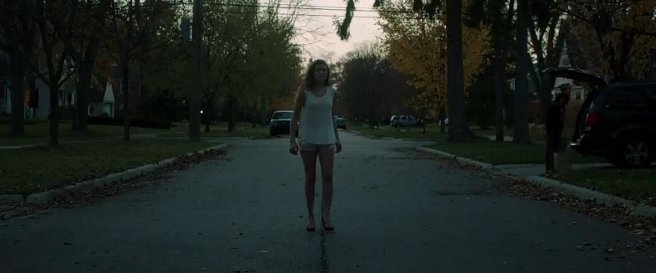
Evidence that It Follows is an exploration of (Neo-)Freudian psychoanalytical theory abounds throughout the picture. In fact, one of the most ominous aspects of the film’s prologue, shot in an extended long take, foreshadows what is to come. A young woman named Annie (Bailey Spry) runs out of her house dressed in a rather grown-up lingerie ensemble and high heels. Her father (Loren Bass) calls out to her as she circles around the stationary camera several times, afraid of whatever is in the house. The audience never sees what haunts her, so her father is the sole person (or even thing) that we can associate with the house. If you didn’t know the premise of the film, you might think that there is a history of sexual abuse between Annie and her father. She eventually gets into a car and drives far away to a secluded lakefront. She calls home and, fearing that the monster will soon reach her, insists that she loves her dad. Although we do not know who or what defiled and contorted Annie’s body (this is the gory image critic David Edelstein couldn’t erase from his memory), I think it is safe to assume that the monster probably took the form of her father in that unseen moment.

Jay's first vision appears while she's in the middle of a class at a community college. Find below the reverse shot of what Jay sees. Image courtesy of RADiUS-TWC.
Jay’s first vision appears while she’s in the middle of a class at a community college. Find below the reverse shot of what Jay sees. Image courtesy of RADiUS-TWC.

Once Jay contracts the haunting, the fear of sexual misconduct with her loved ones becomes more obvious. In conversation with Kyle Buchanan, Mitchell comments on the first form that Jay’s iteration of the monster takes: “And I think what you’re saying is true, it’s about the contrast of this [old] woman in its location [the campus of Jay’s community college]. Instantly, you realize that something is not quite right. And people are not paying attention to her, although in any other situation, they would be.” I recognized the old woman in her nightgown as the old woman from a photograph on the wall that Jay studies earlier in the film. The implication is that this woman is Jay’s grandmother. When Mitchell refers in the same interview to his method of keeping a distance between what the protagonists see from their perspective on the ground and what may be haunting Jay from any other vantage point, I believe he is referring specifically to the moment when Jay sees an old naked man standing atop her roof. Even though Mitchell and co. didn’t put on a longer lens to capture the menace’s visage in more detail, I still recognized that he is probably Jay’s grandfather, from the same photo.

The reverse shot captures the first vision Jay has, while in class at a community college. The old woman, I argue, is her dead grandmother. Image courtesy of RADiUS-TWC.

Although the monster assumes more unfamiliar personages, including a young peeping tom from next door and an extraordinarily tall man (whom I couldn’t place), a majority of its reflections are familiar. When Jay and her friends track Hugh down and visit him at his real address, his mother answers the door, her wide smile in deep contrast to the emotionless face she had on while coming after Hugh (real name Jeff), completely naked, in the parking garage following his successful transmission of the haunting onto Jay. Furthermore, the violent climax at an indoor community pool not only resembles the end of Let the Right One In (Tomas Alfredson, 2008), it further illustrates my argument. The group (minus Greg, of course) plugs in various household appliances, hoping to use Jay to lure the monster into the pool so that they may electrocute it. Mitchell admits to Buchanan that the group’s plan is “the stupidest plan ever!” Paul has brought a gun and depends on Jay’s description of where it is in order to shoot it. Yara gets injured in the process, but it eventually falls into the pool, attempting to drown Jay. She gets away and watches as the pool fills up with blood. Crucially, however, throughout the whole scene the monster appears to Jay as her absent father, whom I also previously glimpsed in a family photograph. Besides wanting to keep these familiar connections as opaque as possible, I don’t understand why Jay, especially in this scene, never calls out whom it resembles. For that matter, after so many close calls, she never tells anyone whose appearance the monster adopts. Either I am completely off base as to why the monster threatens to kill the teenagers while in the form of their parents, or Mitchell is just one cagey guy.

Jay peers into the community pool to see if she and her friends successfully killed the monster. He's no longer there. Image courtesy of RADiUS-TWC.
Jay peers into the community pool to see if she and her friends successfully killed the monster. He’s no longer there. Image courtesy of RADiUS-TWC.

Despite the bloodbath, Jay and her friends are not out of the woods. Inexplicably, Jay sleeps with Paul. It Follows is not funny, but Paul’s asking Jay if she feels any different after they have sex cleverly corrupts the trope of (teenage) virginity. Next we see Paul troll for a prostitute. Meanwhile, Jay curls up on her bed in a familiar fetal position, her mother (Debbie Williams, whose face is never in focus—if it is even in the frame—throughout the film) stroking her naked back. This may be the most haunting image of It Follows. It demonstrates that the threat of death, expressed through her parent’s sexual menace, is ever near and ever present. The final shot of Jay and Paul, holding hands while walking down the street, may hint that the person following them in the distance is also haunting them. In this way, “the terror of interconnectivity and teenage anxiety” is defeated: these friends have become lovers and can now face the monster/death together. Although the film ends on an ambiguous but still upbeat note (in spite of everything that has happened, anyway), the image of Jay’s mother suggestively touching her daughter is creepier and more foreboding than the couple’s maybe-stalker.


Below is the lyric video for “From the Night,” the first song off the 2014 album No One is Lost by Stars. The Canadian band’s dreamy soundscapes complement the electronic synth score by Rich Vreeland (Disasterpeace), which borrows heavily from the horror-film themes of the 1970s and 80s, such as Halloween (John Carpenter, 1978). More than that, the newest record by the prolific band, which I only recently got into thanks to a live studio-session they performed on the CBC radio show Q, thematically and stylistically dovetails with one of It Follows’ themes: the average teenager’s desire to fit in and have fun. The cover of the album, which you can glimpse in the video, showcases a similar youthful yearning for connection and social acceptance that It Follows deconstructs. Most notably, listen to the lyrics after the bridge (at the 3.40 mark in the video). They could be telling Jay and Paul’s story.

http://https://youtu.be/a8rdirj7ZNw

To Each Her Own Cinephilia; Or How I Failed to Connect to Silver Screen Fiend

Cover Image of Silver Screen FiendI finished reading Patton Oswalt’s second memoir, Silver Screen Fiend, days ago but I’ve been struggling to find something to say about it ever since. That’s when it hit me: my not having much to say is indicative of how I feel about this book. It’s neither good nor bad. It’s mostly just underwhelming. As a film fanatic myself, I was very excited to read the newly released Fiend, whose subtitle is Learning About Life from an Addiction to Film. I thought it would offer me insights into how I might balance my career ambitions (whatever those are) with my chronic hunger to watch and analyze films and TV shows. Instead, Oswalt leaves it until the last chapter to bestow wisdom on this topic: “Movies—the truly great ones (and sometimes the truly bad)—should be a drop in the overall fuel formula for your life. A fuel that should include sex and love and food and movement and friendships and your own work. All of it, feeding the engine. But the engine of your life should be your life” (161, emphasis in original). I already knew all that. Thanks, Patton. What’s worse, he comes to the realization that the Movies have taken over his life only once The Phantom Menace profoundly disappoints him, and you know how I feel about Star Wars and George Lucas. At least I have never seen a film so terrible that it shook the very foundation upon which my cinephilia is built: I will never stop consuming films, because I want to better understand what effects they have on our lives, on our cultures.

Silver Screen Fiend briefly recounts the four years between 1995 and 1999 when he obsessively attended film screenings at the New Beverly Cinema and other repertory theaters playing classic films, in the hopes that feeding his addiction as much as possible would make him a (great) film director someday. At the same time, he also became a member of the alternative comedy scene in Los Angeles, and he wrote for MADtv for a short spell before the producers finally realized that his lackluster skits just weren’t cutting it. I’m not being harsh. Here is Oswalt himself on the subject of his being fired: “It also didn’t help that my writing at the time was so fashionably half-assed. I hadn’t even developed my distaste for typos, which made all the sketches I turned in look like I’d written them while being chased by Turkish assassins on a drifting steamboat” (133-4). There are amusing if not exactly laugh-out-loud funny scenes sprinkled throughout, such as his experience shooting Down Periscope (his debut film role, which also earned him a SAG card) and the legal trouble he and his friends faced when they tried to stage a table reading of Jerry Lewis’s controversial, never-publicly-shown Holocaust drama The Day the Clown Cried. What they wound up performing turned out to be a creative collaborative success: a series of sketches about their not being able to perform the screenplay itself due to a producer’s issuance of a cease-and-desist letter.

Although I could relate to his experience as a cinephile—and in particular, a desire to see films in the theater as part of an audience—I couldn’t connect with him in the way that I wanted to (that is, to learn about life through an addiction to film). The book itself starts in an off-putting way: he writes as if he is in conversation with the reader, who is either a friend or an acquaintance, outside the New Beverly, someone he “bulldoze[s] right over… and keep[s] gabbing” away about Billy Wilder’s Sunset Boulevard and Ace in the Hole. I get it; his mind runs sixty miles an hour when you get him started on a film about which he feels really passionate. The problem is that throughout most of the book, he mainly just mentions film titles, ones that appear in the handwritten and poorly duplicated calendar that begins most chapters. Occasionally, he reminds the reader that he uses five film encyclopedias to keep track of what classics he should see, and he marks each entry with a note in the margin describing how and when he saw a particular film. An appendix at the back of the book lists all of the films he saw between May 20, 1995 and May 20, 1999. It’s 33 pages long and quite impressive, but ultimately not very useful. What am I supposed to get out of it? In addition to a decades-old film stub collection, I’ve kept a film journal for almost ten years as well as an alphabetical index of its contents. I can’t imagine that anyone else would ever want to look at such a document or the information it contains. (I started journaling and indexing as a way to keep tabs on what I’ve not only seen but written about as well.) So scanning the wide assortment of titles listed in his appendix, all I could think was, for example, “Ooh! I wonder what he thought of Trainspotting.”

Actor, stand up comic, and author Patton Oswalt.

Oswalt’s film addiction and comedy scene shenanigans are probably given equal “screen time” in the slim volume, but his stories about the latter were more exuberant, filled with more personalities. I think I know why this is, and it’s not because he’s a lazy writer. (If anything, he may be too energetic, especially when it comes to philosophizing about Vincent van Gogh’s creative genius, from which Oswalt draws great and sometimes confusing inspiration.) It is because, as he implies throughout, it is sometimes difficult for a rabid film fanatic to translate her enthusiasm for a film in a way that someone not as interested in it will understand and appreciate. In the chapter “You Can, Unfortunately, Go Home Again,” he writes about meeting a high school friend for a movie while they were both home for Thanksgiving in 1996. Sitting down to the Bruce Willis western Last Man Standing, he geeks out about how the “movie is based on [Dashiell Hammett’s] Red Harvest, but it got there by way of [A] Fistful of Dollars and Yojimbo” (120). This fun fact lodges itself in his companion’s brain so deeply that Oswalt ruins the experience of watching Last Man Standing for the man, because he thinks he’s seen a version of a samurai film. Although I don’t condone binge drinking, this may be the best description Oswalt offers to illuminate the divide between people like us and people like his friend:

Movies, to him [meaning his old high school buddy] and the majority of the planet, are an enhancement to a life. The way a glass of wine complements a dinner. I’m the other way around. I’m the kind of person who eats a few bites of food so that my stomach can handle the full bottle of wine I’m about to drink. (122)

Owing to my gigantic sweet tooth, allow me to paraphrase this treatise using a dessert analogy instead. Some people I know don’t eat dessert or only do so on rare occasions, whereas I always eat dinner in order to have dessert. Since I’m in a confessional mood, I will also admit that sometimes I forgo dinner altogether and dash straight to dessert.

Early on in Silver Screen Fiend, Oswalt defines the film subculture he belongs to as one consisting of “sprocket fiends,” those who dwell in the “subterranean dimension” of repertory theaters, who travel through space and time at the will of a director and his/her vision (7-8). I learned on my first or second day in the Cinema Studies department at NYU that the rest of the Tisch School of the Arts referred to us as moles, because once we burrowed in the ground we were content to stay in the dark. Like Oswalt, I love the sound of celluloid passing through a projector. It makes me feel alive. That’s why the “First Epilogue,” written as a tribute to the owner and manager of the New Beverly Cinema, Sherman Torgan (to whom the book is also dedicated), is the best part. In it, Oswalt shows off his classic film knowledge in a highly imaginative and dexterous manner: he curates a 30-day festival of films that were never made but will hopefully entertain Sherman in the great beyond. If only Hal Ashby could have wrangled John Belushi and Richard Pryor for an adaptation of John Kennedy Toole’s A Confederacy of Dunces. I especially love the quick mention that a young Frances McDormand, one of my favorites, costars as Myrna Minkoff and is, in a word, “Sublime” (172).

Long Take: Hector and the Search for Happiness Finds Nothing to Be Happy About

Viewed March 5, 2015

Movie poster for Hector and the Search for HappinessHector and the Search for Happiness (2014) came and went late last summer in limited release, but I don’t recall it ever coming to a theater near me. Which is just as well, because it is horrible. Ostensibly a comedy, the biggest laugh that the film story elicits occurs when a French woman struggles to pronounce the word “happiness.” The titular character, though embodied by Simon Pegg (one of my favorites), and all those who surround him are so criminally underdeveloped that it is difficult to care much about anyone in the film except in a more theoretical way that the filmmakers don’t support. What’s worse, the representation of the bored British psychiatrist’s journey around the world to find out what makes people happy paints multiple far-flung cultures in broad, caricatured brushstrokes. There is virtually no cultural specificity in any of the places that he visits, and when director and co-writer Peter Chelsom and crew attempt to add critical dissections of serious impediments to people’s general health and well-being in these places, these issues are wiped under the rug, never to be disturbed again. In case you are new to Hector and the Search for Happiness, be warned that I am going to spoil it now. And while you’re at it, take a peek at the film’s trailer to see how much potential the filmmakers wasted.

I have not read the original source novel by French psychiatrist François Lelord, but apparently its raison d’être is to educate a general readership about the psychology of happiness and to offer tips on finding it in everyday life. This explains why, after almost every interaction with someone throughout his international adventure, Hector jots down in his journal maxims such as “Happiness is knowing you’re alive” and “Happiness is not always knowing the full story.” These words are scrawled across the screen in order to keep a running tally of all the lessons learned, as if the film is a PowerPoint lecture. Hector also fills the pages of his notebook, which sexy and domineering girlfriend Clara (Rosamund Pike) gifted him upon his departure, with cutesy doodles of what his childish imagination encounters abroad. The main lesson he must learn is that losing Clara, even though she smothers him with a routine (always the same breakfast; she clips his toenails and packs his bag), would make him really unhappy. That’s right: he goes on this purportedly life-changing adventure only to realize that he likes his life just as it is. Although the couple’s Skype conversations widen the chasm between them more and more throughout, as the film drags on, there is never any doubt as to the fate of their relationship.

And this is why Hector’s first stop in “China” is so perplexing. He never gives any reason as to why he starts there (and isn’t it the tiny kingdom of Bhutan that is regularly cited as the happiest place on earth?) or what he is going to do once he arrives. But Hector doesn’t need a plan when he has filthy rich businessman Stellan Skarsgård to act as his guide in an unnamed Shanghai. It truly boggles the mind as to why Skarsgård’s Edward, so annoyed by Hector on the plane ride over from London, would take the ridiculous man under his wing and show him a good time. For, unbeknownst to Hector, Edward has secured the services of a prostitute named Ying Li (Ming Zhao) to keep Hector company in the nightclub and beyond. Although Clara gave Hector permission to fool around while on his trip, he winds up falling asleep before Ying Li can even get into the bed. At lunch the next day, believing he’s falling in love, Hector discovers the truth when her pimp whisks her away. Hector tries to do the honorable thing and stand up to him, but, despite calling her john “nice,” Ying Li hits Hector on the head and rides away. She doesn’t want his help. So in one fell swoop, Hector goes from ruminating that perhaps happiness is being in love with two women at the same time to realizing that he’s happier not knowing Ying Li’s full story. I never expected the film to engage the topics of prostitution and sexual tourism in Shanghai, but since the filmmakers did, I find it morally reprehensible that Hector, a psychiatrist, would find it so easy to disengage. It’s not as if Ying Li was happy to see her pimp, to return to her life as a sexually exploited woman. She seemed confused as to how she felt about Hector, as if wondering whether or not he could provide an escape. I wouldn’t have wanted to see a film about a white male tourist “saving” a Chinese prostitute. Nevertheless, I didn’t like how the experience of falling for a woman, no matter her profession, had exactly no consequences on Hector’s outlook other than admitting he rather just be ignorant of the circumstances of her life.

Hector and Ying Li get up close and personal. Photo courtesy of Relativity Media.
Hector (Simon Pegg) and Ying Li (Ming Zhao) get up close and personal. Image courtesy of Relativity Media.

But it only gets worse. From Shanghai, Hector treks through the Himalayas to a remote Buddhist monastery. No one mentions the place by name, but it is easy to assume that he has entered Tibet, to seek the advice of Togo Igawa’s Old Monk (the filmmakers couldn’t even give him a name), who mainly just speaks in rhetorical loop-de-loops to help Hector arrive at the lesson that always avoiding things that make you unhappy is no surefire way to attain long-lasting happiness. He spends all of five minutes there, without ever contemplating how the Chinese government’s suppression of Tibetan statehood might affect the happiness of the people living and working there.

Then he moves on to “Africa.” I found this section the most offensive, beginning with the filmmakers’ failure to name a more specific region or country. Perhaps they left the place intentionally unidentified so as to not incur the wrath of people and governments of a particular place or area. But this lack of cultural specificity effectually purports that Hector’s “Africa” stands in for a whole continent, dominated by warlords foreign-born and native alike, backward villagers who travel with their chickens on prop planes, and “Western” organizations that provide humanitarian aid. In fact, Hector spends two weeks helping his medical school friend Michael (Barry Atsma) at the clinic he runs with his African boyfriend. Embarrassingly, it takes him a full two weeks to recognize that Michael and Marcel (Anthony Oseyemi) are romantically involved, coming to the delightful conclusion that “Happiness is when you are loved for who you are.” Unfortunately, just as Michael’s work is merely the conduit through which Hector can explore “Africa,” the former’s sexual relationship with Marcel exists purely as a way for Hector to learn this widely shared belief. Hector doesn’t seem to care about the challenges that the mixed-race, homosexual couple—his friends—must face in this setting. And nor do the filmmakers.

You wouldn't know it from this photo, but Michael, Hector, and Marcel are cruising in a war-torn
You wouldn’t know it from this photo, but Michael (Barry Atsma), Hector (Pegg), and Marcel (Anthony Oseyemi) are cruising in a war-torn “Africa.” Image courtesy of Relativity Media.

Hector continuously acts the fool, and he even comes to the aid of a local warlord named Diego Baresco (Jean Reno). Despite warnings from Michael and Marcel about warlords in the area, Hector proves his goodness to Baresco, who suspects him of working for an international peace-keeping outfit that swoops in only to leave before seeing their work through. Hector reviews the prescriptions that Baresco’s beloved wife takes and makes revisions to her regime, thereby instilling some peace of mind in Baresco. They get drunk together, and on his ride back to the clinic, Hector fails to recognize that his taxi cab has been hijacked by two armed rebels, because all black men look the same to him. He’s soon taken hostage, destined to rot in a cell with one rat as his friend. It’s unclear as to how long he is held captive, and of course we have no idea what the rebels seek to accomplish with their violent acts. We’re just supposed to accept this, because isn’t that what happens in Africa? According to this film, white European and American tourists go missing all the time and are swept into guerrilla warfare. Hector uses Baresco’s pen to negotiate his release, for his captors fear retribution from Hector’s powerful “friend.” They abandon Hector on a country road, and “Happiness is knowing you’re alive” is emblazoned on the screen. Yes, absolutely, but did we need such an extreme scenario to demonstrate this? Especially since nothing becomes of it? Hector doesn’t suffer any post-traumatic stress, and we never witness Michael’s or Marcel’s worry over Hector’s abduction. Before moving on to Los Angeles to meet his former med school flame Agnes (Toni Collette), Hector experiences the gloriousness of sweet potato stew, which a baby-swaddling woman on the prop plane promised to prepare for him once they landed safely in “Africa.” It’s supposed to be physically and emotionally fulfilling, but we viewers never see it. The filmmakers can’t even commit to showing us a traditional “African” dish.

Having survived being held hostage by an indistinguishable
Having survived being held hostage by an indistinguishable “African” rebel group, Hector celebrates by cooking sweet potato stew with local women. Image courtesy of Relativity Media.

In Los Angeles, Hector takes part in Professor Coreman’s (Christopher Plummer) neuroscience study to map emotions such as happiness, sadness, and fear across different parts of the brain. After breaking up with Clara over the phone because his traveling to Los Angeles has finally signaled for the couple that Hector still longs for Agnes, Hector exhibits all three emotions in the scanner, lighting up Coreman’s screen with a rainbow of colors that the professor has assigned to each emotional state. Is this the payoff we’re supposed to receive from Hector and the Search for Happiness? What makes Hector special is his ability to feel happiness, sadness, and fear at the same time when recalling a wide range of events in his life? Having been rebuffed by Agnes, a happily married psychologist with a third child on the way, Hector determines that he must get back to London to be with Clara. As I said before, they live happily ever after. He’s more emotionally available and compassionate towards his patients, and Clara finally realizes that, yes, she wants to have a baby with Hector.

What and whom they always wanted. Clara (Rosamund Pike) and Hector finally tie the knot. Image courtesy of relativity Media.
What and whom they always wanted. Clara (Rosamund Pike) and Hector finally tie the knot. Image courtesy of Relativity Media and MovieStillsDB.com.

The one bright spot in this mess is the chemistry between Simon Pegg and Rosamund Pike. Although their relationship isn’t exactly desirable (she takes great pride in clipping his toe nails!), they have an appealing, silly rapport in scenes where they interact in person. In fact, most of their exchanges occur over video conferencing calls. Notably, Hector and the Search for Happiness may be implying that staying connected through this kind of technology is no substitute for human contact (when Hector tries to tell her that he’d been kidnapped, she fails to register the gravity of the situation). Even phone conversations do not go well between them. There is simply a lack of communication between the lovers, and isn’t that a definite sign of their incompatibility? Clara cannot make up her mind regarding Hector’s up and leaving her for an indeterminate period of time. Hector needs to leave the person he loves in order to realize that happiness lies in a life made with her. This is not an earth-shattering revelation, especially since we watch him come to this conclusion under the most ridiculous of circumstances. As I said before, I am a huge fan of Pegg’s, and it was disappointing to see him attached to such bone-headed and culturally insensitive material. I wonder what attracted him to it in the first place: Hector’s childhood love of The Adventures of Tin Tin, maybe? Then again, shooting a film about happiness around the world does sound really exciting. If only the film wasn’t so concerned with checking off the lessons in the original source novel and instead let the characters interact with each other in more plausible, organic ways.

Who is Laura Lamont?

Laura Lamont's Life in PicturesEmma Straub’s debut novel Laura Lamont’s Life in Pictures charts the transformation of a rural Wisconsin girl, Elsa Emerson, into one of the starlets of Hollywood’s Golden Age. Using Jennifer Jones’s biography as a springboard, Straub writes of a woman who juggles multiple identities throughout her life: daughter, sister, wife, mother, and actress. In fact, the book is divided into twelve chapters whose titles encapsulate the roles she plays. Opening the novel in 1929, “Cherry,” at once suggesting the ripe potential of her later life’s work and the lost grandeur of Chekhov’s last play, details the special circumstances of her childhood spent behind the scenes and on the floorboards of her parents’ barn-house theater. Nine years pass between the suicide of Elsa’s older, beloved and beautiful sister Hildy and her escape from Door County with stranger-cum-costar-cum-husband Gordon Pitts. Within a few years after their arrival in Los Angeles, Gordon signs a contract to be a bit player at Gardner Brothers, and Elsa’s own acting ambitions take a backseat to her familial responsibilities. In the second chapter, “Laura Lamont,” studio executive (and Gordon’s boss) Irving Green flirts with Elsa at a wrap party and rechristens her “Laura Lamont,” telling her that, provided she loses thirty pounds once she gives birth to her (second) child, she is pretty enough to be a star. And so our heroine now sets her mind on becoming the star she always wanted to be.

Straub is a deft storyteller, and structuring her fictional biography according to the highlights of Laura Lamont’s life and career excises the fat of the more uneventful, prosaic moments of a character’s story. However, after reading all 304 pages of Laura Lamont’s Life in Pictures, the titular protagonist still remains somewhat of a mystery. Perhaps this is intentional. We read as Elsa/Laura struggles to define herself, mainly as her new glamorous identity fails to wipe the slate clean. She can’t face up to her mother, who resents Elsa for leaving Door County, seemingly forgetting who she is. Laura is haunted by past traumas, such as her sister’s suicide, and, years after she has divorced Gordon and married the studio’s number two, Irving Green, her first husband becomes a drunkard, a drug addict, a costly thorn in her side. The role that she chooses to most define her is that of mother. More pages are devoted to Laura’s dedication to and admiration of her three children: Clara and Florence, from her first marriage, and Irving Jr. This isn’t objectionable, of course, but as a film scholar and historian, I was more interested in how Straub represented Hollywood of the 1930s, 40s, and 50s.

Jennifer Jones (1919-2009), the real-life inspiration for Emma Straub's Laura Lamont.
Jennifer Jones (1919-2009), the real-life inspiration for Emma Straub’s Laura Lamont.

Just as it is unreasonable for a film critic to judge a motion picture against the film s/he would like to have seen, it is not fair of me to judge Laura Lamont’s Life in Pictures as lacking an in-depth exposé of Hollywood goings-on from the perspective of one star—or cog in the machine. Besides, as Straub told Jacki Lyden in 2012 on NPR’s All Things Considered, “I made sure to stay away actually from Jennifer Jones’ biography ’cause I didn’t want it to be, you know, a thinly veiled version of her. I really wanted my Laura Lamont to stand on her own feet.” However, just as I really enjoyed Farran Smith Nehme’s engagement with the archival preservation of forgotten silent films in her recent novel Missing Reels, the characterizations of Hollywood and its myriad players in Laura Lamont’s Life in Pictures really delighted me. For example, when Laura starts at Gardner Brothers, whose company name recalls that of the real-life Warner Bros. but whose physical location more accurately resembles that of Paramount, she begins cutting a rug in a string of comedies with her red-haired friend Ginger Hedges. Years later, after Ginger becomes a big star in comedy, rival studio Triumph Pictures poaches her, and she later goes on to head the studio while producing and starring on a successful television sitcom with her husband. It should come as no surprise that Lucille Ball inspired the character Ginger. Robert Walker, Jennifer Jones’s first husband, does not end up as ignobly as Gordon Pitts does. At least the real-life actor, who also died young, can claim an illustrious career with the likes of BataanStrangers on a Train, and My Son John in his filmography.

The Song of BernadetteWhen the hardcover’s opening book-flap describes Irving Green as Laura’s “great love,” I recognized that the character must be a stand-in for David O. Selznick, Jennifer Jones’s second husband. Selznick produced such classics as King Kong, Gone With the Wind, Duel in the Sun, and The Portrait of Jennie, the last two of which starred his wife Jones (neé Phylis Lee Isley). Before striking out on his own, Selznick worked at MGM, Paramount, and RKO. While the novel does not present Irving as an independent producer like Selznick, it does show that his decision to put Laura in more serious roles, in romantic, historical epics, eventually nabs her an Academy Award for Best Actress. Jennifer Jones won her first and only Oscar right out of the gate, for her leading role in The Song of Bernadette. In crafting Laura Lamont’s backstory, Straub cleverly keeps the religious theme of Jones’s film when she writes that Laura won for her performance as a nun in Farewell, My Sister, a film whose script somewhat imitates her relationship with Hildy. Unfortunately, I found the description of Laura and Irving’s relationship lacking in intensity. Although married for years, before his untimely death from a prolonged heart-related illness, I never really understood the lovers’ mutual fascination. Irving is repeatedly described as short, slight, balding, and regrettably, Jewish, as if that is enough to characterize someone. Sure, power is an aphrodisiac, but outside of his unexamined devotion to Laura and her children, I fail to see how he is appealing. He isn’t given any thought-provoking dialogue or much to do at all, really. He mainly just sweeps her off her feet, seeing someone else in Elsa Emerson, a brunette rather than a blonde. Laura herself is a bit of a simpleton, especially when it comes to interacting with her growing children. And Laura’s relationship with her young black maid, Harriet, reads too much like one Joan Crawford or Vivien Leigh had with Butterfly McQueen or Hattie McDaniel on-screen. Since we glimpse Laura mostly in her private life, it is difficult for me to imagine the character as a glamorous starlet. She mainly just upholds the Grand Narrative of the Hollywood Dream Factory: she did as she was told, read her lines, and was happy if the bosses were happy.

Coming off the heels of her beloved father’s death, Irving’s death further pushes Laura into decline. Deep in debt, she abuses anti-anxiety medication, falls into an intractable despair, and eventually attempts suicide. She gradually makes a full recovery and adjusts to a new life out of the limelight. Chapter eleven, “The Shopgirl,” recalls silent film star Louise Brooks’s biography rather than Jennifer Jones’s: the former actress died in 1985, destitute and purportedly a salesgirl in a department store. Meanwhile, in 1975 and now a grandmother, Laura supports herself as a shop assistant for dressmaker-to-the-stars Edna (clearly inspired by famed Hollywood costume designer Edith Head, who was also the model for the scene-stealing Edna Mode in The Incredibles). The novel ends where it began: in the theater. In 1980, the newly rediscovered Laura Lamont makes her Broadway debut in The Royal Family, the same play that she performed with Gordon Pitts before they married and skedaddled to Los Angeles with dreams of stardom shining in their eyes. I can’t deny that the final scene is poignant. Her children reunite in New York to see Laura on opening night, but when I closed the book on her life, I couldn’t help thinking that I wanted more from it.

Rediscovering a Childhood Favorite

For years, whenever someone mentioned Star Wars, I recited the following response: “I used to love the original trilogy as a kid. It was something that I shared with my younger brother and my mother. The three of us bought advance tickets to see The Phantom Menace in 1999, but by that time, I think I’d already forgotten the earlier trio of films.” As you can see, I deployed this not-exactly-called-for viewing history as a diversion. It’s not that I was embarrassed–well, on second thought, maybe it was: I had forgotten virtually everything about these massive films, and the only memory that lingered was the knowledge that I was a fan.

Obviously, I wasn’t a diehard fan. But they must have meant something to me if, sixteen years after Return of the Jedi, I insisted we buy advance tickets to the first prequel, which has since been reviled for, among many other things, introducing the jabbering CGI monstrosity Jar Jar Binks. I’ll leave it to those who live and die by The Force to complain about how Lucas ruined the original trilogy with the retroactive Episodes I through III. I can’t even tell you the other prequels’ names without pushing a few keystrokes over at IMDb.

Instead, I want to talk about my recent–and still ongoing–rediscovery of Episodes IV through VI. It had been nearly two decades since I’d seen them. I decided to rent them from my local public library because I was fed up with not understanding all of the allusions to the film series that regularly float around in pop culture. Whether it’s Jamiroquai singing for us to “Use the Force” or why Adam’s toy replica of the Millennium Falcon on the ABC sitcom The Goldbergs is the boy’s most prized possession, I’ve always wondered, “What makes Star Wars so great?”

Well, I’m afraid I cannot figure it out, because the most earth-shattering observation that I have made is that these films simply are not very good. While I could criticize the special visual effects, I understand that in their day they were ground-breaking. But I doubt they are the reason why millions of people worldwide worship these films.

I will attack the acting, though. It’s atrocious, and funnily enough, Mark Hamill isn’t the worst. His all-American, aw-shucks performance fits his character’s arc well: as Luke Skywalker, he goes from living on the desolate Tatooine planet, his uncle stifling him with mundane responsibilities, before he realizes his destiny is fated elsewhere. Namely, saving the galaxy from Darth Vader’s destructive vision. Princess Leia and Han Solo, two (im)probable lovers portrayed by Carrie Fisher and Harrison Ford, respectively, have the worst exchanges that are meant to pass for sexual tension. The best part was when Leia called Han Solo a “nerf herder” in The Empire Strikes Back, thereby reigniting my memory of a power-pop band that my sister and I used to listen to in the 90s. I had no idea Nerf Herder went on to lend Buffy the Vampire Slayer its theme song. I am so not a geek.

Overall, Episodes IV and V (I have yet to watch The Return of the Jedi) appear to be one drawn-out B-movie. It’s not just the special effects and acting. It’s also the set and costume designs. When inflation is taken into account, I wonder what Star Wars‘s budget of $11 million would be today, because it looks cheap. The writing is bad, and the imperial generals and admirals have some of the worst line-delivery, which the out-of-sync (and THX-mastered) audio makes even more distracting. As for the costumes: does anyone really buy Chewbacca? It’s clearly a really tall man in an itchy diarrhea-brown yeti costume. Speaking of ensembles, in one scene, Princess Leia is dressed in an all-white ski suit, the next, a drapey, polyester nightie. Don’t tell me that George Lucas and his collaborators weren’t channeling Ed Wood and Roger Vadim when they created this mythology. And I swear that everyone pronounces Leia’s name as “Leah” in Star Wars and later as “Laya” in The Empire Strikes Back. A similar transformation occurs to Han Solo’s moniker; the long A in “Han” is further accentuated.

Some people say that Star Wars is a western set in space. On what evidence? Because the good guys wear white, the bad guys black? That’s not even true; the imperial stormtroopers almost look like carbon copies of Darth Vader, but they wear white plastic armor. It’s quite a stretch to say that the Rebel forces represent villagers or homesteaders, and Darth Vader the outlaw who comes to town to disrupt their peaceful way of life.

Star Wars is a lot of things, but it is not a western. It’s primarily a paternal melodrama, because the main conflict exists between Luke, the so-called “New Hope” of Episode IV’s subtitle, and the father whose identity had always been a mystery to him. And seriously, how could Darth Vader’s confession toward the end of The Empire Strikes Back have shocked audiences in 1980, even if they don’t know that “Vater” means “father” in German? Luke’s uncle and Ben Kenobi (Alec Guinness, the only interesting actor in this whole enterprise) had dropped clues that Luke’s father joined the dark (aka darth?) side. The second installment sets up how the epic battle that we’re slowly building towards will be one over Luke’s soul. Good thing the Force is strong with him!

That brings me to my next point: Yoda. Yoda is a Jedi master who has trained Jedi knights for over 800 years. A lime green puppet voiced by Frank Oz, he might be the most offensive thing about Star Wars. Given the design of his countenance and his speech pattern (his grammar goes object-subject-verb), he is most obviously modeled on a stereotypical wise old Asian man and would later be reincarnated as Mr. Miyagi. Yoda presents the best personification of The Force, some pseudo-religion about how everything is connected and therefore anything can be moved.  This is where all of the references to “Jedi mind tricks” in Kevin Smith movies come from. And this is how Lucas and co. chose to distinguish their vision of the future in space from that which appeared on TV screens in Star Trek. I’d rather be beamed somewhere distant than have a muscle spasm in my shoulder trying to move a spaceship.

Unfortunately, it’s impossible to watch Star Wars without thinking of everything that has come after it. You could say that I revisited these films because I wanted to see the parallels between the biggest movie of the year, Guardians of the Galaxy, and Star Wars. Although drawn from a lesser series of Marvel comic books than The Hulk or Iron Man were, Guardians has a lot in common with Star Wars. Peter Quill’s outlaw name, Star Lord, sounds like it was ripped from the earlier films’ iconography. Like Luke, he doesn’t know who his father is, but as we understand from the set-up for the shoo-in sequel, we’re going to find out how learning his father’s identity will have significant repercussions for the whole galaxy. Like Han Solo, Peter’s a loner, a rogue and a charmer. His beat-up, lived-in ship resembles the ramshackleness of the Millennium Falcon, and the mutual attraction between Peter and the green warrior princess Gamora is as sure a thing as Han Solo and Princess Leia finally giving in to their shared desires. The main villain of Guardians, Ronan, may be dispatched by the film’s end, but he’s kind of like Darth Vader: he defies the supreme ruler, Thanos, in an attempt to control the galaxy, destroying whole planets with the press of a button, much like Vader. But Guardians of the Galaxy, by no means my favorite film, is far more appealing, visually interesting, and more succinctly told. We don’t need a sequel or two or three, but we’ll get them anyway, because that’s Hollywood’s business model.

Speaking of superhero movies, isn’t that what Star Wars really is? For reasons that I have already described, Luke Skywalker is the quintessential superhero, for he has elements of Superman (daddy issues) and Spider-Man (his harnessing the Force is akin to Peter Parker’s web-slinging). You could even say his piloting proficiency mimics the technological prowess of Batman, whom some consider a superhero and others do not. I may one day be able to understand the appeal of these stories, but I will never be able to connect to them emotionally. They’re just fairytales for boys.

News Clip: AMPAS Chooses an Oscar Host I Barely Know

I would like to thank the Academy for, in their latest attempt to court a younger viewership, choosing a host for the 85th Academy Awards whose creative output I’m completely unfamiliar with. This is a first. Congratulations, you just alienated a 26-year-old.

Per the Washington Post, the creator of the cult favorite TV show Family Guy (1999-present), Seth MacFarlane, is poised to emcee Movie Night on February 24, 2013. Isn’t he the guy who made a movie about a foul-mouthed CGI teddy bear? (Who cares if it grossed more than $420 million worldwide; what does that box office take say about us?) Isn’t MacFarlane also the guy who last week couldn’t find the microphone while presenting an award at the Emmys? Honestly, I thought this was a joke until I read press release attached to WP TV columnist Lisa de Moraes’s news brief.

It’s not that I have a list of more desirable candidates for the coveted hosting gig. But, if you insist… How about Jimmy Fallon? Hugh Jackman, perhaps? Louis C.K., if you want to be “edgy”? Ellen DeGeneres again? Wait, wait! I got it! Amy Poehler would be awesome as Oscar host. You might think she’s more associated with TV than she is with film. OK, that’s true, but so are all these other people (except Jackman, of course). After all, it’s not like MacFarlane is known for much else besides stupid animated fart jokes on TV.

None of this is to say that I won’t be watching the Oscars telecast when it airs. I hate it, always, but I can’t help myself.

Long Take: The Hunger Games Panders to a Built-In Audience and Squanders Its Narrative Potential

Viewed September 21, 2012

For months leading up to its March 2012 release, The Hunger Games (Gary Ross, 2012) was billed as the next franchise based on a series of young adult novels set to break box office records, and it delivered. I stayed clear of the theater when it came out because news reports on TV showed the books’ fans camping out days ahead of time, and I will do pretty much anything to avoid a crowd. When I finally learned the premise (children and teens from “districts” all over a future dystopian North American nation are ritually forced to fight each other to the death in an annual televised event), I quickly identified the parallels with the once-banned Battle Royale (Kinji Fukasaku, 2000). One Saturday, my dad came home from services at shul and related that his young rabbi used The Hunger Games and a crucial plot twist from the third act to make a point in his sermon (my dad told me what it was). The film effectively spoiled, I took my time seeking it out, which I only did because, as a film historian, I am interested in what people watch. Having now seen it, I can tell you that The Hunger Games was made with only its built-in audience of fanatical readers in mind: the teenagers and their parents as well as the child-free adults under 40 who never encountered a pop culture trend they didn’t like (see Fifty Shades of Grey for more proof). I can’t comment on Suzanne Collins’s trilogy, having never even read a single sentence from any of the novels, but isn’t it telling that as one of the screenwriters, the author allows co-writer-director Gary Ross to water down the disturbing conceit with a boring and self-conscious indictment of our popular culture that I’m not sure any of the rabid fans fully understands? As always, there be spoilers ahead.

Sometime in the distant future, an oppressive government in Panem institutes a sacrificial blood-letting of Olympic proportions: as penance for a past rebellion, one boy and one girl from each of the nation’s twelve districts is chosen from a lottery (called a “Reaping” and, per my dad, resembling the Nazis’ rounding up of European Jews) to train and compete in the eponymous competition. The film begins as the 74th Hunger Games get underway. Our heroine who’s handy with a bow and arrow, Katniss Everdeen (Jennifer Lawrence), lives with her good-for-nothing mother (Paula Malcolmson) and darling younger sister Primrose (Willow Shields) in the impoverished District 12. A mining and milling community with sanitation systems straight from the 19th century and simple, drab clothing that contrasts sharply with the out-there fashions of other Panem citizens, District 12 brings abject Appalachia to mind (these scenes were shot in North Carolina). At the Reaping, Primrose’s name is called in what amounts to an interminable, super-serious scene that ends in Katniss becoming the first-ever voluntary participant. Like the actress’s character in Winter’s Bone (Debra Granik, 2010), for which Lawrence received an Academy Award nomination for Best Actress, Katniss is a teenage survivor who lives and is willing to die for her sister. Yes, of course, the scene is appropriately dour, but it tries too hard, what with the cartoonish appearance and overly enthusiastic pronouncements of emcee Effie Trinket (Elizabeth Banks) and the audience’s failure to applaud for the Capitol-produced introductory propaganda video or the selection of Katniss and Peeta Mellark (Josh Hutcherson). And this is just the tip of the iceberg. Katniss and Peeta are whisked away to the Capitol for the Games, and that’s ostensibly where the action begins, only it actually stalls.

While screening the movie on DVD, I wrote in my notes (in all caps, mind) that The Hunger Games is “indulgent”: “It takes its time [introducing characters and situations] because the filmmakers know their built-in audience has memorized everything in the book and wants to savor these characters and scenes” as much as possible. Hence Haymitch Abernathy’s (Woody Harrelson) languorous introduction as the teens’ reluctant mentor (he’s a cynical drunk who thinks neither one has got what it takes to survive and win). So much of the scene that revolves around Haymitch, on the high-speed train ride from District 12 to the Capitol, does just that: it revolves around and barely includes him. Katniss and Peeta scrutinize his character and debate whether or not they should trust his guidance, occasionally allowing a somewhat flamboyant Harrelson to participate. To me, this is storytelling as clumsy and lazy as Ross’s shooting Katniss’s earlier hunt for deer meat is cliched (with a rough, jump cut-laden, shaky documentary style). In other words, Ross proves he is not an inspired director of action (remember, he previously directed the wholesome and straight-forward Pleasantville and Seabiscuit, from 1998 and 2003 respectively).

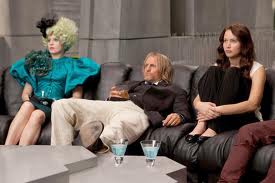
Effie, Haymitch, and Katniss look as bored as I was while watching their movie. Not much happens in the first hour or so. Image courtesy of http://www.collider.com.

The indulgence in establishing Haymitch carries over to other characters, only their purposes remain enigmatic for the uninitiated. For example, who exactly is Effie Trinket and what does she do, other than wear grotesque 1940s-inspired skirt suits? Introduced as a villain at the Reaping, she appears to be part of District 12’s trusted team. But there is no explanation or demonstration as to why or how she can make this transition. Moreover, Cinna (Lenny Kravitz) doesn’t have a clearly defined role, either. I assume that he’s merely a stylist, choosing for Katniss dresses that shoot fiery flames out of their skirts (so that she comes across as both dangerous and, well, hot). Apparently, Kravitz’s casting in this part angered many die-hard fans of the books, because he doesn’t physically conform to the Cinna of their imaginations. Meaning: they were disappointed that Cinna is played by a black man. Since Cinna is given so little to do, I don’t understand how anyone could get upset by that. If anything, the filmmakers should have cast someone who can act. Of course, one solution to this problem (that Cinna needn’t have even appeared in the film), however, is impossible: Cinna, in order to appease the fans, just has to be there.

Speaking of dresses that “light” up, let’s discuss the schizophrenic production and costume designs. As I previously mentioned, District 12 is so depressed as to be imprisoned in another century. When Effie, so far the only blatant anachronism in District 12, escorts Katniss and Peeta onto the bullet train, we ogle the 1930s interior design of the space, which coincidentally is one of the best sets. Side note: it is telling that they don’t fly to the Capitol, for the train is historically a potent symbol for modernity. Unsurprisingly, it literally transports them to another era. And what do we find at the Capitol upon arrival? As you peer through the poor visual effects, trying to make sense of the setting, you glimpse traces of Washington, DC (there’s a Mall with a reflecting pool) and vaguely neo-classical postmodern architecture. Honestly, it looks like a fascistic version of any and all representations of the mythic underwater civilization Atlantis (and maybe the Bahamian resort, too). The hordes of people gathered to watch live TV interviews are clearly dressed to go to a rave, decked out as they are with neon-colored clothes and hairstyles. There may have been glow sticks, I can’t be sure. One of the Games commentators/TV interviewers, Caesar Flickerman (Stanley Tucci), wears glittery suits and purple hair pulled up into a ponytail. Since everyone looks utterly ridiculous (and has an incredibly stupid name), it’s difficult to take the proceedings seriously, and the routinely oppressed’s struggle isn’t all that palpable. The filmmakers exaggerate both the built environment and the “bizarre” fashions of Panem’s citizens so as to link the inauthenticity of this world to our own celebrity-obsessed and reality TV-centric culture. From an intellectual standpoint, I get it. But as it is executed, it comes across as pained, heavy-handed, and too self-conscious. As if to say, Just look at how horrible these people are. You know, we’re not that much different… There’s nothing wrong with this message, but I’m afraid that because it is so over-the-top yet matter-of-fact, it produces a lot of noise and very little contemplation in the pandered-to viewer.

The Hunger Games being gladiatorial bloodsport, it makes sense that each district’s team rides in on the back of chariots here, in this fascistic square, their long procession resembling the parade of nations that is part of the Opening Ceremony at the Olympics. Image courtesy of http://www.mtv.com.

Despite the book being billed as a treatise on the horrific violence of war, which we send our innocent children to fight in the spirit of freedom (talk about a paradox), the film only spends the last hour or so of the 142-minute running time depicting the Games. (Collins is often reported as saying that the juxtaposition of TV channels showcasing young people alternately competing on a reality TV show or fighting in Iraq and Afghanistan inspired the story.) Instead, so much of it is devoted to the players’ Reaping, training, gaining of sponsorships (I still don’t understand how they work), and winning the audience’s favor. Again, Collins, Ross, and co. highlight how unreal (our) reality TV is through Haymitch’s packaging Katniss and Peeta as star-crossed lovers for the media, especially as we learn about it the same way that Katniss does: watching Peeta confess to Casear Flickerman that winning the Games would be a bittersweet victory. For surviving would mean that his crush would have to have died. For much of the film, they can barely tolerate each other. Katniss holds a grudge against Peeta because he once threw a loaf of bread into the mud as she sat starved nearby in the rain. He resents that she’s a more highly ranked player (scoring 11 out of ten points) and that everyone pays more attention to her. Despite their differences, they support each other during the Battle in the Woods, and in the end, they perform their roles as younger lovers for the pervasive cameras. It’s just, are they only keeping up appearances or do they fall for it, too? It’s an interesting idea, but the filmmakers expend no energy in developing it except in the second-to-last scene when they both enjoy a hero’s welcome (I’ll get to how that’s possible in a moment) and she finds her friend/boyfriend, Gale Hawthorne (Liam Hemsworth), out in the crowd. The expression on her face reads: “Oh shit, I forgot about him.” (And it’s easy to see why: this character consists of so little, he only watches the soap opera that is Katniss and Peeta’s romance unfold on TV and thus exists to make it harder for Katniss and Peeta to really become lovers.)

The movie’s PG-13 rating is really no indication that The Hunger Games tones down the violence implicit in its central conceit. Besides, similarly rated films with graphic displays of violence also get past the censors at the MPAA (language and sexuality are the real sticking points, and that’s a discussion for another time). I don’t seek out film reviews, but since his write-up was sent to my inbox as part of a daily roundup of entertainment news articles that I subscribe to, I read David Edelstein’s, originally published in New York. Horrified that the on-screen carnage of kids killing kids didn’t visibly “devastate” the hungry audience of which he was a part, Edelstein attacks director Gary Ross for framing the children’s inevitable deaths with “restraint” and “tastefulness” (as if that’s commendable!), which according to him, Ross has been praised for doing. I agree with Edelstein to an extent (the editing is fast and uncontemplative), but I still found the brutality of the participants profoundly unsettling: like, for instance, the way one girl shoots Katniss’s attacker in the back with a bow and arrow from far away, not out of solidarity but because killing him is merely a means to an end (killing Katniss).

More than this, The Hunger Games falls short of producing an effective commentary on war. The filmmakers fail to develop any of the Games participants other than Katniss and Peeta (with the lone exception of Rue, played by Amandla Stenberg, who comes to Katniss’s aid in the beginning before being snuffed out herself). And since we can’t even grieve for the fallen children-soldiers, you might ask, What is the point? Really, all we’re capable of, in Edelstein’s words, is this: “When a child dies, we breathe a sigh of relief that the good guys have one less adversary, but we rarely go, ‘Yes!‘” The greatest missed opportunity in this regard involves the character Cato (Alexander Ludwig), who scowls at everyone during training and basks in the glory he has inherited from previous champions who overwhelmingly hail from his District (1). Cato has been gearing up for the event seemingly all his life, and in the end, before he falls back onto the ground to be ravaged by demonic dog-like creatures, he hints to the spectator that he has a form of post-traumatic stress disorder as he indignantly whines, “Killing is all I know!” So just before he falls, we can reflect that he’s been robbed of a proper childhood and is subsequently doomed. The worst of it all is that this is the full extent of the filmmakers’ engagement with the subject of how being trained or programmed to kill has wrecked their psyches. Pitiful.

Katniss doesn’t bury Rue, her sister/daughter surrogate, but she gives her the only funeral any of the children can hope to receive. Image courtesy of http://www.mockingjay.net.

But of course they’re doomed. That’s the exact point of this exercise and the dramatic irony of the oft-spoken motto, “May the odds be ever in your favor.” Because beyond manipulating diegetic viewers’ emotions with stories about Katniss’s sacrificing herself to protect her sister or Peeta’s heretofore unconfessed love for Katniss, the producer of the Games, Seneca Crane (played by Wes Bentley), influences the actions of the participants as if he were a film director (he certainly carries himself like Michael Bay). When Katniss hides out in an unpopulated corner of the playing field, he burns it down so that she runs toward those who are out to get her. The dogs that eat up Cato spontaneously appear thanks to Seneca’s puppet-mastering; he wants to up the tension and kill off Katniss if he can. Most of all, he approves of an explicit rule-change after riots break out in the predominantly black District 2 following Rue’s (televised) death: two people can win the Games so long as they are on the same team. He later rescinds the offer once Katniss and Peeta are the only ones left standing. And here’s where my dad’s rabbi supposedly spoiled the plot: the so-called lovers vow to take their lives rather than follow the renewed rules of the old game. Fearing more reprisals, Seneca allows them to be dually victorious. The scenes which demonstrate how Man has overtaken Nature through computer programming and how Katniss and Peeta repeatedly challenge the rule of law at the Games are of a piece with the central message of The Hunger Games and probably constitute its finest expression: re-evaluate the truthfulness of “reality TV.”

One of the greatest unresolved mysteries of the film is the prize that the winner(s) receive(s). Obviously, living to see another day is rewarding in and of itself, but what do they gain otherwise? Fame? Fortune? At the victory ceremony held at the Capitol, the president of the totalitarian regime, Coriolanus Snow (Donald Sutherland), crowns Katniss, thereby complementing the beauty pageant-like interviews she endured earlier in the picture before the Fight to the Death commenced. Paradoxically, when she returns to District 12 triumphant, she doesn’t reunite with Primrose. (Instead, we see her look out onto Gale, confused.) As a melodrama studies scholar, I couldn’t believe that the filmmakers failed to include such a scene. If we can’t see Primrose embrace her virtuous older sister and perennial protector, then what is the point of her sacrifice anyway? Everyone, including Primrose, knows what is at stake.

This brings me to my final point. Much has been made about Katniss Everdeen as a feminist icon. Writing of the novels, Lauren Osborn of the online zine Vagina claims that, “Katniss—as a fiercely independent, loyal, and capable young woman—stands as a symbol of feminism in modern literature.” I guess she would if your only point of comparison is Bella Swan from the Twilight YA series. In her examination of this year’s female film characters (women and girls alike), Washington Post film critic Ann Hornaday praises The Hunger Games for being one of the satisfying “girl-powered fantasies” to come out recently (on the other hand, she’s disappointed that adult women are not represented as strong or compelling as their younger female counterparts). In my opinion, Katniss isn’t so much a feminist warrior as she is an amalgamation of different idealized femininities. She’s maternal, as she volunteers for the Games to spare her sister from a 100% certain death and mourns the younger Rue. (Later, Rue’s District 2 partner Thresh, played by Dayo Okeniyi, stops short of killing Katniss out of respect for her honoring Rue in death.) Despite her attitude toward the government and the Games, which she thinks makes her totally unlikable, Katniss wins over everyone because of her beauty. That flame-throwing dress works wonders. And if you think her skill with a bow and arrow makes her decidedly unfeminine, think again: she’s an archetypal Amazonian. Romance may not be a priority for Katniss, as Osborn argues, but she is nevertheless at the center of a love triangle, and neither suitor deserves her. Such is always the case.

I couldn’t find an adequate photo of Katniss in her flaming dress, so please pardon the text, though it does say it all, doesn’t it? Image courtesy of http://www.theapod.com.

I give the filmmakers credit for not belaboring how The Hunger Games continues into the sequel Catching Fire. (I swear, everyone is in a tizzy about who will direct it and who will play additional characters with unbelievably ridiculous names.) The scene of Katniss and Peeta’s heroes’ welcome is cut between Seneca’s forced suicide (punishment for having failed to keep the Games under control) and President Snow’s sorrowful glance down on the Capitol from a balcony on high. The film fades to black after he turns his back and steps into the building, subtly portending his downfall. I don’t know much about the other two novels, but I assume that Katniss will lead a revolution against Snow’s highly structured Reign of Terror. Perhaps future installments will be more action-packed and ultimately less boring. Perhaps there will be more to the characters’ social interactions besides a “will-they-or-won’t-they” storyline, preferably along the lines of race and class, which The Hunger Games sets up but barely engages. What I’m saying is, perhaps viewers who have not read the books will be given a reason to give a damn. But I’m not holding my breath.

Jump Cut: Trainspotting on TV

Tonight ushers in the premiere of CBS’s Elementary, the newest rehashing of the Sherlock Holmes story, set in a contemporary New York. It looks as if, in some circles at least, its promising buzz has turned into less-than-enthusiastic reviews. But I am going to watch anyway, for Jonny Lee Miller plays the iconic character. You see, with him returning to the American tube, this means that you can see four of the six members of the principal cast of Trainspotting (Danny Boyle, 1996) on TV every week. You might recall that besides being one of my very favorite films, Trainspotting represents a watershed moment in the history of my cinephilia.

In addition to Miller’s (Sick Boy) starring role on Elementary, three other Trainspotters keep busy as parts of big TV casts. Robert “Bobby” Carlyle (Begbie) is on the audience favorite Once Upon a Time (2011-present), playing a certain Mr. Gold, a creep whose storybook world double is Rumpelstiltskin. I only ever watched the pilot that aired last year. I watched, of course, because he is in it, but sadly it was not my cup of tea. Since 2008 (or the fifth season), Kevin McKidd (Tommy) has appeared on the same network, ABC, as Dr. Owen Hunt, Iraq War veteran/PTSD sufferer/Dr. Christina Yang husband-turned-adulterer in the commercial juggernaut that is Grey’s Anatomy (2005-present), which is entering its ninth—and hopefully last—season tonight. Finally, we have Kelly Macdonald (Diane). If there is a leading lady on HBO’s Boardwalk Empire (2010-present), then it would have to be her: she plays Margaret Shroeder, an Irish immigrant in 1920 Atlantic City who falls under the spell of the county treasurer/bootlegging gangster Enoch “Nucky” Thompson. The third season started a little more than two weeks ago with them, having gotten married to protect his investments, on the outs.

The star of Trainspotting—and the only bonafide “movie star” of the bunch—Ewan McGregor (Renton), was going to be part of an ensemble for HBO: indie auteur Noah Baumbach developed, co-wrote, and directed the pilot adaptation of The Corrections with author Jonathan Franzen’s full participation. Then in May, the cable channel pulled the plug on the production, for whatever reason. I was really looking forward to this, not because I know anything about The Corrections (which for the record, I do not), but because I knew it meant five, yes, FIVE! cast members of Trainspotting were going to be on American TV regularly. Interesting to see how their wildly different career trajectories brought them to the same medium, “across the pond” as it were, but on programs that couldn’t be any less similar.

The only cast member never to have secured a regular role on an American TV show is Ewen Bremner (Spud). What hypothetical or existing show can you imagine him having a part on? Although I gave up on it within the first five episodes of its most recent third season, I think I could imagine Ewen on FX’s Justified (2010-present). If you think the waifish Jeremy Davies can play the heir to an Appalachian drug empire with the most nervous energy, I wouldn’t put it past Mr. Bremner to do him one or two better. If he were cast—and I know this is nothing but a pipe dream—then maybe I’d tune into the show again. Even with Timothy Olyphant’s central performance, I couldn’t get interested in Justified, particularly because its Southern California filming locations betrayed its Kentucky setting to such an extent that I didn’t buy any of it. But I digress.

By way of conclusion, I think it’s worth noting the fun coincidence that the Oxford English Dictionary‘s “Word of the Day” is “trainspotter.” Not only do I subscribe to this mailing list, I collect the words I like the sound and/or meaning(s) of. Allow me to educate: according to the trusty ol’ OED, the word, a noun and originally and chiefly British, refers to 1) “A person (often a boy) whose hobby is observing trains and recording railway locomotive numbers, sometimes with other details” and 2) “In extended use (freq. depreciative): a person who enthusiastically or obsessively studies the minutiae of any subject; a collector of trivial information.” That’s me!

Though the OED gives “trainspotterish” as a related word, it stops short of giving the further association and definition of “trainspotting,” which refers to a heroin addict’s practice of finding a fresh vein into which he or she can inject the drug. (The markings on their arms resemble train tracks.) Yes, this means that the title of the book and movie Trainspotting represents a utilitarian concept, and in much the same way that we say we “geek out” whenever we get really excited about something in pop culture, thereby taking ownership of the image which may make us seem uncool or esoteric to others, I like to call myself a “trainspotter.” I don’t watch trains (but I do whenever I have the chance), and I’m not a heroin addict, but I am a trainspotter—especially when it comes to Trainspotting.

News Clip: A Quick Primer on Two Upcoming Gyllenhaal Releases

For days, I have been trying to condense the following into a tweet, but I can’t manage to do it. Apologies are in order, too, for it’s not exactly breaking news.

But as you may have noticed, the siblings Gyllenhaal each have a film coming out at the end of the month, just a week apart. First, Jake plays a cocky young LAPD officer who becomes the target of a drug cartel/gang in End of Watch (David Ayer, 2012), and poor single mom Maggie teams up with stoic teacher Viola Davis to found an inner city charter school in Won’t Back Down (Daniel Barnz, 2012)—at least that’s what I think they’re doing to fight the education system that’s failing their kids.

The point is, I can’t help thinking that, though the stories are worlds apart, both of the ridiculous-sounding movie titles are at least somewhat interchangeable. In other words, Jake Gyllenhaal and on-screen partner Michael Peña may as well perform in a movie called Won’t Back Down. After all, the phrase is fit for an actioner, and it does bear a striking resemblance to the mixed martial arts flick for the Step Up set, Never Back Down (Jeff Wadlow, 2008.) End of Watch, on the other hand, is so esoteric as to be vague. Since the fighting mantra “Won’t Back Down” does the mothers-fed-up-with-the-school-system storyline no favors, why not call it End of Watch? As in, “Not on my watch!” The effect won’t be much changed.

Neither one of these films interests me enough to entice me to the theater. Especially End of Watch. Haven’t we seen that one before? When I think of the features that it most recalls, Harsh Times (2005) and Training Day (2001), I realize they were also written (and in the case of the former, directed) by David Ayer. Won’t Back Down is rather simply an inspirational uplift movie I can wait to see on DVD.