Quick Edit: How Do You Solve a Problem Like Bernie?

Viewed August 21, 2012
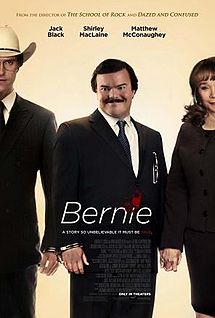
Director Richard Linklater originally made a name for himself with film-stories set in his native Texas, everything from Slacker (1991) and Dazed and Confused (1993) to SubUrbia(1996) and The Newton Boys (1998). Even his beloved European-set Before Sunrise “franchise” has a Texas connection: Ethan Hawke’s writer, who in some small part might be based on Linklater himself, also hails from the southwestern state. The comedic true crime story Bernie (2011) returns Linklater to Texas for the first time since 2006’s Fast Food Nation and reunites him with the star of 2003’s The School of Rock, Jack Black, as well as early muse Matthew McConaughey.

I passed on Bernie when the film hit select theaters in late April of this year, not because I wasn’t interested in the story of a much fawned-over gay assistant funeral director shooting dead his 81-year-old multi-millionaire companion, the small town’s wicked witch, but because I already knew all of its plot details. I had read a New York Times Magazine article by Joe Rhodes, the nephew of the victim Mrs. Marjorie Nugent, and learned that for nine months Bernie kept up the pretense that Marjorie, stuffed in a freezer, was alive while he spent millions of her dollars, “generously” gifting people all over town. Despite Bernie’s, uh, indiscretions, Rhodes, like practically everyone involved, seems to find him the more sympathetic character. It’s a fascinating story, but I wonder if Bernie‘s storytelling format was the best choice. In any case, I heartily recommend Rhodes’s examination of the events leading up to and following Bernie Tiede’s killing Mrs. Nugent that, as the movie’s tagline says, constitutes a story “so unbelievable it must be true.” You just might want to see the movie first, because it does spoil the plot. As does this review of the film Bernie.

East Texas. The date? I’m not quite sure, as the true events took place in the 1990s. But while the production and costume design seem to indicate this period, Bernie (played by Jack Black) has an iPhone, which wasn’t released until summer 2007. So what can you do? Anyway, as the assistant funeral director in Carthage (approximately 7,000 inhabitants strong), Bernie is well-known for his attentive care of the recently bereaved (particularly elderly widows), and his boss especially values his employee’s superb up-selling skills. Bernie manages to thaw Marjorie’s (Shirley MacLaine) cold, miserly heart following his supervision of her bank-owning husband’s funeral (which actually took place in 1990). From that point on, they are virtually inseparable. They travel everywhere together, go on extensive shopping sprees, and eat at the finest restaurants as well as the local, rustic watering holes. (Hilariously, in one scene, Marjorie pesters Bernie to help her pick out a nice dress for dinner, forcing him to stop whatever he was doing at the time he received her call. Then, in an unfussy cut, it’s revealed that they’re only dining at a chintzy Mexican cantina in town). People speculate that Bernie has to be supplying sexual favors in order to receive that kind of lavish, undivided attention from Marjorie, who has alienated everyone who has ever come in her path, including her family members. Marjorie becomes so attached to Bernie that she demands to know where he is and what he is doing at every hour. In his defense, the word that Bernie constantly uses to describe Marjorie’s dependency on him is “possessive.” Then, in an impulsive move one day in 1996 (again, according to actual events), Bernie takes the shotgun for killing pesky armadillos and shoots Marjorie in the back four times, the symbolism not lost on the audience. Immediately remorseful, Bernie prays, but instead of alerting the police, he packs her into the freezer in the garage and goes about life as if she is merely the house-bound victim of a series of strokes. No one else likes to see or talk to her, anyway—except for her nosy stockbroker (Richard Robichaux), who’s onto Bernie’s misdeeds.
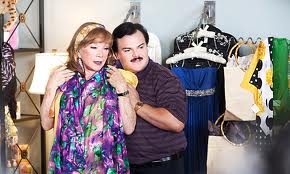
As they grow closer, Marjorie defers to Bernie on all matters of fashion. She even starts to wear her hair down. Image courtesy of http://www.nytimes.com.

No matter how overly prepared I was to watch Bernie, I never expected that Linklater, who co-wrote the script with Texas Monthly crime reporter Skip Hollandsworth, would choose to frame the narrative as a docudrama, complete with historical reenactments starring Black, McConaughey, and MacLaine; numerous talking head interviews with real townspeople; and title-cards that read “Who is Bernie?” and “Was Bernie gay?” One might even be tempted to label the film a mockumentary, for it gently pokes fun at the residents’ bigotry and simple-mindedness. For instance, knowing Bernie to be an outstanding Christian for all his involvement in church activities, including orgiastically singing hymns and paying for a new prayer wing (with Marjorie’s money, of course), the people of Carthage refuse to believe Bernie killed the town’s least popular resident—even after he confesses to the crime once Marjorie’s financial adviser and family members start investigating his trail of lies. In fact, Bernie is so well-liked for his caring and easygoing demeanor that District Attorney Danny Buck Davidson (McConaughey, made comically un-handsome and outfitted with shirts—baggy ones, at that—big, round eyeglasses, and short, matted hair) successfully motions for Bernie’s murder trial to be moved 50 miles away to ensure that selected jurors are unbiased. In the end, he’s sentenced to life in prison, and according to Rhodes, he will be eligible for parole in 2027, when he is sixty-nine-years-old.

One of the real, colorful townspeople of Carthage gives us a handy-dandy geography lesson, enumerating the cultural differences among almost all of the republics of Texas. Image courtesy of http://www.largepopcorn–nobutter.blogspot.com.

In exploring the surreal circumstances of Bernie and Marjorie’s relationship, the film regrettably relies too much on the testimonials of real Carthagians. It’s unclear if their lines are scripted, improvised, or unrehearsed. But the warm, burnt cinematography by Dick Pope seamlessly blends their one-sided conversations (with the documentary lens) with the scenes featuring the trio of the top-lining professional actors and their supporting cast. In other words, despite the fragmented structure of Bernie, Carthage comes across as a fully realized universe and lived-in place, even if Black, McConaughey, and MacLaine barely share any screen-time with the “real” people. However, though all three turn in captivating performances (particularly Black, who dials his trademark zaniness way down), I couldn’t help wishing that Linklater and co. had given the stars more to do. Earlier, I labeled their scenes “historical reenactments” because they mostly just serve the narrative as related by practically everyone in town. They seemingly act out scenes in order to support the Carthagians’ arguments about how gregarious a fellow Bernie was (cue Jack Black, in character, directing and performing in a high school production of The Music Man) and how downright nasty Marjorie was (see MacLaine throw a Hispanic family’s mortgage loan in the garbage as soon as they leave the bank).

Admittedly, one of the best scenes integrates the documentary and comedy-drama bits and, unsurprisingly, unfolds at the very end, allowing the story to come full-circle: one of Bernie’s real-life apologists visits him in jail, still in denial, and reiterates her request that he sing at her own funeral, whenever it is. Touched, Bernie tries to tell her that it’s impossible, as he doubts he’ll ever get permission. But she’s just not hearing him. When their time together is forced to close, the camera follows Bernie contentedly walk back toward his cell, eventually staying put to capture his receding presence—and slightly sashaying hips. As if to say again, “Can you believe this man is a convicted murderer?” This isn’t to say that the filmmakers think Bernie is innocent. He is most definitely not. Having formed my first impression of Bernie Tiede based on Joe Rhodes’s interpretation of his aunt’s life partner-turned-killer, I can see that the filmmakers find him just as sympathetic as Rhodes does. We’re meant to perceive Bernie as simply a good person who snapped and did a very bad thing. More tellingly, to some degree, I think the storytelling structure of Bernie precludes the spectator from strongly identifying with Marjorie. That is, representing the real townspeople’s overwhelmingly sentimental observations about Bernie does very little to redeem Marjorie; no one comes to bat for her. To add insult to injury, MacLaine’s limited screen presence means her character isn’t as fleshed out as Jack Black’s Bernie, leading my dad to comment that her bickering Marjorie recalls her performance as a grumpy and difficult First Lady to Nicolas Cage’s secret serviceman in Guarding Tess (Hugh Wilson, 1994).

It was only during my Google search for images to accompany this article that I made the connection that Bernie has a premise not-too-dissimilar from the one guiding Weekend at Bernie’s (Ted Kotcheff, 1989), wherein Andrew McCarthy and Jonathan Silverman live large at their horrible boss’s vacation home after the titular schmuck (Terry Kiser) dies unexpectedly during their stay; like Bernie, the pathetic stooges pretend their employer is still alive and try to outrun the cops (among others). But whereas Weekend at Bernie’s takes a slapstick approach to defiling the sanctity of the human corpse, Bernie explores the all-too-realness of this possibility. It’s an intriguing little story, and it’s shocking that Carthage still sings his praises. Just what exactly is in the well-water over there? I wonder how the town’s residents responded to the film, too.

Long Take: Winchester ’73 Shows How the West Was Won Still Fascinates Us

Viewed August 9 & 16, 2012

Like some—maybe even many—people of my generation, I didn’t grow up with a fondness for the western. This kind of picture wasn’t widely produced when I was a youngster. Since genres go through cyclical periods of (often frenzied) popularity and then disuse, to put it simply, timing is important, but not everything. Although my father is a fan of the classic westerns of the 1940s and 50s, he never instilled in us kids an enthusiasm for movies set in the Old West, centered on macho disputes over land, women, and personal freedom that are couched as epic battles between good and evil. It’s only been in recent years, after being forced (yes, forced) to watch them and analyze their deeper meanings, that I have come to appreciate the western. And in an effort to clean out my nearly full DVR this summer, I submitted to Anthony Mann’s Winchester ’73 (1950) and found a mythologizing film-story set in 1876 about how the titular gun “won the west” and conquered the popular imagination (thus, the film is also a study in American material culture). You’re about to enter Spoiler Territory ahead. Consider this your first and final warning. Then again, the movie’s sixty-two years old. The statute of limitations has been lifted for quite some time now.

Jimmy—sorry, James—Stewart stars as Lin McAdam, a highly skilled rifleman who rolls into Dodge City, Kansas, with best friend and sidekick Frankie “High Spade” Wilson (Millard Mitchell) on the centennial Fourth of July, a day that the town celebrates by hosting a shooting competition. The prize is one of one thousand priceless, perfectly manufactured Winchester repeating rifles, Model 1873. Sheriff Wyatt Earp (Will Geer) confiscates McAdam’s and High Spade’s guns as soon as they enter town, since Dodge City is a no-gun zone. This means the only way McAdam can best his arch-nemesis Dutch Henry Brown (Stephen McNally), who is also in town, is to beat him at this game, which he does with a lot of panache. In one of those now recognizably racist representations of American Indians, McAdam pays little money for a Indian spectator’s tribal necklace so that he may break off one of its medallions and blow a hole through it after Sheriff Earp throws it up in the air. Covetous of McAdam’s (fully operational) trophy, which McAdam declines to have engraved with his name for lack of time (a maneuver that makes for convenient story plotting), Dutch and his men ambush the winner, steal it from him, and ride out of town without collecting their own guns from the sheriff’s brother, Virgil. McAdam and High Spade are hot in pursuit.

Dodge City Sheriff Wyatt Earp, center, presides over a shooting competition between the just Lin McAdam, left, and the outlaw Dutch Henry Brown, right. Earp has no idea what his contest has set off. Image courtesy of http://www.listal.com.

Synopses of Winchester ’73 typically relate that the film tracks the journey of the rifle, as it is passed from one person to the next. Dutch loses it in a card game to the Indian trader Joe Lamont (John McIntire) while seeking to refuel and arm his men at a saloon on the border with the Indian territory. Later, Lamont refuses to offer Young Bull (Rock Hudson in one of his earliest screen credits) the Winchester ’73, a rifle like the ones that Lakota Chief Crazy Horse (alongside Sitting Bull) and his men used to defeat Lt. Col. George Custer at the Battle of Little Big Horn just months ago. In a deal gone wrong, Young Bull strips Lamont of the gun and then kills and scalps him off-screen. In this way, both sides want the rifle for protection and conquest, but it’s impossible to read their awed faces when in its presence without acknowledging that they have all bought into the myth that the gun, at least in retrospect, is “The Gun that Won the West.” In each man’s eyes, it’s his own ticket to greatness, infamy, legend. Not only will the Winchester ’73 help him reach all of his goals, it will bestow special god-like powers. (Yes, having a murderous streak running through you will make you believe you’re a god when you have the power to kill people from far away, without having to continually reload your weapon.)

For some of the men, like Steve Miller (Charles Drake), who gets it in the aftermath of an impromptu battle against Young Bull, the gun could potentially transform him from coward to brave hero. Except, it doesn’t. He doesn’t have it for more than a day. A supposed friend, the psychopathic Waco Johnny Dean (a charismatic Dan Duryea) shoots Steve dead in front of his fiancee, the former Dodge City saloon girl Lola Manners (Shelley Winters), whom Steve previously and temporarily abandoned when Young Bull chased their wagon the day prior, leading them to seek refuge at the camp of inexperienced U.S. cavalrymen led by Sergeant Wilkes (a funny Jay C. Flippen). It should be noted that during this hideout, McAdam and High Spade also happen upon the army’s makeshift outpost and, thankfully, successfully guide everyone in battle. McAdam rides away before Sgt. Wilkes discovers Young Bull’s rifle, and so he gives it to Steve, a golden opportunity for him to later, fatally, prove his manhood. Very fetishistic, indeed. (It’s worth noting, too, that Wilkes couldn’t have known that it’s McAdam’s rifle; he just wanted to thank him for his superb reinforcements. The historical paper trail on the gun’s provenance runs cold when one looks for the owner’s name on the engraving, which therefore suggests that the mythic Winchester ’73 belongs to everyone and no one at the same time. But, of course, as film-viewers, we know it belongs to one man specifically.)

The eponymous repeating rifle that belongs to McAdam, but from the look of it to everyone and no one in particular. Image courtesy of http://www.derekhill.wordpress.com

And that’s just it. Winchester ’73 is about men and their toys. Or so it would seem. From the beginning, we understand that McAdam and High Spade have been hot on Dutch Henry Brown’s trail for a long time for a specific crime he once committed, though we don’t know what it is. That he took off with the priceless rifle McAdam deservedly won is just an excuse to keep pursuing him. So, while I like to think of Winchester ’73 as a film that examines how a single material object shaped the lives of all those who came in contact with it, in the process both deconstructing and perpetuating the legend that the gun played a vital role in settlers’ so-called “civilized” domestication of the Wild West, I can’t help but notice that the gun itself is a MacGuffin. Sure, it’s not an empty plot device a la the eponymous Maltese Falcon in John Huston’s film noir from 1941; the Winchester is loaded with symbolism in cultural, historical, and political terms. However, McAdam doesn’t seem to want or need the gun to feel complete. He just really wants Dutch dead.

Things heat up once all parties reach Tascosa, Texas, where Dutch and his men botch a bank robbery. Waco Johnny Dean, a would-be co-conspirator, has brought with him Lola Manners. For when you take away a man’s life in outlaw country, you take with you his gun and his bride. Anyway, seeking information about Dutch’s whereabouts from Waco Johnny, McAdam has no choice but to kill his uncooperative informant, thereby releasing Lola from her prison of implied sexual slavery in one fell swoop. She’s grazed by a bullet from the gunfire in the street (following Dutch’s ill attempt at robbing), a hooker with a heart of gold because she tried to get a child to safety. McAdam chases after Dutch to the hills outside of town. Director Anthony Mann uses parallel editing to cut between the action in town and on the rocks. In this climatic scene, High Spade illuminates for Lola—and by extension, the audience—the reason for McAdam’s lust for Dutch’s blood: turns out they’re brothers, and Dutch (né Matthew) killed their upstanding father when he refused to offer shelter to his thieving son. For added pathetic emphasis, High Spade says Dutch shot his dad in the back. OK. We get it, he’s one spineless, evil dude, contractually bound to get his narrative comeuppance.

Honestly, the revelation that McAdam and Dutch are brothers is so contrived, a crucial piece of the story’s puzzle lazily tacked on before the super-imposed title card flashes “The End.” Definitely, if we knew of their familial connection early on in the film, which my father is convinced is the case (I swear to you, it’s not), the narrative would lose some of its suspense. But not much of it. In fact, if their backstory were more fleshed out throughout the picture, then the stakes would have been upped exponentially, kind of like how the paternal melodrama of Red River (Howard Hawks, 1948) plays out between cattle rancher John Wayne and his adopted, rebellious son Montgomery Clift: will Wayne really make good on his promise to kill Clift in the end for his mutinous betrayal? In the very least, with an improved development of the brothers’ individual motivations in Winchester ’73, we wouldn’t have to rely on first impressions alone to size up Dutch’s character before he even makes a break for McAdam’s prize. Come to think of it, how did they manage, in that hotel room scuffle, not to hint at their relation? No warring brothers could plausibly accomplish that. Then again, if Mann and screenwriters Robert L. Richards and Borden Chase had taken the route I’m retroactively proposing, McAdam’s quest for the rifle would be even more transparently about beating his brother at a childish game of war and less about how “The Gun Won the West.”

In this promotional still for the movie, the self-aggrandizing sexual power that the Winchester ’73 gives off is completely unambiguous. That’s Lola in McAdam’s crotch, nursing a war wound. Image courtesy of http://www.hollywoodsgoldenage.com.

But the filmmakers themselves can’t make up their minds about what to do with the gun. (Or maybe I’m just projecting my own intellectual frustrations. That seems more likely.) Because in the end, after inevitably killing his brother, McAdam wins the war and takes back the spoils that are rightfully his. With the ruckus caused by the snatching of his toy now settled, he is also rewarded the love of a woman (who has proven herself good). Sure, she’s a flirt, but she’s also a defiant survivor clearly bedazzled by McAdam’s shooting skills and respectful interaction. He treats her like a lady, not a tramp. (In an earlier scene, before Young Bull’s not-so-surprise ambush, McAdam gifted Lola his six-shooter, and his gentlemanly gesture wasn’t lost on her: she was to shoot herself before letting any Indian take her captive.) So it appears as if there has been some underlying anxiety over McAdam’s masculinity, after all. In other words, regaining the Winchester ’73 does complete his own transformation. Implicitly, but not-so-subtly, he couldn’t settle down with a woman (preferring High Spade’s company to anyone else’s, it has to be said) before he successfully vanquished his brother. And now that he has his rifle prize back, his righteous, unambiguously heterosexual manhood is restored and he can aggressively pursue romance with Lola. That’s just about what you would expect from any and all westerns, but Winchester ’73 more explicitly weds generic trademarks (such as the domestication of redemptive rogue souls) to the complex processes of mythologizing the Wild West in popular American culture. It does this, my friends, by harnessing the emotive and symbolic power of the titular gun.

Long Take: Hope Springs, Not Exactly as Promised

Viewed August 11, 2012

This past Saturday was my birthday, and in my family—as in many families, I would suspect—we go to the movies to celebrate before dining out. We’re just not that creative. Unfortunately, there were slim pickings to choose from this year. I had no desire to get confused during The Bourne Legacy (Tony Gilroy, 2012) or to catch up by seeing last month’s The Dark Knight Rises (Christopher Nolan, 2012). So I opted for Hope Springs (David Frankel, 2012), the sweet little comedy about a couple in their sixties rekindling the romance and spicing up their sex lives after thirty-one years of marriage. When I told my film critic friend Gabe of my plans to see this movie, he joked, “I had no idea you were a sixty-something sex-starved housewife with zero interests.” My response? “Now you do!”

It’s not that I regret my choice, but Hope Springs did very little to impress me. I wasn’t expecting much, as I had somewhat foolishly read reviews beforehand, positive and negative alike. In particular, I knew not to expect a zany battle-of-the-sexes-type romantic comedy that the trailers and TV spots implied. In fact, while Hope Springs is not without its funny moments, it should be more accurately classified as a drama, for it treats Kay (Meryl Streep) and Arnold’s (Tommy Lee Jones) lack of physical and emotional intimacy in their marriage as a deathly serious problem. And that’s fine by me. When a couple that has been together for over thirty years and raised two children (who are now out of the house), sleep in separate rooms and barely talk to each other, getting them to reconnect is serious business. Washington Post chief film critic Ann Hornaday claims, “Hope Springs is a minor miracle of a movie,” as it tackles its subject “with a degree of integrity and candor rarely seen in American movies.” I agree, but to an extent. Here’s why. Fair warning: spoilers follow!

Omaha, Nebraska. We meet Kay and Arnold right around their thirty-first wedding anniversary. And that’s the first of many implausibilities. Given their socially conservative backgrounds, having met and married when Kay was in college or just graduated, they should be married for longer and with older kids, too. Anyway, stuck in a deep rut wherein they sleep in separate rooms (owing to Arnold’s years-old back injury) and gift each other a new cable subscription, Kay intends to break free, taking Arnold with her. A retail clerk at a Coldwater Creek fashion outlet for conservatively inclined middle-aged women shoppers, she takes what little money she’s saved over the years and splashes out on a week of intensive couple’s counseling sessions with Dr. Bernard Feld (Steve Carell as subdued as ever) in Great Hope Springs, Maine. (I imagine that screenwriter Vanessa Taylor grants Kay this job so as to distance her from earlier iterations of this sad-sack character. In other words, Kay isn’t simply a fed-up homemaker, she’s a fed-up former housewife who in recent years as reentered the workforce, albeit only the service industry.) From the beginning, and throughout most of their sojourn, Arnold is hostile to Kay’s expensive, faraway effort to save their marriage, but of course he gradually becomes more game, more willing to open up to Kay, at Dr. Feld’s insistence.

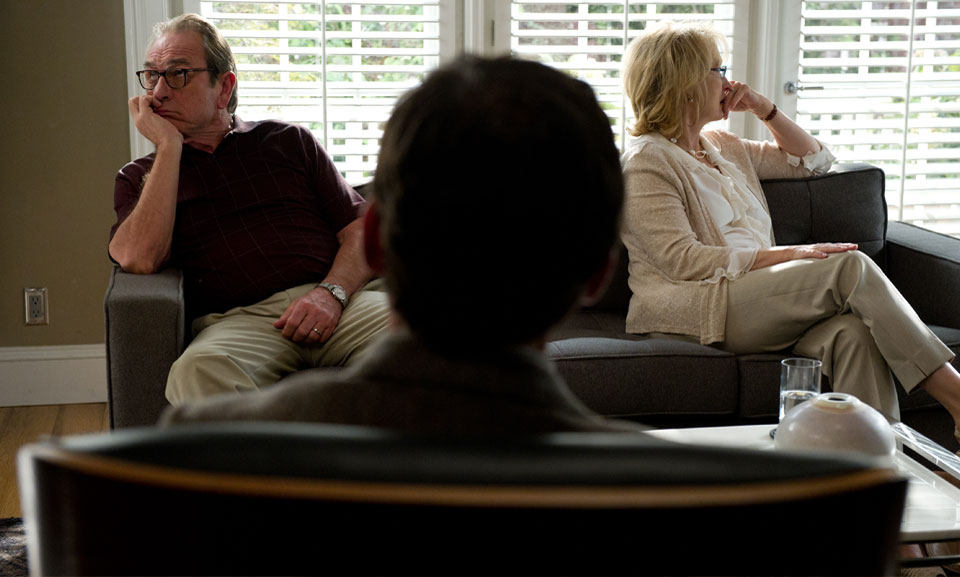
Arnold and Kay, as seen from Dr. Feld’s perspective, before they inevitably get back together in the end. First step: turning around to look at one another. Image courtesy of Sony Pictures and http://www.hopesprings-movie.com.

Hope Springs is highly uncinematic and not at all like the promotional image seen directly above. It mainly cuts between long scenes set in Dr. Feld’s office, where he prods each with questions about his or her sexual history and fantasies, and short scenes that take place around the small, idyllic town, whether at the staid motel room, kitschy diner, bar, or lighthouse museum. Director David Frankel, who previously worked with Streep on her Oscar-nominated role in The Devil Wears Prada (2006), adds no flourishes. What he’s produced is an awfully boring film whose scenes—let alone frames—hardly look different from each other. It doesn’t help matters that cliched pop songs dominate the soundtrack, everything from Annie Lennox’s “Why” to Al Green’s “Let’s Stay Together” (the latter of which sounds during a failed attempt to have sex). The instrumental score is almost non-existent; I noticed it in only one scene. Bad form.

But what of these therapy sessions? Although I have never seen either program, I suspect that the HBO series The Sopranos (1999-2007) and In Treatment (2008-2011) more innovatively shoot conversations between a therapist and his or her patient, appropriately heightening the tension between them. To the contrary, everything in Hope Springs is straight-forward. I can only recall one interesting editing technique in all of the scenes at Dr. Feld’s: we hear him ask Arnold questions he doesn’t want to answer, and the camera focuses on Arnold’s anguished face in close-up as he listens to Dr. Feld. Then again, I also appreciated those zoomings in on Kay’s face as she listens to Arnold’s confessions. Whereas my dad liked that Steve Carell managed to reel in his trademark goofy mania, I endlessly tried to come up with names that could play the part with more… oomph. This is not to say that Carell turned in a weak or bad performance, as it probably has more to do with the way Taylor wrote Dr. Feld and how Frankel interpreted the character from her script. What if Dr. Feld had been less calm? Hell, what if he had a sense of humor?

Speaking of casting, let’s address Streep’s and Jones’s performances and their characters. A living legend, Streep predictably embodies her character to the fullest (at least as fully as she can, given the limited script), complete with timid mannerisms and speech and an incredibly dowdy hairstyle. But like Hornaday, I couldn’t help wishing that “her sweet, naive character had just one more layer to make her sharper and more complex,” like her character in It’s Complicated (Nancy Meyers, 2009). As the instigator of the project to rebuild their marriage, Kay begins as the more sympathetic of the pair. We root for her to get what she wants; after all, her desires are more than reasonable. But when Dr. Feld coaxes her sexual fantasies out of her, and she comes up short, not only did I feel sorry for Kay (who claims that she has only ever wanted Arnold, in vanilla-flavored sexual positions and scenarios), I wondered, what is the point? Why should I care about this woman if she doesn’t want something, for lack of a better word, interesting? It’s not enough that, after Dr. Feld’s encouraging her to experiment and act on her fantasies, she attempts to give Arnold a blow job in a movie theater. “Attempts,” being the operative word there. She’s too embarrassed, uncomfortable, and ill-experienced to finish, and she crawls away in shame. What’s worse is that she only ever wants to please Arnold. Other than wanting him to kiss and touch her in innocent ways, she never asks for him to pleasure her in any way. Presented entirely for laughs, Kay doesn’t realize that oral sex isn’t just performed on the man; I wanted to pull my eyes out. Ugh. Compounding all of this is the final scene during the end credits: at the pair’s vow renewal ceremony on the Maine beach a year later, with Dr. Feld and family gathered, Kay pledges to keep her hair long because she knows that Arnold likes it that way. So much for wishing that the original trip had given her a backbone and an independent spirit, which was in evidence when she first boarded the plane in Omaha without Arnold (who showed up, hemming and hawing, at the last possible moment).

Kay and Arnold during one of Dr. Feld’s “intimacy homework assignments.” Woozy. Image courtesy of http://www.washingtonpost.com.

Admittedly, one of the reasons why I had not wanted to see Hope Springs was because I found Tommy Lee Jones unappealing as Meryl Streep’s romantic lead. I didn’t think his on- and off-screen persona meshed well with the demands of what I thought at the time was a romantic comedy. But now I am happy to say that his casting and performance are spot-on. He’s less the grizzled lawman in No Country for Old Men (Joel & Ethan Coen, 2007) or The Fugitive (Andrew Davis, 1993) and more the grizzled businessman in The Company Men (John Wells, 2010). Whereas the chameleon-like Streep alters her voice and appearance when playing Kay (looking older and mousy), Jones looks the same as he always does, except his principal prop is a suitcase rather than a shotgun. As an avatar of a chiseled and mythically strong American masculinity—aging but active, a maverick for the greater good—it’s interesting to see how easily Jones transfers this to his portrayal of Arnold, who’s emotionally stunted, uncommunicative, non-confrontational, and angry. New York‘s film critic, David Edelstein, proposes that Kay’s withholding sexual favors for years frustrated Arnold to the point where he never returned to the bedroom, even after his back got better. As if to say, you did it to yourself, Kay. Ouch. Having said this, though, Jones easily earns the most laughs since he’s the only one, say, really uncomfortable discussing his sex life with a complete stranger. He comes up with many wisecracks, memorably about Dr. Feld’s monotone approach to sexuality (if you’ve seen the trailer, you know what I mean), and Jones is a gifted physical comedian. Who knew?!

According to the movie’s trivia page on the Internet Movie Database, Jeff Bridges was originally offered Jones’s role. When my sister brought this little factoid to my attention, I contemplated how different the movie would be. It definitely would have been more pleasant to sit through the sex scenes (more on those in a moment), since Bridges is a considerably more attractive man. We can’t know why Bridges turned it down unless he ever publicly addresses the question, but we can take comfort that he co-starred in a much more sophisticated romantic drama (with comedic elements) in 1996: The Mirror Has Two Faces, with director-star Barbra Streisand. While Columbia University professors Gregory Larkin (Bridges) and Rose Morgan (Streisand) may be unmarried when the film begins, The Mirror Has Two Faces similarly tracks their platonic relationship as it morphs first into a platonic marriage and later, once she’s had enough of a shared life without passion and romance, a fully-fledged sexual marriage. Granted, I don’t approve of how Rose’s third-act makeover from ugly duckling to stunning swan fixes the sexual intimacy problem of their marriage (in fact, Gregory and Rose marry late in life because they’ve finally found their intellectual equals), but The Mirror Has Two Faces doesn’t shy away from addressing a middle-aged couple’s sexual desires and fantasies. Rose is a fiercely intelligent, neurotic, cosmopolitan, and desirous woman. So much easier to relate to than the bland Midwestern housewife Kay. (By the way, shouldn’t Nebraskans be offended that the Coasts, both East and West, continue to culturally belittle them?)

Actually, now’s a good time to look at those Hope Springs sex scenes. I bet that the filmmakers and the studio behind it think they pushed the envelope simply by making a movie about a husband and wife in their sixties trying to rediscover each other and themselves sexually. Oh, whatever. They don’t go very far. Yes, they push the PG-13 rating, but only in terms of language. For example, Dr. Feld asks if Kay ever wishes they assumed more than just the missionary position during sex. Would she, he asks, prefer to try out anal sex? Blushes and hand-waving ensue. Out of the question. But when sex between Kay and Arnold is represented on-screen, after a romantic dinner at a high-class restaurant in town (for a change!), we see no sexagenarian flesh. Just a lot of fully-clothed groping. Even when Arnold gets on top of her, their clothes stay on completely. I hate it in movies when characters have sex fully dressed. Unless you’re in public and having sex standing up, there is no excuse. How confrontational and realistic do the filmmakers—and I’m talking about those of Hope Springs specifically now—think they are when these sex scenes leave so much to be desired? Maybe I’m being too harsh. It is, after all, a big studio picture that clearly wants to appeal most to Middle American viewers of a certain age, who should find Kay and Arnold hopelessly familiar.

Still, after years of watching films from around the world about people—young and old alike—desperately trying to make a (sexual) connection with someone else, Hope Springs simply comes up short. Ann Hornaday mentions in her Washington Post review that the film is “like the more cheerful, reassuring and commercially palatable version” of a story similar to Michael Haneke’s Palme d’Or-winning Amour (2012), about an elderly man faced with losing his terminally ill wife. I haven’t seen Amour yet, but somehow I just can’t imagine this to be the case. A more appropriate “world cinema”/”art-house”/auteurist comparison is Andreas Dresen’s Cloud 9 (2008), a small, German character study in which a sixty-something-year-old woman, after thirty-odd years of a happy if routine marriage, embarks on a torrid affair with a man in his seventies! With disastrous consequences, of course. As if that were not enough, the director shows the adulterous couple, who, I might add, are nowhere near as glamorous or fit as Streep or Jones, fornicating in graphic detail, their flabby flesh rolling all over each other. It may not be a pretty sight, but it’s certainly more frank, and in its frankness, a beautiful thing. And when you turn to more commercial (read: simply American) output, even It’s Complicated provides a more nuanced view of people approaching 60 who let go of their inhibitions and assert their sexuality in aggressive ways. It’s not for nothing that Alec Baldwin says to his ex-wife Meryl Streep that their affair is like something out of a French film.