The ending of Before Sunset (Richard Linklater, 2004) presents a litmus test, a method for separating the romantics from the skeptics in the audience. Being a logical person, however, I have always thought Jesse’s satisfied smile as he answers, “I know” to Celine’s playful admonishment, “Honey, you’re gonna miss that plane” meant their remaining together—perhaps even in Paris—was a sure thing.
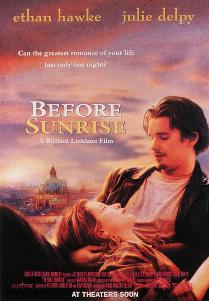
Before Sunset is one of those rare “franchise” films in that it’s actually better than the originator of the series, Before Sunrise (Linklater, 1995). The later film, edited so that Jesse and Celine’s chance reunion over the course of one afternoon unravels in approximate real-time, is wistful in tone and very adult in theme. By virtue of their having a history (and our being privy to it), it’s much more intimate than Sunrise. And who could resist the opportunity to see the idealistic twentysomethings (who, as strangers, once shared a formative romantic night together in Vienna) all grown-up and cynical, processing that rendezvous and how it has shaped their lives since. That’s why, combined with the supposed ambiguity of Before Sunset‘s conclusion, we fans have hoped that director Richard Linklater and stars Ethan Hawke and Julie Delpy would bring these vivid characters back to the big screen again.
Aside from wanting to fulfill their own creative energies and desires to shoot another picture about Jesse and Celine, I would imagine that the creators also want to please the fans who can’t let the characters go. Like many others, I have followed the possibility of a third film coming to fruition, reading everything from an online interview over here to a newspaper profile over there. Recently, everyone involved has kept the details of the (pre)production close to the vest, only ever going so far as to say something to the effect of “we’re working on it, we’re working on the script.” Well, good news, friends: they’ve done us even better by finishing the shoot just yesterday! Mike Fleming of Deadline New York reports that Before Midnight wrapped production in Greece Tuesday night (I guess Hawke’s title suggestion, Before We Go Crazy, didn’t make the cut). Fleming quotes a written statement from the co-writers, which offers nothing in terms of the story or plot of the new film. In other words, it’s still unclear if Jesse and Celine have stayed together since Paris or are reconciling yet again. Hell, they may have even dated and split up in the interim. We have to wait a little bit longer to find out.
But what a coup, huh? How marvelous that everyone managed to fool us all into thinking that the film hadn’t even gone into production yet. Here’s to a swift post-production and not-too-distant release date!
It’s true, I haven’t been to the movies in over three weeks, since my birthday on August 11th. And even then, just choosing something to see was difficult to do. It’s been a really crappy summer for movies (I don’t care what you say; superhero/comic book movies are boring), so let’s hope the year improves as studios start rolling out their prestige pictures, their awards bait. But that’s not the point of this post. Instead, I would like to comment on the overnight success of The Possession (Ole Bornedal, 2012), which is all set to win the Labor Day weekend box office—with an unimaginative title and poster to boot. According to Pamela McClintock of The Hollywood Reporter, Lionsgate estimates that the exorcism film-story will bring in $21.3 million for the mini major, making the movie the second highest grossing Labor Day weekend box office winner ever recorded on the books (in inflated dollars, of course).
That a horror film, even during summer (or the last days of it), can scrounge up so much money isn’t surprising (McClintock reminds us that 2007’s Halloween, directed by Rob Zombie, currently holds the record for the biggest box office overhaul for any Labor Day weekend with $30.6 million in tickets sold). I’m just wondering why audiences have, for lack of a better word, “flocked” to see this film. Admittedly, I am biased against pictures that revolve around exorcisms (and, while we’re at it, horror films in general) and would never in a million years pay to see this in the theater, but I read Bilge Ebiri’s review of The Possession, anyway. You can click to read it yourself; he doesn’t spoil anything. And that’s exactly the point: you can’t spoil what happens in any of these formulaic movies. As Ebiri notes, “Demon-possession movies are now so ubiquitous that we don’t really expect any dramatically new shocks from them.” Granted, he seems to have liked this one more than he was expecting to, for dramatic reasons that have little to with the scary, climatic scenes.
This being a think piece that aims to ask questions about genre and audience appeal, I still want to know why The Possession is on track to actually exceed studios’ expectations. Is it because there’s really nothing else out there worth seeing? That can’t be, for Mike Birbiglia won’t stop tweeting about all the dozens of Q&As he’s hosting around the country for his directorial debut Sleepwalk with Me (2012). Is it because, for a change, The Possession centers not on a Catholic-tinged Satan overtaking a family’s young daughter but on an ancient Jewish demon entering the same kind of girl? A premise, it should be noted, that isn’t alienating Hispanic viewers as Ray Subers of Box Office Mojo predicted it would. (McClintock reports, “The film also is over-indexing in Hispanic Catholic markets.”) Is it because Matisyahu, the Hasidic reggae musician, plays the exorcist? (I know that alone would draw my brother in.) If it’s not quite clear, I am being facetious. I know why horror movies, no matter how generic they are, are so “ubiquitous” (to borrow Ebiri’s term) and wildly popular. In short: they’re cheap to produce (not too many stars demanding hefty paychecks), and they reliably offer the spectator a sort of interactive thrill ride, complete with jumps in seats, shouts at the screen, and peeks at the screen through fingers laced across faces. In fact, it’s these kinds of conventions that ensure the genre’s popularity, and word-of-mouth has a lot to do with it (this is undoubtedly the case for The Possession, too).
Besides, Sam Raimi produced it. For the horror fan, that might lend it some credibility. More pertinently, however, I wonder what the appeal of this particular film is for the young women who went to see it. McClintock writes that the audience this weekend is mostly female: “[Women] made up 59 percent of the audience, while 54 percent of those buying tickets were younger than 25.” Which means the production company’s marketing strategy that McClintock alludes to (ie. targeting girls and young women) has paid off handsomely. Is it typical for exorcism movies to be marketed toward this demographic? I really have no idea what the advertising campaign consists of, and McClintock doesn’t clue me in, but I am curious about this. For horror films have, historically speaking, been either geared toward young men or toward neither sex in particular (once studios realized women like these kinds of scares, too!). Though I haven’t seen it, I understand that Jennifer’s Body (2009), as devised by screenwriter Diablo Cody and director Karyn Kusama, was supposed to be a feminist-inflicted mash-up between demon possession movies and slasher flicks. I guess I should see it to find out why this film tried to reach a diverse audience—but especially women, I would think—and failed. Wait, don’t tell me. It probably has to do with Megan Fox, right?
Approaching Edinburgh Castle along High Street (aka the Royal Mile), near sundown, as captured by the author.
Edinburgh. Edinburgh. Edinburgh. Say that three times fast, pronouncing the Scottish capital’s name just as the natives do (nowhere near “burg” and slightly clipped away from the longer “burra”). If only the incantation were like the one in Beetlejuice (Tim Burton, 1988), except it would transport me. When my sister and I came to Edinburgh, after a few days in Glasgow and before making our way to London in December 2006, my expectations were as high as the Castle, which sits above the city as if it were a crown or the cherry atop a hot fudge sundae. In the city center, it’s virtually impossible to look up without seeing Edinburgh Castle. This undoubtedly leaves a rather picturesque impression on the mind, long after you have gone.
Running tangential to my rampant Anglophilia (and the equivalent for Ireland, whatever its name may be), is my even more ravenous hunger for all things Scottish. I cannot pinpoint exactly where and when it began. I’m sure members of my family would tell you that it started consuming me when I first rented on VHS the new, much buzzed-about indie hit Trainspotting (Danny Boyle, 1996) at the tender age of ten. (What can I say? I have two of the most permissible parents on the planet when it comes to thematic content in film.) However, I don’t think that is entirely true, for I must have already had an intense interest in Scotland to have even heard of such a film about a cadre of heroin addicts and to seek it out for screening. But truth be told, it lay the groundwork for my passionate exploration of Scotland, through movies, music, history, literature, politics, comedy, etc., which continues unabated to this day. Trainspotting represents for me one of my most formative experiences of cinephilia, and thus warrants its own future post. But suffice it to say that when I arrived in Edinburgh, I wanted to see how it matched up with the hundreds of Trainspotting viewings I had enjoyed already.
I wasn’t expecting much overlap in scenery, actually. Trainspotting had been shot mostly in Glasgow. I remember a Glaswegian telling me in an anonymous online chatroom (remember those? how quaint!) that the Taxi Driver-themed nightclub where Mark Renton (Ewan McGregor) meets Diane(Kelly Macdonald) is—or at least, was—located in his city. I’m not sure that the filmmakers even used Irvine Welsh’s inspired setting, Leith, when they shot the picture. And in retrospect, I regret not riding the bus out there, especially after having read much of the Trainspotting author’s oeuvre set in the (once-)depressed municipal port north of the city.
Not being big shoppers, my sister and I knew that we still had to see Princes Street, the main thoroughfare in Edinburgh, which divides New Town from the Old (and vice versa). In the opening scene of Trainspotting, Renton and his best bud Spud (Ewen Bremner) run down this avenue, cops in hot pursuit. Iggy Pop’s “Lust for Life” provides the propulsive score to the action. Eventually, Renton’s voice-over intones why people “choose life” and why he explicitly hasn’t. These audio and visual ingredients are iconic on their own, but when mixed together, they ensure the film’s cult status right out of the gate. Which is exactly why I had to make a pilgrimage to Princes Street (it’s not hard to do, the train station’s right there). This scene is practically the only one shot in Edinburgh; they couldn’t easily double Glasgow when introducing the city with this kind of iconic shorthand.
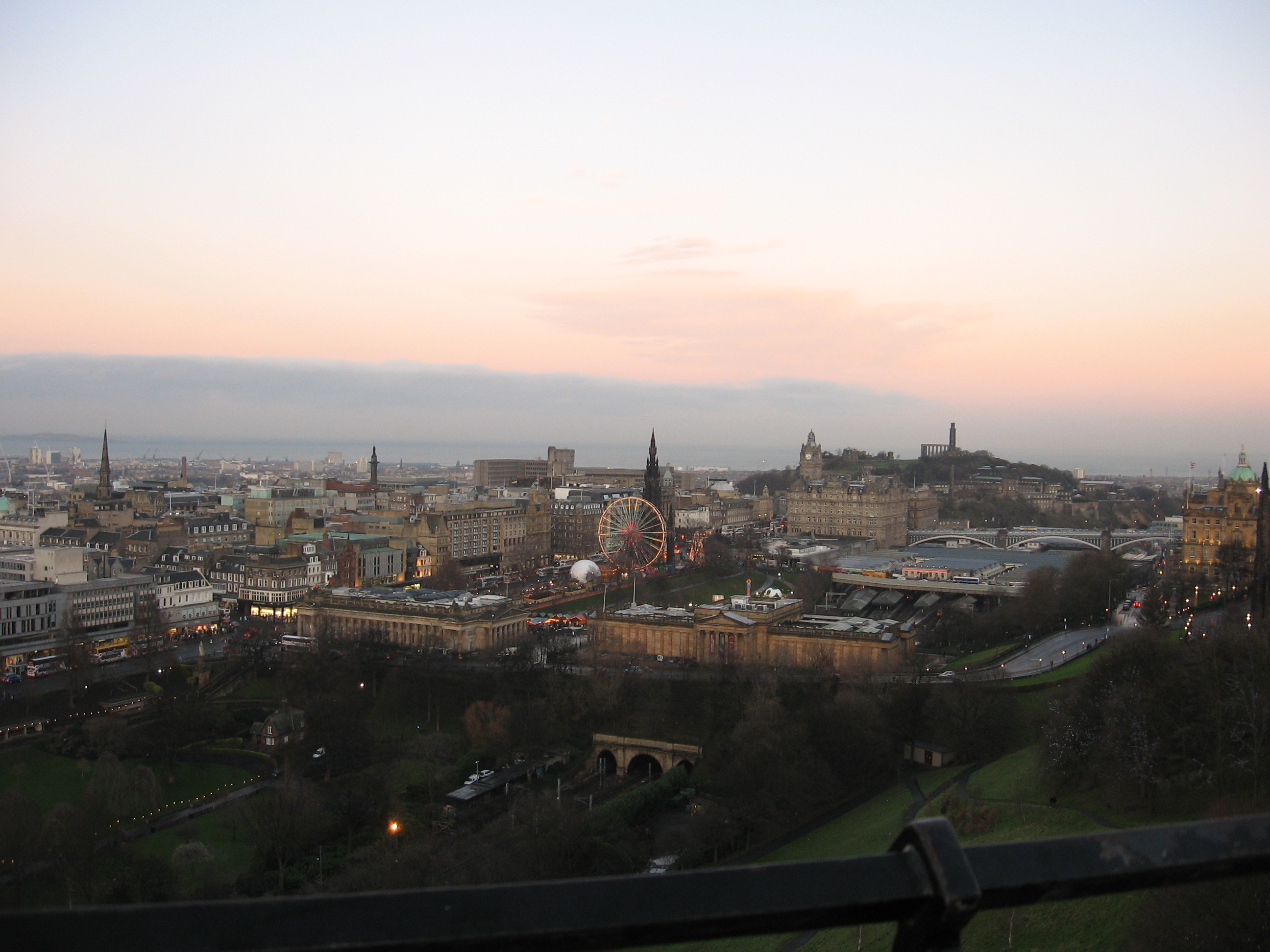
The view from Cockburn Street (if memory serves) of Princes Street. The Royal Scottish Academy and National Gallery of Scotland are in the foreground, with Waverley Train Station in the middle, and off in the distance is Calton Hill. Photo by the author.
There aren’t many films set—let alone shot—in Edinburgh, as film industries favor the more populous Glasgow for its urban Scottish stories (don’t get me started on Highland film settings). Shallow Grave (Danny Boyle, 1994) and One Day (Lone Scherfig, 2011) are notable exceptions, and they both capture Edinburgh as the beautiful, historic, lived-in city that I dreamily wandered around for days. But 16 Years of Alcohol (Richard Jobson, 2003) and Driving Lessons (Jeremy Brock, 2006) provide more specialized glimpses of the capital city that I recognize from personal experience.
The first, billed on a poster as “Trainspotting Meets A Clockwork Orange” (it’s like neither of those two), has a memorable scene set on Calton Hill, where the reformed skinhead protagonist (played by Kevin McKidd, of Trainspotting fame) seeks redemption. Standing on a hillside walkway, where I snapped the above picture, I remember feeling overjoyed at the sight of Calton Hill in the faraway distance, its unfinished early 19th century Parthenon and Nelson Monument (the tower that looks like an upside down telescope) presiding over the city. I recalled both landmark structures from my viewing of the little-seen 16 Years of Alcohol, which underscores their deeply symbolic position to quiet but melodramatic effect. The film also has many scenes set in closes, or steep streets that connect the Royal Mile to streets down below. Although I remember giddily exploring one or two of these dark passageways, I regret not taking a haunted tour of Edinburgh that used them as occasions to tell macabre stories about the city’s past.
Driving Lessons takes place mostly in England, but the wacky actress Julie Walters dupes her assistant Rupert Grint into chauffeuring her all the way to Edinburgh for a speaking engagement. Much of the Edinburgh action hews closely to the area around Princes Street, but the characters stop in at a pawn shop on the Royal Mile, not far from the chintzy souvenir shop where I purchased a Royal Standard of Scotland (you know, the golden flag with a red lion). I later found out it wasn’t the real thing (the lion on my flag didn’t have a blue tongue, probably because the unauthorized production and display of the royal family’s rampart is punishable by law). Whenever I see Driving Lessons, I’m reminded of this… fact. And until fairly recently, the flag’s inauthenticity always made me feel dejected whenever I looked up at it, hanging on the wall above my bed. So I finally replaced it with the Scottish national flag, the Saltire (or St. Andrew’s Cross), which my sister gifted me for my birthday a few weeks ago. Her message? “Let your Scottish freak flag fly!”
No film could prepare me for Edinburgh. When we first arrived, the air smelled delicious, of smoked hot dogs. Later, when my sister and I sampled different varieties of Scotch whisky at Edinburgh Castle, we realized the city’s aroma was the byproduct of numerous nearby distilleries. To this day, when I think of Edinburgh and inevitably yearn to return there (specifically to live), I can’t help but smell it. Even if the whisky burned my throat.
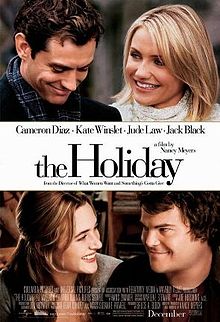
I woke up one morning in Edinburgh with a sore throat, but it wasn’t because of the whisky. I had stupidly gone to sleep with damp hair the night before. At the time, it spoiled my memory of the previous night, which came to me as an utter surprise. Not knowing how to spend the evening after dinner (my sister and I aren’t big on bars or nightclubs), I allowed her to drag me to see The Holiday (Nancy Meyers, 2006). As you might recall, she’s really into romantic comedies, and I am not. In any case, I rather enjoyed the film and its romantic sense of adventure. It made me wish I could meet a sensitive and sexy Scot while on my travels, just as Cameron Diaz’s unemotional-to-a-fault workaholic falls into bed with the mysterious cad-turned-superdad played by Jude Law. Oh well. Such romantic fantasies are just made for the screen (pun intended). After all, my real love affair was with Edinburgh, who made such a euphoric impact on all of my senses, including, most of all, my sense of self. This is going to sound really cheesy, but it’s true. Since I had romanticized the city for years, I hoped against hope that I would fall in love with the place and never want to leave. This dream did indeed come true, but I also had to make the painful realization that the days I spent in Edinburgh were not nearly sufficient enough for me to really get to know the city. Instead, Edinburgh is like a soul mate you meet all-too-briefly before you go your separate ways. No matter where I am or what I do, I can’t shake the memory of Edinburgh’s cheeky smile, traumatic and triumphant life experiences, and a self-confidence that set me at ease. I can’t wait for us to meet again.
Up next: another entry of Movie Travel Diary. But until then, tell me about your movie-related experiences in Edinburgh. Which film(s) best represents the Edinburgh you know from your own travels?
Like some—maybe even many—people of my generation, I didn’t grow up with a fondness for the western. This kind of picture wasn’t widely produced when I was a youngster. Since genres go through cyclical periods of (often frenzied) popularity and then disuse, to put it simply, timing is important, but not everything. Although my father is a fan of the classic westerns of the 1940s and 50s, he never instilled in us kids an enthusiasm for movies set in the Old West, centered on macho disputes over land, women, and personal freedom that are couched as epic battles between good and evil. It’s only been in recent years, after being forced (yes, forced) to watch them and analyze their deeper meanings, that I have come to appreciate the western. And in an effort to clean out my nearly full DVR this summer, I submitted to Anthony Mann’s Winchester ’73 (1950) and found a mythologizing film-story set in 1876 about how the titular gun “won the west” and conquered the popular imagination (thus, the film is also a study in American material culture). You’re about to enter Spoiler Territory ahead. Consider this your first and final warning. Then again, the movie’s sixty-two years old. The statute of limitations has been lifted for quite some time now.
Jimmy—sorry, James—Stewart stars as Lin McAdam, a highly skilled rifleman who rolls into Dodge City, Kansas, with best friend and sidekick Frankie “High Spade” Wilson (Millard Mitchell) on the centennial Fourth of July, a day that the town celebrates by hosting a shooting competition. The prize is one of one thousand priceless, perfectly manufactured Winchester repeating rifles, Model 1873. Sheriff Wyatt Earp (Will Geer) confiscates McAdam’s and High Spade’s guns as soon as they enter town, since Dodge City is a no-gun zone. This means the only way McAdam can best his arch-nemesis Dutch Henry Brown (Stephen McNally), who is also in town, is to beat him at this game, which he does with a lot of panache. In one of those now recognizably racist representations of American Indians, McAdam pays little money for a Indian spectator’s tribal necklace so that he may break off one of its medallions and blow a hole through it after Sheriff Earp throws it up in the air. Covetous of McAdam’s (fully operational) trophy, which McAdam declines to have engraved with his name for lack of time (a maneuver that makes for convenient story plotting), Dutch and his men ambush the winner, steal it from him, and ride out of town without collecting their own guns from the sheriff’s brother, Virgil. McAdam and High Spade are hot in pursuit.
Dodge City Sheriff Wyatt Earp, center, presides over a shooting competition between the just Lin McAdam, left, and the outlaw Dutch Henry Brown, right. Earp has no idea what his contest has set off. Image courtesy of http://www.listal.com.
Synopses of Winchester ’73 typically relate that the film tracks the journey of the rifle, as it is passed from one person to the next. Dutch loses it in a card game to the Indian trader Joe Lamont (John McIntire) while seeking to refuel and arm his men at a saloon on the border with the Indian territory. Later, Lamont refuses to offer Young Bull (Rock Hudson in one of his earliest screen credits) the Winchester ’73, a rifle like the ones that Lakota Chief Crazy Horse (alongside Sitting Bull) and his men used to defeat Lt. Col. George Custer at the Battle of Little Big Horn just months ago. In a deal gone wrong, Young Bull strips Lamont of the gun and then kills and scalps him off-screen. In this way, both sides want the rifle for protection and conquest, but it’s impossible to read their awed faces when in its presence without acknowledging that they have all bought into the myth that the gun, at least in retrospect, is “The Gun that Won the West.” In each man’s eyes, it’s his own ticket to greatness, infamy, legend. Not only will the Winchester ’73 help him reach all of his goals, it will bestow special god-like powers. (Yes, having a murderous streak running through you will make you believe you’re a god when you have the power to kill people from far away, without having to continually reload your weapon.)
For some of the men, like Steve Miller (Charles Drake), who gets it in the aftermath of an impromptu battle against Young Bull, the gun could potentially transform him from coward to brave hero. Except, it doesn’t. He doesn’t have it for more than a day. A supposed friend, the psychopathic Waco Johnny Dean (a charismatic Dan Duryea) shoots Steve dead in front of his fiancee, the former Dodge City saloon girl Lola Manners (Shelley Winters), whom Steve previously and temporarily abandoned when Young Bull chased their wagon the day prior, leading them to seek refuge at the camp of inexperienced U.S. cavalrymen led by Sergeant Wilkes (a funny Jay C. Flippen). It should be noted that during this hideout, McAdam and High Spade also happen upon the army’s makeshift outpost and, thankfully, successfully guide everyone in battle. McAdam rides away before Sgt. Wilkes discovers Young Bull’s rifle, and so he gives it to Steve, a golden opportunity for him to later, fatally, prove his manhood. Very fetishistic, indeed. (It’s worth noting, too, that Wilkes couldn’t have known that it’s McAdam’s rifle; he just wanted to thank him for his superb reinforcements. The historical paper trail on the gun’s provenance runs cold when one looks for the owner’s name on the engraving, which therefore suggests that the mythic Winchester ’73 belongs to everyone and no one at the same time. But, of course, as film-viewers, we know it belongs to one man specifically.)
The eponymous repeating rifle that belongs to McAdam, but from the look of it to everyone and no one in particular. Image courtesy of http://www.derekhill.wordpress.com
And that’s just it. Winchester ’73 is about men and their toys. Or so it would seem. From the beginning, we understand that McAdam and High Spade have been hot on Dutch Henry Brown’s trail for a long time for a specific crime he once committed, though we don’t know what it is. That he took off with the priceless rifle McAdam deservedly won is just an excuse to keep pursuing him. So, while I like to think of Winchester ’73 as a film that examines how a single material object shaped the lives of all those who came in contact with it, in the process both deconstructing and perpetuating the legend that the gun played a vital role in settlers’ so-called “civilized” domestication of the Wild West, I can’t help but notice that the gun itself is a MacGuffin. Sure, it’s not an empty plot device a la the eponymous Maltese Falcon in John Huston’s film noir from 1941; the Winchester is loaded with symbolism in cultural, historical, and political terms. However, McAdam doesn’t seem to want or need the gun to feel complete. He just really wants Dutch dead.
Things heat up once all parties reach Tascosa, Texas, where Dutch and his men botch a bank robbery. Waco Johnny Dean, a would-be co-conspirator, has brought with him Lola Manners. For when you take away a man’s life in outlaw country, you take with you his gun and his bride. Anyway, seeking information about Dutch’s whereabouts from Waco Johnny, McAdam has no choice but to kill his uncooperative informant, thereby releasing Lola from her prison of implied sexual slavery in one fell swoop. She’s grazed by a bullet from the gunfire in the street (following Dutch’s ill attempt at robbing), a hooker with a heart of gold because she tried to get a child to safety. McAdam chases after Dutch to the hills outside of town. Director Anthony Mann uses parallel editing to cut between the action in town and on the rocks. In this climatic scene, High Spade illuminates for Lola—and by extension, the audience—the reason for McAdam’s lust for Dutch’s blood: turns out they’re brothers, and Dutch (né Matthew) killed their upstanding father when he refused to offer shelter to his thieving son. For added pathetic emphasis, High Spade says Dutch shot his dad in the back. OK.We get it, he’s one spineless, evil dude, contractually bound to get his narrative comeuppance.
Honestly, the revelation that McAdam and Dutch are brothers is so contrived, a crucial piece of the story’s puzzle lazily tacked on before the super-imposed title card flashes “The End.” Definitely, if we knew of their familial connection early on in the film, which my father is convinced is the case (I swear to you, it’s not), the narrative would lose some of its suspense. But not much of it. In fact, if their backstory were more fleshed out throughout the picture, then the stakes would have been upped exponentially, kind of like how the paternal melodrama of Red River (Howard Hawks, 1948) plays out between cattle rancher John Wayne and his adopted, rebellious son Montgomery Clift: will Wayne really make good on his promise to kill Clift in the end for his mutinous betrayal? In the very least, with an improved development of the brothers’ individual motivations in Winchester ’73, we wouldn’t have to rely on first impressions alone to size up Dutch’s character before he even makes a break for McAdam’s prize. Come to think of it, how did they manage, in that hotel room scuffle, not to hint at their relation? No warring brothers could plausibly accomplish that. Then again, if Mann and screenwriters Robert L. Richards and Borden Chase had taken the route I’m retroactively proposing, McAdam’s quest for the rifle would be even more transparently about beating his brother at a childish game of war and less about how “The Gun Won the West.”
In this promotional still for the movie, the self-aggrandizing sexual power that the Winchester ’73 gives off is completely unambiguous. That’s Lola in McAdam’s crotch, nursing a war wound. Image courtesy of http://www.hollywoodsgoldenage.com.
But the filmmakers themselves can’t make up their minds about what to do with the gun. (Or maybe I’m just projecting my own intellectual frustrations. That seems more likely.) Because in the end, after inevitably killing his brother, McAdam wins the war and takes back the spoils that are rightfully his. With the ruckus caused by the snatching of his toy now settled, he is also rewarded the love of a woman (who has proven herself good). Sure, she’s a flirt, but she’s also a defiant survivor clearly bedazzled by McAdam’s shooting skills and respectful interaction. He treats her like a lady, not a tramp. (In an earlier scene, before Young Bull’s not-so-surprise ambush, McAdam gifted Lola his six-shooter, and his gentlemanly gesture wasn’t lost on her: she was to shoot herself before letting any Indian take her captive.) So it appears as if there has been some underlying anxiety over McAdam’s masculinity, after all. In other words, regaining the Winchester ’73 does complete his own transformation. Implicitly, but not-so-subtly, he couldn’t settle down with a woman (preferring High Spade’s company to anyone else’s, it has to be said) before he successfully vanquished his brother. And now that he has his rifle prize back, his righteous, unambiguously heterosexual manhood is restored and he can aggressively pursue romance with Lola. That’s just about what you would expect from any and all westerns, but Winchester ’73 more explicitly weds generic trademarks (such as the domestication of redemptive rogue souls) to the complex processes of mythologizing the Wild West in popular American culture. It does this, my friends, by harnessing the emotive and symbolic power of the titular gun.

 The ending of Before Sunset (Richard Linklater, 2004) presents a litmus test, a method for separating the romantics from the skeptics in the audience. Being a logical person, however, I have always thought Jesse’s satisfied smile as he answers, “I know” to Celine’s playful admonishment, “Honey, you’re gonna miss that plane” meant their remaining together—perhaps even in Paris—was a sure thing.
 Aside from wanting to fulfill their own creative energies and desires to shoot another picture about Jesse and Celine, I would imagine that the creators also want to please the fans who can’t let the characters go. Like many others, I have followed the possibility of a third film coming to fruition, reading everything from an online interview over here to a newspaper profile over there. Recently, everyone involved has kept the details of the (pre)production close to the vest, only ever going so far as to say something to the effect of “we’re working on it, we’re working on the script.” Well, good news, friends: they’ve done us even better by finishing the shoot just yesterday! Mike Fleming of Deadline New York reports that Before Midnight wrapped production in Greece Tuesday night (I guess Hawke’s title suggestion, Before We Go Crazy, didn’t make the cut). Fleming quotes a written statement from the co-writers, which offers nothing in terms of the story or plot of the new film. In other words, it’s still unclear if Jesse and Celine have stayed together since Paris or are reconciling yet again. Hell, they may have even dated and split up in the interim. We have to wait a little bit longer to find out.




 CINE FEEL YEAH