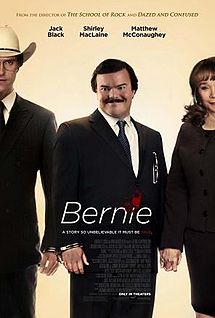
Director Richard Linklater originally made a name for himself with film-stories set in his native Texas, everything from Slacker (1991) and Dazed and Confused (1993) to SubUrbia(1996) and The Newton Boys (1998). Even his beloved European-set Before Sunrise “franchise” has a Texas connection: Ethan Hawke’s writer, who in some small part might be based on Linklater himself, also hails from the southwestern state. The comedic true crime story Bernie (2011) returns Linklater to Texas for the first time since 2006’s Fast Food Nation and reunites him with the star of 2003’s The School of Rock, Jack Black, as well as early muse Matthew McConaughey.
I passed on Bernie when the film hit select theaters in late April of this year, not because I wasn’t interested in the story of a much fawned-over gay assistant funeral director shooting dead his 81-year-old multi-millionaire companion, the small town’s wicked witch, but because I already knew all of its plot details. I had read a New York Times Magazine article by Joe Rhodes, the nephew of the victim Mrs. Marjorie Nugent, and learned that for nine months Bernie kept up the pretense that Marjorie, stuffed in a freezer, was alive while he spent millions of her dollars, “generously” gifting people all over town. Despite Bernie’s, uh, indiscretions, Rhodes, like practically everyone involved, seems to find him the more sympathetic character. It’s a fascinating story, but I wonder if Bernie‘s storytelling format was the best choice. In any case, I heartily recommend Rhodes’s examination of the events leading up to and following Bernie Tiede’s killing Mrs. Nugent that, as the movie’s tagline says, constitutes a story “so unbelievable it must be true.” You just might want to see the movie first, because it does spoil the plot.As does this review of the film Bernie.
East Texas. The date? I’m not quite sure, as the true events took place in the 1990s. But while the production and costume design seem to indicate this period, Bernie (played by Jack Black) has an iPhone, which wasn’t released until summer 2007. So what can you do? Anyway, as the assistant funeral director in Carthage (approximately 7,000 inhabitants strong), Bernie is well-known for his attentive care of the recently bereaved (particularly elderly widows), and his boss especially values his employee’s superb up-selling skills. Bernie manages to thaw Marjorie’s (Shirley MacLaine) cold, miserly heart following his supervision of her bank-owning husband’s funeral (which actually took place in 1990). From that point on, they are virtually inseparable. They travel everywhere together, go on extensive shopping sprees, and eat at the finest restaurants as well as the local, rustic watering holes. (Hilariously, in one scene, Marjorie pesters Bernie to help her pick out a nice dress for dinner, forcing him to stop whatever he was doing at the time he received her call. Then, in an unfussy cut, it’s revealed that they’re only dining at a chintzy Mexican cantina in town). People speculate that Bernie has to be supplying sexual favors in order to receive that kind of lavish, undivided attention from Marjorie, who has alienated everyone who has ever come in her path, including her family members. Marjorie becomes so attached to Bernie that she demands to know where he is and what he is doing at every hour. In his defense, the word that Bernie constantly uses to describe Marjorie’s dependency on him is “possessive.” Then, in an impulsive move one day in 1996 (again, according to actual events), Bernie takes the shotgun for killing pesky armadillos and shoots Marjorie in the back four times, the symbolism not lost on the audience. Immediately remorseful, Bernie prays, but instead of alerting the police, he packs her into the freezer in the garage and goes about life as if she is merely the house-bound victim of a series of strokes. No one else likes to see or talk to her, anyway—except for her nosy stockbroker (Richard Robichaux), who’s onto Bernie’s misdeeds.
As they grow closer, Marjorie defers to Bernie on all matters of fashion. She even starts to wear her hair down. Image courtesy of http://www.nytimes.com.
No matter how overly prepared I was to watch Bernie, I never expected that Linklater, who co-wrote the script with Texas Monthly crime reporter Skip Hollandsworth, would choose to frame the narrative as a docudrama, complete with historical reenactments starring Black, McConaughey, and MacLaine; numerous talking head interviews with real townspeople; and title-cards that read “Who is Bernie?” and “Was Bernie gay?” One might even be tempted to label the film a mockumentary, for it gently pokes fun at the residents’ bigotry and simple-mindedness. For instance, knowing Bernie to be an outstanding Christian for all his involvement in church activities, including orgiastically singing hymns and paying for a new prayer wing (with Marjorie’s money, of course), the people of Carthage refuse to believe Bernie killed the town’s least popular resident—even after he confesses to the crime once Marjorie’s financial adviser and family members start investigating his trail of lies. In fact, Bernie is so well-liked for his caring and easygoing demeanor that District Attorney Danny Buck Davidson (McConaughey, made comically un-handsome and outfitted with shirts—baggy ones, at that—big, round eyeglasses, and short, matted hair) successfully motions for Bernie’s murder trial to be moved 50 miles away to ensure that selected jurors are unbiased. In the end, he’s sentenced to life in prison, and according to Rhodes, he will be eligible for parole in 2027, when he is sixty-nine-years-old.
One of the real, colorful townspeople of Carthage gives us a handy-dandy geography lesson, enumerating the cultural differences among almost all of the republics of Texas. Image courtesy of http://www.largepopcorn–nobutter.blogspot.com.
In exploring the surreal circumstances of Bernie and Marjorie’s relationship, the film regrettably relies too much on the testimonials of real Carthagians. It’s unclear if their lines are scripted, improvised, or unrehearsed. But the warm, burnt cinematography by Dick Pope seamlessly blends their one-sided conversations (with the documentary lens) with the scenes featuring the trio of the top-lining professional actors and their supporting cast. In other words, despite the fragmented structure of Bernie, Carthage comes across as a fully realized universe and lived-in place, even if Black, McConaughey, and MacLaine barely share any screen-time with the “real” people. However, though all three turn in captivating performances (particularly Black, who dials his trademark zaniness way down), I couldn’t help wishing that Linklater and co. had given the stars more to do. Earlier, I labeled their scenes “historical reenactments” because they mostly just serve the narrative as related by practically everyone in town. They seemingly act out scenes in order to support the Carthagians’ arguments about how gregarious a fellow Bernie was (cue Jack Black, in character, directing and performing in a high school production of The Music Man) and how downright nasty Marjorie was (see MacLaine throw a Hispanic family’s mortgage loan in the garbage as soon as they leave the bank).
Admittedly, one of the best scenes integrates the documentary and comedy-drama bits and, unsurprisingly, unfolds at the very end, allowing the story to come full-circle: one of Bernie’s real-life apologists visits him in jail, still in denial, and reiterates her request that he sing at her own funeral, whenever it is. Touched, Bernie tries to tell her that it’s impossible, as he doubts he’ll ever get permission. But she’s just not hearing him. When their time together is forced to close, the camera follows Bernie contentedly walk back toward his cell, eventually staying put to capture his receding presence—and slightly sashaying hips. As if to say again, “Can you believe this man is a convicted murderer?” This isn’t to say that the filmmakers think Bernie is innocent. He is most definitely not. Having formed my first impression of Bernie Tiede based on Joe Rhodes’s interpretation of his aunt’s life partner-turned-killer, I can see that the filmmakers find him just as sympathetic as Rhodes does. We’re meant to perceive Bernie as simply a good person who snapped and did a very bad thing. More tellingly, to some degree, I think the storytelling structure of Bernie precludes the spectator from strongly identifying with Marjorie. That is, representing the real townspeople’s overwhelmingly sentimental observations about Bernie does very little to redeem Marjorie; no one comes to bat for her. To add insult to injury, MacLaine’s limited screen presence means her character isn’t as fleshed out as Jack Black’s Bernie, leading my dad to comment that her bickering Marjorie recalls her performance as a grumpy and difficult First Lady to Nicolas Cage’s secret serviceman in Guarding Tess (Hugh Wilson, 1994).
It was only during my Google search for images to accompany this article that I made the connection that Bernie has a premise not-too-dissimilar from the one guiding Weekend at Bernie’s (Ted Kotcheff, 1989), wherein Andrew McCarthy and Jonathan Silverman live large at their horrible boss’s vacation home after the titular schmuck (Terry Kiser) dies unexpectedly during their stay; like Bernie, the pathetic stooges pretend their employer is still alive and try to outrun the cops (among others). But whereas Weekend at Bernie’s takes a slapstick approach to defiling the sanctity of the human corpse, Bernie explores the all-too-realness of this possibility. It’s an intriguing little story, and it’s shocking that Carthage still sings his praises. Just what exactly is in the well-water over there? I wonder how the town’s residents responded to the film, too.
For the past week or so, one image has stuck with me. It’s of a woman riding alone in a tiny space capsule, hurtling ever closer to the outer reaches of the earth’s orbit. It’s unclear where she’s going and what she will do there upon arrival. I imagine she has a purpose; I just don’t know what it is. No matter how many times she returns to me as a vision, during the day and at night, I can’t see what’s ahead of her or what she’s left behind. I want to know her story. I think it might be potentially interesting.
Despite being unable to develop the lone astronaut’s narrative, I can easily trace the different threads of information that likely led to her appearance in my mind’s eye. First and foremost, the first American woman in space, Dr. Sally Ride, died on July 23 at the age of 61, after quietly suffering from pancreatic cancer for more than a year. After her groundbreaking trips on the shuttle Challenger in 1983 and 1984 and their attendant media circuses, she lived out of the limelight, retiring from NASA in 1987 and then pouring all her energy into teaching and running the company she founded in 2001, Sally Ride Science. Ride’s high school classmate and sometime book collaborator Dr. Susan Okie recounts in The Washington Post her driven friend’s company mission to promote science and technology as “cool” for middle school students and their teachers, to inspire young girls especially to pursue careers in these fields. I don’t have a scientific or mathematical mind (I really wish I did!), but I so deeply respect Sally Ride and all of her accomplishments.
The pioneering American astronaut Sally Ride. Photo courtesy of NASA, via Agence France-Presse — Getty Images. Accessed at The New York Times.
It is a peculiar distinction in the world of playwrights: Works written by men are often called plays. But works written by women are often categorized as “women’s plays.”
“There is a notion in the canon, when men write plays, they speak to the entire human condition, and plays written by women speak to women,” said actress Kathleen Chalfant, a 1993 Tony Award nominee for best actress in a play for her role in Angels in America: Millennium Approaches.
Even plays written by men that are “particularly masculine and talk about issues particular to men, are never called ‘men’s plays,’ ” she added.
Now, I don’t envision the lone astronaut’s narrative trajectory taking place on the stage (I don’t think in terms of the theater). But Brown’s and Chalfant’s observations made an impression on my psyche. Specifically, Chalfant’s choice of words really struck a chord with me, when she argues that there is a perception that plays written by men “speak to the entire human condition” whereas ones by and/or about women can only hope to speak to women, as if the woman’s experience is less than or at least incapable of elucidating the human experience for everyone. Certainly, this isn’t a new controversy or even one confined to the theater. There is a persistent gender bias across all art forms, manifest in libraries and bookstores, museums and galleries, and—most precious to me—cinemas. I think the image of the female space cruiser appeared to me unconsciously as a direct response to the bone-headed notion that women playwrights can’t, in Chalfant’s words, “speak to the entire human condition.” The drive to explore the worlds beyond our own and the desire to comprehend our purpose and beginnings are characteristically human. I know the lone astronaut’s journey of self-discovery is something of a hyperbole, but what if her story could capture for men and women alike a uniquely feminine take on the human experience?
Admittedly, I can’t wave any sci-fi geek flag, having never read Isaac Asimov, Philip K. Dick, George Orwell, or even Ray Bradbury. (But tell me, does Aldous Huxley’s Brave New World grant me at least a few colors? ‘cuz I loved that as a teen.) I’ve only ever seen two episodes of Star Trek, and that number indexes all iterations of the series. I’ve never cracked open a comic book, let alone picked one up. However, I can and do appreciate smart, sophisticated, hard-core sci-fi movies, particularly the kinds that tackle what it means to be human. This is why I love Blade Runner (Ridley Scott, 1982) and will never tire of it. I also like Duncan Jones’s directorial debut Moon (2009), starring the criminally underrated Sam Rockwell as the lone astronaut on a three-year-mission stationed on the massive titular rock. While I don’t suspect the female space explorer of my imagination is ultimately on a quest to discover her true identity in the same way that Rockwell’s Sam Bell does (see, I’m trying not to spoiling anything!), I see her journey as equally alienating, mundane, but also extraordinary.
Most importantly, I envision her story as one that doesn’t hinge on her relationships with men or children. She isn’t escaping a tumultuous love affair, or searching for her true love on another planet, for that matter. She isn’t trying to put her life back together because she lost a child or because she can’t have one. Don’t get me wrong: she’s not without her problems, but her problems don’t define her. And I’ll be damned if I ever base her entire identity on whether or not she has a significant other and/or whether or not she is a mother. After all, wife and mother are historically the only culturally acceptable roles prescribed to women. And in the cyclical culture wars about women’s place in society, debates about the constitutionality of accessible birth control measures and the (im)possibility of a woman “having it all” (meaning: balancing a rewarding career with a family) abound today. Just look at the uproar new Yahoo! CEO Marissa Mayer caused when she announced that she plans to return to work soon after the birth of her first child. The first hot-button issue affects me directly, whereas the conversation about rich white women’s struggles to negotiate their seemingly opposed desires for a career and family addresses me in no way at all. I have no career to speak of and, as of right now, I would be happy never to have children.
Imagine the successes if there were more female characters onscreen than the 33 percent that appeared in the 100 top-grossing films in 2011. And imagine if more than 11 percent of those movies had female protagonists.
I find it alarming that the films she uses as evidence that female-driven movies can be resounding box-office successes include Sex and the City (Michael Patrick King, 2008), Mamma Mia! (Phyllida Lloyd, 2008), and Twilight (Catherine Hardwicke, 2008) as well as its first sequel. Especially since this is coming a little more than two months after she published a short editorial about how purging “chick flicks” from our culture is absolutely necessary. I know, I know, she’s merely pointing out that there is a “hungry, underserved female audience” for movies about women, but all of these examples represent just what she wants to see banished:
You know the kind of movies I mean. They inevitably star Kate Hudson or Katherine Heigl. Most involve a wedding, a boyfriend or, usually, both. And they’re often just bad movies.
Arguing that even Oscar-winning films like Terms of Endearment (James L. Brooks, 1983) and Thelma & Louise (Ridley Scott, 1991) are tainted with the label “chick flick,” Silverstein opines, “I want Hollywood to stop making these formulaic films and branding all movies starring women, good and bad, as chick flicks.” I definitely agree with this sentiment, and if we return to Silverstein’s first op-ed piece I mentioned, I also concur that having more women directing, producing, writing, photographing, and editing films would help alleviate the problem. Though, when you look at her three examples for women-focused blockbusters, Mamma Mia! and Twilight are both written and directed by women. Yikes.
I will say this: Silverstein sure does like to invoke Bridesmaids (Paul Feig, 2011) and its approximately $170 million domestic overhaul. But she fails to draw attention to the fact that its star, Kristen Wiig, wrote the screenplay with her old friend from their days with the improv group The Groundlings, Annie Mumolo. You’ve read me attest to Bridesmaids‘s assets before, so I won’t indulge in too much praise here now. Suffice it to say that, despite a subplot involving Wiig’s romantic dalliances with two diametrically opposed males, the film is actually about female friendship, as Wiig the maid of honor and Maya Rudolph the bride must adjust their long-term intimacy in expectation of the latter’s nuptials. Moreover, I think remembering that Wiig, the darling of Saturday Night Live from 2005 to 2012 and the scene-stealer from the likes of Knocked Up (Judd Apatow, 2007) and Adventureland (Greg Mottola, 2009), co-wrote her own breakout role isn’t just necessary, it is also a starting point when examining the trend making the rounds this year in film and on television.
——————————
Of course, I’m talking about actresses making their debuts as produced screenwriters in order to address the dearth of quality film roles for women. Within the last two weeks alone, indie starlet Zoe Kazan has released Ruby Sparks (Jonathan Dayton & Valerie Faris, 2012), her critical dissection of the Manic Pixie Dream Girl archetype that men often write for their male protagonists, and just two days ago Rashida Jones went against type in Lee Toland Krieger’s Celeste and Jesse Forever (2012). A regular from my favorite TV comedy, Parks and Recreation (2009-present), Jones acknowledges in an interview with Melena Ryzik of The New York Times that she usually plays “the dependable, affable, loving, friend-wife-girlfriend,” and that as co-scribe with former boyfriend-turned-best-friend Will McCormack, she was finally able to star as “a character that’s maybe less than likable.”
French-American actress Julie Delpy’s fourth feature, the sequel to 2 Days in Paris (2007), hits theaters next Friday. 2 Days in New York (2012) may not be her first film as writer-director-star, but like Kazan and Jones, she aims to write a “real” woman, not a fantasy that men have of (French) women, she tells Karina Longworth of LA Weekly. In the new film, she co-stars with Chris Rock as a successful, artistic/intellectual couple forging a blended family, and the arrival of her father, sister, and former lover from France threatens to upturn what they’ve built, albeit comically so. Casting Chris Rock as her romantic lead may provide a pointed commentary on race in contemporary America, especially since neither Marion nor Mingus make a big deal of their interracial coupling (it’s presented matter-of-fact, according to Longworth), but you might even say that as much as the role is a welcome leap for Rock, it may also bring fans of his raunchy stand-up into the art-house.
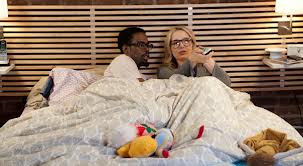
Mingus and Marion in bed, trying to overcome the vagaries of adult life in 2 Days in New York. Image courtesy of http://www.girls-can-play.blogspot.com.
I wish to avoid analyzing a film I have yet to see (for the record, though, I really like 2 Days in Paris), and I want to acknowledge Delpy’s frustration with being categorized as a woman filmmaker: “By making it obvious that it’s rare, you also minimize my work.” In this way, she echoes Nora Ephron, who, of When Harry Met Sally… (Rob Reiner, 1989) and You’ve Got Mail (Ephron, 1998) fame, died June 26 of pneumonia at age 71 (she had suffered from acute myeloid leukemia). As recounted in Charles McGrath’s obituary in The New York Times, Ephron wrote in I Remember Nothing, one of her book of essays, that she won’t miss panels on Women in Film when she dies (sorry, Melissa Silverstein). Although Ephron’s films are dominated by female protagonists and might even have been branded “chick flicks,” her screenplay for When Harry Met Sally… is such a cultural touchstone that men and women often agree that the film is, in the words of Vulture’s editors, “arguably the greatest rom-com of all time.” In conversation with All Things Considered‘s Audie Cornish on NPR, Rashida Jones interpreted the interviewer’s observation that Celeste and Jesse Forever resembles Ephron’s beloved story about friends turning into lovers, although in reverse, as “the biggest compliment.” I haven’t seen Jones’s film yet, so I cannot weigh in on that score.
Upon their arrival in New York, Sally and Harry enjoy a bite at Katz’s—much to Sally’s memorable delight. Image courtesy of http://www.impassionedcinema.com.
But are these women of summer, written and actualized in each case by the same woman, really a step in the right direction? According to The Washington Post‘s chief film critic, Ann Hornaday, that answer is “no.” She recently published a critical inventory of the season’s female characters, girls and women alike. While she finds much to celebrate when it comes to young women defying stereotypical roles, she finds the women leave much to be desired. And I quote:
At the box office, the summer of 2012 may be about breaking records with movies about boys and their toys (“Hulk smash,” indeed). But culturally, the season’s been all about the girls. Beginning with Snow White and the Huntsman, continuing through Brave and with a dash of talk-worthy premium cable thrown in, girls seem to have taken over screens both large and small, their inner struggles magnified into mythic battles, their most mundane problems examined with probing, disarmingly frank intimacy.
Hornaday also reminds us that Tim Burton’s version of Alice in Wonderland (2010) and this spring’s mega-hit The Hunger Games (Gary Ross, 2012) also feature strong-willed female teens who don’t need a Prince Charming to rescue them, as they fight epic duels on their respective quests to right evil social injustices. By comparison, the female leads of Ruby Sparks and Celeste and Jesse Forever, for example, are pathetic. In particular, Hornaday writes,
But as clever as Ruby Sparks is in puncturing the male wish-fulfillment fantasy of unconditional acceptance and worship, Kazan’s Ruby never gets to be her own fully realized character, instead playing a role similar to that of the Magical Negro, who exists chiefly in order to help the white male hero find transcendence, meaning and the happy ending that was somehow never in doubt.
As you might recall, I had similar misgivings about the conclusion of Ruby Sparks; it upholds the convention of other love stories featuring Manic Pixie Dream Girls when the narcissistic novelist finally releases his titular creation from his magical spell and later goes on to meet the girl of his dreams who resembles his ideal far too much. When it comes to Celeste and Jesse Forever, Hornaday laments that Jones’s eponymous character, a
put-together and on-track young woman who, as she navigates a complicated relationship with the far less directed man in her life (played by Andy Samberg), is made to look either uptight, witchily judgmental or miserably alone — before she sees the light and realizes that she’s the problem, what with her intelligence and high expectations and all [emphasis in original].
Celeste and Jesse Forever: a couple tries to stay best friends through a painful divorce. Image courtesy of http://www.cnn.com.
Certainly, I cannot just take this one critic’s word as the gospel truth. I will see these movies, eventually, to make up my own mind, but I can understand what Hornaday is saying. After all, both Ruby and Celeste are characters defined by the relationships that they have with the men in their lives. Marion of 2 Days in New York, which Hornaday doesn’t discuss, also fits the bill, and she’s also a mom.
But there’s one last facet to this trend of actresses writing their own parts: overwhelmingly, their chosen genre is the romantic comedy, which is historically perceived as a woman’s form (even though, of course, it has more male writers than it does female ones). As if men don’t enjoy movies about the pursuit of love and that very special happy ending! (There are enough movies focalized through the heterosexual male point-of-view, such as Annie Hall [Woody Allen, 1977] and Knocked Up, which are both written by men, to warrant a future article about the so-called masculinization of the romantic comedy.) To cut a long story short, I would like to see more female filmmakers work in other idioms and elevate female film characters to be more than just the wife and mother, the Madonna or the Whore. How about a chilling thriller or detective story? or a smart and sophisticated actioner? I would love a provocative sci-fi movie, too. I know what you’re thinking, doesn’t Another Earth (Mike Cahill, 2011) qualify? Well, star Brit Marling may have co-written the script about the possibility of finding redemption as if in a parallel universe, but—spoiler alert!—her character winds up having a sexual affair with the man whose family she killed in the car accident, an irreparable act for which she seeks forgiveness as a means of escape. This plot point is hardly original, as it falls into that same class of tropes I can’t stand.
There is some hope, though, that more complex female characters will continue to spring up. I would venture that at the moment only Girls, the controversial HBO comedy-drama series created by its star Lena Dunham (who also writes and/or directs some episodes), presents a convincing and nuanced vision of (young) women’s relationships—to men, parents, work, culture, and friends. The program follows the runaway success of Dunham’s first full-length motion picture, Tiny Furniture (2010), which she also wrote, directed, and starred in; it’s an acerbic and poignant study of the post-college malaise and the attendant struggles to understand the world and be understood within it. Girls may ostensibly be an urban exploration of recent college grads’ experiences with love and sex, tracking their conflicting desires for independence and dependable partnership, but in actuality it is a brilliant love story about two best friends, Hannah (Dunham) and Marnie (Allison Williams), who live together and grow apart while trying to make it big in the city.
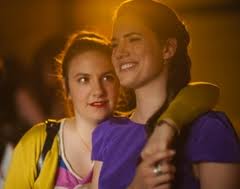
Hannah and Marnie are Girls and best friends who try hard not to let their dealings with men dictate who they are as individuals. Image courtesy of http://www.trippedmedia.com.
In the fall, Mindy Kaling, a staff writer, producer, and regular cast member of The Office (2005-present), will premiere her own show, entitled The Mindy Project (check out the trailer here). Yeah, I sincerely hope that as the program’s creator, producer, and writer, she changes the name before it first airs; as it stands, the title makes it sound like the comedy series, in which she plays a gynecologist, is a celebrity-hosted reality show or stand-up special. The trailer demonstrates that the self-professed lover of romantic comedies has deployed many generic conventions in creating this universe of characters and situations, including, but not limited to a drunken toast at an ex-boyfriend’s wedding, women’s anxiety over aging, and a female sidekick who tells her, “Your life is not a romantic comedy!” I know, I probably shouldn’t be looking forward to this, but I like Mindy Kaling, and I hope that her show—in the very least—offers an interesting critique of socially acceptable behavior for women. If not that, then maybe I’ll watch it just to dissect it.
——————————
Let’s return once more to the image I have of a woman astronaut gliding through space alone. I’m still nowhere closer to developing her back-story or devising her narrative purpose. Right now, she just represents the potential of female characters in fiction, but films in particular, who have interesting, fully realized inner lives that eschew all the narrative tropes that heretofore define women. She’s out there, doing it her own way, and if she comes back, maybe then I can make sense of her. Perhaps she will fulfill my fantasy and teach us something about what it means to be human—and not just a woman.
Having seen so many movies, made note of your favorite directors, and developed crushes on certain actors and actresses, do you ever watch a movie convinced that one of the performers on-screen is—contrary to the credits you’ve just read—another actor entirely? You’re not alone. What follows is a completely subjective list of acting doppelgängers, people who, to my eyes, bear more than a passing resemblance to one of their cohorts. I call some sets “twins,” and it’s been a bit of a struggle finding photos that can accurately show you how I could ever mistake them for each other. Admittedly, though, I’m so familiar with some of these performers that it’s impossible for me to confuse them with anyone else. Most of the pairs below represent struggles I had in my childhood identifying who’s who. Please feel free to sound out in the comments section below the pairs who regularly confuse you, too. (For the record, I extracted these photos from Google Images after conducting basic searches.)
Let’s start things off with a pair of actresses whose heydays were in the 1980s. Honestly, I couldn’t have asked for better photos to bring out the physical similarities between Kathleen Turner (left) and Kelly McGillis, as she hangs on Top Gun (Tony Scott, 1986) co-star Tom Cruise. They’re both sporting off-the-shoulder tops, accentuating their wavy hair. Both stars were sex symbols in their day. Turner made her big-screen debut as a femme fatale in Body Heat (Lawrence Kasdan, 1981) and later embodied the curvaceous cartoon Jessica Rabbit with just her husky voice in Who Framed Roger Rabbit? (Robert Zemeckis, 1988). Besides Top Gun, McGillis was in Witness (Peter Weir, 1985), as Harrison Ford’s Amish love interest, and in The Accused (Jonathan Kapaln, 1988), as the attorney for Jodie Foster’s brutal rape victim, a decidedly less sexy role. I should note that I only think they look alike when they were younger, as today the women couldn’t look any more different. Presently, we don’t see either actress much, particularly McGillis since she came out of the closet in 2009. Turner, who suffers from rheumatoid arthritis, has been busy walking the floorboards, notably starring in a theatrical production of Who’s Afraid of Virginia Woolf? in 2005.
Next we have the British actor Ben Miller—not to be confused with Ben Miles of Coupling fame—and his lookalike the Welsh comic Rob Brydon (right). I first spotted Miller in Johnny English (Peter Howitt, 2003) as Rowan Atkinson’s sidekick Bough, and since he’s made a name for himself playing super-serious corporate or governmental honchos, including James Lester on the silly BBC sci-fi series Primeval (2007-2011). Rob Brydon, on the other hand, I’m much more familiar with. He starred in the 2000-2003 series Marion & Geoff as a taxi driver who records confessional monologues while stalking outside the residence his ex-wife, Marion, shares with the man she left him for, Geoff, of course. You might know Brydon as “Himself” in the Michael Winterbottom classics Tristram Shandy: A Cock and Bull Story (2005) and The Trip (2010), opposite Steve Coogan, who also plays a version of himself in those movies. It may not be easy to tell from these thumbnail photos (the only way I could publish images of all the doppelgängers), but Miller and Brydon look so much alike that when you search Google Images for pictures of either one, “Ben Miller Rob Brydon” is a suggested search term. Hell, even I needed to look multiple times to identify who’s who in this image that I found online with the actors already juxtaposed:
Ben Miller (left) and Rob Brydon, or so I believe.
Speaking of Steve Coogan, I think he looks a lot like Jack Davenport (right), from the Pirates of the Caribbean blockbusters. He played Commodore Norrington who so wanted Keira Knightley’s Elizabeth Swan but lost out to Orlando Bloom and Johnny Depp’s swashbucklers. He’s currently on the NBC backstage musical soap opera Smash (2011-present), which I’ve never seen. As a fan of Steve Coogan’s work, including I’m Alan Partridge (1997, 2002) and Saxondale (2006-2007) to name but a few, I should make it clear that I don’t actually mistake these actors for each other. Searching for comparable photos was tricky, as Coogan typically has long, wavy hair these days, and Davenport has short and spiky hair. There’s something about the way they play pompous or clueless that makes me sense a closeness. At right, Davenport appears in character as the immature Steve from the British comedy series Coupling (2000-2004), and Coogan, at left, is the arrogant TV presenter Tony Wilson in Winterbottom’s 24 Hour Party People (2002), which is my favorite film.
My sister is going to shake her head when she reads this: I continually mistake two actresses who are on the rise, Rachel McAdams (left) and Elizabeth Banks. My sister thinks I’m crazy, but hear me out. It has to do with their toothy grins, broad jawlines, and wide foreheads. It doesn’t help any that they regularly appear as blondes (I believe they’re both natural brunettes) and balance their filmographies with pretty much equal helpings of comedy and drama these days. In other words, when I watch a film that stars either one of them, I imagine that the other may have also been on the casting director’s list of actresses for the same role. For example, despite writer-director Woody Allen’s more pointed search for actors to fill parts in his almost yearly produced movies, I can see Elizabeth Banks as Inez, Owen Wilson’s shrill and obnoxious fiancee in Midnight in Paris (2011), a role that McAdams played. Similarly, isn’t it possible to see McAdams in Man on a Ledge (Asger Leth, 2012) or People Like Us (Alex Kurtzman, 2012) instead of Banks? Or is my sister right; am I crazy?
Let’s move Down Under and take a look at Noah Taylor (left) and Ben Mendelsohn. These Aussie actors are hardly ever up for the same parts nowadays, their physiognomies seemingly worlds apart. Mendelsohn makes for a much more imposing presence now, having played baddies in the superb 2010 Australian crime family drama Animal Kingdom (David Michôd) and the straight-to-DVD Nicolas Cage-Nicole Kidman starrer Trespass (Joel Shumacher, 2011), whereas Taylor looks like he’s withering away nowadays, as evidenced in Tim Burton’s Charlie and the Chocolate Factory (2005) and Richard Ayoade’s fun directorial debut Submarine (2010), movies in which he played each of the teen protagonists’ withdrawn dad. When I was younger, I used to mistake them for each other all the time (it’s in their mouths and speech!), but now they probably couldn’t be any more different. By the way, to add to the confusion, they have both appeared in the same films, including The Year My Voice Broke (John Duigan, 1987) and The New World (Terrence Malick, 2005).
In much the same way that time has made Noah Taylor and Ben Mendelsohn look less and less alike, so too has it placed the doppelgängers Henry Thomas and Jeremy Davies on opposite ends of the spectrum. I guess what I’m trying to say is that today, the skinny child-star Thomas (left) has put on weight, particularly in his face, while Davies seems only to have gotten thinner and thinner. But look at them in these old photos; don’t they at least look like brothers? At least grant me that Thomas looks more like Davies than he does Brad Pitt or Aidan Quinn, who both played his older siblings in the classic melodrama Legends of the Fall (Edward Zwick, 1994). We haven’t seen much of Thomas lately, but Davies plays the sniveling snake Dickie Bennett on FX’s Justified (2010-present), a show whose just-aired third season I tried several times to watch but just couldn’t get into. I think these guys resemble each other because they have the same face shapes and they have been in films where they weren’t, shall we say, the manliest of men. See how soft-spoken Thomas is in I Capture the Castle (Tim Fywell, 2003) and Davies is in CQ (Roman Coppola, 2001).
The next pairing arrives courtesy of my dad, who hit the nail on the head when he said that the English actresses Gabrielle Anwar (left) and Emily Blunt look an awful lot alike. It’s impossible to mistake them, really, as there are more than thirteen years between them, but the similarities in their features are striking. It all hinges on their mouths, though Anwar may have a greater overbite than Blunt (sorry, there’s no nicer way of putting it!). If you do a Google image search for each woman, you will see how they both prefer to pout when posing on the red carpet, and neither likes to give big, toothy smiles (yes, these stills are something of a rarity on Google). Anwar had a bigger film career in the 1990s, appearing in such hits as Scent of a Woman (Martin Brest, 1992) and The Three Musketeers (Stephen Herek, 1993), which was beloved in my childhood. She has since re-found fame on the USA TV series Burn Notice (2007-present). Blunt, on the other hand, has been on the ascendant since her breakout role in The Devil Wears Prada (David Frankel, 2006).
A few nights ago, I caught, again, Dutch writer-director Marleen Gorris’s Oscar-winning Antonia, better known in English as Antonia’s Line (1995). Watching Jan Decleir, the famous Dutch actor (left), I couldn’t believe how much he looks like the beloved English actor Jim Carter, probably best known as Mr. Carson, the butler of Downton Abbey (2010-present), ITV and PBS’s pop culture phenomenon about the fading British aristocracy at the beginning of the 20th century. But oh, how do I love Jim Carter! He’s in everything: Shakespeare in Love (John Madden, 1998); Cranford (2007, 2009), which is one of my favorite British miniseries; and Bright Young Things (Stephen Fry, 2003), where he makes a hilarious cameo. I haven’t seen even the smallest percentage of Decleir’s many credits, but I remember him especially from Character (Mike van Diem, 1997), which also took home the Academy Award for Best Foreign Language Film (for the Netherlands). The actors are roughly the same age (Decleir is two years older); isn’t their resemblance uncanny?!
So far, all of these acting doppelgängers have been contemporaries. They have all lived in the same era (our current time). But now I want to offer a different kind of comparison. Turner Classic Movies has featured Englishman Leslie Howard in marathons of his movies every Tuesday night this month. Although his credits span from the 1910s up to 1942 (his last movie was the Howard-directed R.J. Mitchell biopic The First of the Few aka Spitfire, which premiered in the U.S. less than two weeks after he died, his plane shot down by Germans), I see a lot of the actor Michael Fassbender in him. Catching the hilarious comedy Stand-In (Tay Garnett, 1937) on TCM, I was struck by how Howard’s uptight New York-based banker, out of his element as the head of a struggling movie studio in Hollywood, reminded me of Fassbender’s suave British Lieutenant Archie Hicox in Inglourious Basterds (Quentin Tarantino, 2009). They’re very different characters, but the way they carry themselves seemed very similar to me. And the more I studied Howard, who I might add, is probably most recognizable as Ashley in Gone with the Wind (Victor Fleming, et. al, 1939), the more I could discern Fassbender’s affinities to him: they both have very long, narrow visages with tall foreheads; extra slim, long, and narrow torsos; and when Fassbender plays posh Englishmen (or androids), as in Basterds or Prometheus (Ridley Scott, 2012), he sounds a lot like Howard, who also directed and starred in Pygmalion (1938) as the condescending Professor Henry Higgins. My DVR is virtually full of Howard movies; I’m as drawn to him as I am to the magnetic Fassbender.
Since I’m in an historical mood, I thought I would point out that I have actually confused the younger versions of Karen Allen (left) and Brooke Adams. Allen is probably most known for playing Marion Ravenwood in Raiders of the Lost Ark (Steven Spielberg, 1981), a role she later reprised in Indiana Jones and the Kingdom of the Crystal Skull (Spielberg, 2008), and Jeff Bridges’s alarmed wife in Starman (John Carpenter, 1984). Adams is two years older and has more credits from the 1970s, including her starring role in Terrence Malick’s debut Days of Heaven (1978). I could never remember that it was Adams in Heaven and not Allen, Allen in Starman and not Adams. Both actresses have widely spaced eyes, wide faces with high cheekbones, and dimples in their chins. Not to mention, they both have pretty low voices. They don’t look so alike these days, and they haven’t been productive in recent years.
This last pair of celebrity lookalikes aren’t actors. Well, one is: Robert Carlyle (left), the prolific Scottish thesp best known for his stunning turn as Begbie in Trainspotting (Danny Boyle, 1996), which is incidentally one of my favorite films of all time. His doppelgänger? Hockey great Wayne Gretzky! From 1979 to 1999, he played with one of the four following teams: the Edmonton Oilers, LA Kings, St. Louis Blues, and NY Rangers. If you cannot see the resemblance, I don’t know what to say. But a little back-story is in order. I really should credit my dad with this comparison because he refers to Carlyle, jokingly, as “Wayne Gretzky.” He learned of Carlyle when the actor starred in the 1997 British sleeper hit The Full Monty (Peter Cattaneo), where he wore his hair blond, thereby more closely resembling a young Gretzky. So whenever he catches a glimpse of him today, usually on my TV screen, he’ll ask, “Who’s in this? Oh, Wayne Gretzky!” even though Carlyle, to my knowledge, hasn’t been blond since. You can currently check him out on ABC’s Once Upon a Time (2011-present), where he looks like the ghost of his former self. Whereas Carlyle has turned hauntingly thin, Gretzky, who’s less than four months older, has filled out more in middle age.
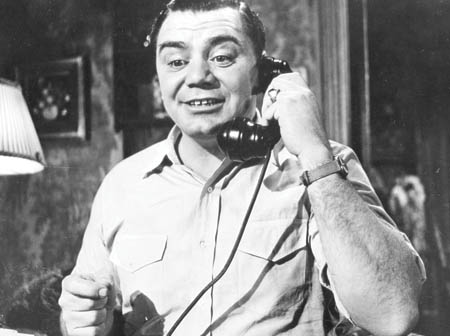
On Sunday, July 8, beloved character actor Ernest Borgnine died. He was 95. For years, I have been drawn to his toothy, grandfatherly smile, and I was initially upset that The New York Times only published a short obituary. (Compare it to the one they gave Andy Griffith.) I felt that it betrayed his legacy on film and television, everything including From Here to Eternity (Fred Zinnemann, 1953) and Bad Day at Black Rock (John Sturges, 1955) to The Wild Bunch (Sam Peckinpah, 1969) and McHale’s Navy, which aired from 1962 to 1966. But I have since moved on, and I watched for the first time the film for which he won the Oscar for Best Actor: Marty (Delbert Mann, 1955). I don’t speak in exclamations, but I have to say that some of the interjections featured at left on the original theatrical poster ring true for me, too. Marty is wonderful, superb, warm, and rich. (It’s a shame the poster design isn’t any of these things, though.)
For much of my childhood, I only knew of Marty as the answer to the question that longtime Twenty One game show champ Herb Stempel (played by John Turturro) fails to deliver at the turning point of Robert Redford’s Quiz Show (1994). Stempel knows the title of 1955’s Best Picture Oscar-winner, but he throws the game, for the benefit of his opponent, the dashing literature professor Charles Van Doren (Ralph Fiennes), and accepts a payout from the producers, who wish to capitalize on Van Doren’s pedigree and good looks. But this really has nothing to do with Marty.
Marty, in fact, is about a thirty-four-year-old Bronx butcher (Borgnine) who lives with his widowed Italian mother. All of his younger siblings have been married off and left the nest, and he resigns himself to believing he’ll die single, convinced no woman could be interested in an overweight butcher. He’s painfully shy and incredibly sweet. In this way, Marty turned out to be just what I was looking for since I already find Borgnine an always appealing presence (even when he’s playing the bad guy). Desperate to please his mother, Teresa (Esther Minciotti), he agrees to go out to the Stardust Ballroom to meet other singles, alongside his buddy Angie (Joe Mantell). And, of course, he does, but it’s not easy. Be warned: I’m going to spoil all now.
Clara (Betsy Blair) has also come to the Stardust Ballroom, on a blind double date with a doctor who quickly ditches her because she’s a “dog.” He trawls the dance floor looking for a man to take his place so he can run off with another girl. At first he propositions Marty, who despondently looks on as couples dance around him, but he rejects the man’s offer of $5, admonishing him for wanting to treat a woman in such a way. One of the best scenes is virtually wordless, shot from Marty’s perspective, as he watches the doctor introduce Clara to his replacement. From across the room, Marty sees a mortified Clara run out of the dance hall, and he follows her. He’s gotten nowhere with other women tonight, so he may as well try to comfort her. Perhaps part of him also figures that he’ll be able to relate to her because he’s been rejected, too. (Actually, another great preceding scene takes place earlier that day when he comes home from work and, with Angie’s prodding, calls a woman he’d met last month. In one shot, the camera moves in on his face, closer and closer, while he tries to ask her out, his desperation and despondency becoming more and more suffocating. We can’t hear her voice, only his many attempts describing himself to her and guiding the conversation. It’s impossible for the viewer not to empathize with him. When he hangs up, the camera slowly pulls out. Dejected.)
Marty desperately rings for a date.
Maybe it’s presentism, but I couldn’t help feeling that the romance between Marty and Clara is rather modern for its time. And no, it’s not because the film, itself based on a 1953 teleplay starring Rod Steiger, was remade in 1991 by Chris Columbus as Only the Lonely, with the great John Candy. Marty plays out across two consecutive days, with a good chunk of its running time devoted to the night that Marty and Clara meet and get to know each other as they wander from place to place. Structurally, it reminds me of Before Sunrise (Richard Linklater, 1995), which is also about strangers falling in love over the course of one night together, albeit in Vienna.
Furthermore, Marty seems to be a new kind of male character in 1955 and one who has left an indelible impression on filmmaking today. Strangely enough, while watching Marty I thought about some Judd Apatow productions. Freaks and Geeks (created by Paul Feig), which ran from 1999 to 2000, is similarly about social outcasts but follows adolescent rather than stunted adults’ growing pains. Obviously the titular anti-heroes of the seminal TV show are numerous and varied, and not all of them had love on their minds. However, I do sense a spirit in Freaks and Geeks derived from Marty through its treatment of the characters’ struggles for individuality, independence, and acceptance. Both triumphantly reverse the trend of nice guys finishing last. Perhaps the connection between Marty and Apatow is even more pronounced in the mega-producer’s first directorial effort, The 40-Year-Old Virgin (2005). Although there is nothing to suggest that Marty is a virgin, he and Andy are alike in that they each overcome their sexual immaturity when they meet the right woman. Their journeys are sympathetically portrayed, but Marty’s is much more sensitively drawn and even includes a back-story involving suicidal thoughts (which Clara implies through her body language that she also has had). Marty is more than a Mama’s Boy, a trait easy to ridicule, but that’s not the only reason he’s romantically challenged. Feeling crippled by his heavyset frame and working-class occupation (more on that in a bit), Marty may be one of the earliest versions of a romantic anti-hero, and without him I don’t think Andy’s predicament, however raunchy, would be so endearing.
But Marty isn’t the only character who complicates archetypes. His mother, who speaks ungrammatically with a thick Italian accent, sounds like the women who frequent his neighborhood butcher shop. In the opening scene, they chastise him for being as old as he is and unmarried. And though his mother pushes him to go to the Stardust Ballroom, awkwardly using slang she picked up from her nephew and promising the place will be “loaded with tomatoes,” she is not nearly as opinionated as these women. Maureen O’Hara’s cruel and overbearing mother in Only the Lonely barely resembles Teresa. Teresa instead is a caring woman who accepts her nephew Tommy (Jerry Paris) and his wife Virginia’s (Karen Steele) plea to ask her sister, Marty’s Aunt Caterina (Augusta Ciolli), to come and live with her and Marty. To cut a long story short, Caterina just won’t let Virginia run her own household, especially now that she is a new mom. It’s only after Teresa spends time with Caterina, a depressed widow who feels abandoned, without a purpose because all she wants to do is cook and clean for her loved ones (yeah, some things about Marty seem a little outdated), that she begins to behave differently, out of character. Suddenly, it dawns on her that Marty’s finding a wife would render her obsolete (except it’s safe to assume that his big heart would preclude this from ever happening). And so she’s civil around Clara when she meets the young, plain science teacher late at night, before Marty accompanies her home, but the next day Teresa pooh-poohs his choice because she’s not, well, Italian. Her protestations aren’t convincing; she’s clearly reaching for any excuse to dismiss Marty’s attraction to Clara. Thus, at first glance, it might appear as if Teresa is a contradictory character, a victim of underdevelopment. But on the contrary, I think she’s a finely drawn and complex character, given the short screen-time she’s granted, for these same reasons. It’s a shame about that horrible Caterina-I-want-chew-ta-comeh-live-in-mya-house accent of hers, though.
Marty and Clara bond over their histories of rejection (he tries to build them up as not nearly as repulsive to the opposite sex as they feel they are), their social alienation (their aforementioned suicidal tendencies), and their stunted maturity, as Clara also lives at home. Hearing about Marty’s dream of buying the butcher shop where he works (thereby rendering him as aspiring to overcome his working class roots) helps convince Clara to take an administrative education job in Port Chester, which would force her to finally move out. My other favorite scene features a lovestruck Clara, newly returned home, recounting her evening to her parents, who are already tucked into their Ozzie and Harriet beds. It’s a virtuosic monologue by actress Betsy Blair, running through several emotions and offering fragmentary thoughts. Her new hopeful outlook on life and love stuns them, and this scene is the cornerstone of a quiet, touching performance.
Marty and Clara.
Marty promises to phone Clara the next afternoon, after church and lunch, to make plans for that Sunday evening. Unfortunately, he lets everyone around him—his friends, cousin, and mother—influence him to banish the thought of pursuing his burgeoning romance with Clara. It’s heart-breaking that he doesn’t come to his senses until night-time, fed up with standing around with his gang of friends, only ever talking in the round about what they’d like to do. Hey! That’s another Apatow comparison: Marty’s friends hold him back from maturing in much the same way that Ben’s (Seth Rogen) stoner roommates in Knocked Up (2007) wish that he would just wallow in irresponsibility with them. But like Ben, he breaks through and stands up for himself, for his desires. Marty phones Clara because it is stupid to let a good thing with her slip through his fingers. His final monologue, delivered to Angie, is terrific, and sums up what it’s all about:
[…] What, am I crazy or something? I got something good here. What am I hanging around with you guys for? You don’t like her. My mother don’t like her. She’s a dog, and I’m a fat, ugly man. Well, all I know is, I had a good time last night. I’m going to have a good time tonight. If we have enough good times together, I’m gonna get down on my knees, I’m gonna beg that girl to marry me. If we make a party on New Year’s, I got a date for that party. You don’t like her, that’s too bad. [He rings her on the public phone at the bar. He waits for her to pick up.] Ange, when are you gonna get married? You’re thirty-three years old, your kid brothers are married. You oughta be ashamed of yourself. [Into the phone] Hello? [To his friend] Excuse me, Ange. [Closes phone booth door.] Hello, Clara?
What a glorious, optimistic, and open-ended final scene. Again, I feel this is rather sophisticated storytelling, too, thanks to Paddy Chayefsky of Network (Sidney Lumet, 1976) fame (he also won an Oscar for adapting his earlier Marty teleplay). Any filmmaker today probably wouldn’t be able to resist the idea of concluding the story so that the lovers are without-a-doubt fully reconciled, opting instead to film the scene so that they meet in person. I suspect that Marty’s calling Clara on the phone may have been boundary-pushing, since Clara acknowledges to her parents that waiting for a phone call from Marty rather than an in-person visit is not exactly ideal or proper. Or maybe the phone call, which is represented on the movie poster above, signifies more than just a change in social mores. Perhaps it is also about class; for when Clara brings up having to wait for his phone call, during her aforementioned monologue, she alerts her parents to Marty’s insecurity with being a butcher, a profession that, after all, he never desired to pursue. Therefore, their union signals not only their growth as individuals finally coming into adulthood, as they embark on new, upwardly mobile occupational trajectories, but also a transgressive bridging over a class-based and cultural divide. (Clara may not be Italian, but she is Catholic, so that’s should shush Marty’s mother.)
Marty is a sweet little movie, funny and dark in places. I regret I didn’t discover it until after its star Ernest Borgnine died.
It seems most appropriate to inaugurate this new blog about cinephilia–however misspelled–with a post about the first incidence of it in my life that I can recall. Now that I have cable, with premium movie channels that repeatedly air the film, I am constantly reminded of how big a role Little Women (Gillian Armstrong, 1994) played in my childhood and continues to inform me of who I am.
Before this adaptation of the classic Louisa May Alcott tale, which had been brought to screens of various sizes before, I was more or less a typical eight-year-old movie-watcher. Until the film came to home video after its December 1994 theatrical release, I didn’t pay attention to the conventions of opening and closing credit sequences or what the individual crew members’ contributions entailed. Perhaps it is because we rented the VHS almost on a weekly basis that I became familiar with the strange words “editor” and “director of photography,” and I began to seek out definitions. On a very basic level, I can recall how my relationship with Little Women educated me about the different practices that go into making a film.
We didn’t see Little Women in the theater. The reason is lost to history now. But how we responded to it in my house has taken on a sort of legendary status. Up until the night my sister and I watched the rented video separately and alone, we weren’t exactly the best of friends. We had shared a bedroom, but when we reached a certain age (she’s three and half years older), we decided to go our separate ways. Or maybe it was because she was entering middle school and more interested in playing with girlfriends than with her geeky, needy sister that we split up.
For whatever reason, we were on the outs the day we rented Little Women for the first time. Somehow, she was the first to see the new Winona Ryder movie. And I will never forget how she came into my room to watch my reaction–just as the romantic music swelled as Jo more or less proposed to the penniless German Professor Bhaer (Gabriel Byrne). I had been moved to tears; apparently something similar had happened during my sister’s viewing. We bonded over our shared love of this movie about the relationships between sisters, each with their own distinct personality. We each identified with Jo, the free-spirited, “wild,” proto-feminist and aspiring writer. Rather than turn possessive or territorial over claiming Jo as both our kindred spirit and role model, I think we each let the other embrace the character. For there’s no denying that she, as embodied by Ryder, is the best sister: she is the most intellectually curious, politically minded, and, as she herself says, “hopelessly flawed.” It was only more than ten years later, on viewing it alone for the first time in a long while (even after having seen it more than one hundred times), that I came to realize I am probably a lot more like Beth, portrayed in the film by a heart-breaking Claire Danes, than I originally thought. While I would never be content to stay at home or to go without taking a lover, I think her selfless devotion to her family is something to which I have tried–and often failed–to aspire.
Little Women is also special for my sister and me because we shared a teenybopper adoration for the young actor Christian Bale, who played the March family’s next-door neighbor Theodore “Laurie”/”Teddy” Lawrence. He is, on record, our first and only teen idol, and we weren’t even teens when we started fawning over him. We joined his fanclub (I’m sure I have the membership card and autographed portrait in a box somewhere), swooned over his commitment to the environment (he was a vegetarian in those days and an advocate for wildlife, particularly gorilla, conservation), and sought out every new film of his, even going so far as to leave the suburbs and head downtown to the nearest theater playing Todd Haynes’s Velvet Goldmine (1998). Our enthusiasm for Mr. Bale has faded tremendously; we both go through phases of finding him interesting (American Psycho [Mary Harron, 2000]) and ridiculous (Christopher Nolan’s rebooted Batman trilogy). The point is, we have moved on.
When I catch Little Women on cable these days, I can recite lines–nay, whole monologues–of dialogue along with the actors. Suddenly, my memory transports me to the time when my sister and I made a habit of studying scenes to act out for our own amusement. Our favorite cinematic moments to reconstruct were Jo’s refusal of Laurie’s marriage proposal and Laurie’s conversation with a grown-up Amy (Samantha Mathis) in Europe. In it, they discuss whether or not he can love her for her (and not her name and relations) and whether or not she can love anyone who isn’t rich (but he is, anyway). We must have switched roles from time to time, but I remember playing Laurie most of the time.
These scenes stood out for us not only because they’re dialogue-heavy but because they were the crux of what we thought was wrong with the story: that Jo and Laurie didn’t end up together. We regretted Jo’s decision to not marry Laurie, the sensitive and romantic boy who so clearly has been in love with his best friend for over four years. When she says to a man later on in New York that “I should have been a great many things,” we barked at the screen during every viewing the following bitter reminder: “Like Laurie’s wife!” As for the second scene, we just hated the idea that Laurie could be so desperate to be a member of the March family that he would pursue the vain and heartless Amy.
A couple years ago, I made a startling observation upon rewatching Little Women, one that completely changed my understanding of the film and my own outlook on life and love. Strangely, I accepted the story’s resolution: the couplings of Jo and Professor Bhaer and Laurie and Amy. I recognized that Bhaer was a better match for Jo. He has more common interests (as a philosophy professor), sees her as an equal, and, more importantly, he supports her writing career. Not only does he hand over her manuscripts to his editor and/or publisher friends, he challenges her to write from a more personal place. His lack of enthusiasm for her horror and fantasy stories may be one thing, but his prodding does unlock her stubbornness to write about what she knows (which eventually manifests in a set-to-be published novel based on her own life).
I also realized that it was necessary for Jo to turn Laurie down in the first place. The once romantic proposal scene reappeared to me years later as devoid of passion. And I know what explains this change in my perception: between these readings, I became an ardent feminist. Jo has never wanted to be married because she rightly sees it as undoing her independence as well as her desire to see and experience more of the world. (As a child in a Transcendentalist home, she has grown up with the worldview that one should strive to better herself.) Moreover, when Laurie argues that they should marry because he can financially take care of her and her family, that she won’t have to write unless she wants to, I can respond just as Jo does: appalled and defensive of her creative impulse for expression. How could she, after all, marry someone who doesn’t understand her and her desires, who wants her for selfish reasons? Of course, in the novel, Jo had already met and befriended Professor Bhaer by the time Laurie proposes, but since we’re talking about the filmic adaptation and my differing reactions to the central love stories, we must push that aside for now.
I think I even successfully convinced my sister that Jo’s ending up with Professor Bhaer is the better outcome because he would more likely be an equal partner, what with his taking on the position of teacher at the school Jo wishes to establish at the mansion that she inherits from her great aunt. Besides, as I said before, she essentially proposes to him in the rain, leaving him to come up with a response borne of incredulity: “But I have nothing to give you, my hands are empty.” To which she says, placing her hands in his, “Not empty now.” Laurie can have Amy, and Amy can have Laurie. He’s changed a lot since the reality check Jo provided him. Laurie and Amy, in their more superficial and materialistic posturing, deserve each other.
There’s a lot more to Little Women and me, but it’s not the only (long-running) episode of cinephilia I’ve ever had. Merely the first.

 Director Richard Linklater originally made a name for himself with film-stories set in his native Texas, everything from Slacker (1991) and Dazed and Confused (1993) to SubUrbia(1996) and The Newton Boys (1998). Even his beloved European-set Before Sunrise “franchise” has a Texas connection: Ethan Hawke’s writer, who in some small part might be based on Linklater himself, also hails from the southwestern state. The comedic true crime story Bernie (2011) returns Linklater to Texas for the first time since 2006’s Fast Food Nation and reunites him with the star of 2003’s The School of Rock, Jack Black, as well as early muse Matthew McConaughey.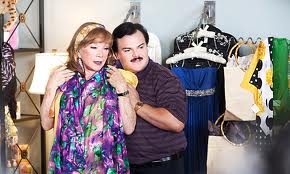














 CINE FEEL YEAH