The heartwarming family drama Big Miracle (Ken Kwapis, 2012), about a heroic whale rescue, is the last movie in which I suspected I would find virtually no glaring flaws. It’s certainly not perfect—it has an unnecessary romantic ending and it is a little slow—but I was definitely impressed with its expansive yet tight script. Here’s a quick rundown of its attributes; there are some spoilers ahead.
It’s a stupid title (the original, working title is the equally bad Everybody Loves Whales), but it teaches a valuable lesson for everyone, children and adults alike: not only is it possible to do the impossible, but it’s best if you try through collaboration, even with people whose ideologies you don’t share. Big Miracle is a dramatization of Operation Breakthrough, the 1988 exercise in international relations that saw the United States and the Soviet Union team up to break free a family of three California gray whales who found themselves trapped in a hole in the ice near Point Barrow, Alaska, five miles away from the open ocean.
Actually, what impressed me most about Jack Amiel and Michael Begler’s screenplay (based on Tom Rose’s nonfiction book Freeing the Whales) was how they managed to incorporate so many perspectives on the event. If I’m not mistaken, these voices include those of the native Inupiat people who worship, eat, and communicate with whales; an incredibly determined but arrogant Greenpeace worker; an evil capitalist from a large oil-drilling company who joins the effort in pursuit of some good PR; the parasitic TV news media in search of a good story and to further their own careers on a temporary national stage; a pair of well-meaning Midwestern inventor-opportunists; a member of President Reagan’s staff, who hopes the story will ensure a favorable legacy for the President as well as an effective quick-start for Vice President George H.W. Bush’s presidential campaign; a colonel from the National Guard, who aims to crack hundreds of miles of ice by pulling the oil-man’s barge with helicopters, but soon gets stuck; and a Soviet-manned icebreaker ship that swoops in to save the day—just in time.
A diverse group of indistinguishable volunteers approach the site where the Soviet icebreaker ship crushed a thick wall of ice, setting the whales free. Image courtesy of Rhythm & Hues Studios, the visual effects company attached to the film project.
Phew! Did you get all that? It’s ambitious, and it works. It might even cohere better than all the narrative strands of Steven Soderbergh’s apocalyptic horror story Contagion (2011). However, I wish the filmmakers hadn’t inserted a subplot involving the former lovers Adam Carlson (John Krasinski), the local TV news reporter who breaks the story, and Rachel Kramer (Drew Barrymore), the dogmatic “pain-in-the-ass” from Greenpeace. So much of their interaction throughout the film is absent of romantic yearning and desire (they have more pressing concerns) that their reconciliation in the end seems forced.
The script and the performances convincingly relate the isolation of Point Barrow, the northernmost point of the United States, as well as the inhospitable climate for the many outsiders who descend upon the small town, including the gray whales, affectionately named Fred, Wilma, and Bamm Bamm after the animated, prehistoric Flintstones family. (Since the baby whale is a male, they opt not to dub him Pebbles and look to the Rubbles clan for inspiration.) Despite this chilly environment, Point Barrow is warmly rendered, its representation hinging on the connection that Adam has with a young Inupiat boy, Nathan (Ahmaogak Sweeney), who longs to leave the community but through this experience learns the value of his culture, thanks to his intuitive grandfather Malik (John Pingayak), who’s also a community elder. More than this, Point Barrow is kinda quirky, a spiritual twin city of the fictional Pawnee, Indiana, featured in the splendid Parks and Recreation (2009-present). For instance, the only restaurant in town is called Amigos, a Mexican cantina that serves as the base of operations for many different interest groups when they are away from the site. It’s touching that its name reminds people of the importance of friendship.
Big Miracle is ostensibly a family film in the vein of Dolphin Tale (Charles Martin Smith, 2011). While there isn’t anything really objectionable (although, I’m sorry to report, Bamm Bamm doesn’t survive, and Sarah Palin makes a “cameo” at the end in some portentous archive footage), the film may be too heady for some children. Since it focuses so much on the seemingly impossible political and bureaucratic maneuvering everyone engages in, I imagine that some youngsters may get bored or frustrated. Not to mention, it also sports an appropriately cynical view of the media, as Los Angeles reporter-on-the-rise Jill Jerard (Kristen Bell) seizes the opportunity to climb the broadcast news ladder to the top by sensationalizing people’s emotions. It’s also upsetting that Adam, smitten with Jill, doesn’t fight to continue reporting on the story he broke nationwide and submits to playing cameraman for Jill before he eventually rejects her editorial style.
The special effects, specifically in the underwater scenes, are definitely more than acceptable, but I am embarrassed to say that I have no idea how they shot those scenes of the whales with their heads above water. In other words, did the filmmakers use real whales? Or did they use mechanical ones, evidently ignoring the lessons Steven Spielberg and co. learned on the set of 1975’s Jaws? (I kid, I kid. I’m sure technologies have advanced so much in the last thirty-seven years that special effects artists know how to work with or around the challenges that water poses to giant synthetic props.)
Rachel gets up-close and personal with a trapped gray whale. I have no idea which one it is: Fred, Wilma, or Bamm Bamm. Image courtesy of The Playlist, hosted by http://www.Indiewire.com.
Well, I’m pleasantly surprised that I haven’t spoiled the entire movie. I recommend Big Miracle in spite of its ridiculous title. It’s funny and sad—perhaps a little too precious—but it’s altogether human.
On Tuesday, Alison Nastasi of Flavorwire posted ten movie titles she has deemed the quirkiest in the history of cinema. Her list runs the gamut from Stanley Kubrick’s classic Cold War black comedy Dr. Strangelove or: How I Learned to Stop Worrying and Love the Bomb (1964) to Sacha Baron Cohen’s performance art piece Borat: Cultural Learnings of America for Make Benefit Glorious Nation of Kazakhstan (Larry Charles, 2006). I would venture to add 2011’s Salmon Fishing in the Yemen, Lasse Hallström’s latest exercise in milquetoast filmmaking, to this group. Released in March 2012 in the U.S., the film went on to receive generally favorable reviews, or so says Rotten Tomatoes, but it failed to catch lots of fish in the audience pool. Could it have been the off-putting and somewhat confusing title? (When I mentioned to my father and brother that I had rented the movie on DVD, they both seemed puzzled by the title. Who calls Yemen “The Yemen”? With a shrug, I suggested that perhaps Yemen is like Gambia, whose short name is technically The Gambia.)
Based on Paul Torday’s novel of the same name, Salmon Fishing in the Yemen charts the relationship between a British financial consultant, Harriet Chetwode-Talbot (Emily Blunt), and a government fisheries expert, Dr. Alfred Jones (Ewan McGregor), whom she contacts to help with a project that one of her clients would like to see implemented. And that’s just what the movie title refers to: the Yemeni Sheikh Muhammad (Amr Waked) wishes to introduce the sport of fly fishing salmon in his arid, river-less homeland. As the film’s romantic leads, McGregor and Blunt have a fair amount of chemistry, but they hardly set the screen on fire. In fact, the film neither works as a romantic comedy nor as an emotional and spiritual uplift movie, the kind of cinema with which director Hallström has made his name. As per usual, I’m going to spoil the plot of the movie below.
The first twenty minutes or so of Salmon Fishing in the Yemen establish the respective personal and professional worlds of Harriet and Fred, cutting between them so that the tension mounts and the spectator knows that as soon as these super-attractive individuals meet, sparks are going to fly. Like many other romantic comedies, Salmon Fishing utilizes the Pride and Prejudice template, at first pitting Harriet and Fred against each other before they fall in love. Obsessed with his own research, Fred resents having to take a meeting with the persistent Harriet at her office, clear on the other side of London town. He rejects her client’s proposal as “fundamentally unfeasible” and laughs in her face; the geography and climate of the Arabian country just don’t allow for this species’s survival. So things between them get off to a rocky start. By the time he returns to his cubicle at the Department of Fisheries and Agriculture, the Prime Minister’s office has gotten involved, forcing Fred’s boss, Bernard (Conleth Hill), to issue an ultimatum: either accept termination of employment or work exclusively on this project—with a raise. If only all career decisions were as easy to make. I should mention that as the head of the PM’s press office, Patricia Maxwell (played by Kristin Scott Thomas) latches onto the sheikh’s aspirational story so as to counterbalance all of the other destructive events taking place across the Middle East and Central Asia, particularly when it comes to Britain’s continued fighting in Afghanistan.
The trouble with Harriet and Fred’s relationship is that the filmmakers have no creative ways to keep them apart, which is a plot contrivance they’re very committed to upholding until the last scene. A reserved and humorless Ph.D. from Scotland, Fred is married to a cold and distant career-minded woman named Mary (Rachael Stirling). Their sex is passionless and perfunctory, and when he desperately suggests that they have a baby together, pledging to raise it while she goes off to work everyday, she doesn’t hear him. He is so emasculated and unfulfilled that he doesn’t have the balls to repeat himself when she requests for him to do so. Much of the film story unfolds while Mary takes an extended business trip to Geneva, freeing Fred to hang out with Harriet outside of their office hours, in London, Yemen, and Scotland. Thus, when Mary returns to surprise Fred, she receives one of her own: during an interrogation, Fred tells his wife that he’s in love with his work colleague Harriet. Seriously? That’s the best you can come up with? It’s completely unoriginal to make the romantic hero unhappily married, to a distant woman, no less, in order to render his attraction to a caring and sensitive woman compelling, even refreshing. How many times have we seen this before? It would have been more interesting if the script merely presented Fred’s being socially awkward as an impediment to their getting together, with his interactions with Harriet and the sheikh eventually loosening him up. At one point, Harriet teases him about having Asperger’s syndrome, and his response is so cryptic that it’s unclear whether or not he truly has it.
But, if you can believe it, the reason why Harriet cannot attach herself to Fred is even more ridiculous. She spends most of the film crying over her boyfriend of three weeks, Army Captain Robert (Tom Mison), who goes missing in action in Afghanistan. Three weeks?! Don’t get me wrong: it’s a devastating loss, and I cannot imagine how unbearable that kind of uncertainty is. However, I can’t help but wonder if her constant grieving, which Fred does his best to soothe her through, isn’t at least a smidge overly dramatic (and how is he able to do that anyway if he has Asperger’s?). When she finally receives notice that Robert was in fact killed in an attack, she blubbers about how she didn’t even get to know him. Mourning what might have been is perfectly understandable, but through most of the film, she acts as if she has known Robert her whole life (even going so far as to quit coming in to work for days on end), perhaps clinging to his proposal that she wait for him until he gets back from the war. And when he miraculously survives, Patricia uses Robert to elevate the Yemeni project in the eyes of the British public, inviting him to the site to fish in the wadi. No surprise: Robert turns out to be a bore whose embraces stifle Harriet and make her long for Fred. Hmm, I wonder whom she will pick.
But Salmon Fishing carries more than just a clunky romantic comedy narrative; it also represents an emotional and spiritual uplift movie because it is about the personal growth that derives from leaving one’s comfort zone and dreaming the impossible. Sheikh Muhammad, funnily enough, ties these two strands together, but not without some clumsy narrative tropes. On the one hand, the sheikh, upon his quirky introduction at his Scottish loch-side estate, is established as Harriet and Fred’s matchmaker. Over drinks after dinner, he quizzes his project’s top team members about their personal lives, remarking that what Harriet and Fred have in common is that they are each away from their loved ones. What is the sheikh suggesting, anyway? “Ooh, you can get up to something while you’re here, in one of my dozens of guestrooms”? No, but it is a hint that the sexual tension between them is noticeable and that Sheikh Muhammad would approve of their eventual union. Later, at the end of the film, just when it appears that Harriet is leaving the wadi with Robert, the sheikh climbs atop a mound of rocks to see if the salmon have survived a flood that local dissidents have caused by opening the sheikh’s dam. When he spots one still unbelievably swimming upstream, Harriet and Fred rejoice, and he renews his vow to stand by the sheikh and continue to build the site. Harriet volunteers to assist (meaning: to stay with him). Thus, in this moment, Sheikh Muhammad’s gaze from on-high allows him to keep alive the twin dreams of introducing salmon fishing in the country and commencing in earnest their heretofore tentative romance, which I must add, is signaled not with a passionate kiss but with their holding each other’s hands.
Sheikh Muhammad, Fred, and Harriet go over their plans—for salmon fishing in the desert and, implicitly, for romance. Image courtesy of http://www.collider.com
More problematic, however, is the sheikh’s characterization. He is obviously meant to challenge stereotypes about Middle Eastern men, specifically those with oil-exploitative wealth and thus political power, but in doing so, he perpetuates them. He quickly bonds with Fred over a session of fly fishing, talking candidly and self-consciously about his crazy plans, inserting the odd curse word here and there. But he is also stoic and wise, speaking eloquently about his country, hobby, and dreams of development. That he trusts a young British woman with his £50 million investment, asking her to recruit a fisheries consultant and such, suggests that he not only holds zero grudges against the former occupiers of his country, but that he is also one for gender equality. Eh, not so fast: while hobnobbing with Harriet and Fred during their first stay at his Scottish glen estate, he mentions that he has many wives. Thus, he isn’t quite as progressive or “visionary” as Harriet believes; he still leads a rather traditional lifestyle, and the fact that the filmmakers use polygamy to signify his Otherness means that they are treading on popular Western-conceived notions of Middle Eastern cultures. In other words, are there no other ways to say the sheikh is a mixture of worldviews? There isn’t anything even distinctly Yemeni about him, his culture remaining a mystery to the Anglo-American viewer. (Morocco stands in for Yemen, I should I add, too.)
Worse still, it isn’t until the end of the film, I think during a press conference or photo opportunity, that Sheikh Muhammad explains his uncommon project for developing the wadi and surrounding land areas as beneficial to the local communities. Although it is unclear what his title entails (as in, what is his jurisdiction?), the sheikh obviously feels a sense of responsibility toward his people (whoever they are) and thus wants to use his wealth to enrich their lives. However, for most of the film, given Fred’s reluctance to accept the sheikh’s plans, salmon fishing in Yemen comes across as merely one rich, eccentric man’s expensive and incomprehensible (i.e. Western) hobby. The intricacies of his vision are never really elaborated; has he surmised that fly fishing promotes irrigation, provides clean water access, or even relieves stress for resident farmers? This is also why I couldn’t help but wonder, why wouldn’t he just invest £50 million in a much more practical development plan? Added to all of this is the sheikh’s unpopularity with some gun-toting, perhaps tribal, terrorists. His heated argument with one of the militants, who harasses him on the building site, goes un-subtitled, and when he later summarizes what transpired between them for Harriet and Fred, they don’t follow up with questions. At one point, while fishing in Scotland, Fred even saves the sheikh from an assassination attempt with his perfectly angled and cast fishing line. Right… Did no one ever ask Sheikh Muhammad if his money would be better spent on a more popular project? Then again, no one can argue with money and power.
Sheikh Muhammad and Harriet supervise the construction of a Yemeni river for salmon fishing. He comes prepared with a sheathed dagger at his waist. Image courtesy of http://www.pinkjulepabroad.com
In fact, the premise and beginning of Salmon Fishing in the Yemen seemed to suggest that the film is about a clash of cultures, which is something that director Hallström specializes in. Scanning his filmography, it is easy to spot how he gravitates toward stories that revolve around outsiders, such as Tobey Maguire’s Homer Wells in The Cider House Rules (1999) and Juliette Binoche’s Vianne in Chocolat (2000), characters who bring about sea-changes when they, respectively, step onto an apple orchard or into a small ultra-religious village. You might expect something similar to happen between Fred and Sheikh Muhammad, but because the sheikh is so “Western” he doesn’t present any real culturally ideological challenges. Instead, Fred, a skeptical scientist, merely must learn to believe that they can pull it off, despite all evidence to the contrary, because the sheikh’s unflappable faith is contagiously comforting. After all, when a rich man charms you with a highly appreciative salary, glowing compliments, and lavishly furnished wadi-side tents in addition to granting you free-reign at his Scottish estate, how can you resist agreeing with him?
This brings me to my next point: I cannot ignore Salmon Fishing‘s representation of Scotland and Scottish identity, topics that I have begun to ritually analyze. Sheikh Muhammad is obviously obsessed with Scotland, a somewhat perplexing but ultimately amusing characterization. His fascination with the culture presents something of a chicken-and-the-egg paradox: is his Scottish estate—located in the Highlands, no less—his favorite among all his land holdings because he loves fishing for salmon or is it the other way around? In other words, how did his love affairs with Scotland and salmon even start? Interestingly, Yemeni men dressed in traditional clothing guard his glen manor, but he keeps on a Scottish butler, Malcolm (Hamish Gray), to greet guests and manage the property’s day-to-day operations. Later, when the British Prime Minister’s publicist Patricia visits to discuss the impossibility of swiping 10,000 wild British salmon and transferring them to Yemen, the sheikh’s men are decked out in kilts!
Patricia, Malcolm, and Sheikh Muhammad pass a line of Yemeni guards in kilts. Image courtesy of http://www.allmoviephoto.com
My knee-jerk reaction to this scene was a rolling of the eyes. Kilts, of course. What could be more Scottish? But on second thought, this image is representative of how Salmon Fishing sheds light on how Scottish identity seems much more performative than others. That is, putting a kilt on a man renders a whole history, culture, and nation wearable, transferrable. Just notice how the sheikh’s robe clashes with the tartan of his men’s kilts, thereby divorcing the fashion statement from the cultural significance of the patterns, which historically correspond to Scottish families or clans. One of my favorite commentaries on the flexibility of Scottish identity, or how easy it is for non-Scots to adopt traditional Scottish clothing, dancing, or cooking as a way to express themselves or define who they are, comes from The Big Tease (Kevin Allen, 1999). In it, co-screenwriter and now-late night talk-show host Craig Ferguson stars as a Glasgow-based hairstylist who travels to Los Angeles to compete in a hairdressing competition. When he meets with the manager of his hotel to discuss a discrepancy on his bill, the manager (Larry Miller) professes his love for Scotland, saying that, though he’s never been to the Northern European country, he has seen enough pictures of the place to feel that he is, in fact, Scottish. Why do so many non-Scots identify with Scotland, perhaps even wishing to be Scottish? Do they feel an affinity toward a group of people who they perceive as eccentric (i.e. kilts, bagpipes, thick accents, haggis) or as heroic underdogs (Braveheart certainly made fighting against English colonizers fashionable)?
I think that it is all these things, to some degree, and in the case of Salmon Fishing, Sheikh Muhammad’s eccentric character (manifest in his hobby, dress, and home) aligns with his perception of Scottishness as a wearable identity. Unfortunately, Fred, as a Scotsman, never remarks on the sheikh’s overly enthusiastic appreciation for Scotland and Scottish culture. If he had, perhaps a more satisfying cultural exchange between the two men would have occurred. Instead, the filmmakers leave it up to Harriet’s boyfriend Robert to comment on the sheikh’s seemingly conflicted cultural identities. Once the war-torn lovers reunite in Yemen, Robert jokes that Sheikh Muhammad’s next venture will be to erect a golf course in the desert. This rubs Harriet the wrong way, as she is by now a full-on convert to the sheikh’s optimistic vision, and signals the lovers’ fundamental incompatibility.
As with its rom-com narrative thread, Salmon Fishing in the Yemen‘s inspirational theme flounders. But at least its dissection of Scottishness proved more rewarding, though not wholly satisfying.
Thank goodness for friends who have access to an HBO Go account. Without such a person I wouldn’t have been able to see the very hard-to-find Dreaming of Joseph Lees (Eric Styles, 1999). I had once seen a teeny bit of the film many years ago when it aired on a cable channel in the middle of the night. Since then, I have never forgotten about it. So when my sister announced its temporary availability (through July 15) on the subscriber-only online streaming service, I jumped at the chance. Boy, am I glad that I did! Given its scarcity on the DVD (and even VHS) market, I kind of regret that I must spoil the film’s story in my analysis, but I hope that my enthusiasm for its representation of female desire and pleasure will convince you to put it on the top of your must-see list, if it’s not already there. (Amazon.com allows you to rent or buy a digital copy.)
A British production shot on the Isle of Man and distributed in the U.S. by Fox Searchlight Pictures in 1999, Dreaming of Joseph Lees is actually all about desire: the act and emotional and mental states of wanting as well as the wish to be wanted right back. Samantha Morton, in one of her early film roles, plays Eva, a young woman living in rural Somerset, England, in 1958 with her aloof father (Frank Finlay) and much-younger siblings Janie (Lauren Richardson) and Robert (Felix Billson). As her voice-over narration states from the get-go, she has been in love with her second cousin, the geologist Joseph Lees (Rupert Graves), since she was fourteen years old. Presumably, WWII and the subsequent reconstruction of displaced or otherwise ravaged lives have a lot to do with separating them. However, thirteen years out, the war is never so much implied. Instead, Joseph loses one of his legs in a marble quarry accident while doing research in Italy, a tragic event that delays his return home and his re-entrance into distant family affairs. Having given up the hope of ever reuniting with her childhood crush, Eva allows local pig farmer Harry (Lee Ross) to aggressively pursue her. Defying the expectations of her family, she even moves in with her possessive paramour. And that’s when Joseph re-emerges, to shake up her life.
The story is divided into two sections, pre- and post-Joseph’s reappearance. The first chronicles Eva’s day-to-day existence, working as a clerk in a sawmill, looking after her family, attending a life-drawing class some evenings, and even helping Harry’s adult sister, Maria (Holly Aird), learn to read and write. Anytime someone at home mentions Joseph, his injury, or his whereabouts, Eva is overcome with emotion. Morton uses her characteristically expressive face to relate Eva’s all-consuming infatuation, her eyes looking as if they’re on the verge of tears at just the mention of his name. Father doesn’t quite understand her fascination with a distant cousin whose name he can barely remember, but Janie knows all about Eva’s private longing. In fact, demonstrating the pleasures of sharing a secret with someone close is part and parcel of the film’s overall representation of female desire. Not to mention its affecting portrait of the intimate friendship between sisters.
During the first (approximate) half, Eva explores her passionate yet pent-up sexuality in the absence of her beloved. Eva accompanies Maria, who encourages her lovesick brother to seduce her friend, to the boxing gym where Harry and Maria’s own crush train. In a reversal of the male gaze, so dominant in mainstream narrative cinema, the women peek through the window to ogle the male nude bodies in repose following arduous physical exercises. Although eventually caught, Eva feels no shame. If anything, glimpsing the affable and unpretentious Harry in this space may comfort her in her subsequent decision to date him. After all, he had previously tried wooing her outside the sawmill by suggesting he “take [her] to heaven and back,” a proposition she first rejected because she not only views his euphemism for sex as immature, but she also would rather take Joseph as her first lover.
However, Harry and Eva’s first official date to watch a boxing match foreshadows their incompatibility. At the sporting event, Eva, goaded on by Maria, attempts to get close to the action, to be nearer the “blood and gore.” I have interpreted this to mean that she is interested in the male form in masculine settings, but the violence of the sparring and the encroaching crowd prove too much for her. Harry may come to her rescue, but not much can be helped. The fact that Harry’s nose bleeds whenever he’s nervous around Eva, spontaneously echoing the brutality of the fight, suggests that their burgeoning romance is unstable and unsustainable.
Despite this, their relationship intensifies. Later, she reflects that, even though she moved to his nearby farm and entered into a fully sexual relationship with Harry, she knew that she would never marry him. For the film spectator, this probably constitutes the most confusing decision Eva makes; why move in with him, in 1958, if you never wanted to marry him? It’s equally surprising that her father, who initially protested, allows her “to follow [her] heart,” perhaps believing that their cohabitation would later lead to marriage. However, it is clear that, at the beginning of their new living arrangements, Eva feels a sense of freedom, unbound by social restrictions and familial commitments. This release is no better expressed than through Harry’s masturbating Eva on the bed, under the frill of her skirt. This is the first of a few sex scenes in which Eva’s pleasure is highlighted—almost to the exclusion of her individual partners’.
Soon, things are far from tranquil on the farm. Harry’s possessiveness and emotional instability are too much for Eva to handle, but whenever he threatens violence against her or himself, she feels she cannot abandon him. (Late in the film, he kills his three dogs when, out of frustration, she pleads for him to get rid of them, meaning to shoo them out of the house. His misinterpretation of her feelings convinces her to leave, but she stays because he threatens suicide.) Thankfully, Janie arrives with good news that changes Eva’s life: the whole family’s been invited to a cousin’s wedding where she is sure to bump into Joseph, finally. The sisters embrace, Eva kissing Janie’s forehead in a tacit acknowledgment of their shared secret.
Although the audience has glimpsed Joseph before in scenes establishing his rehabilitation in Italy as well as through Eva’s memories of him, the wedding presents the first instance he appears contemporaneously. Sitting in the church pews, Eva looks over her shoulder as he enters the building, and at the wedding reception, she and Janie watch him from across the room, the camera assuming their perspective. Inter-cut with shots of Joseph are shots of Eva fidgeting with her earring, looking longingly and deep in thought. Janie is so desperate to see her older sister end up with Joseph that she rejects a man’s dance invitation to Eva and nudges her to go over to Joseph. If not now, when? is the thinking. You might expect a clumsy exchange, with Eva making an ass of herself. But that’s not the case. She skips greetings, and at first Joseph turns down her request to dance, citing his physical disability, but when she persists, he agrees. A tinkling lullaby-like score replaces the up-tempo song that the live band plays as they slow-dance on the floor with other couples bouncing around them. It is as if they are of another time and place, but the audience is made privy to their instant (re)connection. The melodramatic change on the sound track emphasizes the granting of Eva’s—and by extension, our—wish fulfillment.
In the next scene, my fear that Joseph would not remember Eva proves unfounded; they strike up an easy rapport, reminiscing about the past, and they both resent Eva’s father for tearing her away, as the party wears down. Their attraction extends beyond the event, with Janie mailing a postcard inviting him to the family home and his sending Eva coffee-table books on Italian art that she later pours over, as if looking for Joseph within their pages. Of course, Harry becomes jealous, throwing her book in the mud. He makes amends the next morning by cleaning and returning the book to its proper owner, but not without attaching a guilt-inducing line about how he would die if she didn’t love him.
Thus, even after we have met Joseph, he remains at a distance. An unnamed film reviewer in The Hollywood Reporter is frustrated that Joseph “remains an enigma” throughout the film. The supposed underdevelopment of his character is beside the point because we know Joseph as Eva’s Obscure Object of Desire. The pleasure of seeing him on-screen is bound up in the realization that Eva’s fantasy is finally made real and he is made flesh. For example, in the sex scenes between Eva and Joseph (which take place after she temporarily leaves Harry and surprises Joseph on his doorstep), Eva never appears naked on-screen, but Joseph’s skin is regularly exposed. The camera objectifies his body as Eva caresses it with kisses, particularly when, in bed with her straddling his torso, Joseph tells Eva the harrowing story of how he lost his leg. His vulnerability turns her on. So, although the short scene following the wedding party demonstrates his own sentimental attachment to his distant cousin (he rummages through photo albums and scrapbooks), it may not even be required. For it is enough that Joseph exists to reciprocate her feelings and want her as much as she wants him. Then again, I may be biased: I have enjoyed watching the actor Rupert Graves perform on-screen ever since 1996’s Different for Girls (Richard Spence), and I find him very attractive.
The thorn in their side, though, is Harry, who becomes increasingly more manipulative. His dangerous behavior lures a concerned Eva back home, a measure that Joseph understands and supports. To cut a long story short, Harry, who, I might add, had cheated on Eva before she ever left, disappears and worries his sister. Using Eva’s guilt over having wanted someone else, Harry traps her into staying with him because he breaks into the sawmill where she works and cuts off his left leg below the knee. Superficially, his act of mutilation suggests that he believes Eva will only love him if he is (anatomically) more like Joseph, but it more accurately recalls the disorder of his bleeding nose.
One might argue that the film isn’t feminist (enough) because Eva suffers for having desires and for seeking out their attendant pleasures, consigned to the position of Harry’s caregiver. I would argue, however, that it is feminist because the whole film is an exercise in fantasy-building. In other words, following feminist film theorist Elizabeth Cowie’s influential reasoning in “Fantasia,” the ending is satisfying for the (female) spectator of this romantic melodrama because identifying with and watching Eva’s desire unfold may actually be more pleasurable than the desire itself. It does not matter whether or not Eva and Joseph live happily ever after. The fact that she even had a desire (which Joseph reciprocated) is enough is please or “makes it all worthwhile.” Better to have loved and suffered than never to have loved at all.
But who is to say that our hope-against-hope lovers won’t end up together after all? The film closes with Joseph paying a surprise visit at the farm, which obviously stirs up a whirlwind of emotions in Eva. She still wants Joseph; he knows this. He has come to take her away, but she refuses to budge for the sake of Harry’s well-being. Her sacrificing their happiness wounds both lovers. And when Joseph loiters outside the house after their exchange, Eva, sensing his presence but assuring Harry she’s not leaving, steps outside. The camera lingers on their hearty embrace, which suggests that they are trying to savor each other’s presence, fearing a long-term and potentially permanent separation. (He’s going to Italy again for work.) Janie steps out of the house, smiling as she looks on. It is in this moment that her role as a stand-in for the film viewer comes full-circle. Throughout the film, we the audience have lived somewhat vicariously through Eva’s dreaming of Joseph Lees, which Janie has played an instrumental part in shaping.
Despite Janie’s approving smile, I still think the filmmakers leave their future open-ended. Maybe that’s just me. After all, I prefer romantic dramas to romantic comedies because I like being reminded that loving someone is, for lack of a better word, hard. Emotionally draining. Conflicting. Perhaps even dangerous. My sister, a rom-com connoisseur, thinks the hug between Eva and Joseph at the end means they do wind up together. I just don’t think it’s that easy. Besides, believing that their longing for each other will persist in perpetuity may actually be more pleasurable than seeing or imagining them, say, cutting into a wedding cake.
It is not yet apparent—but it soon will be—that I am not one for romantic comedies. While I can enjoy some of them, I much prefer romantic dramas, particularly those set in a bygone era. We tend to think of such narrative dramas as more plausible than their comedic counterparts. And with good reason. Comic writer, essayist, and actress Mindy Kaling put it best in The New Yorker, back in October of last year:
I like watching people fall in love onscreen so much that I can suspend my disbelief in the contrived situations that occur only in the heightened world of romantic comedies. I have come to enjoy the moment when the male lead, say, slips and falls right on top of the expensive wedding cake. I actually feel robbed when the female lead’s dress doesn’t get torn open at a baseball game while the JumboTron camera is on her. I regard romantic comedies as a subgenre of sci-fi, in which the world operates according to different rules than my regular human world. For me, there is no difference between Ripley from Alien and any Katherine Heigl character. They are equally implausible. They’re all participating in a similar level of fakey razzle-dazzle, and I enjoy every second of it.
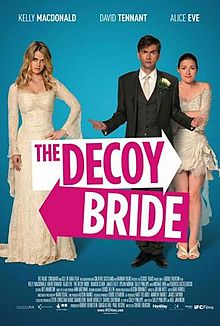
I felt a sense of enlightenment upon first reading her observation about the romantic comedy. It is with her outlook on her favorite movie genre that I am able to approach—and even appreciate—examples from it. For this reason, I was able to enjoy Sheree Folkson’s The Decoy Bride (2011), though I admit that the setting and actors were the main draws. Spoilers ahead!
Kelly Macdonald stars as Katie NicAoidh, a thirty-two-year-old who gives up her dreams of making it in the big city (Edinburgh!) and returns home to Hegg, a fictional island located way out there in the Outer Hebrides. She leaves her cheating musician of a fiance behind, along with a soul-sucking job writing for an online men’s trousers catalogue (laying it on thick, eh?), to wallow in self-pity at her mother’s bed & breakfast establishment. Her romantic future looks bleak (she’s turned “vegan” when it comes to men), as she is the youngest of 75 island residents and the only single woman among them. Cue the arrival of her soul-mate! James Arber (a flappable David Tennant) is an up-and-coming “serious author” who is engaged to the superstar American actress Lara Tyler (Alice Eve). When the pestering cameras of paparazzi make it impossible for the couple to get married in private, Lara and her handlers (agent Michael Urie and his assistant Sally Phillips, who co-wrote the screenplay) arrange their super-secret nuptials on Hegg. Having glimpsed her arch-enemy, the paparazzo Marco (Federico Castelluccio), trawling the chapel, Lara runs away the morning of her wedding, leaving her agent, Steve (Urie), to devise a dubious plan: he hires Katie to pose as Lara during the ceremony, hoping to pass off the event as the couple’s wedding to the press (he doesn’t even let James in on it). Steve believes that if the press and public already think they’re married, then they will be able to wed privately, for real. Don’t you see why it’s best to think of the romantic comedy as a sub-genre of sci-fi?
Complications arise when Katie accidentally signs the register with her own name, rendering her marriage to James official. (Seriously, she thought Steve’s offer of £5000 was worth the trouble of breaking the law?) It’s worth mentioning here that they had met each other the day before: James, under an assumed name (to keep his wedding secret from the islanders), bumped into her while Katie was researching the definitive guidebook to Hegg that she is writing. After she makes a disastrous pass at him, they both decide that they don’t like each other. Later, when James discovers what Steve has orchestrated, the verbal sparring matches between James and Katie really begin.
Steve locks the fighting newlyweds in the tower of the castle that he has had renovated for the secret, romantic destination wedding. James and Katie’s being locked up in the honeymoon suite and their subsequent determined escape from it subvert the setting’s fairytale ending connotations. But this is just the beginning of their love story. Like in the seminal romantic comedy Pride and Prejudice, the protagonists must offend each other before they fall deeply in love. This process begins shortly after James saves Katie from drowning in the castle’s moat, a heroic gesture that is clearly a reference to legends of chivalry. Astonishingly, his rescue surprises both of them—but not the spectator. Besides, how could anyone let someone else drown, no matter how irritating the person is?!
The Decoy Bride utilizes many tropes of the romantic comedy genre, especially the wedding theme, which is so prevalent that it warrants its own sub-genre. The “wedding film” has proliferated in the 2000s, counting among its ranks such films as The Wedding Planner (Adam Shankman, 2001), The Wedding Date (Clare Kilner, 2005), 27 Dresses (Anne Fletcher, 2008), Bride Wars (Gary Winick, 2009) and even the “manly” antidotes Wedding Crashers (David Dobkin, 2005) and American Wedding (Jesse Dylan, 2003). Last year’s hugely successful Bridesmaids (Paul Feig, 2011) injected a feminine-inspired cynicism into all the stages of planning a wedding. Feminist film scholar Diane Negra, in What a Girl Wants? Fantasizing the Reclamation of Self in Postfeminism, estimates that the American bridal industry is worth about $161 billion today (52). Along with magazines and news stories, these films contribute to pop culture’s fascination with the wedding event and stress the importance of the heteronormative rite-of-passage that getting married supposedly is for young women. As a wedding film, The Decoy Bride both makes fun of marriage and reaffirms its significance. On the one hand, the film upends the notion that marriage is a sacramental testament to everlasting love because James and Katie, who despise each other, accidentally wed. But on the other, since the mismatched couple fall in love while trying to get divorced, the spirit with which they were married turns out not to have been a fluke after all.
Although The Decoy Bride belongs with other wedding films, it has more in common with Pride and Prejudice than it does, say, Bride Wars. An English-language classic, Jane Austen’s 1813 novel is a telling portrait of the life options available to the women of her time: marry for money, for the betterment of your family, or face poor spinsterhood. The strength of Austen’s story lies in its form as a comedy of manners, the whole time poking fun at the institution of marriage and the people who endeavor to strike up the deals. While there is much more at stake pending Elizabeth Bennet and Mr. Darcy’s eventual union as opposed to whether or not Anne Hathaway and Kate Hudson will each secure the same overbooked wedding venue, Mr. and Mrs. Darcy’s early nineteenth century love story is thoroughly modern. Perhaps that is because our Anglo-American culture continues to recycle it. The (im)probable lovers have been immortalized in book and screen adaptations numerous times, often with funny sounding titles like Bridget Jones’s Diary (written by Helen Fielding in 1996 and directed by Sharon Maguire in 2001) or You’ve Got Mail (Nora Ephron, 1998). In fact, Katie resembles Bridget Jones’s version of Lizzie Bennet in that she is often publicly shamed for being over thirty and single. As struggling authors, James, who suffers from writer’s block, and Katie, who is just coming into her own as an author of a Hegg travel guide, lunge their daggers into each other’s literary egos in much the same way that Tom Hanks and Meg Ryan of You’ve Got Mail spar over carving out their respective book-selling niches on the Upper West Side. The Decoy Bride goes one step further in its homage to romantic comedies, pretty much all borne of Pride and Prejudice, with a scene in which James and Katie strip out of their wet clothes in her mother’s kitchen, a thin linen separating them—and tempting them to look at each other—as if they are in Frank Capra’s It Happened One Night (1934).
My sister, an unabashed aficionado of romantic comedies, insists that the films work so long as the leads have chemistry. Kelly Macdonald and David Tennant do set off some romantic fireworks, but I’m afraid that James is not as appealing or likeable a character as Katie is. Mindy Kaling would be happy to learn that Katie is not so broadly drawn as to fit any of the archetypes for romantic comedies’ leading ladies that Kaling identifies in the piece I quoted from earlier. Katie is not an adorable klutz, a Manic Pixie Dream Girl, a humorless and ambitious workaholic, or a gluttonous slob with a six-pack of abs. She is self-aware (she knows that James is her type, an emotionally stunted “arty” guy, which means trouble) and has a self-deprecating sense of humor. Casting Macdonald in this role is actually refreshing. An “indie” actress who made her debut in Danny Boyle’s Trainspotting (1996), one of my all-time favorite films, she is usually cast in dark pictures, namely the Coen Brothers’ No Country for Old Men (2007) and HBO’s Prohibition-set gangster epic Boardwalk Empire (2010-present). She brings to her character more nuance than we are used to seeing in other rom-com’s heroines. The look on her face when she decides to turn the ferry traveling away from Hegg back around, to reunite with James at the very end, is a prime example of this.
The problem with James as a male lead, an object of desire that we’re meant to want Katie to want and obtain, is that he never gets over himself or overcomes his charlatan ways. Lara chooses Hegg as the destination for their would-be super-secret wedding because it is the setting of his one and only book, The Ornithologist’sWife, a heavy tome that the locals, including Katie, resent because it misrepresents the place. Using James’s book as a guide for planning their wedding, Steve soon discovers that James had never been to Hegg, because the lavish, bird-decorated castle doesn’t already exist there. Steve must invent it to appease his client. James’s dirty little secret remains buried vis-a-vis his fiancee, who, contrary to her lifestyle, is actually a down-to-earth, if a little naive, woman. Lara loves James because she believes he is a genius, regularly quoting his words back to him. On the occasion she says something stupidly romantic, he says he can’t believe he wrote that. In fact, it was her own original sentiment. Not only is he cruel, James has nothing in common with Lara, and it seems as if he wants to marry her because her desirability to others is a feather in his cap. He thinks that in addition to stroking his ego, she will also prove to be a fruitful muse and ensure his own fledgling fame lasts.
Despite the journey he takes with Katie all over the island, falling in love while trying to get divorced, it is revealed in the end, following the improbable lovers’ separation, that James and Lara never corrected the press and public’s shared impression that they wed. In other words, everyone thinks they’re still married. Thus, the dedication in his second book (“To my wife”), which is based on his experience with Katie, is directed not at Lara but at our heroine. While it may be a comfort that James and Katie share a private romance that is made public through his new novel, the fact that James would wish to deceive everyone, especially Katie, about being married to someone he does not love means he hasn’t learned his lesson. He may have started to write what he knows, at Katie’s insistence, but he hasn’t fully understood how to own up to it. Some romantic prize to be won.
Of course, embedded in all of this is a slight critique of our celebrity-obsessed culture. Lara is sympathetic in her desire for privacy, as is her hiding out in the village once the world’s press descends on Hegg. Since Steve has barred anyone from entering the castle, in trying to maintain the so-called integrity of the sham wedding, Lara applies her own makeup (quaint!) and takes up a disguise as an old village lady so that she may wander around the press camp undetected. In doing so, she chats with Marco, the paparazzo who has made her life a living hell and who redeems himself because he shows off candid photos of Lara that he never sold. In a pre-end credits scene, Lara attends Marco’s gallery opening, their suggestive smiles captured on film by a hovering paparazzo for the glossy tabloid Stars Today.
Back in Hegg, Lara also meets Katie’s mother, Iseabail (Maureen Beattie), who sold the wedding story to the press. Given the fact that Iseabail is terminally ill with an unnamed disease (this constitutes the weakest part of the film story), Lara’s threatening to push Iseabail, in her wheelchair, over a cliff if she doesn’t throw her huge wad of cash into the sea is unbelievably harsh. Lara then mistakes Iseabail as the inspiration for the titular character in James’s novel, a move that Iseabail encourages and in the end influences the actress to fund the dying woman’s trip around the world with Katie. (Having stayed put in Hegg all her life, Iseabail is itching to leave, her bucket list dreams recalling those of Tom Hanks in Joe Versus the Volcano [John Patrick Shanley, 1990].)
An opportunist and busybody, Iseabail is but one of the eccentric villagers. Others include elder citizens who hawk cookies and tea as well as expensive pet rocks to the deluge of visitors. Stranger still, there is Angus (Hamish Clark), a former boyfriend of Katie’s who weds someone he does not evidently love on the very day that Katie comes back to town. He later attempts to fight James for Katie’s hand. This is a ridiculous plot contrivance to prove to James and the audience that Katie is desirable. Then again, Katie is uneasy when it comes to the attention that Angus and William (James Fleet), Katie’s boss at the general store, regularly pay her. This probably has more to do with her unwillingness to stay in Hegg and her professional ambitions to travel and write. In the end, while she succeeds as the published author of a definitive if little-read history of Hegg, it is unclear if she and James will stay in Hegg. Or whether they will get married again—for real.
The Decoy Bride, a Scottish and Manx co-production, was shot on the Isle of Man in the Irish Sea, and while Hegg by no means represents a mythical Scotland a la the villages in Brigadoon (Vincente Minnelli, 1954) or Brave (Mark Andrews, Brenda Chapman & Steve Purcell, 2012), the film does tread on all-too-familiar territory. The script calls for Katie and James to seek out Reverend McDonough (Tony Roper) because, as Katie assures, “he’ll know what to do.” Apparently in tune with island superstitions, he officiates their ceremonial divorce, which he rushes to perform before the first sunset as if he is breaking a spell. In fact, you might say that James and Katie’s determination to reverse their vows is not too dissimilar from Princess Merida and Queen Elinor’s race to lift the bear curse on the latter woman in Brave, which coincidentally stars Kelly Macdonald as the fiercely independent princess.
According to the film’s trivia page on the Internet Movie Database, many scenes and characters were struck from the shooting script because the budget was much lower than the screenplay’s earliest appraisal. This handicap is most noticeable toward the end of the film, leading up to the lovers’ inevitable reunion. I have no idea what changes would have been made if the filmmakers had the full £7 million as intended, but The Decoy Bride is a cute little movie nonetheless. Especially if you suspend your disbelief.
Having been too young to watch the Fox TV series 21 Jump Street when it originally aired from 1987 to 1991, I mainly just knew it as the show about young-looking undercover cops that launched Johnny Depp, among other also-rans. That’s probably how most people of my generation (the news media has anointed us “millennials,” a moniker that annoys me to no end) “remember” it. So why not re-package it as a comedy with the up-and-comers Jonah Hill and Channing Tatum? Despite the surprisingly positive reviews 21 Jump Street (Phil Lord & Christopher Miller, 2012) received upon its release as well as my dad’s oft-repeated requests to see it, I refused to see it in the theater. Honestly, I can’t remember my specific reasons for holding so firm on this point; it was not as if I had wanted to see something else and Dad refused to go. March 2012, unless you are a dedicated follower of all things The Hunger Games, was a bad month for movies.
Why did my father want to see 21 Jump Street so badly? Well, ever since catching Superbad (Greg Mottola, 2007) on basic cable years ago, he has been obsessed with Jonah Hill’s foul-mouthed performances. That’s right: even with the channel’s edits for language and content, my dad still found the film–and Jonah Hill’s horny teenager–uproariously funny. I joke that he is the only 62-and-a-half-year-old who eagerly anticipates Hill’s films. For example, Dad still wants to see The Sitter (David Gordon Green, 2011), which I have no interest in viewing because of its allegedly racist, homophobic, and sexist sense of humor. It’s also noteworthy that my father’s Jonah Hill fandom does not extend to his more “serious roles.” Dad was disappointed that the comic actor played it “straight” in Moneyball (Bennett Miller, 2011), for which he received an Oscar nomination for Best Supporting Actor.
Anyway, we rented 21 Jump Street on DVD as soon as it became available, and we both laughed our asses off. It had been a long time since I had seen a comedy that made me laugh so unabashedly hard (it is quite politically incorrect, you know). Unfortunately, owing to the film’s mixture of genres (more on that in a moment), it loses its steam in the last act, as things become more out of control and ridiculous. Now’s a good time to alert you that, as with pretty much everything I write, I’m going to “spoil” 21 Jump Street.
Jonah Hill and Channing Tatum star as rookie cops Schmidt and Jenko, respectively, who, after a botched arrest in a public park, are transferred to a secret unit of the unnamed city’s police force: 21 Jump Street. Operating out of an abandoned church at this address, Captain Dickson (a very flummoxed and funny Ice Cube) leads a team of young-looking cops as they go undercover in local high schools and communities to bust criminals. Dickson, his patience already exhausted, assigns Schmidt and Jenko the case of finding the dealer and infiltrating the supplier of a new LSD-like drug on the campus of a neighborhood high school. The drug’s street name is wholly unimaginative (HFS, as in “holy fucking shit”), but Dickson introduces it to the partners and audience in a novel, synced-in way: through the screening on YouTube of a video in which a teenager documents the various stages of his experience on the drug. Dickson fills in the last bit, which immediately ups the stakes of their mission: the kid in the video whose antics so amused Jenko later overdosed and died.
Schmidt and Jenko were enemies all throughout high school because the former was a geek and the latter the dumb jock who picked on him. They only recently became best friends while at the police academy, in a quick blink-and-you’ll-miss-it exchange wherein Schmidt openly admires Jenko’s easy physical dexterity and Jenko respects Schmidt’s study habits. In other words, they decide with a fist bump to “be friends,” recognizing that each other’s strengths will help him improve. Now that they are partners and BFFs, it is with a little trepidation that they re-enter high school. Will everything be the same?
21 Jump Streethas been called the male-centric version of Never Been Kissed (Raja Gosnell, 1999), the romantic comedy in which the homely newspaper copyeditor Drew Barrymore gets a chance to prove her worth as an investigative reporter while reliving the horrors of high school. This comparison is superficial and off-base because 21 Jump Street is not as sentimental or nostalgic (the pre-title sequence is the only scene set in the past). Nor does the newer film’s narrative focus on the protagonists’ transformation from unpopular (or in Jenko’s case, popular) to cool (or uncool). Dickson’s stern pointer to the more handsome of the two, Jenko, to keep his dick in his pants and not have “relations” with teachers, staff, or students is a preemptive “shut-up!” to those viewers who have already made the Never Been Kissed connection (because Barrymore and her English teacher, Michael Vartan, find love). But a tiny romance with a student is slotted in for Schmidt, who’s long been petrified of girls, thereby subverting the rule that “nice guys finish last.” Jenko’s desirability is more often commented upon than his own desires are expressed, which perhaps foreshadows Channing Tatum’s unselfconscious turn and public appeal to be a leading man in Steven Soderbergh’s Magic Mike (2012).
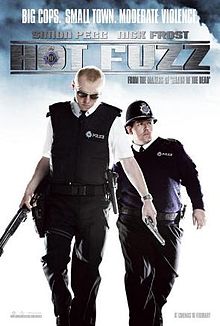
In updating the television show for today’s audiences, screenwriter Michael Bacall (who developed the story with its star, Jonah Hill) combines the police procedural format with conventions from the buddy cop genre, “high-concept” action movies, and even high school-set comedies about social hierarchies. This genre mixing suggests that the film’s intended audience is very cine-literate. As a buddy cop movie, 21 Jump Street has less in common with the classics Lethal Weapon (Richard Donner, 1987) and Point Break (Kathryn Bigelow, 1991) than it has in common with the recent fan-boy favorites Hot Fuzz (Edgar Wright, 2007) and The Other Guys (Adam McKay, 2010), which are both parodies and legitimate entries of the genre. For the later films speak the same language, positioning their respective “odd couple” policemen of inaction as the triumphant heroes of Michael Bay’s explosion-laden cinema. The early scene in which Schmidt and Jenko pursue drug dealers while on the beat in a public park, the action cut between their frenzied bicycle-riding in close-up, set to a rocking score, and their more languid rolling over the grass in a medium shot (without music), at once expresses the partners’ frustration with their jobs (it is not as heroic as they would wish) and their desires to live in a Michael Bay-type action film. Later in the film, they chase after the same drug dealers, this time on the ramps of a painfully obvious Southern California freeway, commandeering a number of vehicles (including a student driver car with two steering wheels and a baby pink VW bug) and turning their heads at almost every maneuver because they expect their efforts to have resulted in explosions. Whereas the first scene in the park is subtle, this later car chase scene is like a Saturday Night Live skit run amok.
Thankfully, most of 21 Jump Street‘s comedy derives from its deconstruction of high school’s social hierarchies. Other than Never Been Kissed, the film also references such classics as Sixteen Candles (John Hughes, 1984) and The Breakfast Club (Hughes, 1985) and even the resplendent TV series created by Paul Feig, Freaks and Geeks(1999-2000). Having been popular back in the day, Jenko advises his partner and friend with a number of key behaviors that will ensure he fits in, chief among them: make fun of people who “try too hard.” When Jenko demonstrates this on their first day, still in the parking lot, he receives a rude awakening. He calls one of the popular kids “gay” for riding a moped, and when accused of gay-bashing, Jenko reacts by punching the kid, who just happens to be gay. Thus the put-upon popular kid and his friends accuse Jenko of hitting him because he is gay, which Jenko of course couldn’t have known. Meanwhile, Schmidt makes the observation that everything that made him uncool in school, such as his cultural sensitivity, staunch environmentalism, and awkward sense of humor, is now in vogue. Things have changed in the less than ten years since they were in high school, and these changes precipitate an identity crisis for each.
21 Jump Street is not exactly like the teen comedies based on Shakespeare’s plays, including Never Been Kissed (As You Like It) and Gil Junger’s 10 Things I Hate About You (The Taming of the Shrew, 1999), but it does use misidentification as a starting point for comic hijinks. Since neither Schmidt nor Jenko studied their fake profiles before enrolling, they fail to identify correctly as their assumed identities in the principal’s office. This means that the dumb hunk Jenko winds up with Schmidt’s class schedule, which is heavy on the sciences (where Dickson thinks the drug’s makers are convening). The shy and awkward Schmidt is saddled with Jenko’s less academically challenging but more artistic and social courses. It’s in his drama class that he becomes close to Molly (Brie Larson), a pretty, funny girl who non-exclusively dates Eric (Dave Franco), the popular kid who took Jenko to task for bullying his gay friend. Not surprisingly, Eric is soon revealed to be the high school’s number one dealer of HFS, thereby requiring Schmidt to get close to him.
Meanwhile, Jenko uses the nerds in his science class to trace Eric’s phone calls on his mobile. He may become friendly with them, inviting the small group to a party that Schmidt hosts at his parents’ house in spite of Dickson’s forceful reminder never to do so (Schmidt has moved back in with his parents along with Jenko to keep up the charade that they are brothers new to the neighborhood). And Jenko may enjoy science more because of their tutelage of him, but of the two, Jenko grows the least as a character. Unlike Schmidt, who must get over his fear of firing his gun (definitely a sexual handicap), Jenko doesn’t have any real challenges. He hardly has low self-esteem, but hearing his best friend make fun of his intelligence with Schmidt’s new-found popular classmates takes its toll on their relationship. In the end, though, Jenko’s fun science experiments with the gang help him stop the drug dealers from getting away. He effectively builds and hurls a bomb, made with alcohol and batteries, at their runaway vehicle. Cue explosion. Schmidt eventually becomes a man of action when, in puerile, penal fashion, he shoots the drug supplier, the jocky Mr. Walters (Rob Riggle), in the crotch. Upon shooting the P.E. teacher and track coach’s dick off, Schmidt announces that Mr. Walters “peaked in high school.” Talk about rewriting the social rules of high school.
But this begs the question: should Schmidt and Jenko have grown more as characters? On the one hand, I think character development would certainly have improved the story. But on the other hand, I appreciate how the filmmakers eschew traditional storytelling methods. As I previously mentioned, Schmidt and Jenko become friends in a flash while at the academy, with the tacit assumption that Jenko had already become less of a jerk in the years they spent apart. This means that the film neither tracks the development of their relationship, from enemies to best friends, nor their own transformations. Perhaps the protagonists’ not having major narrative trajectories is exactly the point. Sure, Schmidt must learn to take risks (it’s part of his job!), and he does. When it comes to women, his becoming popular has little to do with it. Molly doesn’t like him because he hangs out with Eric; she arguably prefers him for his awkward sense of self. They feel a connection because they have a similar sense of humor. As for Jenko, hanging out with science geeks may make him one by association, but he doesn’t metamorphize into a genius. Besides, that’s impossible to convey in fewer than 120 minutes. In this way, they merely grow together from being inept cops to being fully capable of bringing the bad guys to their knees. Ooh, did I just write that in digital ink?
By way of conclusion, here are some odds and ends to 21 Jump Street that I really enjoyed. Hill and Tatum have tremendous chemistry, and Tatum proves he can deftly handle comedy, as when he tries to intimidate one of the drug dealers in the beginning with, “Hey, you want me to beat your dick off?”
As a big fan of the TV series Parks and Recreation (2009-present), I loved seeing Nick Offerman cameo as the deputy police chief who transfers the bumbling idiots to the undercover bureau. His description of the program as a rehashing of the past because the higher ups lack creativity in catching criminals constitutes a witty meta-commentary on the business of filmmaking today, what with the prevalence of sequels and reboots.
Furthermore, the characterizations of the adults at the school (weirdly named Sagan High… after Carl Sagan?) are clearly meant to make fun of archetypal teachers and principals who are ignorant of their students’ problems. For example, Principal Dadier (Jake Johnson from New Girl) and drama teacher Mr. Gordon (Chris Parnell) regularly say that they should care more about their students than they do. Mr. Walters, the creep that he is, had to have been a douche bag when he was in school because he simply never left. Perhaps the funniest situation arises because Jenko’s science teacher (Ellie Kemper) is overly flirtatious. She is physically conflicted over her desire for Jenko, both making her body available for ogling and saying she just can’t entertain the thought of crossing the line between teacher and student. The good news is that Jenko never takes advantage of her or any other woman who flings herself at him.
On the downside, the filmmakers waste that well-hidden cameo by Johnny Depp. At the end of the film, his Tom Hanson from the original series, along with partner Doug Penhall (Peter DeLuise), appears as an undercover cop who has lived with the drug dealing gang for years, going so far as to get tattoos and wear prosthetic makeup around the clock. When a gunfight breaks out between Schmidt and Jenko and the drug dealers, Hanson and his partner are caught in the cross-hairs and die gruesomely after professing their love for each other. This being a Jonah Hill movie, of course there is bromance. But doing away with these characters in this manner seems insensitive and outlandish. But what really explains this maneuver? Maybe the filmmakers weren’t expecting any fans of the original show to see the movie.
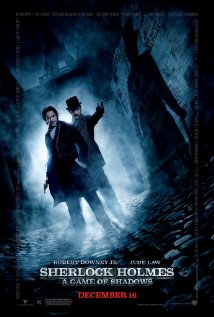
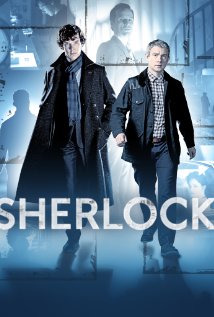
Sir Arthur Conan Doyle’s greatest literary creation, the private detective Sherlock Holmes, is everywhere these days. If he’s not appearing in the over-hyped BBC series Sherlock (2010-present) as a fast-talking, tech-savvy eccentric with a Dr. Watson who’s a PTSD-afflicted veteran of the war in Afghanistan, then he’s gearing up for a fall CBS show, Elementary (from 2012), where his sidekick will be a woman. Coincidentally, the star of the former program is Benedict Cumberbatch, who co-starred last year in director Danny Boyle’s innovative stage-play Frankenstein for the National Theatre with Elementary‘s lead Jonny Lee Miller. But Warner Bros. has pumped the most money, special effects, and star power into their Sherlock Holmes-as-action-hero franchise, and the sequel to the 2009 revisionist adaptation, Sherlock Holmes: A Game of Shadows (Guy Ritchie, 2011), is boring and tedious. As always, spoilers follow.
Robert Downey, Jr. and Jude Law reprise their roles as Holmes and Watson, respectively, in order to foil the criminal mastermind James Moriarty’s (Jared Harris) plot to instigate and manipulate a world war through the purchase and control of several industries, including the manufacture of machine guns. Downey and Law have a lot of chemistry, because after all it is a bromance. To my mind, the homo-eroticism is more pronounced in A Game of Shadows than in the first film, what with Holmes, disguised as a woman, surreptitiously joining Watson on his honeymoon with the long-suffering Mary (Kelly Reilly). (You’ve seen this sight gag in the trailer.) Of course, Holmes cites Moriarty’s vow to kill Mary and the only person Holmes cares about for the reason that he just had to crash the couple’s much needed alone-time. That, and stopping Moriarty from succeeding in carrying out his plan is simply more important. Holmes perfectly times the moment he pushes Mary off the train so that she lands in the river below the bridge, where his brother Mycroft Holmes (Stephen Fry), making his first appearance in the series, can safely retrieve her. Talk about bride flight.
There is no room in this (b)romance for Mary, but at least Ritchie and his married screenwriters Kiernan and Michele Mulroney write this subtext into Holmes’s and Watson’s dialogue. Watson eventually accepts Holmes’s melodramatic gestures, once he realizes that his and Mary’s assassins are on the train, blowing holes through the walls in pursuit of their prey. Crucially, however, he expels pent-up rage at his best friend, who clasps Watson’s head between his thighs. Remember, Holmes is wearing a dress. Ordinarily I would shriek with delight at this juxtaposition, but the nudge-nudging here is bruising.
On closer inspection, you can see that women just have no place in this world. Irene Adler (Rachel McAdams), Holmes’s iconic love interest and intellectual sparring partner, resurfaces after her disappearance in the first film, only to fall victim to her employer’s schemes within the first ten minutes or so. (I forgot about that; I guess Moriarty wants to get rid of two people Holmes cares about.) It may be a byproduct of McAdams having so little time on screen, but she and Downey have nowhere near as sparkling a chemistry as Downey and Law do. And that is the point. Other than Mary, the only other Englishwoman to grace us with her presence is Holmes’s daft landlady Mrs. Hudson (Geraldine James), who has a brief stint at 221B Baker Street before the real action begins. The scene in which the dandy Mycroft, who is someone indispensable to the British government but without a clearly defined role within it, walks around his house buck-naked, ordering his decrepit butler around and informing Mary of her husband’s whereabouts (received via telegram) despite her discomfort with his nudity, makes it very clear that the boys have a lot more fun without any girls around.
Even Holmes and Watson’s new partner in crime (fighting), the gypsy fortune teller Madam Simza Heron (Noomi Rapace in her first English-language role), hardly gets any play. From the moment of her introduction (Holmes winds up saving her from an assassination attempt before she goes underground in France, where he and Watson later track her down), her part is marginalized. Though she treks all the way to Switzerland with the pair for the climactic event, you barely know she’s there. The guys ostensibly keep her around because she will lead them to her brother, Rene, a member of a revolutionary group that she was once a part of and which Moriarty now controls. Madam Simza coaches them on how to dress less conspicuously as they cross national borders, assists Watson in literally bringing Holmes back to life after Moriarty captured and hung him up by a hook in his shoulder, and identifies Rene at the international summit in Switzerland despite his extreme cosmetic surgery. (I didn’t tell you that this movie is ridiculous?) Since she spends most of her time with Watson, she cannot be a romantic interest for either of the men. While this is refreshing (for once, a woman doesn’t exist in a “manly” action film for the sole purpose of affirming the hero’s masculinity), I’m afraid the screenwriters Mulroney just don’t know what to do with her. Hell, even after the smoke has cleared in the end, there is no follow-up with Madam Simza.
Back in 2009, Sherlock Holmes was billed as an inventive rehashing of a familiar story. For in it, Holmes is literally a man of action, not some aloof intellectual. He’s “edgy,” participating in bare-knuckle fights. It was during this film that audiences first witnessed “Holmesavision,” his deconstruction of hand-to-hand combat, narrated in voice-over so as to grant viewers access to his mind, to his ingenious plans for how to tackle each of his opponents (“Holmesavision” is actually the name of a featurette on the sequel’s DVD about this very storytelling device). Unfortunately, I cannot share in the filmmakers’ enthusiasm for this kind of indulgence. It is tedious and boring how we’re made privy to his particular, slowed-down way of seeing the physical threat before him and then subjected to watching him carry it out in real time. In later scenes, such as when Holmes, Watson, and Madam Simza are running through the forest with Moriarty’s henchman hot on their tail and blazing bullets, the action slows again. Why are people constantly trying to adapt The Matrix (Andy & Larry Wachowski, 1999)? Doesn’t it strike anyone else as passe?
Admittedly, I am biased against action movies. This is why I find the narrative emphasis on Holmes’s fighting ability, at the expense of showcasing his intellectual prowess and highly evolved deductive reasoning skills, so disheartening. As much as I find Mark Gatiss and Steven Moffat’s Sherlock grating, pompous, and too slick for its own good, I can concede that at least the show’s makers get Holmes’s astounding puzzle-solving skills right; his “Holmesavision” zeros in on the teeny tiny details others can’t see because they don’t know where to look. His view of the world is grounded in logic, or at least the logic of his own universe. Thus, when in the end of A Game of Shadows, Holmes defeats Moriarty in Switzerland over a game of chess and reveals how he uncovered his arch-nemesis’s plan to destroy the world, at the same time explaining all to the audience, the fun of watching a brilliant mind at work is already spent. Quite literally. He connected all the dots beforehand, never even letting on to his companions that he has already figured everything out and planned ahead, sending word to Mary in London in order to ensure the public discredits the mild-mannered and secretly evil Professor Moriarty. Well, gee, Mr. Holmes, I’m sure glad you brought me along for this crazy ride. This makes Holmes no different from the hero of other it’s-the-end-of-a-major-plot-to-destroy-the-world movies and almost diametrically opposed to the Holmes that has fascinated us so for 125 years. I’m all for reinvention, but this tactic is just uninspired.
Although the story of A Game of Shadows itself is original, I believe, the ending–in which Holmes and Moriarty fall to their death at the Reichenbach Falls, conveniently located across from Moriarty’s balcony–is drawn from Conan Doyle’s 1891 attempt to kill off his hero. According to Wikipedia, the fans weren’t having it, and so the author was goaded into bringing back Sherlock in a series of prequels. The point is, this is how Holmes dies. Like Sherlock‘s final episode of the second season, titled “The Reichenbach Fall,” in which Watson also witnesses his BFF’s death (Moriarty kills himself instead), Holmes later appears in a cliffhanger. Whereas in Sherlock, he watches from afar as Watson grieves over his grave, in A Game of Shadows, he disguises himself as an armchair in Watson’s study, right before his eyes if only Watson knew to look. Warner Bros. preemptively assumes that audiences want more of this Holmes character, and the studio would do well enough to leave him alone. Trompe-l’œil, indeed.

 The heartwarming family drama Big Miracle (Ken Kwapis, 2012), about a heroic whale rescue, is the last movie in which I suspected I would find virtually no glaring flaws. It’s certainly not perfect—it has an unnecessary romantic ending and it is a little slow—but I was definitely impressed with its expansive yet tight script. Here’s a quick rundown of its attributes; there are some spoilers ahead.







 CINE FEEL YEAH