Long Take: Reclaiming Brave

Viewed June 27, 2012

Pixar’s thirteenth feature, Brave (Mark Andrews, Brenda Chapman & Steve Purcell, 2012), may not be the best of the studio’s output. While it doesn’t reach the narrative heights of Ratatouille (Brad Bird, 2007), The Incredibles (Bird, 2004), Wall-E (Andrew Stanton, 2008), or Toy Story 3 (Lee Unkrich, 2010), the film certainly doesn’t belong with the drudgery that is Cars (John Lasseter, 2006) or Cars 2 (Lasseter, 2011). Set in medieval Scotland, Brave is a solid piece of Pixar animation and an affecting story that anyone would be proud to produce. Unlike most critics, who have contributed to the film’s middling score on Rotten Tomatoes (it’s middling for a movie by Pixar, whose works are almost always universally praised), I didn’t find Brave disappointing. In fact, it exceeded my expectations. Originally conceived by director Brenda Chapman, Brave is a welcome woman-centric entry into the Pixar canon. But it really should be celebrated for what it gets right: its overwhelmingly feminist story. You know the drill by now: I’m going to spoil the movie below.

During its opening weekend, Brave racked up $147 million in worldwide box office receipts ($66 million of which was gained in the US alone), thereby quelling fears that audiences wouldn’t turn out for the first Pixar movie to have a female protagonist. There is such a thing as brand loyalty, and when the film’s studio is synonymous with quality (in terms of story, characters, and art), who really could have thought that Brave wouldn’t bring audiences in, anyway? Still, it is refreshing to reflect that, provided the little ones weren’t bored with the emotional story, spectators of all ages were treated to a poignant film about mother-daughter relationships. In other words, Brave is not just another fairytale.

The mother-daughter relationships in fairytales historically pit good against evil, generally in the form of a young, beautiful, and sweet-natured “princess” overcoming the emotional and physical torture inflicted upon her by her stepmother. For example, Cinderella’s stepmother punishes her with menial labor around the house because her now deceased husband loved his daughter more than he loved her, and Cinderella is rewarded in the end for her moral goodness when the prince chooses her for his bride and not one of her stepsisters. More tellingly, one of the most enduring fairytales, which is coincidentally the first full-length animated feature (by Pixar’s parent company, Disney, no less), is about a witch’s murderous envy of her stepdaughter’s beauty. According to Maria Tatar, the Grimm brothers’ early version of “Snow White” reflects “children’s fears about the cruelty of stepmothers, at a time when mortality rates for child-bearing women were exceptionally high.” However, Monica Hesse is quick to point out that the original Grimm story was about a mother’s desire to kill her own daughter for the same reason. In this sense, Brave breaks with the fairytale tradition because the generational conflict is about compromise forged out of love.

Princess Merida (voiced by Kelly Macdonald) and Queen Elinor (Emma Thompson) don’t see eye-to-eye on how the princess should comport herself. The teenaged Merida has taken after her warrior father, the fun-loving and rough-housing King Fergus (Billy Connolly). She prefers to fill the hours horseback riding through the nearby forest, climbing steep rock-faces to enjoy the view from the top, and practicing her already accomplished archery skills. Elinor is trying to make a lady out of her daughter, insisting she perfect her enunciation, needlepoint, and hospitality. Even though Merida is nowhere near ready to assume queenly duties (and nor does she want to), the queen has gone behind her daughter’s back to invite the first-born sons of three neighboring clans to compete in the Highland Games for Merida’s hand in marriage. Merida tries what she can to deter her mother’s plans, even going so far as to compete in—and win—the archery contest for her own hand. Watch this scene and get the chills:

So, Brave is a universal story about wanting to choose your own path in life. Following Merida’s embarrassing commandeering of the Games, mother and daughter get into a heated fight. Unfortunately, I can’t remember who acted first, but I know that Merida takes a knife to Elinor’s tapestry-in-progress, a portrait of the family, separating Elinor from the rest, and Elinor throws Merida’s bow into the fireplace, immediately regretting such an impulsive move. Although Merida’s desires are decidedly different from Ariel’s, the generational conflict in Brave reminds me of the one central to The Little Mermaid (Ron Clements & John Musker, 1989). Merida even enlists the transformative powers of a witch (Julie Walters), only, unlike Ariel, she selfishly wishes to change her mother rather than herself. (Recall how, in striking a deal with Ursula in order to meet and woo a land-bound prince, Ariel gained legs in exchange for her beautiful singing voice.) In Brave, the witch, who so desperately wants to work in peace as a wood-carver (“too many dissatisfied customers”), forgets to give Merida special instructions for serving Elinor the magic cake, and that is when the action really takes off.

The working title of Brave was The Bear and the Bow, and it is a good thing that the filmmakers made the switch. For the title would have given away the narrative twist, which Brave‘s marketing materials have done so well to keep under wraps: consuming Merida’s peace offering, the witch’s cake, transforms Elinor into a bear! A wacky Freaky Friday of sorts ensues with mother and daughter teaming up to reverse the spell while dodging the riotous clansmen in the castle. King Fergus in particular has a bear on his hit list; in the pre-title sequence, set when Merida received her first bow as a little girl, the giant, legendary bear Mor’du attacks the family’s picnic and eats Fergus’s left leg below the knee (off-“camera,” of course).

I’m not sure that the bear carries any special significance in Scottish culture, especially since neither Scotland nor the whole island of Great Britain has been home to wild bears for thousands of years. However, the bear metaphor is apt because we tend to anthropomorphize the wild animal due to the mother bear’s fierce protection of her cubs. Just this week, Good Morning America reported that three bear cubs broke into a car near Denver searching for food, their mother initially scared off by police officers who snapped photos of the bandits red-handed. The only other mention of animals in Brave are of the mythical sort. I can’t recall the exact circumstances, but someone mentions to Fergus the impossible existence of dragons, which I have interpreted to be a slight against How to Train Your Dragon (Chris Sanders & Dean DeBlois, 2010), perhaps the first and only near-Pixar quality DreamWorks Animation film about a viking community that, oddly enough, has a character or two with a Scottish accent.

In any case, Brave has received a lot of attention because animating Merida’s untamed orange curls pixel-by-pixel is an impressive feat. However, just as the filmmakers successfully infused children’s toys with life and a rat with excellent culinary skills, the animators of Brave wonderfully imbue the bear with Elinor’s prim-and-proper personality. We still see Elinor in the bear as she proudly wears her crown and insists that Merida keep her bow off the table. Though they’re both despondent, things calm down between them once the duo have learned, via a potion-controlled automated message from the now-absent witch, that if they do not mend their bond by the second sunrise, Elinor’s metamorphosis will become permanent. Frustrated that she can no longer speak, mother and daughter gradually develop a language based on non-verbal sounds, hand (or paw) gestures, and facial expressions. The first steps toward reconciliation occur on the banks of a river, where Merida teaches her mother how to fish. The irony is not lost on me: a young woman teaches a bear to fish with just its bare claws. Later, when they happen upon Mor’du’s pit and must run away to save themselves from his wrath, Merida rides on her mother bear’s back. Merida’s horse Angus may prove valuable in the end, but this earlier scene is poignant because it shows how connected mother and daughter are, despite (or because of) Elinor’s change.

In fact, one of the aspects I like best about Brave is how active both Merida and Elinor are. Their daring escape from Mor’du’s lair is just the tip of the iceberg. In the end, after Fergus finally discovers the broken furniture in Elinor’s bedroom and attributes the mess to Elinor the bear, believing she is Mor’du and therefore responsible for taking his leg and killing his beloved wife, he locks a protesting Merida in her room and chases Elinor out of the castle. With the manpower of the three visiting clans behind him, Fergus follows Elinor to a mystical Druid circle. Eventually, Merida gets out of her temporary prison, stitching up her mother’s tapestry while bouncing along on Angus’s back. She arrives just in time for the real Mor’du to show up and attack the humans. Fergus withdraws his fight, and everyone watches as Elinor the bear defends Merida, ingeniously wearing down one of the stones so that when Mor’du slams into it, it crushes and kills him. This resolution is satisfying because it defies expectations laid out at the beginning. Not only has the queen come to respect her daughter’s rough-and-tumble talents, she has also exhibited them herself. It is Elinor, after all, a woman bear of action, who defeats her husband’s wild foe—and not Fergus himself who does the deed. It is also important to note that Mor’du isn’t a villain; he is the way he is because he was once a human prince who broke with tradition and sought the witch’s magic in order to rule the kingdom on his own. His curse became permanent because he was too stubborn to right his wrongs. So, when Elinor kills him, his soul gratefully finds peace.

The maternal melodrama reaches its tearful conclusion when Merida, having practiced the womanly needlepoint skills her mother desperately grilled into her, wraps the tapestry around Elinor the bear. With a humble apology and a profession of love, Merida manages to bring back her mother’s human form, just as the sun rises. As much as I like New York magazine’s pop culture blog, Vulture, I am not willing to ignore its faults. Contributor Kyle Buchanan misunderstands a lot about the witch’s spell, believing that she casts it “[j]ust for cruel kicks.” First of all, Merida asks for the witch to “change” her mom, not for one to more accurately change her mother’s mind about her future, so we can hardly blame the witch for Merida’s confusing choice of words. Buchanan also takes the witch’s explanation of the spell’s conditions too literally, incredulous as to how the witch could have known that Elinor’s tapestry needed mending. That’s not actually the case, Kyle. The witch’s “answering service antidote” refers to the mother-daughter bond in a metaphorical way. It is Merida who conjures the idea to stitch the tapestry back together. Just think of how pleasing it would be to her mom!

Originally, I rolled my eyes at the the plot contrivance that the spell’s effects are only temporary for the first two days, but in hindsight I realize that it is enough time for the mother and daughter to reconnect. After all, they used to be close because of their shared belief in magic, and they do know each other very well. Through their adventure, they arrive at a compromise, which technically lies heavily in Merida’s favor. For even before Merida breaks the spell in the Druid circle, the princess’s agility outdoors and heartwarming speech in front of the fighting clansmen who have convened for the Highland Games inspires Elinor, still a bear, to sign the rest of her daughter’s speech, announcing that Queen Elinor has decided to suspend the Games. In witnessing Merida’s full appreciation for tradition, Elinor insists that the three suitors who have competed for her hand, along with everyone else throughout the kingdom, should have the right to choose whomever they want to marry. Talk about a change of heart.

This resolution complements the film’s overarching feminist representation of power. Fergus may be the king of all four clans, which are each headed by men, but it is Elinor who effectively rules. She organizes the Highland Games and arranges Merida’s marriage. When fighting breaks out among the clans upon their arrival, she brings it to an end with a stern turn about the room, silencing even her brawling husband. Most importantly, Queen Elinor stops Merida, who speaks passionately about the importance of tradition, before her daughter chooses who among the sons of Lords Macintosh (Craig Ferguson), MacGuffin (Kevin McKidd), and Dingwall (Robbie Coltrane), will be her husband. In this way, through her influence over her mother, Merida becomes the most powerful DunBroch in the kingdom. In the future, she may remember to keep her bow off the dining room table to please her mother, but she will not have to hang it up completely.

Brave is violent in parts, such as whenever Mor’du appears on-screen. But perhaps more shocking than this is the prevalence of nudity. For example, Merida locks Fergus and his men outside on the tower in order to get Elinor, newly transformed into a bear, out of the castle. The men tie their kilts together and climb down, and as they walk out of the frame, the spectator glimpses their bare asses. Later in the film, after Merida breaks the spell, her mischievous little brothers, the triplets Hamish, Hubert, and Harris, run over to the naked Queen Elinor, their bare asses also visible (they had eaten from the magic cake at one point, too). It is an interesting choice to feature comic nudity in an animated family film. Pixar had never gone this route before. But I am glad that the filmmakers included a sexualized instance of the female gaze. When Lord Dingwall introduces his son before the royal family, a gigantic Schwarzenegger-like figure with bulging muscles and an unreal tan stands in front of them. Elinor leans forward in her throne to watch the expression on Merida’s face as she registers the man’s appearance. It’s not clear whether or not the denouement that he is not Lord Dingwall’s son disappoints either woman, but their looking at his body suggests that the filmmakers have a keen sense of irony when it comes to fairytale desires.

As a lover of all things Scottish, I admit that I was originally trepidatious going in to see Brave because the film circulates many stereotypes, including a mystical highland setting, jokes about kilts (Lord Dingwall moons Lord MacGuffin), and anachronistic blue face paint. In fact, I didn’t even like the title because it resembles too closely Mel Gibson’s rape of Scottish and English history also known as Braveheart (1995). Thankfully, the film is neither Brigadoon (Vincente Minnelli, 1954) nor Braveheart, and these small quibbles do not detract from the emotional pull of the story. In sum, I appreciate that the film reclaims the adjective “brave,” which typically connotes masculine courage, by attaching it to a young woman’s adventure of self-discovery.

Long Take: Sherlock Holmes: A Game of Shadows Is Not Worth Playing

Viewed June 25, 2012

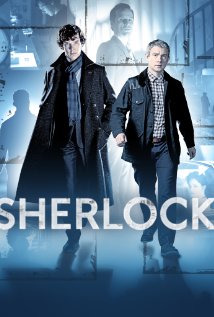
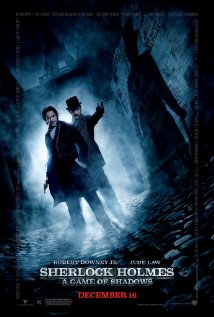
Sir Arthur Conan Doyle’s greatest literary creation, the private detective Sherlock Holmes, is everywhere these days. If he’s not appearing in the over-hyped BBC series Sherlock (2010-present) as a fast-talking, tech-savvy eccentric with a Dr. Watson who’s a PTSD-afflicted veteran of the war in Afghanistan, then he’s gearing up for a fall CBS show, Elementary (from 2012), where his sidekick will be a woman. Coincidentally, the star of the former program is Benedict Cumberbatch, who co-starred last year in director Danny Boyle’s innovative stage-play Frankenstein for the National Theatre with Elementary‘s lead Jonny Lee Miller. But Warner Bros. has pumped the most money, special effects, and star power into their Sherlock Holmes-as-action-hero franchise, and the sequel to the 2009 revisionist adaptation, Sherlock Holmes: A Game of Shadows (Guy Ritchie, 2011), is boring and tedious. As always, spoilers follow.

Robert Downey, Jr. and Jude Law reprise their roles as Holmes and Watson, respectively, in order to foil the criminal mastermind James Moriarty’s (Jared Harris) plot to instigate and manipulate a world war through the purchase and control of several industries, including the manufacture of machine guns. Downey and Law have a lot of chemistry, because after all it is a bromance. To my mind, the homo-eroticism is more pronounced in A Game of Shadows than in the first film, what with Holmes, disguised as a woman, surreptitiously joining Watson on his honeymoon with the long-suffering Mary (Kelly Reilly). (You’ve seen this sight gag in the trailer.) Of course, Holmes cites Moriarty’s vow to kill Mary and the only person Holmes cares about for the reason that he just had to crash the couple’s much needed alone-time. That, and stopping Moriarty from succeeding in carrying out his plan is simply more important. Holmes perfectly times the moment he pushes Mary off the train so that she lands in the river below the bridge, where his brother Mycroft Holmes (Stephen Fry), making his first appearance in the series, can safely retrieve her. Talk about bride flight.

There is no room in this (b)romance for Mary, but at least Ritchie and his married screenwriters Kiernan and Michele Mulroney write this subtext into Holmes’s and Watson’s dialogue. Watson eventually accepts Holmes’s melodramatic gestures, once he realizes that his and Mary’s assassins are on the train, blowing holes through the walls in pursuit of their prey. Crucially, however, he expels pent-up rage at his best friend, who clasps Watson’s head between his thighs. Remember, Holmes is wearing a dress. Ordinarily I would shriek with delight at this juxtaposition, but the nudge-nudging here is bruising.

On closer inspection, you can see that women just have no place in this world. Irene Adler (Rachel McAdams), Holmes’s iconic love interest and intellectual sparring partner, resurfaces after her disappearance in the first film, only to fall victim to her employer’s schemes within the first ten minutes or so. (I forgot about that; I guess Moriarty wants to get rid of two people Holmes cares about.) It may be a byproduct of McAdams having so little time on screen, but she and Downey have nowhere near as sparkling a chemistry as Downey and Law do. And that is the point. Other than Mary, the only other Englishwoman to grace us with her presence is Holmes’s daft landlady Mrs. Hudson (Geraldine James), who has a brief stint at 221B Baker Street before the real action begins. The scene in which the dandy Mycroft, who is someone indispensable to the British government but without a clearly defined role within it, walks around his house buck-naked, ordering his decrepit butler around and informing Mary of her husband’s whereabouts (received via telegram) despite her discomfort with his nudity, makes it very clear that the boys have a lot more fun without any girls around.

Even Holmes and Watson’s new partner in crime (fighting), the gypsy fortune teller Madam Simza Heron (Noomi Rapace in her first English-language role), hardly gets any play. From the moment of her introduction (Holmes winds up saving her from an assassination attempt before she goes underground in France, where he and Watson later track her down), her part is marginalized. Though she treks all the way to Switzerland with the pair for the climactic event, you barely know she’s there. The guys ostensibly keep her around because she will lead them to her brother, Rene, a member of a revolutionary group that she was once a part of and which Moriarty now controls. Madam Simza coaches them on how to dress less conspicuously as they cross national borders, assists Watson in literally bringing Holmes back to life after Moriarty captured and hung him up by a hook in his shoulder, and identifies Rene at the international summit in Switzerland despite his extreme cosmetic surgery. (I didn’t tell you that this movie is ridiculous?) Since she spends most of her time with Watson, she cannot be a romantic interest for either of the men. While this is refreshing (for once, a woman doesn’t exist in a “manly” action film for the sole purpose of affirming the hero’s masculinity), I’m afraid the screenwriters Mulroney just don’t know what to do with her. Hell, even after the smoke has cleared in the end, there is no follow-up with Madam Simza.

Back in 2009, Sherlock Holmes was billed as an inventive rehashing of a familiar story. For in it, Holmes is literally a man of action, not some aloof intellectual. He’s “edgy,” participating in bare-knuckle fights. It was during this film that audiences first witnessed “Holmesavision,” his deconstruction of hand-to-hand combat, narrated in voice-over so as to grant viewers access to his mind, to his ingenious plans for how to tackle each of his opponents (“Holmesavision” is actually the name of a featurette on the sequel’s DVD about this very storytelling device). Unfortunately, I cannot share in the filmmakers’ enthusiasm for this kind of indulgence. It is tedious and boring how we’re made privy to his particular, slowed-down way of seeing the physical threat before him and then subjected to watching him carry it out in real time. In later scenes, such as when Holmes, Watson, and Madam Simza are running through the forest with Moriarty’s henchman hot on their tail and blazing bullets, the action slows again. Why are people constantly trying to adapt The Matrix (Andy & Larry Wachowski, 1999)? Doesn’t it strike anyone else as passe?

Admittedly, I am biased against action movies. This is why I find the narrative emphasis on Holmes’s fighting ability, at the expense of showcasing his intellectual prowess and highly evolved deductive reasoning skills, so disheartening. As much as I find Mark Gatiss and Steven Moffat’s Sherlock grating, pompous, and too slick for its own good, I can concede that at least the show’s makers get Holmes’s astounding puzzle-solving skills right; his “Holmesavision” zeros in on the teeny tiny details others can’t see because they don’t know where to look. His view of the world is grounded in logic, or at least the logic of his own universe. Thus, when in the end of A Game of Shadows, Holmes defeats Moriarty in Switzerland over a game of chess and reveals how he uncovered his arch-nemesis’s plan to destroy the world, at the same time explaining all to the audience, the fun of watching a brilliant mind at work is already spent. Quite literally. He connected all the dots beforehand, never even letting on to his companions that he has already figured everything out and planned ahead, sending word to Mary in London in order to ensure the public discredits the mild-mannered and secretly evil Professor Moriarty. Well, gee, Mr. Holmes, I’m sure glad you brought me along for this crazy ride. This makes Holmes no different from the hero of other it’s-the-end-of-a-major-plot-to-destroy-the-world movies and almost diametrically opposed to the Holmes that has fascinated us so for 125 years. I’m all for reinvention, but this tactic is just uninspired.

Although the story of A Game of Shadows itself is original, I believe, the ending–in which Holmes and Moriarty fall to their death at the Reichenbach Falls, conveniently located across from Moriarty’s balcony–is drawn from Conan Doyle’s 1891 attempt to kill off his hero. According to Wikipedia, the fans weren’t having it, and so the author was goaded into bringing back Sherlock in a series of prequels. The point is, this is how Holmes dies. Like Sherlock‘s final episode of the second season, titled “The Reichenbach Fall,” in which Watson also witnesses his BFF’s death (Moriarty kills himself instead), Holmes later appears in a cliffhanger. Whereas in Sherlock, he watches from afar as Watson grieves over his grave, in A Game of Shadows, he disguises himself as an armchair in Watson’s study, right before his eyes if only Watson knew to look. Warner Bros. preemptively assumes that audiences want more of this Holmes character, and the studio would do well enough to leave him alone. Trompe-l’œil, indeed.

Steven Soderbergh: Workman’s Competence

Yesterday, the U.S. Supreme Court ruled 5 to 4 that President Obama’s Patient Protection and Affordable Care Act of 2010 is in fact constitutional, thereby cementing his legacy. I was so excited to hear this news, as it will ensure that millions of presently uninsured Americans will get the affordable healthcare that they rightly deserve. Yep, the country is starting to look a little different, the future a little brighter, after June 28th.

But this probably has more to do with the fact that today marks the premiere in theaters of Steven Soderbergh’s Magic Mike (2012), which is being hyped as possibly the greatest male stripper movie ever made. (Have we forgotten all about Peter Cattaneo’s sleeper hit The Full Monty, from 1997?) The movie review aggregator site Rotten Tomatoes lists Magic Mike‘s rating as 82% fresh. Despite the cheesy marketing ploys–one of which saw star Channing Tatum, whose own experience as a stripper inspired the story, lead a flash mob during his Today Show appearance–it looks as if Magic Mike might be more than just the sum of its “beefcake” parts. This is important, for how else am I going to convince my dad to take me to see it? (I don’t drive, and I live nowhere near a theater, if you can believe it.) Apparently, the fact that serious auteur Steven Soderbergh directed it isn’t enough of a reason. But it should be.

Here’s why: this week, in anticipation of the film’s release, I kept thinking about what would influence Soderbergh to pursue this kind of project. He’s hardly ever made anything as campy; the Ocean’s Eleven trilogy (2001, 2004, 2007) is fun because the biggest movie stars in the world gamely make fun of themselves, all while strutting around in impeccably tailored clothes, in beautiful locales, to David Holmes’s smooth and funky score. Come to think of it, that doesn’t sound too dissimilar from his newest effort.

On a more serious note, what I recognized while going through Soderbergh’s filmography is that most of his films are concerned with the characters’ professional work. This is not to say that he is Ken Loach, who has made many films about working class British men’s work lives. I’m thinking of The Gamekeeper (1980), Riff-Raff (1991), and The Navigators (2001) in particular, not to mention his films about nationalist revolutions (Land and Freedom, 1995; The Wind That Shakes the Barley, 2006) and even U.S. labor unions (Bread and Roses, 2000).

But work in Soderbergh’s movies is more nuanced than in your average film, if the average film is now either a romantic comedy (in which the female lead inevitably works at a women’s fashion and lifestyle magazine) or an actioner along the lines of Die Hard (John McTiernan, 1988), in which a police officer successfully foils a terrorist’s plot, but not without a few explosions going off to highlight just how extraordinary his dayjob is. The point is that, sure, what the characters do for a living is important to the story in virtually all films, including ones in which the protagonist does not work. There’s usually a reason for that.

The director Steven Soderbergh. Photo courtesy of IMDb.

But consider this: Soderbergh’s first feature after the Cannes success sex, lies, and videotape. (1989) was Kafka (1991). I haven’t seen the film, but I can imagine that, given the author’s biography (his writing provided an escape from his hum-drum workaday life as a clerk for an insurance company), work is not just an important facet of Kafka’s identity, but also a setting much explored in the film.

Arguably his first studio film, Out of Sight (1998) centers in part on the romantic entanglement of a US Marshall (Jennifer Lopez as Karen Sisco) and bank robber-turned-prison escapee Jack Foley (George Clooney in a star-making turn), thereby subverting the narrative conceit of the pursuit that is essential to her line of work. The year 2000’s Erin Brockovich famously transformed Julia Roberts into a Best Actress Oscar winner for her portrayal of a real-life legal clerk and environmental activist. The film chronicles Brockovich’s investigation of Pacific Gas & Electric Company’s cover-up of groundwater contamination in a local community whose residents have become gravely ill. Her efforts take a toll on her relationships with her family and boyfriend, and she also confronts death threats because of what she has uncovered.

Based on a British TV series from 1989, Traffic, also from 2000, takes a more dynamic approach to its inside story of the illegal drug trade: through the interweaving perspectives of a Mexican police officer battling widespread corruption in his force, a conservative American judge/politician whose own daughter is an addict, and the wife of a drug lord going to extremes to protect her family from the law and the cartel. Again, this film, for which Soderbergh won the Oscar for Best Director, would not work without an emphasis on the conflict between each character’s personal and professional lives.

Last year’s underrated Contagion (2011) takes a similar multi-perspective approach to the recounting of a mysterious virus’s spread across the globe. Matt Damon’s part as a new widower, immune to infection, trying to keep his teenage daughter safe may have a pathetic advantage when you consider that the other story lines revolve around the work lives of scientists and public health officials. However, Contagion is compelling, both as a horror film and thriller, precisely because we see these people at work: epidemiologists trying to contain the virus (Kate Winslet) or investigating its point of origin (Marion Cotillard), the head of the Centers for Disease Control and Prevention (Laurence Fishburne) juggling the supervision of others’ tasks as well as being the face of an organization mired in controversy, and a CDC scientist (Jennifer Ehle) toiling away in the lab in order to develop a vaccine. In the end, we understand that business travel is the reason it immediately spread from Macau, near Hong Kong, to places as far-flung as the Minneapolis suburbs and Paris (if I’m not mistaken). Global business and culture are conduits through which more than just money, goods, and services are transferred.

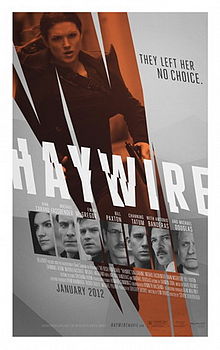
Even Soderbergh’s more experimental, low-budget features explore the world of work. The improvised Bubble (2005) stars non-professional actors in a murder mystery set in a depressed town’s doll factory. The porn actress Sasha Grey takes top-billing in The Girlfriend Experience (2009) as a NYC high-end call girl who specializes in providing clients with the titular fetish. I would even argue, alongside LA Weekly film critic Karina Longworth, that this past January’s release, Haywire (2011), fits into this category of Soderbergh’s ouevre. He built a film around the mixed martial artist Gina Carano, casting her as a double-crossed secret agent/assassin hell-bent on exacting revenge against her employer and one-time lover (Ewan McGregor). Carano’s body and the way she uses it, effectively propelling the action around the world, is a piece of performance art. She does all her own stunts, and much of the story is communicated through her victorious hand-to-hand fights with men like Channing Tatum, Michael Fassbender, and McGregor. In other words, we see Carano’s Mallory Kane excel at work despite the unfair treatment she endures in the workplace.

The director, who, I might add also serves as the cinematographer on his pictures, under the pseudonym Peter Andrews (is that gesture meant to hide his work or call attention to it?), has also made films about the actor and writer Spalding Gray: 1996’s Gray’s Anatomy and And Everything Is Going Fine (2010). The first is more accurately a filmed monologue, essentially capturing Gray at work as the performer of staged autobiographical storytelling, whereas the second is a more conventional documentary about the life and work of the artist, who allegedly drowned himself in New York’s East River in 2004.

The theme of work pops up in Soderbergh’s other films, including The Informant! (2009), Che (2008), and Solaris (2002). Even his foray into television, alongside oft-collaborator and co-producer George Clooney, K Street (2003), concerns the work of lobbyists and politicians. This is nothing to say of the projects that he has worked on as just a producer. Unscripted (2005), for instance, follows three real actors around Los Angeles as they scramble to book gigs and catch their big break.

Thus, it is not so strange to see that Steven Soderbergh, who has just renewed fears that he’s quitting movie-making forever, again, has directed a film about male strippers and how the world they inhabit at work dictates how they perceive and are perceived by those outside of it. From the first trailer, it appears as if Magic Mike (Channing Tatum) has aspirations of a career in furniture design. Interesting, eh? Anyway, his co-worker and friend (Alex Pettyfer) has a sister (Cody Horn) who’s made it her mission to get the guys out of the heavily exploitative business. The actress recently acknowledged that her character might be unpopular with female audiences, but that she reveled in watching the guys, including Matthew McConaughey in “the role he was born to play,” act and dance in g-strings while on the set. Since I am interested in cinematic representations of the male body’s desirability–in an academic sense, I swear!–and how audiences, men and women alike, read these images, I have been following coverage of Magic Mike pretty closely, and from the get-go I found it intriguing that Soderbergh would tackle this subject, but now I understand that it’s all about the work.

Long Take: Storytelling Fails to Evolve in Prometheus

Viewed June 12, 2012

It’s almost July. That means Marvel’s The Avengers (Joss Whedon, 2012) more than adequately kicked off the summer blockbuster season, as everyone expected it to, and spectators have the final chapter of Christopher Nolan’s Batman trilogy, The Dark Knight Rises (2012), to look forward to when it hits theaters in just a few weeks. But this also means that Prometheus (2012), director Ridley Scott’s first foray into sci-fi territory since 1982’s Blade Runner and one of the most hotly anticipated movies of the summer, has already come and gone. In IMAX 3D, no less. If you haven’t seen it at a theater by now, you’re probably not going to.

As a new convert to Blade Runner fanaticism, I couldn’t wait to see Prometheus, because it has been characterized as sophisticated hardcore sci-fi for months leading up to its release. Unfortunately, I didn’t re-watch any of the four films from the Alien franchise, including Scott’s inaugural one of the same name (1979). Whether or not Prometheus is intended as a prequel to Alien has been hotly debated. As far as I know right now, Scott has reasserted that it is a prequel, after having denied this for some time while the film was in post-production, I believe. Apparently, it now barely shares its “DNA” with the series. Having seen the picture, that’s a hard argument to make. I suppose this is as good a place as any to warn: yes, there be spoilers ahead!

Prometheus is set in 2093 on the eponymous spaceship that is jetting a crew of 17 to the moon of a distant planet. They’re journeying to another solar system, all because Dr. Elizabeth Shaw (Noomi Rapace, in her first lead role in the English-language) and her boyfriend, Dr. Charlie Holloway (Logan Marshall-Green, who bears more than a passing resemblance to the busy actor Tom Hardy), believe that humans’ “makers” come from this corner of the universe.

The scene that establishes these characters, particularly their motivations and methodology, is severely problematic. After all, it is the whole movie that is premised on the following discovery: after having found a thousands-of-years-old cave drawing somewhere on the Isle of Skye that features a celestial leitmotif, which occurs across other ancient civilizations, Dr. Shaw, a devout Christian, is convinced that humans’ ancient alien ancestors painted them. Her reasoning is crazier than and distinct from that of any wacko on the History Channel’s Ancient Aliens series who might suggest that aliens came from outer space and built, say, the Great Pyramids of Egypt. The human-like figures in the drawings represent those who made contact with these ancient alien beings that Shaw and her fellow crew members insist on calling their “makers.” Big mistake. The “makers” are not even depicted; a cluster of heavenly bodies in the upper-left-hand corner of each image that Shaw documents stands in for the aliens. I’m sure that no archaeological society would accept such proof of their existence, so screenwriters Jon Spaihts and Damon Lindelof would have done well to try for at least some professional plausibility. Of course, no one would interpret what Shaw has found as an “invitation” to those stars (her oft-repeated words) in order to find some ancient aliens. Instead, if Shaw and Holloway had found physical instruments made of a foreign material in the cave, then that would have been something. Some crew members don’t even buy the archaeological discovery that the film story is predicated on; they come to resent that they have risked their reputations–not to mention, their lives–to go on this mission based on a hunch. Oops!

After all, the crew has spent two years in cryogenic deep sleep to get to this faraway post. Along the way, a robot named David (Michael Fassbender) has steered the spacecraft on-course, filling the hours by performing regular maintenance, deconstructing ancient alien languages, and watching and re-watching Lawrence of Arabia (David Lean, 1962).

In fact, for an intellectual yet insentient being, David sure does know how to model himself after someone–and not even a “real” someone he knows from personal experience. He isn’t so much captivated by the true historical figure T.E. Lawrence as he is by Peter O’Toole, in his portrayal of the man. David regularly quotes the movie hero’s lines, but he also bleaches or dyes his roots so as to more closely resemble O’Toole’s impression. (It’s unclear what his cosmetic intentions are: it looks as if he is bleaching his roots, but throughout the rest of the film, they are dark. I have interpreted this to mean that, in an effort to be more human than human, David wants to keep up the appearance of having lightened his hair color like so many people do.) But inserting Lawrence of Arabia into the story is an obvious reference. For the irony must not be lost on David that he, like T.E. Lawrence, is playing the part of mediator between rivaling civilizations. It is significant that he chooses to model his behavior (especially his physicality) based on an actor’s portrayal of a real person, thereby blurring the line between fact and fiction when it comes to historical interpretation.

You might even say that casting Fassbender as David deliberately draws attention to the parallels between his celebrity and that of O’Toole. They have more in common than simply being from Ireland. Although Lawrence of Arabia was not the young O’Toole’s first big screen performance, it is what unequivocally made him a big star. And while Fassbender’s part as David is nowhere near as grandly important (despite Scott’s best efforts, such as shooting with 3D cameras, Prometheus doesn’t measure up to the flat yet deep scale of Lean’s earlier 70mm work), many are wondering whether this role will finally catapult him to superstardom.

I have another gripe about this vision of the not-too-distant future: the gender disparity aboard the Prometheus. Of the 17 stated team members, only three are women: Shaw, the commander Meredith Vickers (Charlize Theron), and Dr. Ford (Kate Dickie), whose scientific occupation is so ill-defined that she mainly just appears to be a lackey first for Shaw and later for David and his schemes. (More on that in a bit.) That’s just about 18% of the crew’s population. In almost one hundred years, you mean to tell me that we still won’t have balanced this out? Sure, Shaw is arguably the main character in this ensemble, and Vickers is ostensibly in control while on this mission funded by the Weyland Corporation. In this way, they have inherited the DNA of Ellen Ripley (memorably portrayed by Sigourney Weaver), but it’s not enough. Especially since the two of them pale in comparison to Ripley, vis-a-vis feminist icons in cinema history.

Vickers is presented as a cold, ruthless bitch. She wears her golden hair in a severe ponytail tied down at the nape of her neck. She is on a constant power kick, either wrestling control away from Shaw, whose scientific theories after all are guiding the mission to investigate life on this moon, or going tete-a-tete with David, who is secretive and seems to have his own agenda. (He does.) The charismatic southern captain, Janek (Idris Elba), manages to flirt his way into her pants skin-tight jumpsuit by just suggesting that she needs a lay. Further down the road, once Shaw’s Charlie becomes ill from being infected by an alien specimen (thank you, David!), she is hellbent on torching him so as to stop the spread of infection. This may–and should–be considered good managerial skills, but Shaw’s loss is nonetheless devastating. To add insult to injury, when Vickers scrambles to eject herself from the mission toward the end of the film, after they’ve encountered hostile alien lifeforms that threaten to destroy Earth (more on that later), the commander suffers the iniquity of meeting death by being flattened by a runaway spacecraft part, if my memory serves me right. Ouch.

As for Shaw, I’m not sure what to make of her. She’s a mixture of various contradictions. It doesn’t make sense that an empiricist looking for the beings from which humans are descended (in other words, an evolutionist, albeit of an inter-universal kind) would be a devout believer in god. I know, I know, she’s just meant to be a substitute for the conflicted rationalist in the audience. What’s worse, though, is that Spaihts and Lindelof dumb down Shaw’s crisis of faith, hinging it all on her spiritual talisman: her late, beloved father’s necklace which bears a cross. When team members confront her naivete (the geologist Fifield, embodied with a little punk attitude by Sean Harris, calls her a “fuckin’ zealot”), she never has much of a reply. She’s just so wishy-washy. Which is why I think her attachment to the cross is more sentimental than religious.

Prometheus, while it has so much potential, really is a flawed thing. Crucially, its heroine is so poorly conceived that even through the so-called development of her character, the film falls apart. It gets a lot wrong.

The confusion of science and religion that the film projects through Shaw is its ultimate undoing, and this is further borne out in her choice of words. Once they have surveyed a cavernous depot on the moon where they see signs of life and have extracted what turns out to be the decapitated head of a human-like alien, to take back to the ship and to run tests, Shaw, with Ford and David’s assistance, discovers that the alien’s genetic makeup matches that of humans. (Right…) In any case, within the diegesis of the film, the appropriate response should be that the subject who partially lays on her examination table is an “ancient genetic ancestor” to humans. Instead, Shaw goes around pronouncing him (the being looks male, but of course, who really knows?) her “maker.” Since god historically has been called the maker of life, her diction is misleading. “He” didn’t make her. She is evolved from him. Big difference.

After this, events transpire in which David, on his own secret mission into the heart of the cave, unearths compelling evidence that suggests these beings are “engineers,” astronauts/soldiers whose own mission thousands and thousands of years ago was to explore various reaches of the universe. He hides the fact from his human colleagues that he has found a deep-sleeping engineer in the cockpit of the spaceship (for it’s not a cavern, after all) and reports back to the Prometheus’s hideaway passenger: capitalist and too-good-to-be-true benefactor Peter Weyland (Guy Pearce in horrific old, old-age makeup), whom everyone else thinks died while they were traveling.

When it comes to light that Weyland has been stowed away this whole time, he makes it very clear that this endeavor was always meant to find a “fountain of youth” (my words). His reason for wanting to meet his “maker,” as Shaw puts it, is undoubtedly to extract genetic material or the like in order to perform experiments that would empower him to elongate life on Earth. He wants to play god, which he already does as David’s creator and master.

Here’s another tangent: you might think Weyland would name his “son” Adam, but I think “David” connotes Michelangelo’s ode to perfection, that gargantuan statue preserved in Florence with the same name. According to the Trivia page for Prometheus at the Internet Movie Database, David’s name simply follows a pattern coursing through the Alien films. He marches in the footsteps of the alphabetically ordered androids Ash (Ian Holm in Alien), Bishop (Lance Henriksen in Aliens and as Bishop II in Alien3), and Call (Winona Ryder in Alien: Resurrection). I like my explanation better.

But we mustn’t forget that Weyland has also created life in a more traditional, biological sense. Vickers, we learn toward the end, is his skeptical daughter who literally commandeered the ship in order to challenge his authority, which, of course he undermined anyway. Her rebellion is almost as tense as the replicant Roy Batty’s (Rutger Hauer) uprising against and eventual murdering of his maker/father/god Dr. Eldon Tyrell (Joe Turkel) in Blade Runner, which is a far superior film. But the filmmakers on Prometheus never go far with this, though it is easy to read the tension between Vickers and David as a kind of sibling rivalry.

David, the good servant that he is, leads Weyland, Ford, and even a sick Shaw (more on that below) down to wake up the lone engineer. Unsurprisingly, Shaw continues to misinterpret the signs. Still believing that this engineer represents her “maker” by virtue of sharing his genes (rather than just an ancient genetic ancestor), she is convinced that he is dead-set on decamping his military installation on this moon because he aims to destroy his creation, the humans (presumably alongside other lifeforms) on Earth. At this point while watching the film, I just wanted to shake Shaw’s shoulders and scream at her, “Do you understand evolution at all?!” How can she not see that the engineer is essentially pre-programmed to fulfill this long-delayed mission? It’s impersonal, because he did not create humans.

Besides, who’s to say that he is even supposed to blow up Earth? Because he rips David’s head and shoulders off his frame, knocks Weyland and Ford dead, and later chases after Shaw, all the way to the commander’s self-contained module? (It fell to the ground when Vickers failed to take off.) Couldn’t it be that he was scared, and that David’s translation services did absolutely nothing to explain who these strange creatures were, standing in his spaceship, and what they wanted of him? They are, after all, on his territory, so it follows that he would act defensively.

Prometheus is largely focalized through Shaw’s experience, and nowhere does that become more immersive for the audience than when she climbs into a surgery pod to initiate a mechanical Cesarean just a smidge earlier in the film than the climax I have deconstructed above. But how did she get there? The short answer is because Scott felt the need to top the iconic scene in Alien wherein an alien bursts through John Hurt’s chest. And boy did he ever! The longer answer goes as follows: as I mentioned before in an aside, David, in doing his bidding for Weyland, infects Shaw’s lover, Dr. Holloway, with some alien organism. The parasite nuzzles into its host, who’s unaware of his changing status and has sex with Shaw in celebration of her genetic “maker” find. He also fucks her because she’s depressed that she cannot “make” life herself. Just wait!

Later, after Vickers scorches Holloway, someone sedates the hysterical Shaw, and when she comes to, she learns that she is pregnant. While not exactly an immaculate conception, her pregnancy nevertheless presents its own challenges. Which leads to her racing into the pod–and to attendant  squirming in auditorium seats at the film screening. How Shaw managed to survive uninfected, what with the alien baby bursting through the amniotic sac, leaking fluids onto her sliced open abdomen, is a mystery to me. This scene gives new meaning to the words deus ex machina: her infertility and improbable pregnancy is so conveniently tacked on that its conclusion must be an act of god. Perversely, when she emerges from the pod and encounters David and Weyland in the hallway on their way to wake Sleeping Beauty, no one seems to bat an eyelash once he realizes what she’s been through. I bet Weyland had David infect Holloway in anticipation that the lovers would have sex and solve her infertility problem. This way, he could at least run tests on her (surviving) alien baby.

Speaking of alien babies, perhaps now is a good time to discuss the design of Prometheus‘s marquee monsters. Her newborn (or is it “eewborn”?) hardly resembles John Hurt’s “offspring” in Alien. It’s more like a squid. But when we glimpse it again, after it’s rapidly matured, it recalls a flesh-toned octopus. Only it has more tentacles. And on its underside, to complement these overtly phallic appendages, it has slits that at once look inspired by the venus fly traps and the vagina (dentata). In fact, its vagina-like hole ingests its prey, not too dissimilar from the fully evolved creature at the end of The Thing (Matthijs van Heijningen, Jr., 2011). Eventually, the awakened engineer, in pursuit of Shaw, meets his end within her grown baby’s clutches. Death by sex. And their union produces a curious hybrid, which emerges during the last moments of the film looking a helluva like the aliens we recognize from the franchise. I don’t remember any of the Alien films aside from the aforementioned chest-explosion scene and Ripley’s “Get away from her, you bitch!” Weren’t there also clones, in at least some of the pictures? Are aliens partially descended from humans in the other films? ‘Cuz this alien stranded on the moon is only twice removed from humans!

Despite all of these obstacles, Shaw defies expectations and manages to survive the mission and its catastrophic undoing. Once the engineer locked himself in his chair, at the helm of his archaic yet more technologically advanced spaceship, I assumed no one would leave the moon alive, including–or emphatically so–Shaw. Captain Janek, in his righteousness, sense of duty, and rationality, sacrifices himself and his navigation team, crashing into the engineer’s ship upon take-off. Unfortunately, Scott, Spaihts, and Lindelof don’t give Shaw as heroic an out. Instead, she teams up with the dismembered David, who has convinced her that he can help her get off the moon. Since he’s unable to feel disappointment–or even boredom–I have to wonder: where does he get his survivalist instinct from? In any case, this odd couple–to say the least–continues to search for her “maker,” meaning the genetic ancestor of the engineer and so on. She still hasn’t learned that simple biology lesson. Given how uncommitted the filmmakers are to thoughtfully engaging Shaw’s paradoxical beliefs in science and religion, I would argue that she is driven more by an empirical urge to answer a question that illuminates the purpose of life rather than by a spiritual quest to do the same. She is dead-set on figuring out why humans’ creators would make “us” only to destroy us.

The open-endedness of Prometheus obviously hints at the possibility of a sequel, but the haphazard writing that I have nitpicked here actually makes me think that the film would have been better as a television series or miniseries on a channel such as HBO. It would have allowed a steadier pace and the opportunity to delve deeper into the faux science as well as the various characters’ lives. Perhaps then they would not have been such lazy archetypes, and the robot could then have some competition for the title of the most complex and beguiling crew member. As an added bonus, maybe more time to explore this truly intriguing premise would also permit a clearer explanation of the prologue, in which an engineer purposefully ingests some organism that mutates his genes as he flings himself off a waterfall, contaminating the landscape below. Where is this place? Is it Earth? Is it meant to be Iceland, where indeed the filmmakers shot the scene’s aerial views, or the Isle of Skye, where we meet Shaw in the next shot? Or is it another planet? What is the prologue’s purpose other than to show the self-sacrifice and mutation of the engineer? If it is meant to explain the origin of (human) life, then that is unclear.

I’m apparently not the only one with questions. Critic David Edelstein of New York and his cohorts Kyle Buchanan and Amanda Dobbins over at Vulture have some questions, too, and they offer up theories different from those that I have posited in this piece, including the significance of what I have called the prologue.

Regarding the technical achievements of the film: the special effects are what you would expect of a film on this scale, with as much financial backing as Scott was able to obtain for his return to Alien specifically and sci-fi more generally. Unfortunately, I didn’t get much out of the 3D projection; its most spectacular use was during the prologue. But, man, do I want to go to Iceland.