Long Take: The Hunger Games Panders to a Built-In Audience and Squanders Its Narrative Potential

Viewed September 21, 2012

For months leading up to its March 2012 release, The Hunger Games (Gary Ross, 2012) was billed as the next franchise based on a series of young adult novels set to break box office records, and it delivered. I stayed clear of the theater when it came out because news reports on TV showed the books’ fans camping out days ahead of time, and I will do pretty much anything to avoid a crowd. When I finally learned the premise (children and teens from “districts” all over a future dystopian North American nation are ritually forced to fight each other to the death in an annual televised event), I quickly identified the parallels with the once-banned Battle Royale (Kinji Fukasaku, 2000). One Saturday, my dad came home from services at shul and related that his young rabbi used The Hunger Games and a crucial plot twist from the third act to make a point in his sermon (my dad told me what it was). The film effectively spoiled, I took my time seeking it out, which I only did because, as a film historian, I am interested in what people watch. Having now seen it, I can tell you that The Hunger Games was made with only its built-in audience of fanatical readers in mind: the teenagers and their parents as well as the child-free adults under 40 who never encountered a pop culture trend they didn’t like (see Fifty Shades of Grey for more proof). I can’t comment on Suzanne Collins’s trilogy, having never even read a single sentence from any of the novels, but isn’t it telling that as one of the screenwriters, the author allows co-writer-director Gary Ross to water down the disturbing conceit with a boring and self-conscious indictment of our popular culture that I’m not sure any of the rabid fans fully understands? As always, there be spoilers ahead.

Sometime in the distant future, an oppressive government in Panem institutes a sacrificial blood-letting of Olympic proportions: as penance for a past rebellion, one boy and one girl from each of the nation’s twelve districts is chosen from a lottery (called a “Reaping” and, per my dad, resembling the Nazis’ rounding up of European Jews) to train and compete in the eponymous competition. The film begins as the 74th Hunger Games get underway. Our heroine who’s handy with a bow and arrow, Katniss Everdeen (Jennifer Lawrence), lives with her good-for-nothing mother (Paula Malcolmson) and darling younger sister Primrose (Willow Shields) in the impoverished District 12. A mining and milling community with sanitation systems straight from the 19th century and simple, drab clothing that contrasts sharply with the out-there fashions of other Panem citizens, District 12 brings abject Appalachia to mind (these scenes were shot in North Carolina). At the Reaping, Primrose’s name is called in what amounts to an interminable, super-serious scene that ends in Katniss becoming the first-ever voluntary participant. Like the actress’s character in Winter’s Bone (Debra Granik, 2010), for which Lawrence received an Academy Award nomination for Best Actress, Katniss is a teenage survivor who lives and is willing to die for her sister. Yes, of course, the scene is appropriately dour, but it tries too hard, what with the cartoonish appearance and overly enthusiastic pronouncements of emcee Effie Trinket (Elizabeth Banks) and the audience’s failure to applaud for the Capitol-produced introductory propaganda video or the selection of Katniss and Peeta Mellark (Josh Hutcherson). And this is just the tip of the iceberg. Katniss and Peeta are whisked away to the Capitol for the Games, and that’s ostensibly where the action begins, only it actually stalls.

While screening the movie on DVD, I wrote in my notes (in all caps, mind) that The Hunger Games is “indulgent”: “It takes its time [introducing characters and situations] because the filmmakers know their built-in audience has memorized everything in the book and wants to savor these characters and scenes” as much as possible. Hence Haymitch Abernathy’s (Woody Harrelson) languorous introduction as the teens’ reluctant mentor (he’s a cynical drunk who thinks neither one has got what it takes to survive and win). So much of the scene that revolves around Haymitch, on the high-speed train ride from District 12 to the Capitol, does just that: it revolves around and barely includes him. Katniss and Peeta scrutinize his character and debate whether or not they should trust his guidance, occasionally allowing a somewhat flamboyant Harrelson to participate. To me, this is storytelling as clumsy and lazy as Ross’s shooting Katniss’s earlier hunt for deer meat is cliched (with a rough, jump cut-laden, shaky documentary style). In other words, Ross proves he is not an inspired director of action (remember, he previously directed the wholesome and straight-forward Pleasantville and Seabiscuit, from 1998 and 2003 respectively).
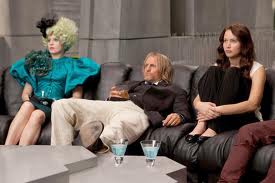
Effie, Haymitch, and Katniss look as bored as I was while watching their movie. Not much happens in the first hour or so. Image courtesy of http://www.collider.com.

The indulgence in establishing Haymitch carries over to other characters, only their purposes remain enigmatic for the uninitiated. For example, who exactly is Effie Trinket and what does she do, other than wear grotesque 1940s-inspired skirt suits? Introduced as a villain at the Reaping, she appears to be part of District 12’s trusted team. But there is no explanation or demonstration as to why or how she can make this transition. Moreover, Cinna (Lenny Kravitz) doesn’t have a clearly defined role, either. I assume that he’s merely a stylist, choosing for Katniss dresses that shoot fiery flames out of their skirts (so that she comes across as both dangerous and, well, hot). Apparently, Kravitz’s casting in this part angered many die-hard fans of the books, because he doesn’t physically conform to the Cinna of their imaginations. Meaning: they were disappointed that Cinna is played by a black man. Since Cinna is given so little to do, I don’t understand how anyone could get upset by that. If anything, the filmmakers should have cast someone who can act. Of course, one solution to this problem (that Cinna needn’t have even appeared in the film), however, is impossible: Cinna, in order to appease the fans, just has to be there.

Speaking of dresses that “light” up, let’s discuss the schizophrenic production and costume designs. As I previously mentioned, District 12 is so depressed as to be imprisoned in another century. When Effie, so far the only blatant anachronism in District 12, escorts Katniss and Peeta onto the bullet train, we ogle the 1930s interior design of the space, which coincidentally is one of the best sets. Side note: it is telling that they don’t fly to the Capitol, for the train is historically a potent symbol for modernity. Unsurprisingly, it literally transports them to another era. And what do we find at the Capitol upon arrival? As you peer through the poor visual effects, trying to make sense of the setting, you glimpse traces of Washington, DC (there’s a Mall with a reflecting pool) and vaguely neo-classical postmodern architecture. Honestly, it looks like a fascistic version of any and all representations of the mythic underwater civilization Atlantis (and maybe the Bahamian resort, too). The hordes of people gathered to watch live TV interviews are clearly dressed to go to a rave, decked out as they are with neon-colored clothes and hairstyles. There may have been glow sticks, I can’t be sure. One of the Games commentators/TV interviewers, Caesar Flickerman (Stanley Tucci), wears glittery suits and purple hair pulled up into a ponytail. Since everyone looks utterly ridiculous (and has an incredibly stupid name), it’s difficult to take the proceedings seriously, and the routinely oppressed’s struggle isn’t all that palpable. The filmmakers exaggerate both the built environment and the “bizarre” fashions of Panem’s citizens so as to link the inauthenticity of this world to our own celebrity-obsessed and reality TV-centric culture. From an intellectual standpoint, I get it. But as it is executed, it comes across as pained, heavy-handed, and too self-conscious. As if to say, Just look at how horrible these people are. You know, we’re not that much different… There’s nothing wrong with this message, but I’m afraid that because it is so over-the-top yet matter-of-fact, it produces a lot of noise and very little contemplation in the pandered-to viewer.

The Hunger Games being gladiatorial bloodsport, it makes sense that each district’s team rides in on the back of chariots here, in this fascistic square, their long procession resembling the parade of nations that is part of the Opening Ceremony at the Olympics. Image courtesy of http://www.mtv.com.

Despite the book being billed as a treatise on the horrific violence of war, which we send our innocent children to fight in the spirit of freedom (talk about a paradox), the film only spends the last hour or so of the 142-minute running time depicting the Games. (Collins is often reported as saying that the juxtaposition of TV channels showcasing young people alternately competing on a reality TV show or fighting in Iraq and Afghanistan inspired the story.) Instead, so much of it is devoted to the players’ Reaping, training, gaining of sponsorships (I still don’t understand how they work), and winning the audience’s favor. Again, Collins, Ross, and co. highlight how unreal (our) reality TV is through Haymitch’s packaging Katniss and Peeta as star-crossed lovers for the media, especially as we learn about it the same way that Katniss does: watching Peeta confess to Casear Flickerman that winning the Games would be a bittersweet victory. For surviving would mean that his crush would have to have died. For much of the film, they can barely tolerate each other. Katniss holds a grudge against Peeta because he once threw a loaf of bread into the mud as she sat starved nearby in the rain. He resents that she’s a more highly ranked player (scoring 11 out of ten points) and that everyone pays more attention to her. Despite their differences, they support each other during the Battle in the Woods, and in the end, they perform their roles as younger lovers for the pervasive cameras. It’s just, are they only keeping up appearances or do they fall for it, too? It’s an interesting idea, but the filmmakers expend no energy in developing it except in the second-to-last scene when they both enjoy a hero’s welcome (I’ll get to how that’s possible in a moment) and she finds her friend/boyfriend, Gale Hawthorne (Liam Hemsworth), out in the crowd. The expression on her face reads: “Oh shit, I forgot about him.” (And it’s easy to see why: this character consists of so little, he only watches the soap opera that is Katniss and Peeta’s romance unfold on TV and thus exists to make it harder for Katniss and Peeta to really become lovers.)

The movie’s PG-13 rating is really no indication that The Hunger Games tones down the violence implicit in its central conceit. Besides, similarly rated films with graphic displays of violence also get past the censors at the MPAA (language and sexuality are the real sticking points, and that’s a discussion for another time). I don’t seek out film reviews, but since his write-up was sent to my inbox as part of a daily roundup of entertainment news articles that I subscribe to, I read David Edelstein’s, originally published in New York. Horrified that the on-screen carnage of kids killing kids didn’t visibly “devastate” the hungry audience of which he was a part, Edelstein attacks director Gary Ross for framing the children’s inevitable deaths with “restraint” and “tastefulness” (as if that’s commendable!), which according to him, Ross has been praised for doing. I agree with Edelstein to an extent (the editing is fast and uncontemplative), but I still found the brutality of the participants profoundly unsettling: like, for instance, the way one girl shoots Katniss’s attacker in the back with a bow and arrow from far away, not out of solidarity but because killing him is merely a means to an end (killing Katniss).

More than this, The Hunger Games falls short of producing an effective commentary on war. The filmmakers fail to develop any of the Games participants other than Katniss and Peeta (with the lone exception of Rue, played by Amandla Stenberg, who comes to Katniss’s aid in the beginning before being snuffed out herself). And since we can’t even grieve for the fallen children-soldiers, you might ask, What is the point? Really, all we’re capable of, in Edelstein’s words, is this: “When a child dies, we breathe a sigh of relief that the good guys have one less adversary, but we rarely go, ‘Yes!‘” The greatest missed opportunity in this regard involves the character Cato (Alexander Ludwig), who scowls at everyone during training and basks in the glory he has inherited from previous champions who overwhelmingly hail from his District (1). Cato has been gearing up for the event seemingly all his life, and in the end, before he falls back onto the ground to be ravaged by demonic dog-like creatures, he hints to the spectator that he has a form of post-traumatic stress disorder as he indignantly whines, “Killing is all I know!” So just before he falls, we can reflect that he’s been robbed of a proper childhood and is subsequently doomed. The worst of it all is that this is the full extent of the filmmakers’ engagement with the subject of how being trained or programmed to kill has wrecked their psyches. Pitiful.

Katniss doesn’t bury Rue, her sister/daughter surrogate, but she gives her the only funeral any of the children can hope to receive. Image courtesy of http://www.mockingjay.net.

But of course they’re doomed. That’s the exact point of this exercise and the dramatic irony of the oft-spoken motto, “May the odds be ever in your favor.” Because beyond manipulating diegetic viewers’ emotions with stories about Katniss’s sacrificing herself to protect her sister or Peeta’s heretofore unconfessed love for Katniss, the producer of the Games, Seneca Crane (played by Wes Bentley), influences the actions of the participants as if he were a film director (he certainly carries himself like Michael Bay). When Katniss hides out in an unpopulated corner of the playing field, he burns it down so that she runs toward those who are out to get her. The dogs that eat up Cato spontaneously appear thanks to Seneca’s puppet-mastering; he wants to up the tension and kill off Katniss if he can. Most of all, he approves of an explicit rule-change after riots break out in the predominantly black District 2 following Rue’s (televised) death: two people can win the Games so long as they are on the same team. He later rescinds the offer once Katniss and Peeta are the only ones left standing. And here’s where my dad’s rabbi supposedly spoiled the plot: the so-called lovers vow to take their lives rather than follow the renewed rules of the old game. Fearing more reprisals, Seneca allows them to be dually victorious. The scenes which demonstrate how Man has overtaken Nature through computer programming and how Katniss and Peeta repeatedly challenge the rule of law at the Games are of a piece with the central message of The Hunger Games and probably constitute its finest expression: re-evaluate the truthfulness of “reality TV.”

One of the greatest unresolved mysteries of the film is the prize that the winner(s) receive(s). Obviously, living to see another day is rewarding in and of itself, but what do they gain otherwise? Fame? Fortune? At the victory ceremony held at the Capitol, the president of the totalitarian regime, Coriolanus Snow (Donald Sutherland), crowns Katniss, thereby complementing the beauty pageant-like interviews she endured earlier in the picture before the Fight to the Death commenced. Paradoxically, when she returns to District 12 triumphant, she doesn’t reunite with Primrose. (Instead, we see her look out onto Gale, confused.) As a melodrama studies scholar, I couldn’t believe that the filmmakers failed to include such a scene. If we can’t see Primrose embrace her virtuous older sister and perennial protector, then what is the point of her sacrifice anyway? Everyone, including Primrose, knows what is at stake.

This brings me to my final point. Much has been made about Katniss Everdeen as a feminist icon. Writing of the novels, Lauren Osborn of the online zine Vagina claims that, “Katniss—as a fiercely independent, loyal, and capable young woman—stands as a symbol of feminism in modern literature.” I guess she would if your only point of comparison is Bella Swan from the Twilight YA series. In her examination of this year’s female film characters (women and girls alike), Washington Post film critic Ann Hornaday praises The Hunger Games for being one of the satisfying “girl-powered fantasies” to come out recently (on the other hand, she’s disappointed that adult women are not represented as strong or compelling as their younger female counterparts). In my opinion, Katniss isn’t so much a feminist warrior as she is an amalgamation of different idealized femininities. She’s maternal, as she volunteers for the Games to spare her sister from a 100% certain death and mourns the younger Rue. (Later, Rue’s District 2 partner Thresh, played by Dayo Okeniyi, stops short of killing Katniss out of respect for her honoring Rue in death.) Despite her attitude toward the government and the Games, which she thinks makes her totally unlikable, Katniss wins over everyone because of her beauty. That flame-throwing dress works wonders. And if you think her skill with a bow and arrow makes her decidedly unfeminine, think again: she’s an archetypal Amazonian. Romance may not be a priority for Katniss, as Osborn argues, but she is nevertheless at the center of a love triangle, and neither suitor deserves her. Such is always the case.

I couldn’t find an adequate photo of Katniss in her flaming dress, so please pardon the text, though it does say it all, doesn’t it? Image courtesy of http://www.theapod.com.

I give the filmmakers credit for not belaboring how The Hunger Games continues into the sequel Catching Fire. (I swear, everyone is in a tizzy about who will direct it and who will play additional characters with unbelievably ridiculous names.) The scene of Katniss and Peeta’s heroes’ welcome is cut between Seneca’s forced suicide (punishment for having failed to keep the Games under control) and President Snow’s sorrowful glance down on the Capitol from a balcony on high. The film fades to black after he turns his back and steps into the building, subtly portending his downfall. I don’t know much about the other two novels, but I assume that Katniss will lead a revolution against Snow’s highly structured Reign of Terror. Perhaps future installments will be more action-packed and ultimately less boring. Perhaps there will be more to the characters’ social interactions besides a “will-they-or-won’t-they” storyline, preferably along the lines of race and class, which The Hunger Games sets up but barely engages. What I’m saying is, perhaps viewers who have not read the books will be given a reason to give a damn. But I’m not holding my breath.

Long Take: The Crimson Petal and the White Makes for Compelling Feminist Melodrama

Viewed September 12 & 14, 2012

CINE FEEL YEAH is all about the cinema, this much is true. But sometimes it is necessary to cast a glance at moving images more broadly defined. Case in point: director Marc Munden’s BBC Two miniseries adaptation of Michel Faber’s 2002 novel of the same name, The Crimson Petal and the White (2011), is so filled to the brim with less than reputable but intriguing characters, compelling melodrama, and enough symbolism to captivate any humanities major that I just couldn’t ignore it. Besides, the dramatic miniseries neatly fits the bill of one of my favorite subgenres, which centers around (usually historical) women rebelling against the dictated norms of her contemporary society. I caught the four-hour-long program when it aired on American premium cable television earlier this month, divided into two parts rather than its original four, and I cannot verify otherwise if the American telecast differs at all from the British standard. Either way, it is long and slow in some parts, but never so dull as to discourage continued viewing. It is also one of the more cinematic miniseries I have seen, featuring a more modern and eclectic score and a number of dizzying edits that are not the bread and butter of literary adaptations for TV. Before I forget: I have to warn you that I’m going to spoil pretty much everything.

The enviously prolific Romola Garai stars as the infamous teenage prostitute Sugar, but as she warns you in her voiceover narration, she is “far from sweet.” The story takes off in 1874, as she plies her trade at Madam Castaway’s (Gillian Anderson, looking a lot like a redheaded Gina McKee to me), a brothel tucked deep inside the dodgy end of London, where poverty, hunger, and disease persist. After hearing raves about Sugar from his friends who only wish they could have her, the feckless William Rackham (Chris O’Dowd), both the heir to a soap-manufacturing company and an aspiring novelist, seeks out her company. Their unproductive encounter, shall we say (drunk, he passes out and wets the bed before they can even begin), sets everything in motion: from that point on, he is hopelessly drawn to her, eventually buying her exclusivity, then moving her to her own apartment and finally into his family home. Right, I must mention that William is married to Agnes (Amanda Hale), who is psychologically disturbed after enduring years of sexual abuse and trauma. Don’t jump to conclusions too quickly there; I will discuss this subject in due course. There is a robust cast of supporting characters, including William’s pious brother Henry (Mark Gatiss), the reformer of prostitutes and tuberculosis sufferer Mrs. Fox (Shirley Henderson), and Mrs. Fox’s brother and Agnes’s physician, Dr. Curlew (Richard E. Grant).

But The Crimson Petal and the White belongs to Garai and, to a lesser extent, O’Dowd. I have watched the English actress seemingly grow up on-screen, and I haven’t always been a fan. Though I love I Capture the Castle (Tim Fywell, 2003), I freely admit that Garai’s central performance is sometimes unpolished, but she has consistently gotten better in everything she has done, from Angel (François Ozon, 2007) to The Hour (2011-present). I don’t wish to be so gushy, but she really excels as Sugar, particularly in presenting her as a confident and pragmatic woman who starts out with ambiguous intentions but eventually earns our sympathy completely by miniseries’ end. It’s a bravura performance. As for O’Dowd, it is strange to see him in a non-comedic role, and in a costume drama to boot! I almost always find him a likable (OK, adorable) countenance, but because his character develops negatively, he gradually becomes less and less attractive. William is pompous, sexist, vulnerable, and brutish.

I haven’t read the book (all of its 800+ pages), so I cannot comment on it, but The Crimson Petal and the White reminded me of certain classic works of English literature and their own screen adaptations, including Jane Eyre by Charlotte Brontë, Tess of the d’Urbervilles by Thomas Hardy, and pretty much anything by Charles Dickens, for it is a coming-of-age story about upward mobility (albeit centered on a woman who doesn’t achieve it). The comparison to Jane Eyre is obvious enough: our heroine enters a household to work as a governess for the child of her lover; who cares if she’s a prostitute and knows the mad wife already exists? William is no Rochester. He’s more like Alec from Tess, as he throws out the woman he seduces and impregnates. Through displays of moral courage and indescribable suffering, Sugar, like Tess, is redeemed. And let us not forget that the title comes from Alfred, Lord Tennyson’s poem “Now Sleeps the Crimson Petal,” which at one point Sugar reads aloud to her charge. I am no expert on poetry, but I think its stanzas speak to the dualism of Sugar’s and Anges’s lives.

The miniseries, and presumably Faber’s tome, is undoubtedly feminist, as it deconstructs how prostitution manifests in many different forms. And I don’t just mean as a comparative analysis of the various hierarchical venues that Sugar inhabits (i.e. the brothel and seedy taverns, the kept apartment, and finally the family home where she works as a governess and serves as William’s mistress and secretary). The Crimson Petal and the White, as adapted by Lucinda Coxon, makes clear that marriage is also a kind of prostitution, and this point is explicitly made through the juxtaposition of Sugar’s and Agnes’s individual experiences.

Whereas Sugar is sexually mature, having been pushed into prostitution at age 13 by her own mother (that’s right, Mrs. Castaway herself! but don’t worry, I haven’t spoiled anything you don’t learn within the first 80 minutes) and gained years of experience in giving men exactly what they desire, Agnes is sexually immature. She is locked in a young, almost prepubescent state, signified by her blonde ringlets, constant nightie-wearing, and, most importantly, fevered anorexia, which curtails her regular menstruation. On top of it all, becoming a mother eight years prior profoundly scarred Agnes’s psyche, so much so that she cannot accept that she ever gave birth in the first place. Thus her postpartum depression is so severe and permanent that William ensures that Agnes never sees their daughter, Sophie (Isla Watt), whom he keeps in another part of the house. Dr. Curlew visits Agnes weekly, using physical examinations as a pretense for violating her body. Ascribing a poor and poorer prognosis surely keeps up appearances, but it is also accurate. Agnes must get worse before she can ever get better.

Long before William set Sugar up her in own flat, she shadowed the man she did not yet trust, to his work and his home. (How ironic it is that he should own a soap-making factory, given his indiscretions.) One day, when Agnes looks out the window and finds Sugar on the street, staring back at her, Agnes becomes convinced that the stranger is her guardian angel come to rescue her (the small feathered wings stitched onto Sugar’s leather jacket help lend this impression). Once William confides in his mistress that his wife is having such delusions (obviously unaware that Sugar is Agnes’s “angel”), Sugar begins to interact with Agnes, either from a distance or on the condition that Agnes not look at her face. Things come to a head when William employs Sugar as Sophie’s governess and the women come face-to-face, usually when Agnes is in distress.

A shut-in from society, Agnes looks out her window and looks for her guardian angel, whom she doesn’t know is actually her husband’s mistress. Image courtesy of http://www.isserleylovesbooks.tumblr.com.

Out of pity (not jealousy), Sugar comes to Agnes’s aid and plots Agnes’s flight in the middle of the night. By this time, William has turned inattentive and cruel, and so I view Sugar’s planning Agnes’s disappearing act as one made out of female solidarity. Perhaps Sugar once wanted to replace Agnes, to bear William the son and heir he always wanted, but it’s clear that William’s raping Agnes one evening, to Sugar’s horror, encourages her to break Agnes out of the prison that is her marriage, which has traumatized her for over eight years and caused her to lose her mind. Thankfully, Agnes flees just in time, before William and Dr. Curlew have her committed. While letting a mentally disturbed woman loose unto the world may be inadvisable, Sugar’s determination to help is unambiguously romantic, possibly even an expression of her own desire to escape. Later, through a case of mistaken identity, William is led to believe he is a widower, and only Sugar knows that the river-ravaged corpse that washed ashore can’t possibly be Agnes because she cut her hair short before departing without a trace. The miniseries ends with no update on Agnes’s whereabouts, again lending a romantic air to Sugar’s emotional and intellectual attachment to Agnes and her gender struggle.

There is never any doubt that Agnes is a pathetic character and therefore deserving of our sympathy. On the other hand, before Sugar fulfills her promise as a guardian angel, she presents a more complex portrait. Having taught herself to read and write, Sugar keeps what she calls a “Hate Book,” which is either a tell-all memoir or a semi-autobiographical novel—it’s hard to say. She fills it with fantasies of exacting revenge on the men who have taken her innocence, and even as she gets to know William she conjures scenes in which she slits his throat or stabs his chest. Although it is clear that these are just her imaginings, the spectator might begin to wonder just what she is capable of. It is only after he takes Sugar away from Mrs. Castaway’s and encourages her to counsel him on business affairs that she begins to see her new client differently (he grants her more space and power than any other has ever done). That Sugar’s livelihood, particularly once William buys exclusive rights to her body, allows her time to write in the “Hate Book” is in stark contrast to William’s fledgling literary career. At Sugar’s urging, he throws himself into his job at the soap factory, choosing to express his masculine identity not through words but through accumulating wealth. More crucially, the “Hate Book” represents an escape, and it is telling that Sugar gives up writing in it as she becomes ever more entrenched in William’s family life, especially as Sophie’s governess. This leads me to the final point of comparison between Sugar and Agnes: it hinges on motherhood.

As I have already described, Agnes is literally unfit to be a mother. Her fragile emotional and mental state won’t allow it, and in her absence, Sophie has been reared by a strict disciplinarian nurse named Miss Cleave (Wendy Nottingham). When Sugar moves into the house and assumes her duties as governess, her predecessor warns that Sophie is a horrible, manipulative child. Nothing could be further from the truth. Within a minute, Sugar understands that she will look after Sophie differently; it’s clear the outgoing woman never gave Sophie a chance and shares William’s view that it is pointless to educate girls (then what does that make you, Miss Cleave, eh?!). In short, Sugar and Sophie form a tight bond, Sugar acting as both the mother Sophie never had as well as the mother she wishes she herself had. In case Sugar’s empathy towards Agnes doesn’t fully redeem her character, her devotion to Sophie does. When they profess their love for each other, it is the only time either one has ever heard those words spoken to her. But then their love is thrown asunder. Late in the miniseries, William casts Sugar out of his home and his life when he learns from Dr. Curlew that she is with child. Desperate, she takes Sophie with her. And that is how it ends.

Sugar and Sophie. Image courtesy of http://www.neovictorianthoughts.wordpress.com.

I am not crazy about Sugar’s kidnapping Sophie. I feel this way not only because she has committed a crime, but because this conclusion reaffirms that (even a fallen or, in Sugar’s words, “pushed”) woman’s role is as mother. Perhaps this is too harsh, given the emotional and psychological torment that biological motherhood bestowed upon Agnes, which was aggravated by the men’s sexual mistreatment of her. After all, she abandons her child forever when she makes way in the night, so being a mom isn’t for everyone. Moreover, I sure am glad that The Crimson Petal and the White doesn’t end tragically, with Sugar dead, say, and by William’s hand no less. In fact, I rather like the actual terms through which Sugar and Sophie’s escape takes place. Sugar tells Sophie to pack for an “exploration,” thereby echoing an earlier scene in which the budding cartographer Sophie asks if she can grow up to be an explorer. “I don’t see why not,” Sugar, ever the retroactive feminist, tells her. Sophie, who at age eight understands she is a second class citizen by virtue of her sex, assumes then that she will only be able to explore places that men do not or will not go to. How can I argue with this kind of language? While technically Sophie won’t be as materially well off as if she were still at home, there is no denying that she will be better loved and raised by Sugar. It is also noteworthy that in the final scene, as they wait for a train to take them far away, Sugar begins to write again, this time on a new pad of paper (the wind blew away pages from the “Hate Book” in their escape and they wind up in William’s befuddled possession).

I didn’t have much use for the subplot involving a tentative romance between Henry Rackham, William’s older brother, and Mrs. Fox of the Rescue Society. It does, however, serve to show that men are so easily crippled or undone by their (repressed) sexual passions. (Henry cannot reconcile his lust for an ailing Mrs. Fox with his desire to become a clergyman and so dies in a fire while fantasizing about her.) Women, on the other hand, are stronger and more resourceful, as evidenced by Mrs. Fox unexpectedly making a full recovery from consumption. As Dr. Curlew’s sister, she also points out how members of the same family can be advocates of diametrically opposed causes: he devotes his time to molesting his female patients while she selflessly labors to rehabilitate women and girls away from their previous lives of sexual exploitation. If only she knew of her brother’s misdeeds.

The Crimson Petal and the White isn’t only graphic in terms of representations of sexuality, it doesn’t pull punches when it comes to bodily functions either. That is, it doesn’t shrink from showing us what bathing, going to the bathroom, and miscarrying might have been like for women in the late nineteenth century. In fact, the scenes in which Sugar, having lost all hope in a future of wedded, familial bliss with William, fails to induce an abortion, first by administering chemicals and next by flinging herself down the stairs, are particularly harrowing. Later, when she hemorrhages at William’s soap factory in front of Sophie, it is a truly gut-wrenching sight. But there still is a sense of relief. And this is all of a piece with the filmmakers’ commitment to impressionistic realism. I know this might sound like a contradiction in terms, but I use “impressionistic” to clarify that the brutal realities of Sugar’s and William’s Londons are filtered through her unique perspective, steeped in abjection and ambition. Also, there is something refreshing about Sugar’s scars, undoubtedly the result of abuse at the hands of her former clients, always being on display, along with patches of irritated skin and her chronically chapped lips. It reminds us that living is hard, and this is especially the case for the sexually exploited.

Quick Edit: What is There to Learn From A Price Above Rubies?

Viewed September 8, 2012

I love movies about women who defy societal expectations, who refuse to conform to the gender role they’re supposed to play without question, and who fight for their own political and financial autonomy. I’ve noticed that an inordinate number of my personal favorites in this subgenre is set in the past and therefore retroactively feminist, including Dangerous Beauty (Marshall Herskovitz, 1998) and Shakespeare in Love (John Madden, 1998). And so I went into Boaz Yakin’s A Price Above Rubies, also from 1998, with pretty high hopes that it would emotionally and intellectually satisfy me just as well. I had wanted to see this film for years, long believing it wasn’t available on DVD (until I recently discovered this isn’t the case), and when I randomly caught on cable a pivotal scene in which the heroine pushes back against her devout husband and a religious leader, I knew two things: first, I must DVR this picture when it airs again, and that if this scene is anything to go by, the rest of A Price Above Rubies has got to be awesome.

The truth is, I wish this were actually the case. The sophomore effort from Yakin, who made a critical splash with his ghetto-based crime debut, Fresh (1994), and has since moved on to write and/or direct action movies such as this year’s Safe (yes, really), A Price Above Rubies is rough around the edges, strange and slightly confusing. More crucially, however, though Renée Zellweger as Sonia is easy to root for, it’s her situation that is poorly developed. Spoilers to follow.

Sonia Horowitz, the daughter of a prominent ultra-Orthodox Jewish jeweler does her parents proud, having married a rising scholar at the Yeshiva named Mendel (Glenn Fitzgerald). When we meet her as an adult, she gives birth to a son, whom Mendel insists they name after the rebbe (the leader of their Hasidic community) rather than her deceased brother Yossi. Following the infant’s emotionally traumatic bris (for Sonia, that is), the young family moves into a Hasidic community in Brooklyn to be nearer Mendel’s extended family and the Yeshiva. Stifled by postpartum depression, Mendel’s obsessive study and inattention to her needs, and a crisis of faith that makes her blood boil, Sonia struggles in her role as stay-at-home mom. Then, one day, Mendel’s sinful older brother, Sender (Christopher Eccleston), invites her to run his jewelry shop nearby. The promise of being able to travel, to buy pieces from jewelers all over Manhattan while exercising her exacting eye for evaluating gemstones, is just the kind of liberation she desires. As such, her business dealings bring her into contact with people outside the incredibly insular community, and one liaison in particular wreaks havoc upon her marriage and familial relationships.

From the get-go, the film comes across as amateurish, like a made-for-TV movie, complete with a hokey, melodramatic score. Alarmingly, the first ten minutes or so also traffic in many Jewish stereotypes, which thankfully recede as the narrative marches on. In the prologue scene set when Sonia is a little girl, she listens to her beloved Yossi (Shelton Dane) tell a bedtime story that takes place in—you guessed it—the shtetl. In another early scene, which incidentally introduces the Hasidic community and establishes Sonia’s uneasiness with her religion and culture, she resents having to stand by and watch her son’s ceremonial circumcision from afar. Furthermore, the characters’ identities are laid on thick through their unambiguous and broad New York Jewish accents. We can’t fault the filmmakers for shooting in English, for it is more accessible and infinitely more commercial than Yiddish (which is the language most ultra-Orthodox Jews speak), but the actors do sound ridiculous.

But why is A Price Above Rubies so strange? It’s sexually confused, for one thing, leading me to believe that Yakin can’t empathize with Sonia’s sexual frustration. Sex with Mendel is passionless because he doesn’t want to offend god with any impure thoughts or actions. Then, a little later on, as Sonia suffers from a particularly severe panic attack, she kisses Mendel’s pushy sister Rachel (Julianna Margulies) as she tries to soothe her. In this moment, you might think Sonia is unfulfilled because she is a lesbian. Not so, and it remains a mystery as to why she hit on her sister-in-law.

Moreover, there are elements of magical realism that don’t quite fit. Following their uncomfortable and perplexing sexual encounter, Rachel takes Sonia to meet with Rebbe Moshe (John Randolph), to whom she relates that she’s convinced the intense burning sensations she’s felt all her life indicate her body contains no soul. Later, it’s revealed that her passionate confession caused the rebbe not only to amorously seek out his long-suffering wife but to also die in the midst of their love-making. For igniting this fire in her husband, the rebbe’s widow (Kim Hunter) is eternally grateful to Sonia. I know what you’re thinking, and that’s not all! Sonia hallucinates throughout the film, imagining Yossi is at her side while she eats a non-kosher lunch in a Chinatown park and when Mendel eventually kicks her out of the house for her supposed indiscretion (more on that in a moment). She converses with Yossi as well as with a beggar woman (Kathleen Chalfant) who impossibly follows her all around the city. It’s unclear if she only appears to Sonia, but notwithstanding one interaction with another woman, I believe the beggar lady is supposed to be a figment of Sonia’s imagination. But this isn’t the only instance of narrative confusion. In fact, there’s a lot more.

For instance, Sonia’s motivations are sometimes unclear. She doesn’t so much as embark on a love affair with her brother-in-law/employer, Sender, as she allows him to take advantage of her sexually. It’s clear in their early scene at the family seder that they have a powerful connection (his touch sends her into a tizzy) because they’re both more cynical than their devout family members. And so it’s awesome that Sender rescues her from the doldrums of her everyday existence with a business proposition. But it’s genuinely disturbing that Sender essentially rapes her before he leaves and she allows this behavior to continue long after the fact. At first, I hesitated to call it rape, but as we should all know by now, “rape is rape.” It may appear as if she consents to his sexual aggression willingly (and maybe she does because she wants to feel something that her husband doesn’t provide), but I think it’s more an expression of her subservient position which has been culturally ingrained in her and other ultra-Orthodox women she knows. Anyway, I kept wondering why Sonia, who we’re supposed to believe is strong-willed and desirous, would consent to such an arrangement. Does she honestly believe that it—their affair and the sex itself—will get better? When she finally comes to her senses and realizes, after she’s been ostracized, that she will never be free so long as he demands favors from her for protection, I couldn’t help thinking, This is all too little too late.

But just why is she ostracized, you ask? Well, already alienated by Sonia’s lack of faith in their religious leaders (she says at marriage counseling officiated by a rabbi that he has no right to tell her what she should think or do), Mendel asks Sender to trail her, and so he vindictively spreads the rumor throughout the Hasidic community that Sonia is having an affair with a Puerto Rican in the Bronx. Obviously, this is not the case. Ramon (Allen Payne) is merely a sculptor and jewelry designer whose pieces are among the most beautiful she’s ever seen, especially an intricately carved 22-karat gold band with an open setting for a gemstone. She spends a lot of time in his basement workshop after she commissions and sells his work (which he labels a mere “hobby”). To make a long story short, everyone—starting with her husband—excommunicates Sonia overnight: Mendel changes the locks on the door, and Rachel refuses to hand over her son and warns Sonia that her own mother has disowned her. Sender welcomes her to a Lower East Side apartment where he can keep tabs on her (this is when she finally refuses his form of “freedom”), so she winds up squatting for a few hours with the beggar woman before the vision of Yossi leads her to Ramon’s, where she falls into his arms and into his bed. But even this illicit tryst produces few fireworks. In fact, when Ramon, who was skeptical of Sonia just the other day, confesses that she is his elusive muse and leans in to kiss her, I couldn’t believe it. (I thought Ramon was gay, anyway!)

More problematic, however, is Yakin’s rushing this conclusion. Why is he so hellbent on establishing Sonia’s abject position literally overnight—only for Mendel to undo it the next morning? A Price Above Rubies ends on a more optimistic note because he invites her to visit their son often, even as she figures out her next steps (she’s not staying with Ramon, that much is clearly stated and in its utterance, supposedly breaks Ramon’s heart). This softened resolution leaves the wrong impression: it says that the shunning was only painful for one night and gives false hope that the community will be more accommodating than we’ve been previously led to believe.

The title refers to a biblical quote that Sender recites atop Sonia, post-coitus. The gist is that women of fortitude, who, of course, obey their husbands, are worth more than precious jewels. Through her rebellion, to achieve a sort of personal virtue and integrity that is at odds with ultra-Orthodox Judaism, Sonia pays “a price above rubies” for her freedom, which indexes not only humiliation and excommunication but also the forced abandonment of her child (she never cries over this, mind you). During their reconciliation, Mendel gifts her a ruby, her birthstone, which during the end credits fits neatly into Ramon’s band in extreme closeup. Neat, right?

Although A Price Above Rubies boasts some strong performances, particularly from Renée Zellweger, I had a difficult time understanding just what I am meant to get out of the film. As I stated before, Sonia is a very sympathetic character, but her journey is poorly conceived and realized. I wish she had been led on another path, because it’s too convenient for her to find a fledgling romance with Ramon—and wholly unnecessary. While the script delves into ultra-Orthodox Jewish life, the magical realist element keeps it at a distance, and Sonia’s childhood trauma (the loss of her brother) should have been explored more, for after all it precipitates her crisis of faith and identity. Too bad the feminist struggle I was looking for was just so damn fleeting.