Why I’m Not Seeing The Dark Knight Rises This Weekend

This being a movie blog, I thought it necessary to address the mass shooting that took place Thursday night at a midnight screening of The Dark Knight Rises (Christopher Nolan, 2012) in suburban Denver, Colorado. A lone twenty-four-year-old gunman named James Holmes shot and killed twelve people, wounding at least 58 others, including people as young as only a few months old. In the rush of news updates, these estimates are subject to change, and soon I suspect we’ll learn more about the movie-going victims.*

My nightly ritual consists of watching ABC World News with Diane Sawyer and NBC Nightly News with Brian Williams, and each news program dedicated last night’s episode to coverage of the horrific event and its aftermath. They were both hard to watch for a number of reasons, chief among them the featured amateur cellphone video of blood-soaked people exiting the multiplex and the repetition of terrifying eyewitness accounts. Tears welled up in my eyes, and sometimes I angrily shouted at the TV. Why did you bring your little children to a midnight movie screening? Why this movie in particular? I feel ashamed for so harshly judging people I don’t know personally, and I am thankful that Holmes’s attack didn’t produce even more casualties. I also couldn’t help but wonder, how could his mother, apparently a psychiatric nurse, reportedly say, upon first hearing that her son has been arrested, that the authorities indeed have the right man? She possibly knew he was capable of such an atrocity and never thought to alert anyone that her son is a potential threat to society?

It has been widely reported that Holmes either dyed his hair red or wore a red wig to mimic Heath Ledger’s portrayal of The Joker in The Dark Knight (Nolan, 2008), that he even announced—to the unassuming crowd watching the movie in Theater 9 before he started gunning people down and/or to the arresting police officers—that he was The Joker. Again, we won’t know the truth behind these details as everyone is still corroborating testimonials and processing exactly what happened. So it remains unclear what the relationship is between this hotly anticipated movie and Holmes’s intentions to massacre people. I agree with Roger Ebert, who wrote yesterday in The New York Times that Holmes more likely perpetrated his deadly actions in order to garner fame, infamy, or some twisted recognition rather than act out a movie-inspired fantasy. Seeing how the TV news media responded, devoting whole programs to “Tragedy in Colorado: Movie Theater Massacre,” makes me cringe, too. They’re just giving him what he wants, and they’re sensationalizing, I thought.

But I know one thing for sure, and it took me a while to make this realization: I won’t be going to see The Dark Knight Rises this weekend, and in fact, I’m not sure when I will feel comfortable going to the theater to do so.

I’m not a big fan of Christopher Nolan’s Batman trilogy; his movies are long, pretentious, and moralizing. However, I had thought I was going to see it because, as I have previously stated, I am interested in what people go to see. I do want to be part of a larger conversation. How could I justify standing on the sidelines, lambasting so-called mainstream audiences’ tastes in movies, if I don’t watch them, too, to form my own informed opinions? (The Dark Knight Rise‘s first controversy this week involved movie aggregator site Rotten Tomatoes having to shut down their comments section because fans who hadn’t even seen the film yet were bullying or threatening film critics who published negative reviews.) A dear friend of mine tried unsuccessfully to convince me to go to a midnight screening; I had no desire to see a 164-minute-long movie at that hour in a packed, claustrophobic theater. Besides, I told him, so many special screenings are sold-out or nearly sold-out, making it more difficult to secure tickets. Despite the Colorado tragedy, the movie has grossed over $30 million from midnight screenings alone, and it remains to be seen how its grosses will eventually be made public since its distributor, Warner Bros., and other movie studios have pledged not to report the numbers out of respect for the victims and their families.

The main reason I’m not going to see the movie is because I think it will be too traumatic an experience. I cannot imagine what the people in Theater 9 have gone through, but I am certain that I won’t be able to concentrate on the film unspooling on-screen because I will be thinking about how all those innocent people eagerly attended a movie they’d been waiting months—maybe years—to see, at first perplexed that one cinemagoer seemed to perform a movie stunt tie-in at the front until it became clear what his true intentions were. I echo the film director’s sentiment, released as a public statement: “The movie theatre is my home, and the idea that someone would violate that innocent and hopeful place in such an unbearably savage way is devastating to me.” I have even written a short essay about my love of going to the movies, getting lost in the dark amid celluloid shadows and strangers. The piece is for a humor writing contest, and I have yet to submit it. I’m a little apprehensive to turn it in without mentioning what happened in Colorado, even if my memories of movie-going are overwhelmingly positive—funny even—and have nothing to do with the violence of the theater.

Truth is, I don’t know when I will be ready to go to the theater to see any movie. It’s all still so raw.

Some have expressed concern that this will negatively impact The Movies (Rebecca Macatee of E! Online is already labeling the newest Batman sequel a “would-be blockbuster,” given what’s transpired). I don’t think most people who have really wanted to see The Dark Knight Rises will stay away. All the power to them, I say. We cannot let one crazed man’s fatal attacks deter us from doing the things we love. We cannot live our lives in fear, to paraphrase Barry Otto in Strictly Ballroom (Baz Luhrmann, 1992). We should pressure President Obama and his Republican challenger Mitt Romney to address the issue of gun control while on the campaign trail, as their tepid expressions of sorrow and compassion are not enough. (Their track records on the issue are not comforting if we’re looking for change, either.)

When it comes to Hollywood and cinema more generally, I do hope that studios, producers, and filmmakers reflect on their storytelling practices and recognize that they could make some changes, too, beyond re-editing the trailer for The Dark Knight Rises and yanking TV spots and trailers for it and the upcoming Gangster Squad (Ruben Fleischer, 2012), which features a scene involving men powering machine guns through a movie screen, firing on the audience. I am not blaming anyone for what happened in Theater 9 other than James Holmes, but the fact that violence is so permissible in movies, often glamorized or sensationalized, is a cultural problem. Many of us have become anesthetized to graphic representations of violence, accustomed to watching people, buildings, cities, and even the world blow up on-screen. Ninety-nine-point-nine percent of us know that this is not real, but there are those who might fetishize these images and seek to replicate them in the real world because the consequences of violence are barely ever the subject of sustained cinematic inquiry. One recent example of this more desirable filmic exploration comes to mind, though: Lynne Ramsay’s stark, impressionistic portrait of a mother coming to terms with the attack her teenage son perpetrated at school in We Need to Talk About Kevin (2011). It is a challenging, beautiful movie, and I guarantee it will stick with you. If more films addressed the viscerality and destructiveness of violence, perhaps they would remind us all that it is never cool, never something we should wish to emulate.

* The New York Times has just published (circa 10.30 pm on Saturday, July 21st ) the names of the twelve victims as well as the first in-depth attempt to get a handle on James Holmes’s character.

A Teachable Moment: “Old Movies” and “Millennials”

Sherlock Jr., directed by Buster Keaton (1924). Image courtesy of Not Just Movies, accessible at http://www.armchairc.blogspot.com

My sister just brought to my attention a Los Angeles Times op-ed piece by the film scholar and cultural critic Neal Gabler entitled “Perspective: Millennials seem to have little use for old movies.” In the essay, Gabler argues that with the popularity of new technologies such as social networking sites and the capability of streaming movies on smartphones and iPads, young Americans only focus their attention on movies of “the here-and-now.” While I don’t disagree with the author’s over-arching commentary, I do take issue with some of Gabler’s points, both major and minor.

First of all, no matter how much I hate the term, I am a “millennial.” Or so I have been told. But because print journalists, TV news anchors and reporters, marketers, and others rampantly use this word to signify a generation, as if “millennial” is self-explanatory, it’s less clear who really belongs to the group. According to that trusty old Internet repository of information known as Wikipedia, those born between 1983 and as late as 2000 or 2004 are by-and-large considered “millennials.” However, to suggest that my coming-of-age is the same as an eight-year-old’s is just plain insulting. We don’t have the same frames of political and historical reference, and we certainly do not share the same taste in movies, music, books, and information sources. Although Gabler uses that nebulous term somewhat reluctantly (“so-called millennials”), he never seeks to define it for his argument beyond implying that “millennials” are students in high school and graduate school, as he quotes instructors from each setting who lament that their students find “old movies” obsolete.

In fact, I was stunned to read one such person’s observation. According to Gabler,

“A friend of mine who teaches in the New York University Cinema Studies graduate program told me he was appalled at how little interest his students—future critics and film scholars, no less—had in old movies. For them, ‘classics’ are movies made in the last five years, and Scorsese is like Washington or Lincoln: ancient.”

I am a 2011 graduate of this very program, and so naturally I am curious as to who Gabler’s curiously anonymous friend is. But more importantly, based on my experience, this description of the Cinema Studies culture at NYU could not be further from the truth. Understandably, it is one man’s opinion, but I can tell you that an overwhelming number of my cohorts were only interested in “old movies.” For example, a friend of mine, a lover of Katharine Hepburn-Spencer Tracy star vehicles, pretty much looked no later than 1967 for motion picture entertainments. I can’t even talk about movies that I watch with an even closer friend because movies in color barely register with her. She has no idea what is playing in theaters, and she is happy to repeatedly screen and discover lesser known gems from the silent era and Japan.

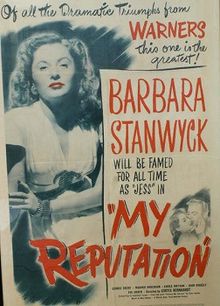
I like to consider myself a film historian of the contemporary moment because I am interested in how people—critics and audiences—respond to what is produced today. However, the education I received at NYU certainly deepened my appreciation for Classical Hollywood Cinema, or movies made during the studio era from roughly 1915 to 1965. That includes silent features, B&W pictures, and genres such as the film noir, western, melodrama, and musical. Now that I live at home, equipped with some premium movie channels, I can supplement what I have learned by enjoying Turner Classic Movies all day, every day. (Wow, that sounds like an advertisement!) For instance, a couple of nights ago, I caught my favorite “classic” leading lady Barbara Stanwyck in My Reputation (Curtis Bernhardt, 1946), and I recommend it for her performance as a widow tentatively embarking on a new romance, family and friends be damned! Who says young people, particularly future film critics and professors, don’t like “old movies”?

According to Gabler, “rank-and-file millennials… find old movies hopelessly passe—technically primitive, politically incorrect, narratively dull, slowly paced. In short, old-fashioned.” Does this mean that he thinks those who go on for advanced degrees in film history and theory are “rank-and-file millennials” since such students are apparently disinterested in “old movies,” too? Besides, he’s also forgetting one of the golden rules about film production and consumption: it’s the story that counts. I, for one, will watch anything so long as the story interests me. It doesn’t matter if it’s in B&W, with actors I don’t recognize, or in a language I don’t comprehend. The way I see it is, every film presents an opportunity to broaden your horizons, and so closing yourself off to what is “old” limits your interaction with history as well as the present moment. After all, we wouldn’t be where we are today if it weren’t for the storytellers who made films about us before. Thus, I shake my head in disbelief when Gabler writes that another university professor told him that his students found Orson Welles’s 1941 game-changer Citizen Kane “antiquated.” Perhaps it’s not the films so much as the instructors’ teaching methods that students can’t relate to. How can you fail to impart upon a willing audience how important Citizen Kane is within the history of film? Keywords for that lesson might include “deep-focus long-takes,” “Rosebud” as “MacGuffin,” “William Randolph Hearst and Marion Davies,” and Welles’s anti-fascist theater troupe.

I love hyperbole as much as the next girl, but it is ridiculous to suggest, as Gabler does, that young people think that any movie not of the current moment is “classic” or “old-fashioned.” I don’t think social mores and aesthetics change so rapidly that young people can no longer relate to movies that came out five years prior. Perhaps Gabler would do well to direct his ire at movie studio executives and their resistance to changing their out-dated business model rather than the young people who see the movies that are aggressively marketed to them. Since his whole argument is premised on the fact that this summer’s The Amazing Spider-Man (Marc Webb, 2012) is a reboot of Sam Raimi’s trilogy, which began no less than ten years ago and wrapped up in 2007, I would recommend that he read Claude Brodesser-Akner’s matter-of-fact account of how rebooting superhero movie franchises works. It is as cynical as you think.

And what is with Gabler’s insistence that young people today “don’t seem to think of movies as art the way so many boomers did”? How can he know this, especially when he acknowledges there are no known studies that “examine the relationship of millennials to old movies”? Instead, he suffices to argue that films are thought of as fashion since what is new captures people’s attention more anything that is even just a little bit behind the times. What he calls “cinematic ageism” here I would label “presentism,” which is really no different than the biased, time-sensitive perspectives on any medium, which, to Gabler’s credit, he also points out is “the natural cycle of culture.” Combating presentism isn’t easy, but last year offered two high-profile attempts: both Martin Scorsese’s Hugo (2011) and Michel Hazanavicius’s The Artist (2011) sought to educate modern-day audiences on the pleasures of silent cinema by using unconventional storytelling methods (3D projection in the case of the former and the silent, B&W form of the latter). Remember, a good number of Hugo‘s theatrical spectators had to have been families, considering its built-in audience were fans of Brian Selznick’s children’s novel The Invention of Hugo Cabret.

Switching gears: toward the end of Gabler’s editorial, he argues that the immediacy of social networking updates precludes old movies from making a lasting impression on millennials since even new movies may become quickly passe through the form’s emphasis on what it is now. While it doesn’t seem that he is hostile to the idea of movies—however new—being part of an “ongoing conversation” on sites like Facebook and Twitter, Gabler is wrong to assume that it is impossible for an “old movie” to have a presence in these online avenues of communication. Obviously, examining these constantly updated “news” feeds is damn near impossible, but I am positive that at least some young Americans regularly evaluate, dissect, and debate with their online (and real!) friends what they have seen and what they will see, “old movies” included. Moreover, I’m hardly the only movie blog author who casts her gaze on pictures that are not of the current moment. But if I’m writing about them, how are they not part of the contemporary conversation, even if I publish on the margins?

Furthermore, Gabler has a point that our culture’s predilection for viewing films on screens that do little to enhance their narrative or architectural scope is problematic, but I don’t think this practice means that old movies are doomed to extinction. After all, so long as film studies programs endure at the university level and expand for high school students, “old movies” will always be a part of the curriculum for reasons I’ve already elaborated. Motion pictures are little over a century old, and they have been considered an art-form for even less time. Even the most cinephiliac among us have in no way seen more than the tip of the iceberg. The biggest threat to the legacy of “old movies” is the lack of compassion and funds for films that are in need of preservation. Of course, instilling a love for movies—particularly “old” ones—among “millennials” will help ensure our continued fascination with these pieces of (film) history. But how can we tackle this dilemma?

Right now, the future of film appreciation rests on the knowledge and talents of those who educate on topics related to film. I truly believe that if you are passionate about something and you can make even the most distant part of life, whether in terms of time, culture, or geography, relevant to someone else, then you are at a distinct advantage to effect change in that person’s thinking. In other words, if film scholars, critics, and historians can impart to students the significance of movies old and new, then these pupils will be empowered to turn on others with their own enthusiasm. Film, as an art and a business (just like fashion), marches on because there are always those who take notice and direct other people’s attention.

P.S. Happy Birthday to Barbara Stanwyck! She’d be 105 today.