Long Take: The Crimson Petal and the White Makes for Compelling Feminist Melodrama

Viewed September 12 & 14, 2012

CINE FEEL YEAH is all about the cinema, this much is true. But sometimes it is necessary to cast a glance at moving images more broadly defined. Case in point: director Marc Munden’s BBC Two miniseries adaptation of Michel Faber’s 2002 novel of the same name, The Crimson Petal and the White (2011), is so filled to the brim with less than reputable but intriguing characters, compelling melodrama, and enough symbolism to captivate any humanities major that I just couldn’t ignore it. Besides, the dramatic miniseries neatly fits the bill of one of my favorite subgenres, which centers around (usually historical) women rebelling against the dictated norms of her contemporary society. I caught the four-hour-long program when it aired on American premium cable television earlier this month, divided into two parts rather than its original four, and I cannot verify otherwise if the American telecast differs at all from the British standard. Either way, it is long and slow in some parts, but never so dull as to discourage continued viewing. It is also one of the more cinematic miniseries I have seen, featuring a more modern and eclectic score and a number of dizzying edits that are not the bread and butter of literary adaptations for TV. Before I forget: I have to warn you that I’m going to spoil pretty much everything.

The enviously prolific Romola Garai stars as the infamous teenage prostitute Sugar, but as she warns you in her voiceover narration, she is “far from sweet.” The story takes off in 1874, as she plies her trade at Madam Castaway’s (Gillian Anderson, looking a lot like a redheaded Gina McKee to me), a brothel tucked deep inside the dodgy end of London, where poverty, hunger, and disease persist. After hearing raves about Sugar from his friends who only wish they could have her, the feckless William Rackham (Chris O’Dowd), both the heir to a soap-manufacturing company and an aspiring novelist, seeks out her company. Their unproductive encounter, shall we say (drunk, he passes out and wets the bed before they can even begin), sets everything in motion: from that point on, he is hopelessly drawn to her, eventually buying her exclusivity, then moving her to her own apartment and finally into his family home. Right, I must mention that William is married to Agnes (Amanda Hale), who is psychologically disturbed after enduring years of sexual abuse and trauma. Don’t jump to conclusions too quickly there; I will discuss this subject in due course. There is a robust cast of supporting characters, including William’s pious brother Henry (Mark Gatiss), the reformer of prostitutes and tuberculosis sufferer Mrs. Fox (Shirley Henderson), and Mrs. Fox’s brother and Agnes’s physician, Dr. Curlew (Richard E. Grant).

But The Crimson Petal and the White belongs to Garai and, to a lesser extent, O’Dowd. I have watched the English actress seemingly grow up on-screen, and I haven’t always been a fan. Though I love I Capture the Castle (Tim Fywell, 2003), I freely admit that Garai’s central performance is sometimes unpolished, but she has consistently gotten better in everything she has done, from Angel (François Ozon, 2007) to The Hour (2011-present). I don’t wish to be so gushy, but she really excels as Sugar, particularly in presenting her as a confident and pragmatic woman who starts out with ambiguous intentions but eventually earns our sympathy completely by miniseries’ end. It’s a bravura performance. As for O’Dowd, it is strange to see him in a non-comedic role, and in a costume drama to boot! I almost always find him a likable (OK, adorable) countenance, but because his character develops negatively, he gradually becomes less and less attractive. William is pompous, sexist, vulnerable, and brutish.

I haven’t read the book (all of its 800+ pages), so I cannot comment on it, but The Crimson Petal and the White reminded me of certain classic works of English literature and their own screen adaptations, including Jane Eyre by Charlotte Brontë, Tess of the d’Urbervilles by Thomas Hardy, and pretty much anything by Charles Dickens, for it is a coming-of-age story about upward mobility (albeit centered on a woman who doesn’t achieve it). The comparison to Jane Eyre is obvious enough: our heroine enters a household to work as a governess for the child of her lover; who cares if she’s a prostitute and knows the mad wife already exists? William is no Rochester. He’s more like Alec from Tess, as he throws out the woman he seduces and impregnates. Through displays of moral courage and indescribable suffering, Sugar, like Tess, is redeemed. And let us not forget that the title comes from Alfred, Lord Tennyson’s poem “Now Sleeps the Crimson Petal,” which at one point Sugar reads aloud to her charge. I am no expert on poetry, but I think its stanzas speak to the dualism of Sugar’s and Anges’s lives.

The miniseries, and presumably Faber’s tome, is undoubtedly feminist, as it deconstructs how prostitution manifests in many different forms. And I don’t just mean as a comparative analysis of the various hierarchical venues that Sugar inhabits (i.e. the brothel and seedy taverns, the kept apartment, and finally the family home where she works as a governess and serves as William’s mistress and secretary). The Crimson Petal and the White, as adapted by Lucinda Coxon, makes clear that marriage is also a kind of prostitution, and this point is explicitly made through the juxtaposition of Sugar’s and Agnes’s individual experiences.

Whereas Sugar is sexually mature, having been pushed into prostitution at age 13 by her own mother (that’s right, Mrs. Castaway herself! but don’t worry, I haven’t spoiled anything you don’t learn within the first 80 minutes) and gained years of experience in giving men exactly what they desire, Agnes is sexually immature. She is locked in a young, almost prepubescent state, signified by her blonde ringlets, constant nightie-wearing, and, most importantly, fevered anorexia, which curtails her regular menstruation. On top of it all, becoming a mother eight years prior profoundly scarred Agnes’s psyche, so much so that she cannot accept that she ever gave birth in the first place. Thus her postpartum depression is so severe and permanent that William ensures that Agnes never sees their daughter, Sophie (Isla Watt), whom he keeps in another part of the house. Dr. Curlew visits Agnes weekly, using physical examinations as a pretense for violating her body. Ascribing a poor and poorer prognosis surely keeps up appearances, but it is also accurate. Agnes must get worse before she can ever get better.

Long before William set Sugar up her in own flat, she shadowed the man she did not yet trust, to his work and his home. (How ironic it is that he should own a soap-making factory, given his indiscretions.) One day, when Agnes looks out the window and finds Sugar on the street, staring back at her, Agnes becomes convinced that the stranger is her guardian angel come to rescue her (the small feathered wings stitched onto Sugar’s leather jacket help lend this impression). Once William confides in his mistress that his wife is having such delusions (obviously unaware that Sugar is Agnes’s “angel”), Sugar begins to interact with Agnes, either from a distance or on the condition that Agnes not look at her face. Things come to a head when William employs Sugar as Sophie’s governess and the women come face-to-face, usually when Agnes is in distress.

A shut-in from society, Agnes looks out her window and looks for her guardian angel, whom she doesn’t know is actually her husband’s mistress. Image courtesy of http://www.isserleylovesbooks.tumblr.com.

Out of pity (not jealousy), Sugar comes to Agnes’s aid and plots Agnes’s flight in the middle of the night. By this time, William has turned inattentive and cruel, and so I view Sugar’s planning Agnes’s disappearing act as one made out of female solidarity. Perhaps Sugar once wanted to replace Agnes, to bear William the son and heir he always wanted, but it’s clear that William’s raping Agnes one evening, to Sugar’s horror, encourages her to break Agnes out of the prison that is her marriage, which has traumatized her for over eight years and caused her to lose her mind. Thankfully, Agnes flees just in time, before William and Dr. Curlew have her committed. While letting a mentally disturbed woman loose unto the world may be inadvisable, Sugar’s determination to help is unambiguously romantic, possibly even an expression of her own desire to escape. Later, through a case of mistaken identity, William is led to believe he is a widower, and only Sugar knows that the river-ravaged corpse that washed ashore can’t possibly be Agnes because she cut her hair short before departing without a trace. The miniseries ends with no update on Agnes’s whereabouts, again lending a romantic air to Sugar’s emotional and intellectual attachment to Agnes and her gender struggle.

There is never any doubt that Agnes is a pathetic character and therefore deserving of our sympathy. On the other hand, before Sugar fulfills her promise as a guardian angel, she presents a more complex portrait. Having taught herself to read and write, Sugar keeps what she calls a “Hate Book,” which is either a tell-all memoir or a semi-autobiographical novel—it’s hard to say. She fills it with fantasies of exacting revenge on the men who have taken her innocence, and even as she gets to know William she conjures scenes in which she slits his throat or stabs his chest. Although it is clear that these are just her imaginings, the spectator might begin to wonder just what she is capable of. It is only after he takes Sugar away from Mrs. Castaway’s and encourages her to counsel him on business affairs that she begins to see her new client differently (he grants her more space and power than any other has ever done). That Sugar’s livelihood, particularly once William buys exclusive rights to her body, allows her time to write in the “Hate Book” is in stark contrast to William’s fledgling literary career. At Sugar’s urging, he throws himself into his job at the soap factory, choosing to express his masculine identity not through words but through accumulating wealth. More crucially, the “Hate Book” represents an escape, and it is telling that Sugar gives up writing in it as she becomes ever more entrenched in William’s family life, especially as Sophie’s governess. This leads me to the final point of comparison between Sugar and Agnes: it hinges on motherhood.

As I have already described, Agnes is literally unfit to be a mother. Her fragile emotional and mental state won’t allow it, and in her absence, Sophie has been reared by a strict disciplinarian nurse named Miss Cleave (Wendy Nottingham). When Sugar moves into the house and assumes her duties as governess, her predecessor warns that Sophie is a horrible, manipulative child. Nothing could be further from the truth. Within a minute, Sugar understands that she will look after Sophie differently; it’s clear the outgoing woman never gave Sophie a chance and shares William’s view that it is pointless to educate girls (then what does that make you, Miss Cleave, eh?!). In short, Sugar and Sophie form a tight bond, Sugar acting as both the mother Sophie never had as well as the mother she wishes she herself had. In case Sugar’s empathy towards Agnes doesn’t fully redeem her character, her devotion to Sophie does. When they profess their love for each other, it is the only time either one has ever heard those words spoken to her. But then their love is thrown asunder. Late in the miniseries, William casts Sugar out of his home and his life when he learns from Dr. Curlew that she is with child. Desperate, she takes Sophie with her. And that is how it ends.

Sugar and Sophie. Image courtesy of http://www.neovictorianthoughts.wordpress.com.

I am not crazy about Sugar’s kidnapping Sophie. I feel this way not only because she has committed a crime, but because this conclusion reaffirms that (even a fallen or, in Sugar’s words, “pushed”) woman’s role is as mother. Perhaps this is too harsh, given the emotional and psychological torment that biological motherhood bestowed upon Agnes, which was aggravated by the men’s sexual mistreatment of her. After all, she abandons her child forever when she makes way in the night, so being a mom isn’t for everyone. Moreover, I sure am glad that The Crimson Petal and the White doesn’t end tragically, with Sugar dead, say, and by William’s hand no less. In fact, I rather like the actual terms through which Sugar and Sophie’s escape takes place. Sugar tells Sophie to pack for an “exploration,” thereby echoing an earlier scene in which the budding cartographer Sophie asks if she can grow up to be an explorer. “I don’t see why not,” Sugar, ever the retroactive feminist, tells her. Sophie, who at age eight understands she is a second class citizen by virtue of her sex, assumes then that she will only be able to explore places that men do not or will not go to. How can I argue with this kind of language? While technically Sophie won’t be as materially well off as if she were still at home, there is no denying that she will be better loved and raised by Sugar. It is also noteworthy that in the final scene, as they wait for a train to take them far away, Sugar begins to write again, this time on a new pad of paper (the wind blew away pages from the “Hate Book” in their escape and they wind up in William’s befuddled possession).

I didn’t have much use for the subplot involving a tentative romance between Henry Rackham, William’s older brother, and Mrs. Fox of the Rescue Society. It does, however, serve to show that men are so easily crippled or undone by their (repressed) sexual passions. (Henry cannot reconcile his lust for an ailing Mrs. Fox with his desire to become a clergyman and so dies in a fire while fantasizing about her.) Women, on the other hand, are stronger and more resourceful, as evidenced by Mrs. Fox unexpectedly making a full recovery from consumption. As Dr. Curlew’s sister, she also points out how members of the same family can be advocates of diametrically opposed causes: he devotes his time to molesting his female patients while she selflessly labors to rehabilitate women and girls away from their previous lives of sexual exploitation. If only she knew of her brother’s misdeeds.

The Crimson Petal and the White isn’t only graphic in terms of representations of sexuality, it doesn’t pull punches when it comes to bodily functions either. That is, it doesn’t shrink from showing us what bathing, going to the bathroom, and miscarrying might have been like for women in the late nineteenth century. In fact, the scenes in which Sugar, having lost all hope in a future of wedded, familial bliss with William, fails to induce an abortion, first by administering chemicals and next by flinging herself down the stairs, are particularly harrowing. Later, when she hemorrhages at William’s soap factory in front of Sophie, it is a truly gut-wrenching sight. But there still is a sense of relief. And this is all of a piece with the filmmakers’ commitment to impressionistic realism. I know this might sound like a contradiction in terms, but I use “impressionistic” to clarify that the brutal realities of Sugar’s and William’s Londons are filtered through her unique perspective, steeped in abjection and ambition. Also, there is something refreshing about Sugar’s scars, undoubtedly the result of abuse at the hands of her former clients, always being on display, along with patches of irritated skin and her chronically chapped lips. It reminds us that living is hard, and this is especially the case for the sexually exploited.

Contrary to One Man’s Opinion, Hollywood’s Not Killing Opera

I am no expert on opera. Far from it, in fact. But Zachary Woolfe’s editorial in The New York Times with the self-explanatory title, “How Hollywood Films Are Killing Opera,” caught my attention. In it, he argues that films such as Moonstruck (Norman Jewison, 1987), Pretty Woman (Garry Marshall, 1990), and even Margaret (Kenneth Lonergan, 2011) have “damaged” the art form by perpetuating an ideal experience that audiences have come to expect if and whenever they do attend an actual performance. Although Woolfe rightly recognizes that opera companies around the U.S. have struggled to stay economically viable for decades before the 2008 financial crisis, he misguidedly accuses these films of keeping opera companies from producing lesser known repertory works for the stage, with dynamic direction and innovative set and costume designs to boot. According to Woolfe, “the typical production style is blandly nostalgic escapism rather than vibrancy or relevance.”

Director Kenneth Lonergan behind the scenes of Margaret (2011). Image courtesy of http://www.nytimes.com.

Now, I have never been to the opera, so I cannot speak from personal experience on what a “typical production style” looks like. Even if I had, I wouldn’t pretend to know what a “typical” one is, either. Instead, I would defer to this expert critic, but I find many points in his argument totally unconvincing. Read on if you wish to learn How Hollywood Films Can’t Possibly Be Killing Opera.

First of all, in generalizing about the state of opera today, Woolfe says that it’s all about putting on old favorites by Puccini and Verdi in order to get butts in seats, butts whose owners have come to think of a night at the opera as a special, gown-wearing event (given Julia Roberts’s wardrobe choice). The problem is, Woolfe offers no statistical data to support this claim. He provides no quantitative analysis to measure where and how often the “popular” operas are put on these days. Likewise, he offers neither the bottom lines from box office receipts nor demographic surveys of the audiences. Just who does he think is going to the opera? Only Moonstruck fans? Without the cold, hard numbers to prove that movies such as Pretty Woman have dictated opera companies’ programs and opera-going audiences’ tastes, Woolfe can hardly blame Hollywood for ruining opera.

Woolfe’s polemic appeared online August 16th, and since then The Washington Post‘s Philip Kennicott published a feature story on the wide-ranging, lesser known works that the Santa Fe Opera has selected for production to satisfy the “serious” opera-lover. Understandably, the company is world-famous and attracts big names for starring roles, and thus it probably costs a small fortune to attend one of their productions. Someone who is a season ticket-holder at Santa Fe probably doesn’t care about the scenes in Moonstruck wherein Nicolas Cage and Cher go to the opera. In any case, Kennicott’s piece serves as an in-depth corrective to Woolfe’s foolish generalization that the opera “landscape is overwhelmingly drab.” So, cheer up, Woolfe. It doesn’t look that bad.

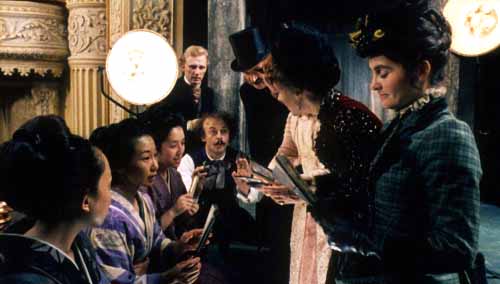
Moreover, Woolfe’s implicit definition of Hollywood is also problematic, for Margaret, which he spends the second half of his article lambasting (full disclosure: I haven’t seen it yet), is emphatically not a “Hollywood” picture. If he was going to include films produced outside the American film industrial complex anyway, Woolfe should have taken a look at Mike Leigh’s opulent costume drama Topsy-Turvy (1999), which chronicles the production of Gilbert & Sullivan’s 1885 comic opera The Mikado. If that film doesn’t give the spectator a deeper appreciation for all the minute decisions that go into making an opera—everything from searching for inspiration and blocking stage movements while dressed in unusual costumes to rehearsing difficult-to-pronounce lyrics—then I don’t know what will. Besides, all the films that Woolfe invokes are not about opera; they merely contain a scene or two depicting the protagonists attending an opera and/or feature operatic leitmotifs on the sound track. So why does he let these film scenes ruin opera for him?

The cast and crew seek the help of some Japanese actresses in rendering Gilbert & Sullivan’s comic opera The Mikado in the Mike Leigh film Topsy-Turvy. Image courtesy of http://www.brightlightsfilm.com.

Woolfe doesn’t like that the date nights at the opera featured in Moonstruck, Pretty Woman, and Margaret lead film audiences to assume that opera-going is only an occasion for dressing up to the nines, to escape the everyday. While he doesn’t find the opera performance in 1986’s Hannah and Her Sisters “exactly innovative” (it’s Puccini again), he wishes that other filmmakers would follow Woody Allen’s lead in representing opera attendance as “no big deal,” something as banal as going to the movies, say. This seems counter-intuitive to me. Clearly, opera and opera-going are very “big deal[s]” for Woolfe. Shouldn’t he be pushing for more evocative scenes in films that showcase opera in a heretofore different light? Furthermore, if good art should inspire a transcendental experience in those who encounter it, maybe even going so far as to help a person forget she’s had a bad day, then why is Woolfe decrying film’s representation of opera as “escapist”? Why does he want opera and opera-going to appear in film just as any other interest or activity does? How will that make opera an any more relevant or essential experience we should seek out?

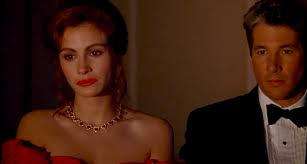
Corporate raider Richard Gere takes his low-class prostitute to the opera, which proves to be an emotional experience for the Pretty Woman. Image courtesy of http://www.operafresh.blogspot.com

Besides, don’t tell me it’s socially acceptable to wear jeans and a t-shirt to the opera. Going to the opera isn’t like attending a baseball game or even a musical play. It’s still largely cost-prohibitive, I bet. So going to the opera is a special occasion.

I didn’t grow up in a home that waxes rhapsodic about the virtues of opera, but I can appreciate them from afar, on an intellectual level. I may not know anything about individual operas (I defer to my dad on the subject whenever the category appears on Jeopardy!), but I know enough to know that opera is not as it is portrayed in Moonstruck and Pretty Woman. So don’t be so condescending, Woolfe.

But what do you think? Is Woolfe exaggerating the effect movies have on opera today?

Quick Edit: How Do You Solve a Problem Like Bernie?

Viewed August 21, 2012

Director Richard Linklater originally made a name for himself with film-stories set in his native Texas, everything from Slacker (1991) and Dazed and Confused (1993) to SubUrbia(1996) and The Newton Boys (1998). Even his beloved European-set Before Sunrise “franchise” has a Texas connection: Ethan Hawke’s writer, who in some small part might be based on Linklater himself, also hails from the southwestern state. The comedic true crime story Bernie (2011) returns Linklater to Texas for the first time since 2006’s Fast Food Nation and reunites him with the star of 2003’s The School of Rock, Jack Black, as well as early muse Matthew McConaughey.

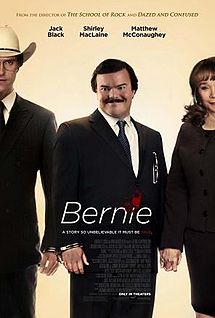
I passed on Bernie when the film hit select theaters in late April of this year, not because I wasn’t interested in the story of a much fawned-over gay assistant funeral director shooting dead his 81-year-old multi-millionaire companion, the small town’s wicked witch, but because I already knew all of its plot details. I had read a New York Times Magazine article by Joe Rhodes, the nephew of the victim Mrs. Marjorie Nugent, and learned that for nine months Bernie kept up the pretense that Marjorie, stuffed in a freezer, was alive while he spent millions of her dollars, “generously” gifting people all over town. Despite Bernie’s, uh, indiscretions, Rhodes, like practically everyone involved, seems to find him the more sympathetic character. It’s a fascinating story, but I wonder if Bernie‘s storytelling format was the best choice. In any case, I heartily recommend Rhodes’s examination of the events leading up to and following Bernie Tiede’s killing Mrs. Nugent that, as the movie’s tagline says, constitutes a story “so unbelievable it must be true.” You just might want to see the movie first, because it does spoil the plot. As does this review of the film Bernie.

East Texas. The date? I’m not quite sure, as the true events took place in the 1990s. But while the production and costume design seem to indicate this period, Bernie (played by Jack Black) has an iPhone, which wasn’t released until summer 2007. So what can you do? Anyway, as the assistant funeral director in Carthage (approximately 7,000 inhabitants strong), Bernie is well-known for his attentive care of the recently bereaved (particularly elderly widows), and his boss especially values his employee’s superb up-selling skills. Bernie manages to thaw Marjorie’s (Shirley MacLaine) cold, miserly heart following his supervision of her bank-owning husband’s funeral (which actually took place in 1990). From that point on, they are virtually inseparable. They travel everywhere together, go on extensive shopping sprees, and eat at the finest restaurants as well as the local, rustic watering holes. (Hilariously, in one scene, Marjorie pesters Bernie to help her pick out a nice dress for dinner, forcing him to stop whatever he was doing at the time he received her call. Then, in an unfussy cut, it’s revealed that they’re only dining at a chintzy Mexican cantina in town). People speculate that Bernie has to be supplying sexual favors in order to receive that kind of lavish, undivided attention from Marjorie, who has alienated everyone who has ever come in her path, including her family members. Marjorie becomes so attached to Bernie that she demands to know where he is and what he is doing at every hour. In his defense, the word that Bernie constantly uses to describe Marjorie’s dependency on him is “possessive.” Then, in an impulsive move one day in 1996 (again, according to actual events), Bernie takes the shotgun for killing pesky armadillos and shoots Marjorie in the back four times, the symbolism not lost on the audience. Immediately remorseful, Bernie prays, but instead of alerting the police, he packs her into the freezer in the garage and goes about life as if she is merely the house-bound victim of a series of strokes. No one else likes to see or talk to her, anyway—except for her nosy stockbroker (Richard Robichaux), who’s onto Bernie’s misdeeds.

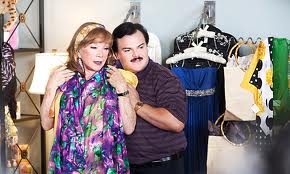
As they grow closer, Marjorie defers to Bernie on all matters of fashion. She even starts to wear her hair down. Image courtesy of http://www.nytimes.com.

No matter how overly prepared I was to watch Bernie, I never expected that Linklater, who co-wrote the script with Texas Monthly crime reporter Skip Hollandsworth, would choose to frame the narrative as a docudrama, complete with historical reenactments starring Black, McConaughey, and MacLaine; numerous talking head interviews with real townspeople; and title-cards that read “Who is Bernie?” and “Was Bernie gay?” One might even be tempted to label the film a mockumentary, for it gently pokes fun at the residents’ bigotry and simple-mindedness. For instance, knowing Bernie to be an outstanding Christian for all his involvement in church activities, including orgiastically singing hymns and paying for a new prayer wing (with Marjorie’s money, of course), the people of Carthage refuse to believe Bernie killed the town’s least popular resident—even after he confesses to the crime once Marjorie’s financial adviser and family members start investigating his trail of lies. In fact, Bernie is so well-liked for his caring and easygoing demeanor that District Attorney Danny Buck Davidson (McConaughey, made comically un-handsome and outfitted with shirts—baggy ones, at that—big, round eyeglasses, and short, matted hair) successfully motions for Bernie’s murder trial to be moved 50 miles away to ensure that selected jurors are unbiased. In the end, he’s sentenced to life in prison, and according to Rhodes, he will be eligible for parole in 2027, when he is sixty-nine-years-old.

One of the real, colorful townspeople of Carthage gives us a handy-dandy geography lesson, enumerating the cultural differences among almost all of the republics of Texas. Image courtesy of http://www.largepopcorn–nobutter.blogspot.com.

In exploring the surreal circumstances of Bernie and Marjorie’s relationship, the film regrettably relies too much on the testimonials of real Carthagians. It’s unclear if their lines are scripted, improvised, or unrehearsed. But the warm, burnt cinematography by Dick Pope seamlessly blends their one-sided conversations (with the documentary lens) with the scenes featuring the trio of the top-lining professional actors and their supporting cast. In other words, despite the fragmented structure of Bernie, Carthage comes across as a fully realized universe and lived-in place, even if Black, McConaughey, and MacLaine barely share any screen-time with the “real” people. However, though all three turn in captivating performances (particularly Black, who dials his trademark zaniness way down), I couldn’t help wishing that Linklater and co. had given the stars more to do. Earlier, I labeled their scenes “historical reenactments” because they mostly just serve the narrative as related by practically everyone in town. They seemingly act out scenes in order to support the Carthagians’ arguments about how gregarious a fellow Bernie was (cue Jack Black, in character, directing and performing in a high school production of The Music Man) and how downright nasty Marjorie was (see MacLaine throw a Hispanic family’s mortgage loan in the garbage as soon as they leave the bank).

Admittedly, one of the best scenes integrates the documentary and comedy-drama bits and, unsurprisingly, unfolds at the very end, allowing the story to come full-circle: one of Bernie’s real-life apologists visits him in jail, still in denial, and reiterates her request that he sing at her own funeral, whenever it is. Touched, Bernie tries to tell her that it’s impossible, as he doubts he’ll ever get permission. But she’s just not hearing him. When their time together is forced to close, the camera follows Bernie contentedly walk back toward his cell, eventually staying put to capture his receding presence—and slightly sashaying hips. As if to say again, “Can you believe this man is a convicted murderer?” This isn’t to say that the filmmakers think Bernie is innocent. He is most definitely not. Having formed my first impression of Bernie Tiede based on Joe Rhodes’s interpretation of his aunt’s life partner-turned-killer, I can see that the filmmakers find him just as sympathetic as Rhodes does. We’re meant to perceive Bernie as simply a good person who snapped and did a very bad thing. More tellingly, to some degree, I think the storytelling structure of Bernie precludes the spectator from strongly identifying with Marjorie. That is, representing the real townspeople’s overwhelmingly sentimental observations about Bernie does very little to redeem Marjorie; no one comes to bat for her. To add insult to injury, MacLaine’s limited screen presence means her character isn’t as fleshed out as Jack Black’s Bernie, leading my dad to comment that her bickering Marjorie recalls her performance as a grumpy and difficult First Lady to Nicolas Cage’s secret serviceman in Guarding Tess (Hugh Wilson, 1994).

It was only during my Google search for images to accompany this article that I made the connection that Bernie has a premise not-too-dissimilar from the one guiding Weekend at Bernie’s (Ted Kotcheff, 1989), wherein Andrew McCarthy and Jonathan Silverman live large at their horrible boss’s vacation home after the titular schmuck (Terry Kiser) dies unexpectedly during their stay; like Bernie, the pathetic stooges pretend their employer is still alive and try to outrun the cops (among others). But whereas Weekend at Bernie’s takes a slapstick approach to defiling the sanctity of the human corpse, Bernie explores the all-too-realness of this possibility. It’s an intriguing little story, and it’s shocking that Carthage still sings his praises. Just what exactly is in the well-water over there? I wonder how the town’s residents responded to the film, too.

Long Take: Hope Springs, Not Exactly as Promised

Viewed August 11, 2012

This past Saturday was my birthday, and in my family—as in many families, I would suspect—we go to the movies to celebrate before dining out. We’re just not that creative. Unfortunately, there were slim pickings to choose from this year. I had no desire to get confused during The Bourne Legacy (Tony Gilroy, 2012) or to catch up by seeing last month’s The Dark Knight Rises (Christopher Nolan, 2012). So I opted for Hope Springs (David Frankel, 2012), the sweet little comedy about a couple in their sixties rekindling the romance and spicing up their sex lives after thirty-one years of marriage. When I told my film critic friend Gabe of my plans to see this movie, he joked, “I had no idea you were a sixty-something sex-starved housewife with zero interests.” My response? “Now you do!”

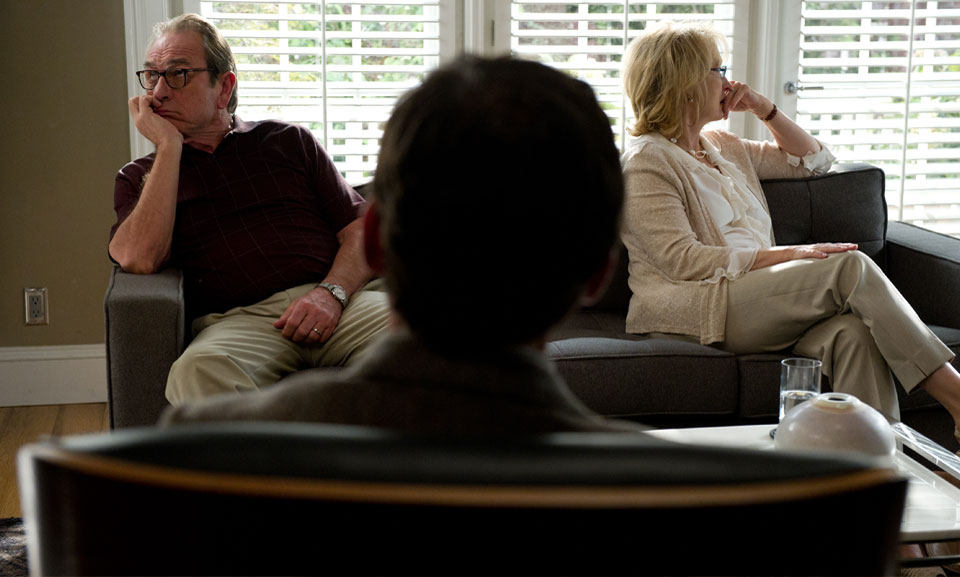
It’s not that I regret my choice, but Hope Springs did very little to impress me. I wasn’t expecting much, as I had somewhat foolishly read reviews beforehand, positive and negative alike. In particular, I knew not to expect a zany battle-of-the-sexes-type romantic comedy that the trailers and TV spots implied. In fact, while Hope Springs is not without its funny moments, it should be more accurately classified as a drama, for it treats Kay (Meryl Streep) and Arnold’s (Tommy Lee Jones) lack of physical and emotional intimacy in their marriage as a deathly serious problem. And that’s fine by me. When a couple that has been together for over thirty years and raised two children (who are now out of the house), sleep in separate rooms and barely talk to each other, getting them to reconnect is serious business. Washington Post chief film critic Ann Hornaday claims, “Hope Springs is a minor miracle of a movie,” as it tackles its subject “with a degree of integrity and candor rarely seen in American movies.” I agree, but to an extent. Here’s why. Fair warning: spoilers follow!

Omaha, Nebraska. We meet Kay and Arnold right around their thirty-first wedding anniversary. And that’s the first of many implausibilities. Given their socially conservative backgrounds, having met and married when Kay was in college or just graduated, they should be married for longer and with older kids, too. Anyway, stuck in a deep rut wherein they sleep in separate rooms (owing to Arnold’s years-old back injury) and gift each other a new cable subscription, Kay intends to break free, taking Arnold with her. A retail clerk at a Coldwater Creek fashion outlet for conservatively inclined middle-aged women shoppers, she takes what little money she’s saved over the years and splashes out on a week of intensive couple’s counseling sessions with Dr. Bernard Feld (Steve Carell as subdued as ever) in Great Hope Springs, Maine. (I imagine that screenwriter Vanessa Taylor grants Kay this job so as to distance her from earlier iterations of this sad-sack character. In other words, Kay isn’t simply a fed-up homemaker, she’s a fed-up former housewife who in recent years as reentered the workforce, albeit only the service industry.) From the beginning, and throughout most of their sojourn, Arnold is hostile to Kay’s expensive, faraway effort to save their marriage, but of course he gradually becomes more game, more willing to open up to Kay, at Dr. Feld’s insistence.

Arnold and Kay, as seen from Dr. Feld’s perspective, before they inevitably get back together in the end. First step: turning around to look at one another. Image courtesy of Sony Pictures and http://www.hopesprings-movie.com.

Hope Springs is highly uncinematic and not at all like the promotional image seen directly above. It mainly cuts between long scenes set in Dr. Feld’s office, where he prods each with questions about his or her sexual history and fantasies, and short scenes that take place around the small, idyllic town, whether at the staid motel room, kitschy diner, bar, or lighthouse museum. Director David Frankel, who previously worked with Streep on her Oscar-nominated role in The Devil Wears Prada (2006), adds no flourishes. What he’s produced is an awfully boring film whose scenes—let alone frames—hardly look different from each other. It doesn’t help matters that cliched pop songs dominate the soundtrack, everything from Annie Lennox’s “Why” to Al Green’s “Let’s Stay Together” (the latter of which sounds during a failed attempt to have sex). The instrumental score is almost non-existent; I noticed it in only one scene. Bad form.

But what of these therapy sessions? Although I have never seen either program, I suspect that the HBO series The Sopranos (1999-2007) and In Treatment (2008-2011) more innovatively shoot conversations between a therapist and his or her patient, appropriately heightening the tension between them. To the contrary, everything in Hope Springs is straight-forward. I can only recall one interesting editing technique in all of the scenes at Dr. Feld’s: we hear him ask Arnold questions he doesn’t want to answer, and the camera focuses on Arnold’s anguished face in close-up as he listens to Dr. Feld. Then again, I also appreciated those zoomings in on Kay’s face as she listens to Arnold’s confessions. Whereas my dad liked that Steve Carell managed to reel in his trademark goofy mania, I endlessly tried to come up with names that could play the part with more… oomph. This is not to say that Carell turned in a weak or bad performance, as it probably has more to do with the way Taylor wrote Dr. Feld and how Frankel interpreted the character from her script. What if Dr. Feld had been less calm? Hell, what if he had a sense of humor?

Speaking of casting, let’s address Streep’s and Jones’s performances and their characters. A living legend, Streep predictably embodies her character to the fullest (at least as fully as she can, given the limited script), complete with timid mannerisms and speech and an incredibly dowdy hairstyle. But like Hornaday, I couldn’t help wishing that “her sweet, naive character had just one more layer to make her sharper and more complex,” like her character in It’s Complicated (Nancy Meyers, 2009). As the instigator of the project to rebuild their marriage, Kay begins as the more sympathetic of the pair. We root for her to get what she wants; after all, her desires are more than reasonable. But when Dr. Feld coaxes her sexual fantasies out of her, and she comes up short, not only did I feel sorry for Kay (who claims that she has only ever wanted Arnold, in vanilla-flavored sexual positions and scenarios), I wondered, what is the point? Why should I care about this woman if she doesn’t want something, for lack of a better word, interesting? It’s not enough that, after Dr. Feld’s encouraging her to experiment and act on her fantasies, she attempts to give Arnold a blow job in a movie theater. “Attempts,” being the operative word there. She’s too embarrassed, uncomfortable, and ill-experienced to finish, and she crawls away in shame. What’s worse is that she only ever wants to please Arnold. Other than wanting him to kiss and touch her in innocent ways, she never asks for him to pleasure her in any way. Presented entirely for laughs, Kay doesn’t realize that oral sex isn’t just performed on the man; I wanted to pull my eyes out. Ugh. Compounding all of this is the final scene during the end credits: at the pair’s vow renewal ceremony on the Maine beach a year later, with Dr. Feld and family gathered, Kay pledges to keep her hair long because she knows that Arnold likes it that way. So much for wishing that the original trip had given her a backbone and an independent spirit, which was in evidence when she first boarded the plane in Omaha without Arnold (who showed up, hemming and hawing, at the last possible moment).

Kay and Arnold during one of Dr. Feld’s “intimacy homework assignments.” Woozy. Image courtesy of http://www.washingtonpost.com.

Admittedly, one of the reasons why I had not wanted to see Hope Springs was because I found Tommy Lee Jones unappealing as Meryl Streep’s romantic lead. I didn’t think his on- and off-screen persona meshed well with the demands of what I thought at the time was a romantic comedy. But now I am happy to say that his casting and performance are spot-on. He’s less the grizzled lawman in No Country for Old Men (Joel & Ethan Coen, 2007) or The Fugitive (Andrew Davis, 1993) and more the grizzled businessman in The Company Men (John Wells, 2010). Whereas the chameleon-like Streep alters her voice and appearance when playing Kay (looking older and mousy), Jones looks the same as he always does, except his principal prop is a suitcase rather than a shotgun. As an avatar of a chiseled and mythically strong American masculinity—aging but active, a maverick for the greater good—it’s interesting to see how easily Jones transfers this to his portrayal of Arnold, who’s emotionally stunted, uncommunicative, non-confrontational, and angry. New York‘s film critic, David Edelstein, proposes that Kay’s withholding sexual favors for years frustrated Arnold to the point where he never returned to the bedroom, even after his back got better. As if to say, you did it to yourself, Kay. Ouch. Having said this, though, Jones easily earns the most laughs since he’s the only one, say, really uncomfortable discussing his sex life with a complete stranger. He comes up with many wisecracks, memorably about Dr. Feld’s monotone approach to sexuality (if you’ve seen the trailer, you know what I mean), and Jones is a gifted physical comedian. Who knew?!

According to the movie’s trivia page on the Internet Movie Database, Jeff Bridges was originally offered Jones’s role. When my sister brought this little factoid to my attention, I contemplated how different the movie would be. It definitely would have been more pleasant to sit through the sex scenes (more on those in a moment), since Bridges is a considerably more attractive man. We can’t know why Bridges turned it down unless he ever publicly addresses the question, but we can take comfort that he co-starred in a much more sophisticated romantic drama (with comedic elements) in 1996: The Mirror Has Two Faces, with director-star Barbra Streisand. While Columbia University professors Gregory Larkin (Bridges) and Rose Morgan (Streisand) may be unmarried when the film begins, The Mirror Has Two Faces similarly tracks their platonic relationship as it morphs first into a platonic marriage and later, once she’s had enough of a shared life without passion and romance, a fully-fledged sexual marriage. Granted, I don’t approve of how Rose’s third-act makeover from ugly duckling to stunning swan fixes the sexual intimacy problem of their marriage (in fact, Gregory and Rose marry late in life because they’ve finally found their intellectual equals), but The Mirror Has Two Faces doesn’t shy away from addressing a middle-aged couple’s sexual desires and fantasies. Rose is a fiercely intelligent, neurotic, cosmopolitan, and desirous woman. So much easier to relate to than the bland Midwestern housewife Kay. (By the way, shouldn’t Nebraskans be offended that the Coasts, both East and West, continue to culturally belittle them?)

Actually, now’s a good time to look at those Hope Springs sex scenes. I bet that the filmmakers and the studio behind it think they pushed the envelope simply by making a movie about a husband and wife in their sixties trying to rediscover each other and themselves sexually. Oh, whatever. They don’t go very far. Yes, they push the PG-13 rating, but only in terms of language. For example, Dr. Feld asks if Kay ever wishes they assumed more than just the missionary position during sex. Would she, he asks, prefer to try out anal sex? Blushes and hand-waving ensue. Out of the question. But when sex between Kay and Arnold is represented on-screen, after a romantic dinner at a high-class restaurant in town (for a change!), we see no sexagenarian flesh. Just a lot of fully-clothed groping. Even when Arnold gets on top of her, their clothes stay on completely. I hate it in movies when characters have sex fully dressed. Unless you’re in public and having sex standing up, there is no excuse. How confrontational and realistic do the filmmakers—and I’m talking about those of Hope Springs specifically now—think they are when these sex scenes leave so much to be desired? Maybe I’m being too harsh. It is, after all, a big studio picture that clearly wants to appeal most to Middle American viewers of a certain age, who should find Kay and Arnold hopelessly familiar.

Still, after years of watching films from around the world about people—young and old alike—desperately trying to make a (sexual) connection with someone else, Hope Springs simply comes up short. Ann Hornaday mentions in her Washington Post review that the film is “like the more cheerful, reassuring and commercially palatable version” of a story similar to Michael Haneke’s Palme d’Or-winning Amour (2012), about an elderly man faced with losing his terminally ill wife. I haven’t seen Amour yet, but somehow I just can’t imagine this to be the case. A more appropriate “world cinema”/”art-house”/auteurist comparison is Andreas Dresen’s Cloud 9 (2008), a small, German character study in which a sixty-something-year-old woman, after thirty-odd years of a happy if routine marriage, embarks on a torrid affair with a man in his seventies! With disastrous consequences, of course. As if that were not enough, the director shows the adulterous couple, who, I might add, are nowhere near as glamorous or fit as Streep or Jones, fornicating in graphic detail, their flabby flesh rolling all over each other. It may not be a pretty sight, but it’s certainly more frank, and in its frankness, a beautiful thing. And when you turn to more commercial (read: simply American) output, even It’s Complicated provides a more nuanced view of people approaching 60 who let go of their inhibitions and assert their sexuality in aggressive ways. It’s not for nothing that Alec Baldwin says to his ex-wife Meryl Streep that their affair is like something out of a French film.

Long Take: What’s It All About, Marty?

Viewed July 20, 2012

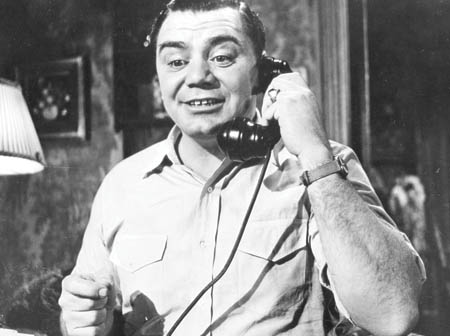
On Sunday, July 8, beloved character actor Ernest Borgnine died. He was 95. For years, I have been drawn to his toothy, grandfatherly smile, and I was initially upset that The New York Times only published a short obituary. (Compare it to the one they gave Andy Griffith.) I felt that it betrayed his legacy on film and television, everything including From Here to Eternity (Fred Zinnemann, 1953) and Bad Day at Black Rock (John Sturges, 1955) to The Wild Bunch (Sam Peckinpah, 1969) and McHale’s Navy, which aired from 1962 to 1966. But I have since moved on, and I watched for the first time the film for which he won the Oscar for Best Actor: Marty (Delbert Mann, 1955). I don’t speak in exclamations, but I have to say that some of the interjections featured at left on the original theatrical poster ring true for me, too. Marty is wonderful, superb, warm, and rich. (It’s a shame the poster design isn’t any of these things, though.)

For much of my childhood, I only knew of Marty as the answer to the question that longtime Twenty One game show champ Herb Stempel (played by John Turturro) fails to deliver at the turning point of Robert Redford’s Quiz Show (1994). Stempel knows the title of 1955’s Best Picture Oscar-winner, but he throws the game, for the benefit of his opponent, the dashing literature professor Charles Van Doren (Ralph Fiennes), and accepts a payout from the producers, who wish to capitalize on Van Doren’s pedigree and good looks. But this really has nothing to do with Marty.

Marty, in fact, is about a thirty-four-year-old Bronx butcher (Borgnine) who lives with his widowed Italian mother. All of his younger siblings have been married off and left the nest, and he resigns himself to believing he’ll die single, convinced no woman could be interested in an overweight butcher. He’s painfully shy and incredibly sweet. In this way, Marty turned out to be just what I was looking for since I already find Borgnine an always appealing presence (even when he’s playing the bad guy). Desperate to please his mother, Teresa (Esther Minciotti), he agrees to go out to the Stardust Ballroom to meet other singles, alongside his buddy Angie (Joe Mantell). And, of course, he does, but it’s not easy. Be warned: I’m going to spoil all now.

Clara (Betsy Blair) has also come to the Stardust Ballroom, on a blind double date with a doctor who quickly ditches her because she’s a “dog.” He trawls the dance floor looking for a man to take his place so he can run off with another girl. At first he propositions Marty, who despondently looks on as couples dance around him, but he rejects the man’s offer of $5, admonishing him for wanting to treat a woman in such a way. One of the best scenes is virtually wordless, shot from Marty’s perspective, as he watches the doctor introduce Clara to his replacement. From across the room, Marty sees a mortified Clara run out of the dance hall, and he follows her. He’s gotten nowhere with other women tonight, so he may as well try to comfort her. Perhaps part of him also figures that he’ll be able to relate to her because he’s been rejected, too. (Actually, another great preceding scene takes place earlier that day when he comes home from work and, with Angie’s prodding, calls a woman he’d met last month. In one shot, the camera moves in on his face, closer and closer, while he tries to ask her out, his desperation and despondency becoming more and more suffocating. We can’t hear her voice, only his many attempts describing himself to her and guiding the conversation. It’s impossible for the viewer not to empathize with him. When he hangs up, the camera slowly pulls out. Dejected.)

Marty desperately rings for a date.

Maybe it’s presentism, but I couldn’t help feeling that the romance between Marty and Clara is rather modern for its time. And no, it’s not because the film, itself based on a 1953 teleplay starring Rod Steiger, was remade in 1991 by Chris Columbus as Only the Lonely, with the great John Candy. Marty plays out across two consecutive days, with a good chunk of its running time devoted to the night that Marty and Clara meet and get to know each other as they wander from place to place. Structurally, it reminds me of Before Sunrise (Richard Linklater, 1995), which is also about strangers falling in love over the course of one night together, albeit in Vienna.

Furthermore, Marty seems to be a new kind of male character in 1955 and one who has left an indelible impression on filmmaking today. Strangely enough, while watching Marty I thought about some Judd Apatow productions. Freaks and Geeks (created by Paul Feig), which ran from 1999 to 2000, is similarly about social outcasts but follows adolescent rather than stunted adults’ growing pains. Obviously the titular anti-heroes of the seminal TV show are numerous and varied, and not all of them had love on their minds. However, I do sense a spirit in Freaks and Geeks derived from Marty through its treatment of the characters’ struggles for individuality, independence, and acceptance. Both triumphantly reverse the trend of nice guys finishing last. Perhaps the connection between Marty and Apatow is even more pronounced in the mega-producer’s first directorial effort, The 40-Year-Old Virgin (2005). Although there is nothing to suggest that Marty is a virgin, he and Andy are alike in that they each overcome their sexual immaturity when they meet the right woman. Their journeys are sympathetically portrayed, but Marty’s is much more sensitively drawn and even includes a back-story involving suicidal thoughts (which Clara implies through her body language that she also has had). Marty is more than a Mama’s Boy, a trait easy to ridicule, but that’s not the only reason he’s romantically challenged. Feeling crippled by his heavyset frame and working-class occupation (more on that in a bit), Marty may be one of the earliest versions of a romantic anti-hero, and without him I don’t think Andy’s predicament, however raunchy, would be so endearing.

But Marty isn’t the only character who complicates archetypes. His mother, who speaks ungrammatically with a thick Italian accent, sounds like the women who frequent his neighborhood butcher shop. In the opening scene, they chastise him for being as old as he is and unmarried. And though his mother pushes him to go to the Stardust Ballroom, awkwardly using slang she picked up from her nephew and promising the place will be “loaded with tomatoes,” she is not nearly as opinionated as these women. Maureen O’Hara’s cruel and overbearing mother in Only the Lonely barely resembles Teresa. Teresa instead is a caring woman who accepts her nephew Tommy (Jerry Paris) and his wife Virginia’s (Karen Steele) plea to ask her sister, Marty’s Aunt Caterina (Augusta Ciolli), to come and live with her and Marty. To cut a long story short, Caterina just won’t let Virginia run her own household, especially now that she is a new mom. It’s only after Teresa spends time with Caterina, a depressed widow who feels abandoned, without a purpose because all she wants to do is cook and clean for her loved ones (yeah, some things about Marty seem a little outdated), that she begins to behave differently, out of character. Suddenly, it dawns on her that Marty’s finding a wife would render her obsolete (except it’s safe to assume that his big heart would preclude this from ever happening). And so she’s civil around Clara when she meets the young, plain science teacher late at night, before Marty accompanies her home, but the next day Teresa pooh-poohs his choice because she’s not, well, Italian. Her protestations aren’t convincing; she’s clearly reaching for any excuse to dismiss Marty’s attraction to Clara. Thus, at first glance, it might appear as if Teresa is a contradictory character, a victim of underdevelopment. But on the contrary, I think she’s a finely drawn and complex character, given the short screen-time she’s granted, for these same reasons. It’s a shame about that horrible Caterina-I-want-chew-ta-comeh-live-in-mya-house accent of hers, though.

Marty and Clara bond over their histories of rejection (he tries to build them up as not nearly as repulsive to the opposite sex as they feel they are), their social alienation (their aforementioned suicidal tendencies), and their stunted maturity, as Clara also lives at home. Hearing about Marty’s dream of buying the butcher shop where he works (thereby rendering him as aspiring to overcome his working class roots) helps convince Clara to take an administrative education job in Port Chester, which would force her to finally move out. My other favorite scene features a lovestruck Clara, newly returned home, recounting her evening to her parents, who are already tucked into their Ozzie and Harriet beds. It’s a virtuosic monologue by actress Betsy Blair, running through several emotions and offering fragmentary thoughts. Her new hopeful outlook on life and love stuns them, and this scene is the cornerstone of a quiet, touching performance.

Marty and Clara.

Marty promises to phone Clara the next afternoon, after church and lunch, to make plans for that Sunday evening. Unfortunately, he lets everyone around him—his friends, cousin, and mother—influence him to banish the thought of pursuing his burgeoning romance with Clara. It’s heart-breaking that he doesn’t come to his senses until night-time, fed up with standing around with his gang of friends, only ever talking in the round about what they’d like to do. Hey! That’s another Apatow comparison: Marty’s friends hold him back from maturing in much the same way that Ben’s (Seth Rogen) stoner roommates in Knocked Up (2007) wish that he would just wallow in irresponsibility with them. But like Ben, he breaks through and stands up for himself, for his desires. Marty phones Clara because it is stupid to let a good thing with her slip through his fingers. His final monologue, delivered to Angie, is terrific, and sums up what it’s all about:

[…] What, am I crazy or something? I got something good here. What am I hanging around with you guys for? You don’t like her. My mother don’t like her. She’s a dog, and I’m a fat, ugly man. Well, all I know is, I had a good time last night. I’m going to have a good time tonight. If we have enough good times together, I’m gonna get down on my knees, I’m gonna beg that girl to marry me. If we make a party on New Year’s, I got a date for that party. You don’t like her, that’s too bad. [He rings her on the public phone at the bar. He waits for her to pick up.] Ange, when are you gonna get married? You’re thirty-three years old, your kid brothers are married. You oughta be ashamed of yourself. [Into the phone] Hello? [To his friend] Excuse me, Ange. [Closes phone booth door.] Hello, Clara?

What a glorious, optimistic, and open-ended final scene. Again, I feel this is rather sophisticated storytelling, too, thanks to Paddy Chayefsky of Network (Sidney Lumet, 1976) fame (he also won an Oscar for adapting his earlier Marty teleplay). Any filmmaker today probably wouldn’t be able to resist the idea of concluding the story so that the lovers are without-a-doubt fully reconciled, opting instead to film the scene so that they meet in person. I suspect that Marty’s calling Clara on the phone may have been boundary-pushing, since Clara acknowledges to her parents that waiting for a phone call from Marty rather than an in-person visit is not exactly ideal or proper. Or maybe the phone call, which is represented on the movie poster above, signifies more than just a change in social mores. Perhaps it is also about class; for when Clara brings up having to wait for his phone call, during her aforementioned monologue, she alerts her parents to Marty’s insecurity with being a butcher, a profession that, after all, he never desired to pursue. Therefore, their union signals not only their growth as individuals finally coming into adulthood, as they embark on new, upwardly mobile occupational trajectories, but also a transgressive bridging over a class-based and cultural divide. (Clara may not be Italian, but she is Catholic, so that’s should shush Marty’s mother.)

Marty is a sweet little movie, funny and dark in places. I regret I didn’t discover it until after its star Ernest Borgnine died.

Steven Soderbergh: Workman’s Competence

Yesterday, the U.S. Supreme Court ruled 5 to 4 that President Obama’s Patient Protection and Affordable Care Act of 2010 is in fact constitutional, thereby cementing his legacy. I was so excited to hear this news, as it will ensure that millions of presently uninsured Americans will get the affordable healthcare that they rightly deserve. Yep, the country is starting to look a little different, the future a little brighter, after June 28th.

But this probably has more to do with the fact that today marks the premiere in theaters of Steven Soderbergh’s Magic Mike (2012), which is being hyped as possibly the greatest male stripper movie ever made. (Have we forgotten all about Peter Cattaneo’s sleeper hit The Full Monty, from 1997?) The movie review aggregator site Rotten Tomatoes lists Magic Mike‘s rating as 82% fresh. Despite the cheesy marketing ploys–one of which saw star Channing Tatum, whose own experience as a stripper inspired the story, lead a flash mob during his Today Show appearance–it looks as if Magic Mike might be more than just the sum of its “beefcake” parts. This is important, for how else am I going to convince my dad to take me to see it? (I don’t drive, and I live nowhere near a theater, if you can believe it.) Apparently, the fact that serious auteur Steven Soderbergh directed it isn’t enough of a reason. But it should be.

Here’s why: this week, in anticipation of the film’s release, I kept thinking about what would influence Soderbergh to pursue this kind of project. He’s hardly ever made anything as campy; the Ocean’s Eleven trilogy (2001, 2004, 2007) is fun because the biggest movie stars in the world gamely make fun of themselves, all while strutting around in impeccably tailored clothes, in beautiful locales, to David Holmes’s smooth and funky score. Come to think of it, that doesn’t sound too dissimilar from his newest effort.

On a more serious note, what I recognized while going through Soderbergh’s filmography is that most of his films are concerned with the characters’ professional work. This is not to say that he is Ken Loach, who has made many films about working class British men’s work lives. I’m thinking of The Gamekeeper (1980), Riff-Raff (1991), and The Navigators (2001) in particular, not to mention his films about nationalist revolutions (Land and Freedom, 1995; The Wind That Shakes the Barley, 2006) and even U.S. labor unions (Bread and Roses, 2000).

But work in Soderbergh’s movies is more nuanced than in your average film, if the average film is now either a romantic comedy (in which the female lead inevitably works at a women’s fashion and lifestyle magazine) or an actioner along the lines of Die Hard (John McTiernan, 1988), in which a police officer successfully foils a terrorist’s plot, but not without a few explosions going off to highlight just how extraordinary his dayjob is. The point is that, sure, what the characters do for a living is important to the story in virtually all films, including ones in which the protagonist does not work. There’s usually a reason for that.

The director Steven Soderbergh. Photo courtesy of IMDb.

But consider this: Soderbergh’s first feature after the Cannes success sex, lies, and videotape. (1989) was Kafka (1991). I haven’t seen the film, but I can imagine that, given the author’s biography (his writing provided an escape from his hum-drum workaday life as a clerk for an insurance company), work is not just an important facet of Kafka’s identity, but also a setting much explored in the film.

Arguably his first studio film, Out of Sight (1998) centers in part on the romantic entanglement of a US Marshall (Jennifer Lopez as Karen Sisco) and bank robber-turned-prison escapee Jack Foley (George Clooney in a star-making turn), thereby subverting the narrative conceit of the pursuit that is essential to her line of work. The year 2000’s Erin Brockovich famously transformed Julia Roberts into a Best Actress Oscar winner for her portrayal of a real-life legal clerk and environmental activist. The film chronicles Brockovich’s investigation of Pacific Gas & Electric Company’s cover-up of groundwater contamination in a local community whose residents have become gravely ill. Her efforts take a toll on her relationships with her family and boyfriend, and she also confronts death threats because of what she has uncovered.

Based on a British TV series from 1989, Traffic, also from 2000, takes a more dynamic approach to its inside story of the illegal drug trade: through the interweaving perspectives of a Mexican police officer battling widespread corruption in his force, a conservative American judge/politician whose own daughter is an addict, and the wife of a drug lord going to extremes to protect her family from the law and the cartel. Again, this film, for which Soderbergh won the Oscar for Best Director, would not work without an emphasis on the conflict between each character’s personal and professional lives.

Last year’s underrated Contagion (2011) takes a similar multi-perspective approach to the recounting of a mysterious virus’s spread across the globe. Matt Damon’s part as a new widower, immune to infection, trying to keep his teenage daughter safe may have a pathetic advantage when you consider that the other story lines revolve around the work lives of scientists and public health officials. However, Contagion is compelling, both as a horror film and thriller, precisely because we see these people at work: epidemiologists trying to contain the virus (Kate Winslet) or investigating its point of origin (Marion Cotillard), the head of the Centers for Disease Control and Prevention (Laurence Fishburne) juggling the supervision of others’ tasks as well as being the face of an organization mired in controversy, and a CDC scientist (Jennifer Ehle) toiling away in the lab in order to develop a vaccine. In the end, we understand that business travel is the reason it immediately spread from Macau, near Hong Kong, to places as far-flung as the Minneapolis suburbs and Paris (if I’m not mistaken). Global business and culture are conduits through which more than just money, goods, and services are transferred.

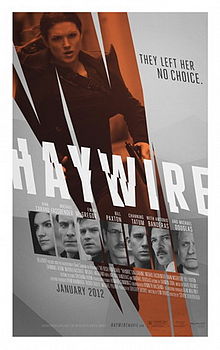
Even Soderbergh’s more experimental, low-budget features explore the world of work. The improvised Bubble (2005) stars non-professional actors in a murder mystery set in a depressed town’s doll factory. The porn actress Sasha Grey takes top-billing in The Girlfriend Experience (2009) as a NYC high-end call girl who specializes in providing clients with the titular fetish. I would even argue, alongside LA Weekly film critic Karina Longworth, that this past January’s release, Haywire (2011), fits into this category of Soderbergh’s ouevre. He built a film around the mixed martial artist Gina Carano, casting her as a double-crossed secret agent/assassin hell-bent on exacting revenge against her employer and one-time lover (Ewan McGregor). Carano’s body and the way she uses it, effectively propelling the action around the world, is a piece of performance art. She does all her own stunts, and much of the story is communicated through her victorious hand-to-hand fights with men like Channing Tatum, Michael Fassbender, and McGregor. In other words, we see Carano’s Mallory Kane excel at work despite the unfair treatment she endures in the workplace.

The director, who, I might add also serves as the cinematographer on his pictures, under the pseudonym Peter Andrews (is that gesture meant to hide his work or call attention to it?), has also made films about the actor and writer Spalding Gray: 1996’s Gray’s Anatomy and And Everything Is Going Fine (2010). The first is more accurately a filmed monologue, essentially capturing Gray at work as the performer of staged autobiographical storytelling, whereas the second is a more conventional documentary about the life and work of the artist, who allegedly drowned himself in New York’s East River in 2004.

The theme of work pops up in Soderbergh’s other films, including The Informant! (2009), Che (2008), and Solaris (2002). Even his foray into television, alongside oft-collaborator and co-producer George Clooney, K Street (2003), concerns the work of lobbyists and politicians. This is nothing to say of the projects that he has worked on as just a producer. Unscripted (2005), for instance, follows three real actors around Los Angeles as they scramble to book gigs and catch their big break.

Thus, it is not so strange to see that Steven Soderbergh, who has just renewed fears that he’s quitting movie-making forever, again, has directed a film about male strippers and how the world they inhabit at work dictates how they perceive and are perceived by those outside of it. From the first trailer, it appears as if Magic Mike (Channing Tatum) has aspirations of a career in furniture design. Interesting, eh? Anyway, his co-worker and friend (Alex Pettyfer) has a sister (Cody Horn) who’s made it her mission to get the guys out of the heavily exploitative business. The actress recently acknowledged that her character might be unpopular with female audiences, but that she reveled in watching the guys, including Matthew McConaughey in “the role he was born to play,” act and dance in g-strings while on the set. Since I am interested in cinematic representations of the male body’s desirability–in an academic sense, I swear!–and how audiences, men and women alike, read these images, I have been following coverage of Magic Mike pretty closely, and from the get-go I found it intriguing that Soderbergh would tackle this subject, but now I understand that it’s all about the work.